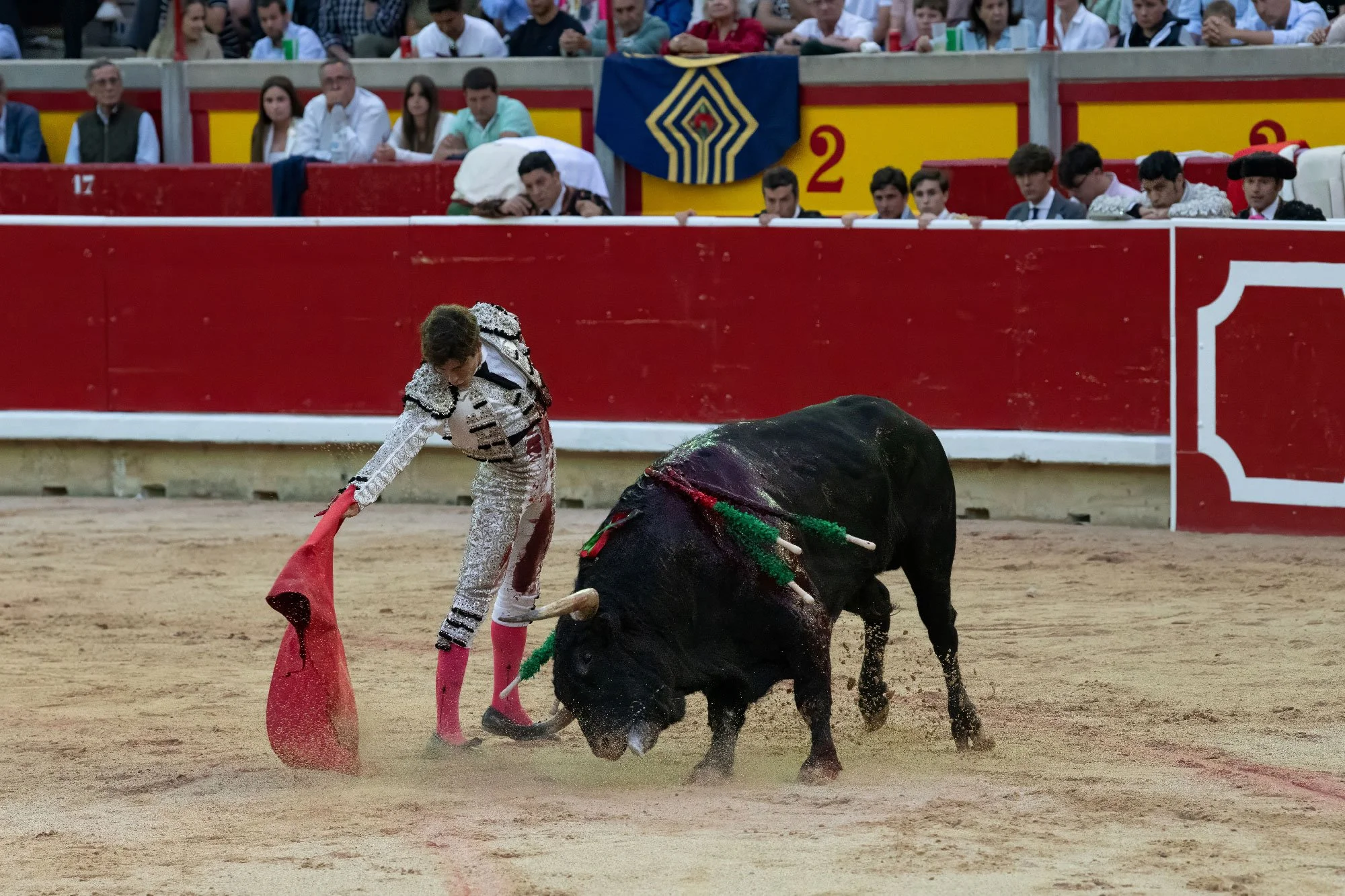
Bullfighting
Bullfighting is one of the most visible examples of animal-based sports that raise questions about harm and how compassion is understood within cultural practices.
“It is contrary to human dignity to cause animals to suffer or die needlessly.”
— Catechism of the Catholic Church 2418
Bullfighting as we know it today, originated in Spain, but spread to other nations (along with the Catholic faith) through conquest and colonialism. Spanish bullfighting emerged at the end of the medieval period, a time marked in Europe by ignorance and brutality, at a time when Spain practiced mandatory conversions and expelled Muslims and Jews. Today, roughly 70% of Spain’s population identifies as Christian and bullfighting continues, as both Christianity and bullfighting persist in a handful of other nations (largely Catholic, like Spain), including Portugal (80–85%), France (50%), Mexico (90%), Colombia (90–95%), Peru (90%), Ecuador (90–95%), and Venezuela (85–90%).
For centuries Christianity has supported and encouraged bullfighting. In many nations, bullfights are held on feast days of patron saints, embedding this bloody practice in the Christian calendar. Regional bullfights in Spain honor such important religious figures as Our Lady of Charity (Nuestra Señora de la Caridad, Toledo), Saint Peter Regalado (San Pedro Regalado, Valladolid), the Virgin of the Macarena (Mary, protector of matadors, Sevilla), and Saint Isidore the Farmer (Farmer or Worker/Laborer, Madrid). Spanish clergy have blessed matadors for centuries; matadors continue to pray to protector saints before entering the bullfighting arena, though it seems odd for an aggressor against those who are innocent to seek protection from saints or Mary.
Our Lady of Charity, a manifestation of Mary, is a mother-figure, a symbol of protective care, hope, and faith through hardship among Catholics in Europe, the Americas, and beyond. She is the beloved patron saint of Cuba, a nation that rejected bullfighting despite more than 400 years of Spanish rule. In Spain, venerated since medieval times, Our Lady of Charity is patroness for matadors, who turn to her for protection.
Bulls were originally driven through public streets to bullfighting arenas, a practice known as the running of the bulls (encierro), ritualized in many Spanish cities. In this sport, citizens run ahead of the bulls along a fixed course through crowded, chaotic streets, putting human lives at risk and, of course, causing additional stress for bulls, who are already frightened and disoriented, having been taken from their herd and familiar surroundings. Running of the bulls is key to the festival of San Fermín (Saint Fermín), patron saint of Pamplona, a late third-century Christian martyr (beheaded in France).
Our Lady of Charity and Saint Fermín maintain their religious importance through the church, but there is no scriptural or theological connection between Christianity and bullfighting. Importantly, some popes overtly opposed this bloody practice: In De Salute Gregis Dominici (1567), Pope Pius V stated that bullfighting is cruel and unchristian and threatened to excommunicate participants; in the same century, Pope Sixtus V reinforced this opposition.
1 John 4:8 and 1 John 4:16
God is love.
Both France and Portugal continue introduced bull-running traditions, though these do not necessarily culminate in the slaying of bulls. In Peru, Colombia, Venezuela, and Mexico, both bull-running and bullfighting persist. Bullfighting in Mexico has effectively been challenged with anymal-cruelty laws, putting an end to these bloody spectacles in Mexico City and in some states.
Proverbs 12:10:
The righteous know the needs of their animals,
but the mercy of the wicked is cruel.
Is bullfighting unchristian? Bulls are bred for aggression and raised in herds before transport to bullfighting events. Separation from their community, being forced onto trucks and transported, then unloaded in radically different and entirely unfamiliar surroundings, causes acute stress for these herd anymals. In the arena, before the matador enters, the bull is always tormented and damaged in specific ways to make bullfighting safer for the matador. Men on horseback throw lances and barbed sticks, aimed to damage muscles and induce blood loss. Trapped, attacked, and strategically wounded, the bull is doomed and could only feel frightened and desperate. Friar Sean Mullen, in a sermon delivered on Good Friday at Saint Mark’s Church in Philadelphia, describes this process:
“There in the center of the sandy ring is the bull: strong, and brave, and noble in his power and his beauty. It is important to remember that the bull has done nothing wrong…
First, the picadors confront him on horseback, piercing him with their lances, drawing the first blood from the bull, and weakening him. Next, come the banderilleros, who jab their barbed banderillas into his flesh. There is more blood now, and a weaker bull….
Now the bull is bleeding; you can see his neck and back and sides stained red. His powerful neck has been weakened, and his head is carried lower now. The Spanish call this state “aplomado.” “When he is aplomado,” Hemingway writes, “he has been made heavy, he is like lead; he has usually lost his wind… he no longer carries his head high… he has obviously been beaten…”
— Friar Sean Mullen
Bullfighting causes deliberate and prolonged harm, and a slow and painful death, to God’s living creatures—and to what end? Bullfighting and the running of bulls are forms of entertainment that stand in opposition to core Christian values such as love, mercy, and the expectation that we serve God by caretaking creation as God would do. Would God treat bulls in such a way?
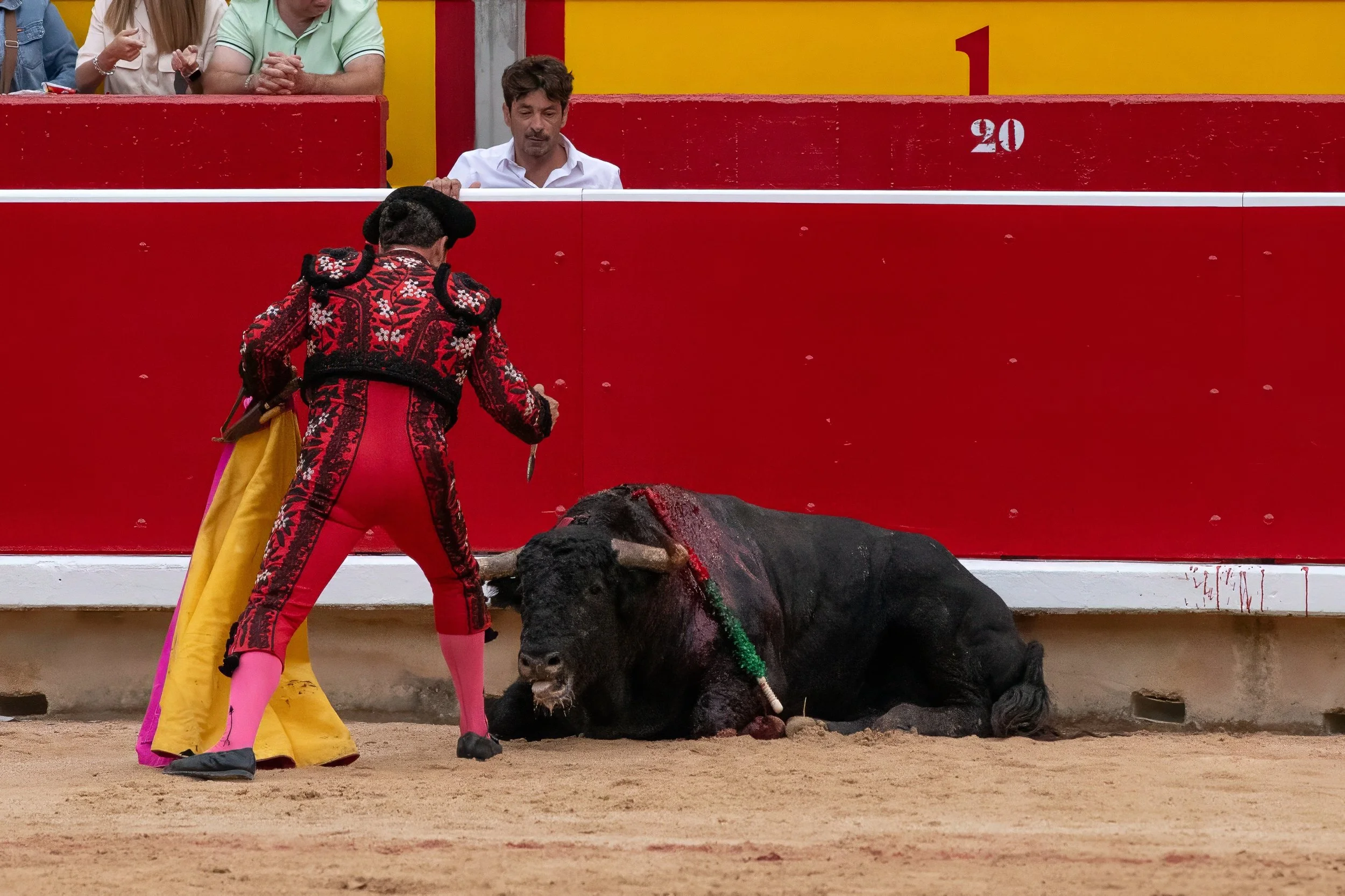
A bull at the end of a bullfighting event. Such practices raise questions about how harm for entertainment aligns with values of compassion and care. (Bel González / AnimaNaturalis)
This discord extends beyond bullfighting to other blood sports, such as dog fighting, cockfighting, and bear baiting. Moreover, less openly violent forms of entertainment that nonetheless exploit and harm anymals also create moral tension between the Christian faith and common practice, including horse racing, greyhound racing, the Iditarod–even the seasonal purchase of rabbits or chicks, whether for Easter or for school projects. For that matter, any time we argue that a “tradition” is justified even though it harms God’s creatures, we stand in opposition to core Christian teachings. This includes hunting and fishing when we can easily find other foods to eat–hunting and fishing for sport. (For more on this, see Sacred Texts, Duties Assigned by God.)
Matthew 5:7
Blessed are the merciful, for they will receive mercy.
Psalms 24:1
The earth is the LORD’s and all that is in it.
Faithful reflection brings the understanding that harming anymals for our entertainment is wholly incompatible with Christian ethics. Many Christians who feel this discord are working to ban bullfighting in their communities, states, and nations. Some have introduced “bull” festivities that do not entail bloodshed, such as California’s festa, complete with parades, dances, a Catholic mass, traditional feasts, and “bullfights” in which bulls wear a Velcro patch (on their shoulders) so that participants can aim a Velcro-tipped “dart” that sticks to the patch. Although deep reflection is likely to lead to the understanding that God’s creatures, including horses and bulls, would prefer not to be used in this way, would prefer to be left to live their own lives in their own communities, this is nonetheless a step in the right direction—a step toward, even if not a full expression of, Christian mercy, love, and faithfulness to a benevolent God in our care for creation.
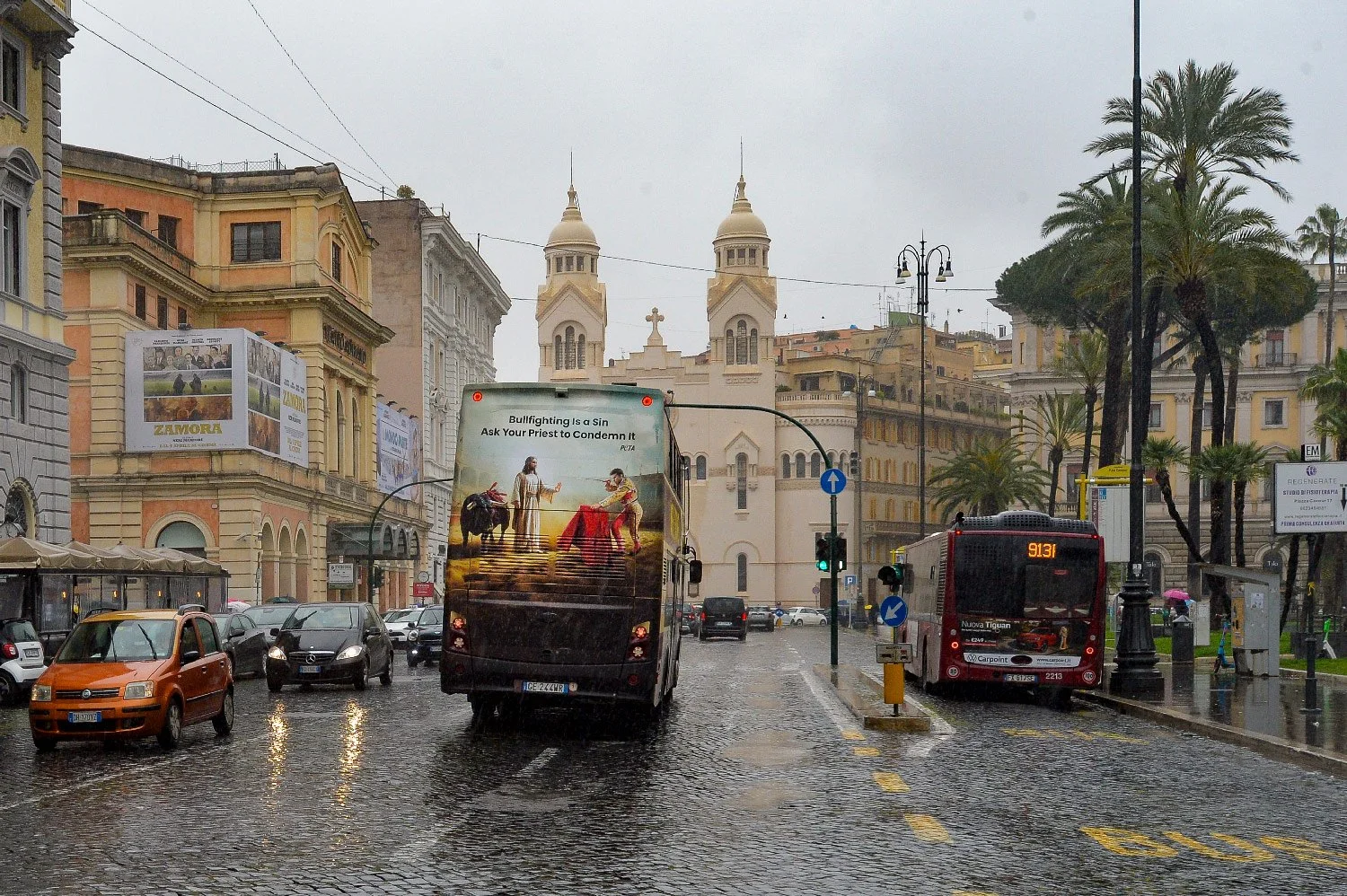
A public message connects faith and bullfighting on a city bus. Questions about how religious teachings relate to practices that harm animals remain part of everyday life. (Stefano Carofei)
A fully compassionate replacement is well represented by the San Fermin of Nueva Orleans, a takeoff on the San Fermín festival in Pamplona. This popular and well-attended festival attracts thousands of participants dressed in white with red sashes who run through the Warehouse District of New Orleans to flee from “bulls,” represented by women and girls on roller skates, who “gore” runners (or swat them) with plastic wiffle-ball bats. Entirely secular, this festival provides an apt example of fun that causes no stress or harm to anymals—and in the full spirit of the Christian faith, all proceeds are given to local charities.
Psalm 145:9
The Lord is good to all,
and his compassion is over all that he has made.