Animals in the Creation Story
(The Hebrew Bible)
Genesis 9:13-15
I have set my bow in the clouds, and it shall be a sign of the covenant between me and the earth…. I will remember my covenant that is between me and you and every living creature.
The Hebrew Bible (Old Testament) reveals God’s intentions for creation and provides a window into the nature of God; both are important for the Christian understanding of our relationship with anymals.
Genesis 1:31
God saw everything that he had made, and indeed, it was very good.
Genesis 1 and 2 record the world as created by God, a perfect world before the sin of disobedience led to the Fall (Genesis 3). This perfect world is a world of kinship and community across species, a world of perfect and total peace. Genesis speaks of the unity of creation and the expectation of a return to the Peaceable Kingdom, as initially created by God.
Kinship: Sixth Day
Genesis 1:24-26
And God said, “Let the earth bring forth living creatures of every kind: cattle and creeping things and wild animals of the earth of every kind.” And it was so. God made the wild animals of the earth of every kind, and the cattle of every kind, and everything that creeps upon the ground of every kind. And God saw that it was good.
Then God said, “Let us make humans....
The Genesis creation narrative shows our place among living creatures: Land animals were created on the 6th day (including humans). Due to cultural bias and the tendency toward human exceptionalism, many people misread this narrative, coming away with the idea that only humankind is created on the 6th day, but Genesis is clear: God created humankind as a land animal on the 6th day.
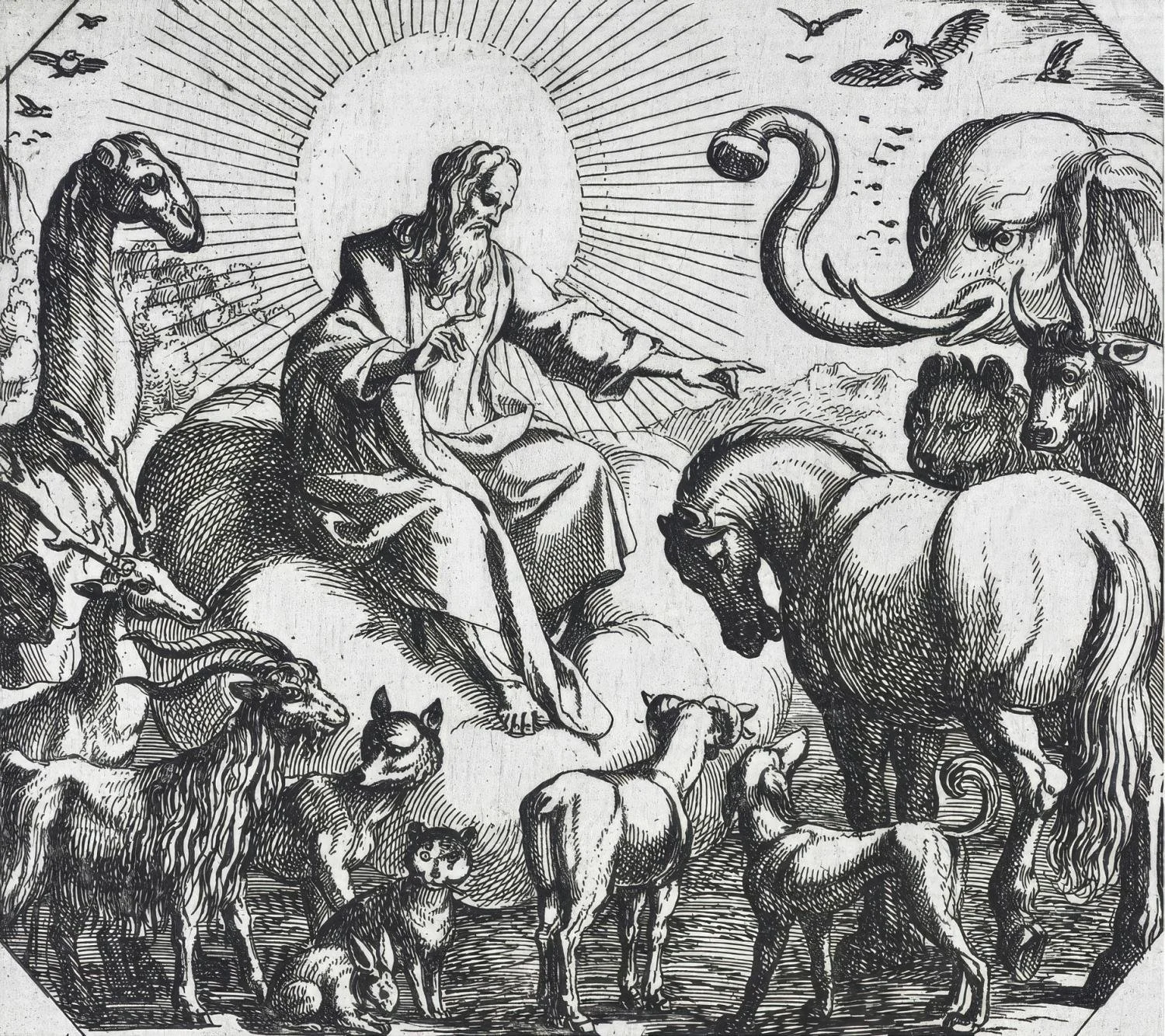
Humankind is created on the sixth day along with land anymals, though many misread this portion of Genesis, as this artist, who portrayed only anymals, likely did.
(“God Creating the Animals,” Antonio Tempesta, Italy, c. 1600, Wikimedia Commons)
Kinship: Nephesh Chayyah
Genesis 1:30
And to every beast of the earth, and to every bird of the air, and to everything that creeps on the earth, everything that has the breath of life.…
In Genesis 1, every living creature is described with the same Hebrew term: nephesh chayyah. This distinguishes plants from animals, naming that which characterizes animate, sentient, breathing beings. Sea creatures and birds are called nephesh chayyah (1:20–21); land anymals are likewise designated nephesh chayyah (1:24–25 and for humans, 1:27), and then all living, breathing creatures are collectively deisgnated nephesh chayyah (1:30). While other pages of the Tanakh are not as clear, Genesis 1 is abundantly clear: God gifted—identically—both humankind and anymals with nephesh chayyah.
Nonetheless, many English translations obscure this continuity, translating inconsistently, fostering the mistaken impression that humans have been endowed with a life categorically different from that given to all other living creatures. The original Hebrew does not support this reading of Genesis 1: God grants nephesh chayyah to all living beings—creatures of the water, of the air, and of the land, which includes humankind.
Ecclesiastes 3:19
For the fate of humans and the fate of animals is the same; as one dies, so dies the other. They all have the same breath, and humans have no advantage over the animals.
There are differences between humankind and anymals: We have been given sacred texts, and through these, the choice to be obedient or disobedient, loving or cruel, generous or selfish and narrow in our religious practice. These differences do not permit the exploitation of anymals—on the contrary: Religious practice leads Christians to feel a deep compassion for all of God’s creatures, for all nephesh chayyah, perhaps especially for those who, due to no fault of their own and contrary to core teachings in sacred texts, have been excluded from the human moral circle.
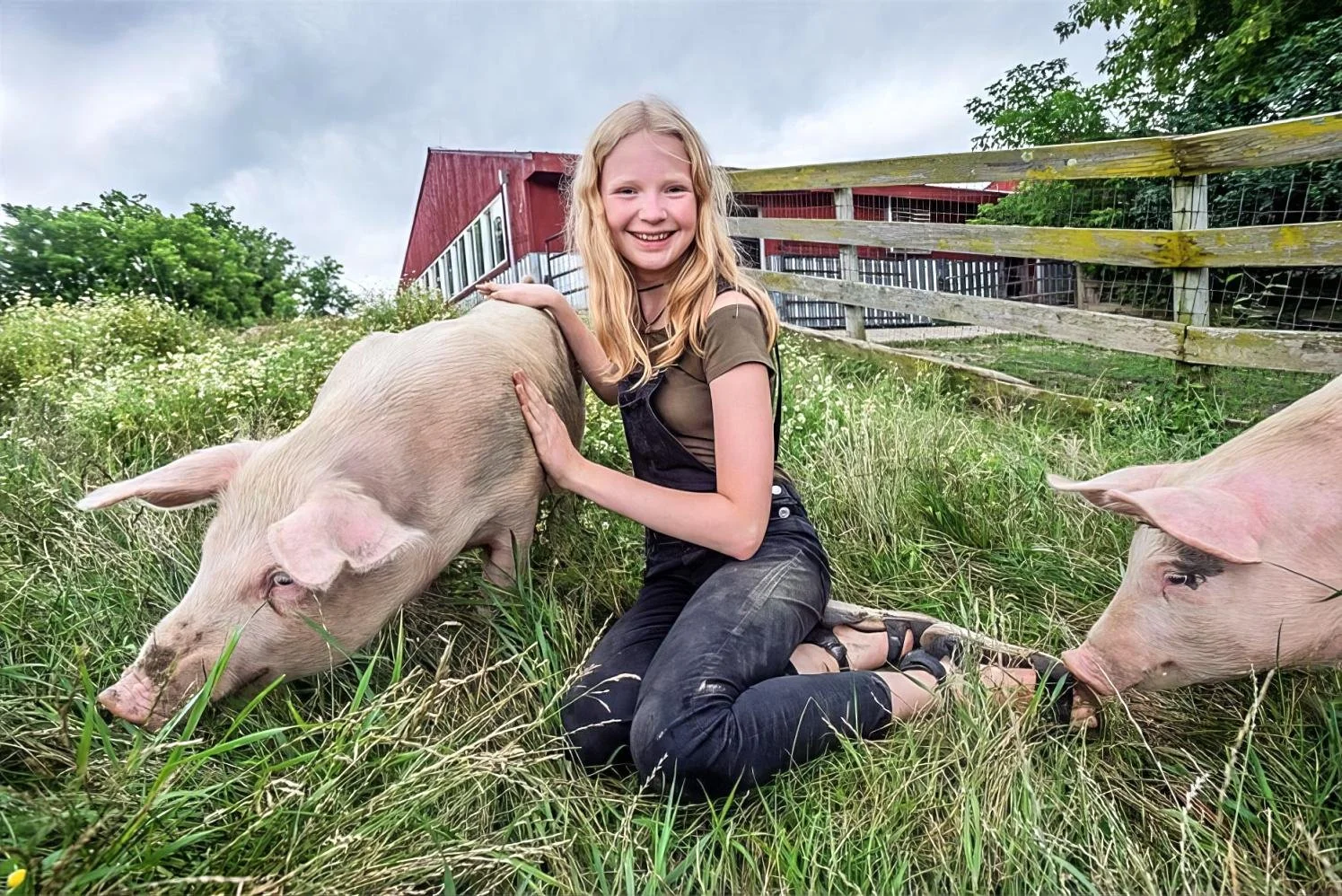
A young person, perhaps for the first time, meets anymals and feels the joy of kinship across species. If not rescued and brought to sanctuary, these pigs would have been slaughtered in their adolescence to be sold as bacon and pork. (We Animals Media)
In the Image of God
Genesis 1:26
Then God said, “Let us make humankind in our image….”
While Genesis 1 shows us that there is nothing unique to humankind about nephesh chayyah, human beings are given something unique and special in the creation narrative: We are made “in the image of God.” While some Christians take this to mean that humankind is entitled to rule the Earth like all-powerful, all-knowing gods, this assessment is tainted with hubris and self-interest.
Proverbs 11:2
When pride comes, then comes disgrace,
but wisdom is with the humble.
History in the larger region explains what this phrase meant historically. In nearby Egypt, “image” or “likeness” refers to servitude and responsibilities to God on Earth in God’s absence. In this context, to be made in the “image” (slm/tzelem) of God is to be created to work on this Earth in God’s likeness, which is to say, in God’s stead, on behalf of the Creator, as the Creator would do (or have us do). We are to faithfully image the Creator—not exactly a license for selfish or harmful dominance of anymals.
Ezekiel 33:31–32
They come to you as people come, and they sit before you as my people, and they hear your words, but they will not obey them. For flattery is on their lips, but their heart is set on their gain…. They hear what you say, but they will not do it.
Scripture is clear. Scripture tells us that humankind is a living creature among living creatures, made on the 6th day with land animals. The universe is God’s glory and not our glory. Pride leads to destruction (Proverbs 16:18): Humility and serving God are core Christian ethics, central to righteousness. Service is rightly and always conducted on behalf of and for God. To be made in the image of God is our special gift amid all of creation: Our special gift is to humbly and diligently serve God amid creation on behalf of the Creator, as God would do.
James 4:10
Humble yourselves before the Lord, and he will exalt you
Vegan Dominion
Genesis 1:26-31
Then God said, “Let us make humans in our image, according to our likeness, and let them have dominion over the fish of the sea and over the birds of the air and over the cattle and over all the wild animals of the earth and over every creeping thing that creeps upon the earth.”
So God created humans in his image,
in the image of God he created them;
male and female he created them.God blessed them, and God said to them, “Be fruitful and multiply and fill the earth and subdue it and have dominion over the fish of the sea and over the birds of the air and over every living thing that moves upon the earth.” God said, “See, I have given you every plant yielding seed that is upon the face of all the earth and every tree with seed in its fruit; you shall have them for food. And to every beast of the earth and to every bird of the air and to everything that creeps on the earth, everything that has the breath of life, I have given every green plant for food.” And it was so. God saw everything that he had made, and indeed, it was very good.
On being made in the image of God, humankind is also given dominion, told to fill and subdue the Earth, and told what to eat: We are given a vegan diet—“every plant yielding seed” and “every tree with seed in its fruit” (1:29). This is affirmed in Genesis 2:16: As soon as the man is placed in the garden (2:15), he is told that he may eat the fruit of “every tree” (2:16) except one (2:17). Genesis 1 and 2 are in agreement: God has told living creatures what to eat, and we are to eat only vegan foods. Humankind, made in the image of God (Genesis 1:26), made to serve God amid creation, is instructed to be vegan, and only as vegans, we are told to subdue the Earth and have dominion.
God created a world of peace and harmony, of kinship and community, where no anymal was to be exploited or slaughtered for food. According to the creation narrative, God chose a vegan life for every living creature. Explicitly, “dominion,” “subdue” the Earth, and being made “in the image of God” do not entitle humankind to eat flesh, dairy, or eggs. (For more on what Christians are to eat, see Food Ethics.)
Duties Assigned by God
Genesis 2:15
The LORD God took the man and put him in the garden of Eden to till it and keep it.
Genesis 2:15 clarifies what we are to do amid creation in the image of God, as vegan servants of God. English translations usually say that humankind is to “till” (’abad) and “keep” (shamar) the land, but these translations do not properly convey the Hebrew meaning. ’Abad is better translated as “to serve” or “to work,” with work being that of a servant, as translated in Joshua 24:15: “choose this day whom you will serve.” This translation affirms what we already know through the life of Jesus: Humankind was created not as a master but as a servant of God. Shamar means “protect” or “guard,” and is translated in Numbers 6:24 as a proactive, emotionally invested version of “keep”: “The Lord bless you and keep you.” Numbers 6:24 conveys the full meaning of shamar, a loving, tender, protective guardianship.
Micah 6:8
He has told you, O mortal, what is good,
and what does the LORD require of you
but to do justice and to love kindness
and to walk humbly with your God?
Genesis 2 recalls God creating the land. Man is created next, specifically to serve the land by guarding and protecting what God has made. Plant life was not created until man was made to tend the land. Having created man to do the necessary care-taking, God created a Garden and then “took the man and put him in the garden of Eden to serve it and protect it” (2:15). In Genesis 2:15 we are created to serve/work the land by guarding and protecting (with tender care) the ground/soil/land that God has made.
Christians often believe that God has given humankind a special authority amid creation, but we are God’s vegan servants (Genesis 1:29–30 and 2:16). We are made in the image of God (Genesis 1:26) to serve and protect the land on God’s behalf, guarding and lovingly tending what God has made (Genesis 2:15).
Luke 4:8
Worship the Lord your God, and serve only him.
Shared Purpose—
One Community
Genesis 2:18-22
Then the Lord God said, “It is not good that the man should be alone; I will make him a helper as his partner.” So out of the ground the Lord God formed every animal of the field and every bird of the air, and brought them to the man to see what he would call them; and whatever the man called every living creature, that was its name. The man gave names to all cattle, and to the birds of the air, and to every animal of the field; but for the man there was not found a helper as his partner. So the Lord God caused a deep sleep to fall on the man, and he slept; then he took one of his ribs and closed up its place with flesh. And the rib that the Lord God had taken from the man he made into a woman and brought her to the man. Then the man said,
“This at last is bone of my bones
and flesh of my flesh;
this one shall be called Woman,
for out of Man this one was taken.”
Genesis 2 recalls that God created anymals and woman for the same purpose, so that man would not be alone and as a “helper as his partner,” revealing a deep kinship across species. Anymals were not found suitable to be Adam’s “helper as his partner.” So, God made woman specifically for this purpose. No earthly hierarchy is indicated; humans are neither above nor separate from other living creatures. Animals (including humans) form one community.
Humankind was created to serve God, in the image of God. Man was placed in the garden to guard and protect (with loving, sustaining care) the land. Woman and anymals are both created to keep the first man company, and woman is his helper and partner.

The anymals and the first woman were created so that Adam would not be alone. The first woman was created to be Adam’s “helper as his partner” in serving God by serving creation.
(“God Creating Adam and Eve,” unknown artist, Italy, c. 1600, Wikimedia Commons)
Creation as a Unified Good
Genesis 1:31
God saw everything that he had made, and indeed, it was very good.
Before human beings are created, God declares light, vegetation, dark, and all living creatures of the sea, sky, and land to be “good” (Genesis 1:4, 10, 12, 18, 21, 25). Genesis 1 conveys the goodness of creation in God’s view, both with and without humankind. This tells us that we are not necessary to the goodness of what God has created, and we are not in any way “more good” than anything else that has been made.
Isaiah 6:3
Holy, holy, holy is the LORD of hosts; the whole earth is full of his glory.
The Hebrew word used for “good” is singular: Creation, though of many parts, is a single entity, existing by and through the Creator. Only God stands apart. We are nephesh chayyah creatures of the Earth, part of the astonishing unity that God created: matter amid matter, life amid life, creatures among creatures.
Psalm 103:14
For he knows how we were made;
he remembers that we are dust.

Creation, both from and of God, is all one unity and is “very good.”
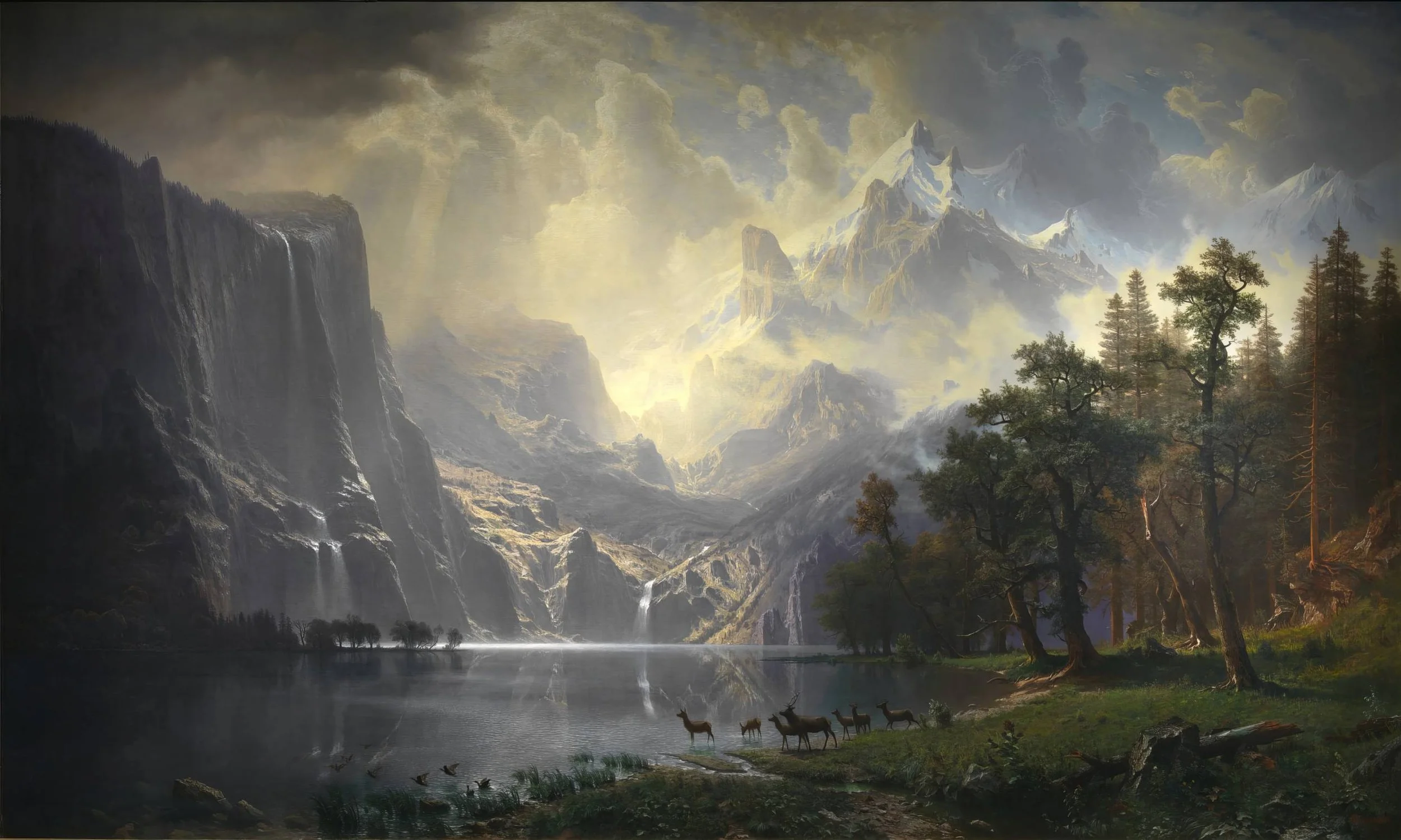
(“A Storm in the Rocky Mountains, Mt. Rosalie,” Albert Bierstadt, United States, 19th century, Wikimedia Commons)
Restoring the
Peaceable Kingdom
Isaiah 11:6-9
The wolf shall live with the lamb;
the leopard shall lie down with the kid;
the calf and the lion will feed together,
and a little child shall lead them.
The cow and the bear shall graze;
their young shall lie down together;
and the lion shall eat straw like the ox.
The nursing child shall play over the hole of the asp,
and the weaned child shall put its hand on the adder’s den.
They will not hurt or destroy
on all my holy mountain,
for the earth will be full of the knowledge of the LORD
as the waters cover the sea.
Sacred texts explicitly extend community beyond human beings. Peace was central to the original creation, where people and anymals lived together harmoniously, as kin, in community, without bloodshed, working together to serve God. Job teaches that a righteous person “shall not fear the wild animals of the earth” and with them, “the wild animals shall be at peace” (Job 5:22-23). The latter prophets remind humankind that we are headed back to this perfect vegan peace, the Peaceable Kingdom. Isaiah eloquently speaks to the work necessary to restore the knowledge of God that is reflected in a world of peace, a world where humankind “will not hurt or destroy on all my holy mountain; for the earth will be full of the knowledge of the Lord” (Isaiah 11:9).
Many Christians look only to salvation, neglecting their earthly duties to God, but Christians are to do the will of God by serving God amid creation, by working to restore justice and peace on Earth, in the here and now, as Jesus did. We are to restore God’s kingdom here on Earth (Matthew 6:10).
Matthew 6:10
Your kingdom come.
May your will be done,
on earth as it is in heaven.
Many ways of serving God by tending to the needs of anymals are overlooked. We serve God when we make sure that church food pantries are stocked with food for dogs and cats, when we pause to help anymals in need, and when we choose a vegan life. We can help to restore peace through prayer, reflection, and by making necessary changes in our daily lives.
James 1:22
Be doers of the word, and not merely hearers who deceive themselves.
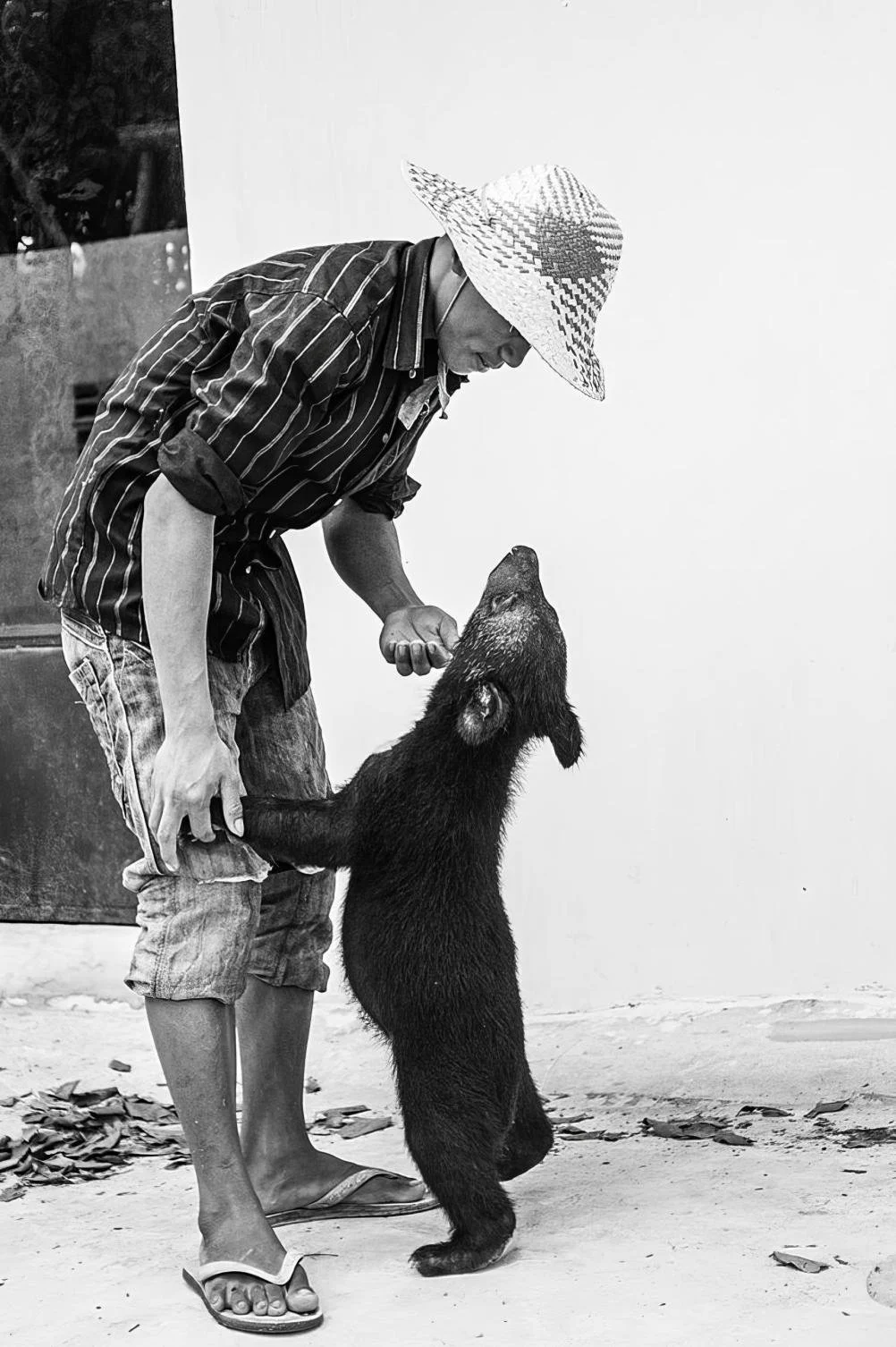
Christians are to work to reestablish peace on earth. We are responsible to heal the harm that we cause anymals. In this picture, a moon bear cub, whose mother was killed or captured, comes to her caretaker at a Cambodian sanctuary, hoping that he will fulfil the simple but essential needs that her mother would have fulfilled. (We Animals Media)