
The Life of Jesus
(New Testament)
John 1:14
And the Word became flesh and lived among us.
Jesus, humble servant who suffered with all who suffered, was God made flesh, born to bring salvation for all. Jesus, the perfect moral exemplar, defied cultural norms and customary boundaries and was moved to righteous indignation in the face of corruption.
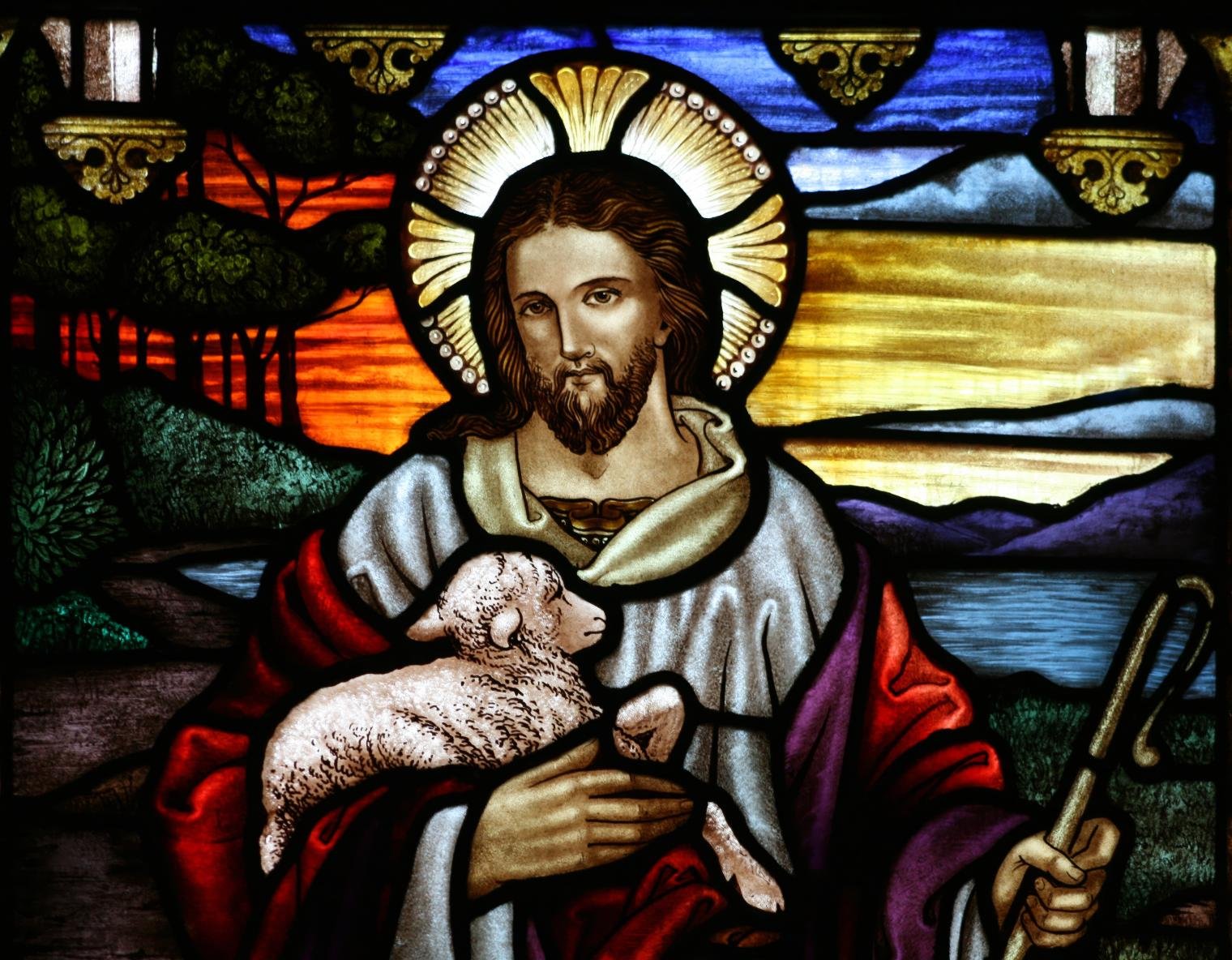
Jesus is often depicted as the good shepherd, tending those in his charge—and all that has been created is in his charge. (Stained glass of Jesus, Australia, Wikimedia Commons)
Salvation for All
Romans 8:21
Creation itself will be set free from its enslavement to decay and will obtain the freedom of the glory of the children of God.
Many Christians have been taught, or simply assume, that Jesus died only for humankind, but others have asked the question, “How could a just and compassionate God permit sentient anymals to suffer without redemption while saving only one creature among many?” Indeed, the New Testament teaches Christians that all of creation has eternal significance. Jesus died so that all might be redeemed; all that has been created will be reconciled, which of course includes anymals.
Colossians 1:19–20
For in him all the fullness of God was pleased to dwell, and through him God was pleased to reconcile to himself all things, whether on earth or in heaven, by making peace through the blood of his cross.
If this were but the one life that has been granted to anymals, and they could find no salvation after the sufferings of this life, would it not be yet more important for Christians to do whatever they could to make the lives of anymals as long and pleasant as possible?
Ephesians 1:8-10
With all wisdom and insight he has made known to us the mystery of his will, according to his good pleasure that he set forth in Christ, as a plan for the fullness of time, to gather up all things in him, things in heaven and things on earth.
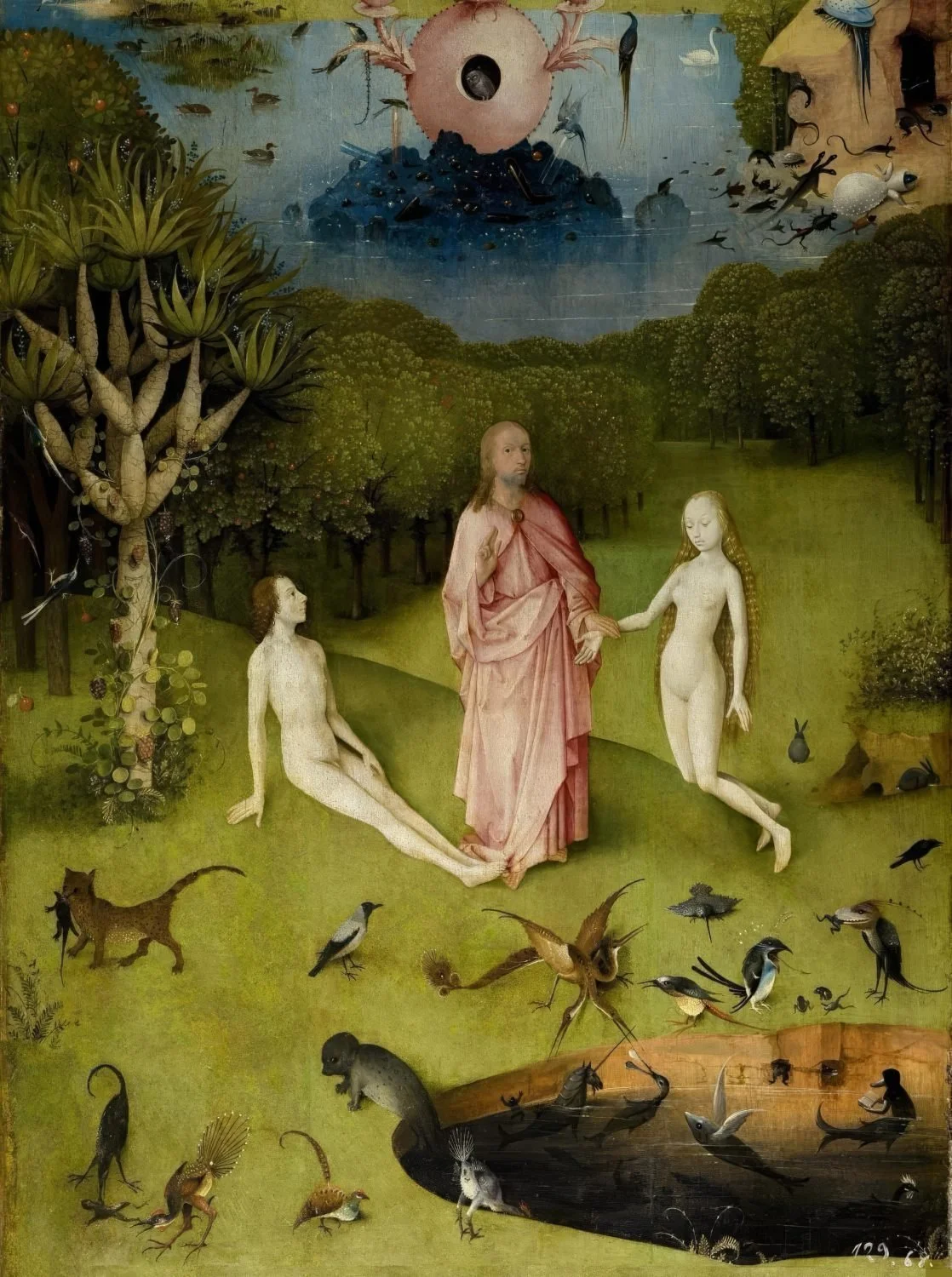
All of us live in a fallen world filled with suffering and bloodshed; Jesus died for all of creation. (“Garden of Earthly Delights,” Hieronymous Bosch, Netherlands, 1500 AD, Wikipedia Commons)
God Made Flesh
John 1:14
The Word became flesh and lived among us.
Jesus was born as a living being, embodied, in the flesh; Jesus suffered and died, though he rose from the dead. Christians often focus on the importance of “God made man” while failing to notice that he was just as much “God made living creature.”
Luke 2:12
…a child wrapped in bands of cloth and lying in a manger.
Though born a male in Judea, his birth, suffering, death, and resurrection are relevant for all men and all women, and inasmuch as his sex and race do not limit the scope of salvation, nor does his specific species limit those for whom he lived and died. Dominican theologian Meister Eckhart (1210–1328) writes, “God is equally near in all creatures.” No matter what the particulars of the birth of Christ, baby Jesus was born in the flesh so that all living, suffering, dying creatures might find salvation.
Colossians 1:16–17
In him all things in heaven and on earth were created, things visible and invisible… all things have been created through him and for him. He himself is before all things, and in him all things hold together.

Jesus was born a man of Jude, but he lived and died for all of creation.
(“Jesus bearing the Cross in Santi” Giovanni e Paolo, Alvise Vivarini, Italy, c.1474, Wikimedia Commons)
Humble Servant of the Oppressed
Mark 9:35
Whoever wants to be first must be last of all and servant of all.
Jesus, the perfect Christian moral exemplar, shows humankind how to live. Though powerful beyond human comprehension, the Gospels portray Jesus as a force of humble servitude, attentive to the needs of those most marginalized and oppressed. Jesus saw to the needs of lepers, who were considered unclean and, as such, were social outcasts, outside society and beneath human civilization. Jesus shows Christians that, whatever one’s culture may teach, those who are most in need are those rightly served with attentive care.
Luke 4:18
The Spirit of the Lord is upon me,
because he has anointed me
to bring good news to the poor.
He has sent me to proclaim release to the captives
and recovery of sight to the blind,
to set free those who are oppressed….
Few are as desperately in need of Christian care as anymals, who suffer on factory farms and in science labs, in breeding facilities and on transport trucks. Christians are to follow the example of Jesus by caring for those who are ostracized, enslaved, and disregarded, whether the oppressed are cows headed for slaughter, dogs in medical laboratories, or foxes chased to their deaths by hunters.
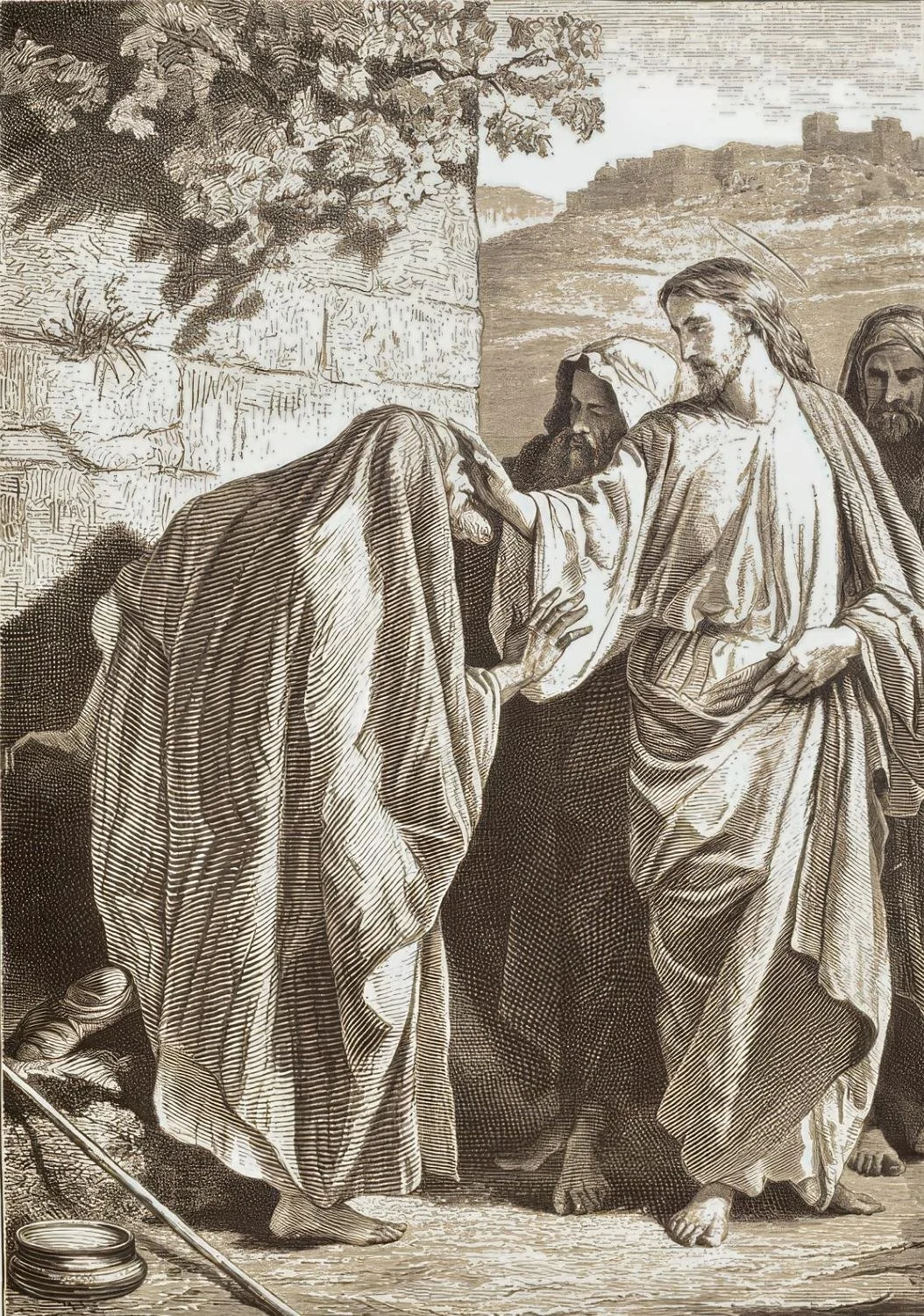
The life of Jesus calls Christians to tend to the needs of those whom others consider unworthy.
(“Jesus Heals the Leper,” Alexandre Bida, France, 19th century, Wikimedia Commons)
Healing a Syrophoenician
Mark 7:25-30
A woman whose little daughter had an unclean spirit immediately heard about him, and she came and bowed down at his feet. Now the woman was a gentile, of Syrophoenician origin. She begged him to cast the demon out of her daughter. He said to her, “Let the children be fed first, for it is not fair to take the children’s food and throw it to the dogs.” But she answered him, “Sir, even the dogs under the table eat the children’s crumbs.” Then he said to her, “For saying that, you may go—the demon has left your daughter.” And when she went home, she found the child lying on the bed and the demon gone.
Some Christians argue that anymals are not the sorts of creatures that we are called to save, and with so much need in the world, why should we put our time, finances, or energy into anymals? One might respond to this in a handful of ways: because their suffering is so great, because they are so powerless, because they are harmed and killed in numbers that are simply inconceivable, because anymals are truly “the least of these” (Matthew 25:40), and because we are collectively responsible for the sufferings brought to anymals by humankind. One might also say, because Jesus healed the Syrophoenician woman’s child.
Being Syrophoenician, this particular woman was from a different community, and held a different faith. She was not devoted to Jesus, or his teachings, or the Christian God, and she was not interested in converting. Nonetheless, she asked Jesus to heal her daughter. Jesus at first refused, noting that the Children of God should be served with the bread of life, that the bread of life should not be wasted on a pagan. Carrying forward Jesus’ food metaphor, she reminded Jesus that even the most lowly ultimately get a few scraps when food is placed on the table. Jesus is moved by her faith in his healing powers and he heals her child.

Jesus heals a Syrophoenician child, someone that his community viewed as outside of his moral circle.
(womeninthebible.net)
In this story, as so often in his life, Jesus rises above the cultural context in which he lived, a context in which cultural boundaries separated lepers, servants and the enslaved, the poor, women, dogs, and those from culturally distinct communities. Jesus touches impure lepers (Mark 1:40–45, Matthew 8:1–4, Luke 5:12–16), the blind (Matthew 9:27–31, Mark 8:22–26, John 9:1–7, Mark 10:46–52), and corpses (Luke 7:11–17); he heals on the Sabbath (Mark 3:1–6, par. Matt 12:9–14; Luke 6:6–11). Jesus shows that compassion is more important than keeping cultural boundaries in place, restoring not only health and life, but their dignity as God’s creations.
Mark 7:8
You abandon the commandment of God and hold to human tradition.
Contemporary cultural norms place anymals outside of our moral circle. They are considered too lowly to be worthy of our attentive care. But the example set by Jesus in the story of the Syrophoenician woman reminds us that we are called to rise above the restrictive norms of our culture, expand our heartstrings, and help all who are in need. Jesus showed us that doing what is right in the sight of God means tending to those in need, no matter who “those” might be.
Acts 5:29
We must obey God rather than any human authority.

Jesus saw to the needs of those whom his culture considered outcasts or too lowly for consideration—those thought to be unworthy of the time and care that Jesus provided.
(“Jesús con la Mujer Enferma” /“Jesus with the Sick Woman,” Juan Rodríguez Juárez, Mexico, c. 1700, Wikimedia Commons)
Present with All Suffering
2 Corinthians 1:7
We know that as you share in our sufferings, so also you share in our consolation.
Suffering is central to the life of Jesus, culminating in his betrayal and death on the cross. The New Testament teaches that Jesus is present in all suffering (2 Corinthians 1:7). If we create or allow suffering, whether in a feedlot, puppy mill, laboratory, breeding facility, or in our backyard, we bring Jesus into that suffering. Do we want to increase the suffering of our savior, or help to reduce that suffering by making different choices at the supermarket and, for example, speaking out against anymal testing facilities and dog breeders?

Jesus suffers for and with creation.
(“Ecce Homo” or “Behold the Man,” Italy, c. 1500, artist unknown, Wikimedia Commons)
Stirred to Righteous Indignation
John 2: 14-15
In the temple he found people selling cattle, sheep, and doves and the money changers seated at their tables. Making a whip of cords, he drove all of them out of the temple, with the sheep and the cattle. He also poured out the coins of the money changers and overturned their tables.
Jesus, the perfect moral exemplar for Christians, shows us what to do in this world, in the here and now. Born to bring a new era, Jesus was an activist on behalf of the marginalized and downtrodden, on behalf of “the least of these” (Matthew 25:40). He aggressively disrupted those who defiled God’s temple, those profiteering from anymal enterprises on temple grounds. Jesus was unwilling to comply and unwilling to look away from injustice and corruption. With righteous indignation, he challenged and disrupted the comfort of normalcy that tends to settle over wrongdoing in every community, and Christians are to model their lives on the life of Jesus.
This concept of righteous indignation is explored more fully in Activism, in a liberationist reading of Jesus.
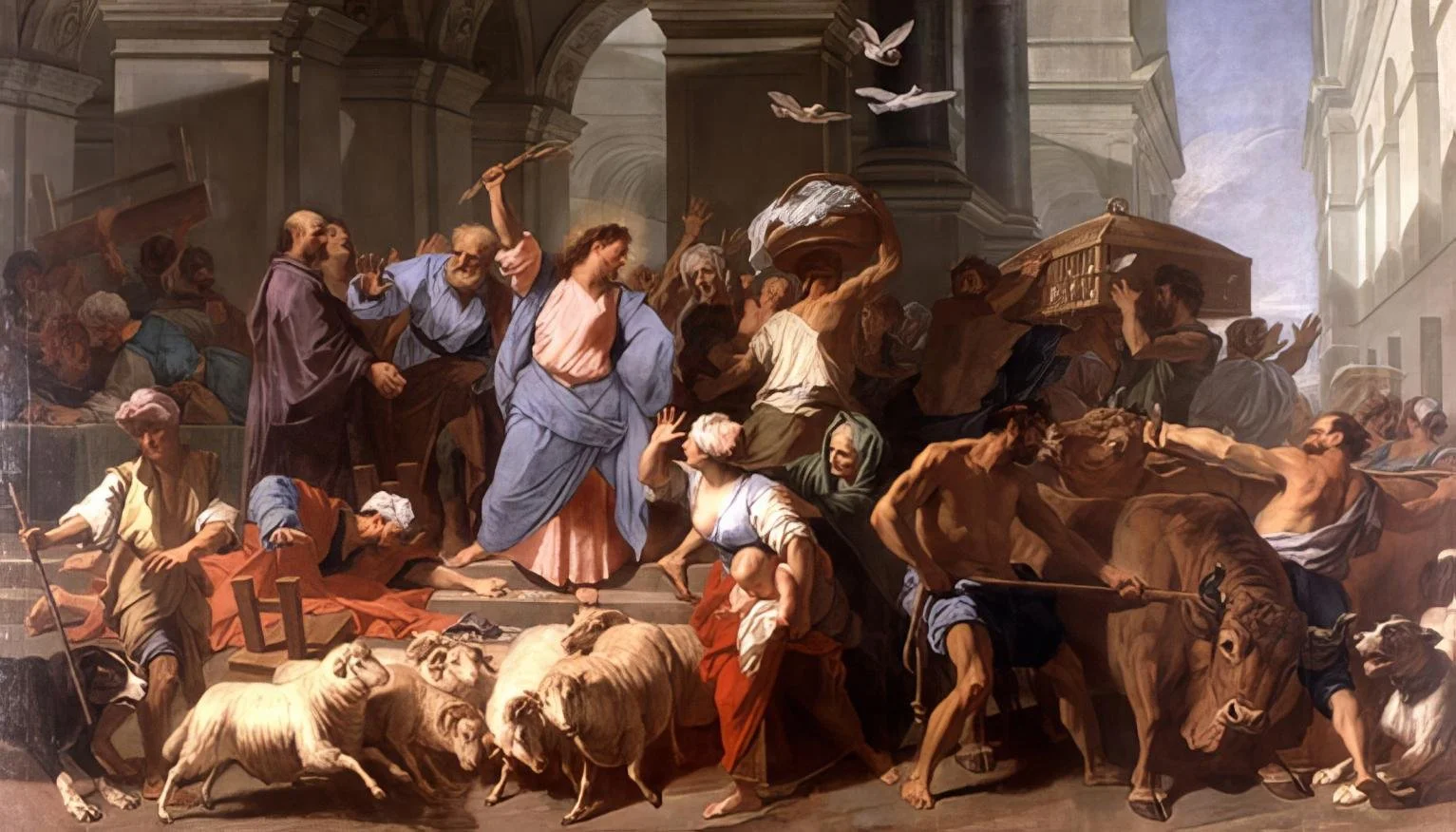
Jesus drove profiteers and their exploited anymals out of the temple.
(“Les Marchands Chassés du Temple,” Jean Jouvenet, France, 1706, Wikimedia Commons)