Sacred Stories: Animals in Christian Narrative
Animals & Religion is designed for those who believe that sacred writings have moral authority and are the best way to understand how we ought to live. This website is for those who, with fresh eyes, would like to explore core sacred texts to better understand rightful relations between humankind and anymals.
Christianity is a path of grace, a journey that offers new opportunities and new insights with the passing of each day. Visitors to the Animals & Religion Website are invited to engage with the material thoughtfully and prayerfully, to return to Scripture, to recall how certain sacred texts have been read, taught, and lived in your religious community, and to ponder how these ancient, holy writings might speak anew in contemporary times.
2 Timothy 3:16
All scripture is inspired by God and is useful for teaching, for reproof, for correction, and for training in righteousness.
This section explores a story where God speaks through a faithful but misused donkey (Numbers 22), stories of anymals and saints from the Catholic tradition (hagiographies), and a story of a snake (Genesis 3), inviting readers to travel with softened hearts and eyes wide, renewing our feelings of wonder at the glory of God. Across centuries and cultures, these engaging narratives have served as a focal point for sermons, engaged young readers, and encouraged Christians to revisit their assumptions about anymals. Foundational reflections on Christian ethics and animals appear in Sacred Texts.
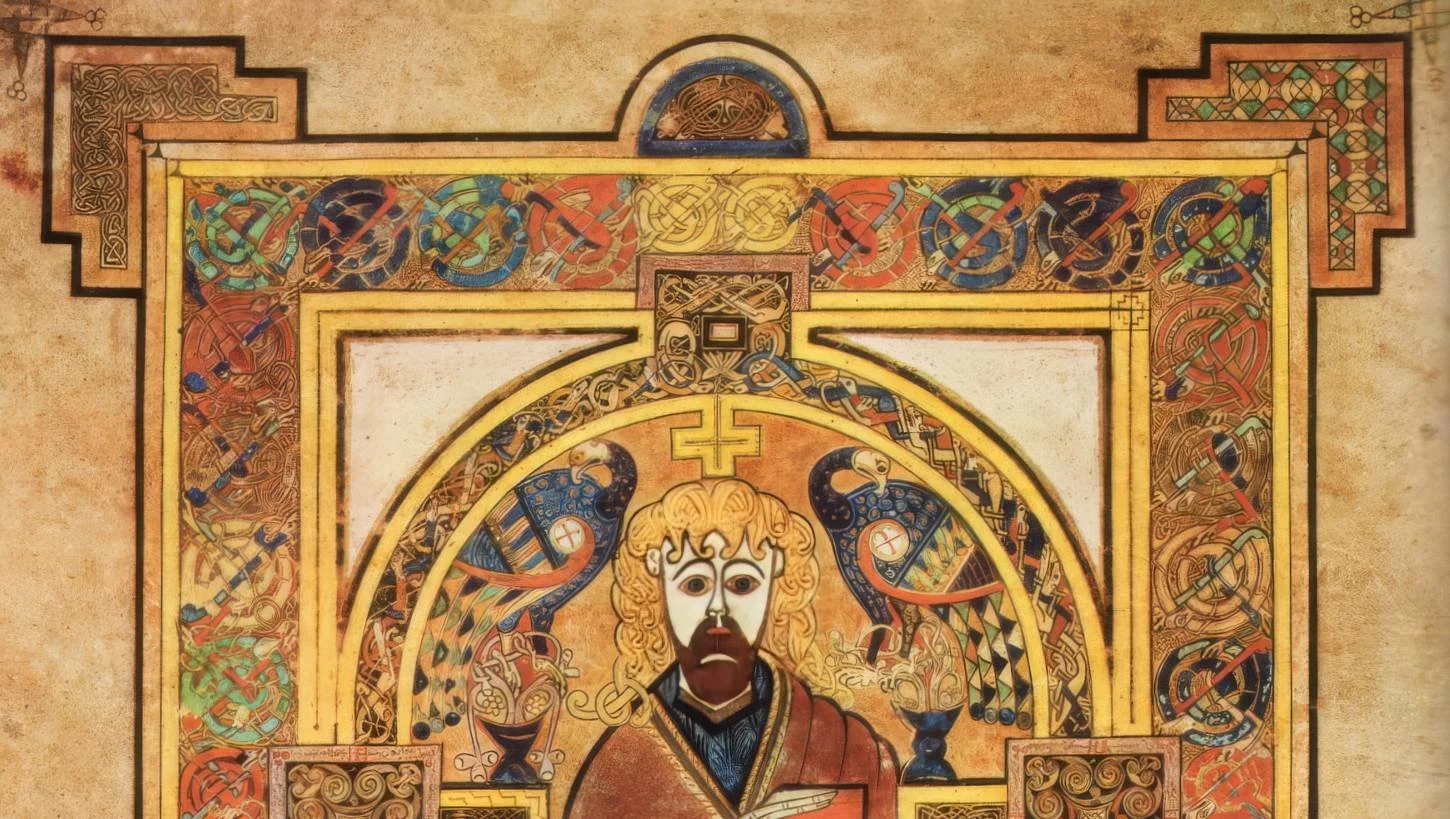
Anymals in the Book of Kells, a medieval manuscript of the four Gospels, which record the life of Christ.
(Detail from the Book of Kells, Ireland, 800 CE, www.openculture.com)
Sacred Stories
-
-
-
-
Animals as moral and spiritual beings

The Donkey & Balaam
(Numbers 22)
Deuteronomy 22:4
You shall not see your neighbor’s donkey or ox fallen on the road and ignore it; you shall help to lift it up.
Anyone who has spent time with donkeys is likely to know them as intelligent, sensitive, social, and inquisitive. They pause to think before they act, they remember what has befallen them, and they are likely to hold a well-deserved grudge against anyone who mistreats them.
Despite their sensitivity and intelligence, human beings have overburdened and beaten donkeys and forcibly bred them to produce more donkeys for work or profit, and to provide nursing milk to be sold for human consumption. In some communities, they are slaughtered, and their bodies are sold for flesh (for profit). Those creating Asian “medicine” exploit their boiled hides to gather an “elixir,” while those developing “modern” medicines exploit the blood of donkeys for serum for heart valve research.
As with anymals more generally, sinful selfishness and a lack of compassion have prevented people from respecting God’s donkeys—anymals are not ours, but God’s. As servants of a loving Creator, we owe them kindness.
James 5:11
…the Lord is compassionate and merciful.
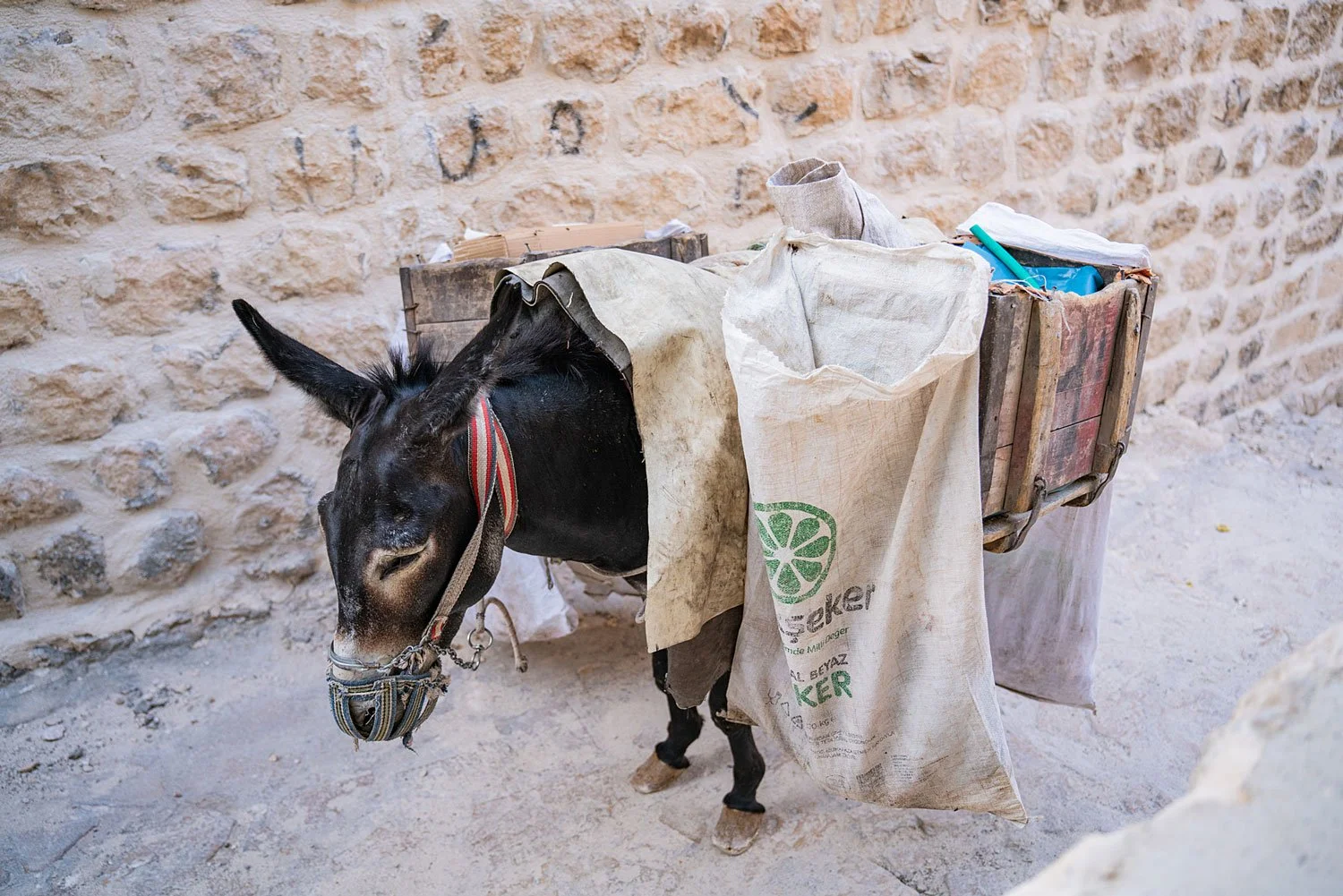
A donkey used for municipal garbage collection stands on a city street bearing a heavy load of bags and large sacks. (We Animals Media)
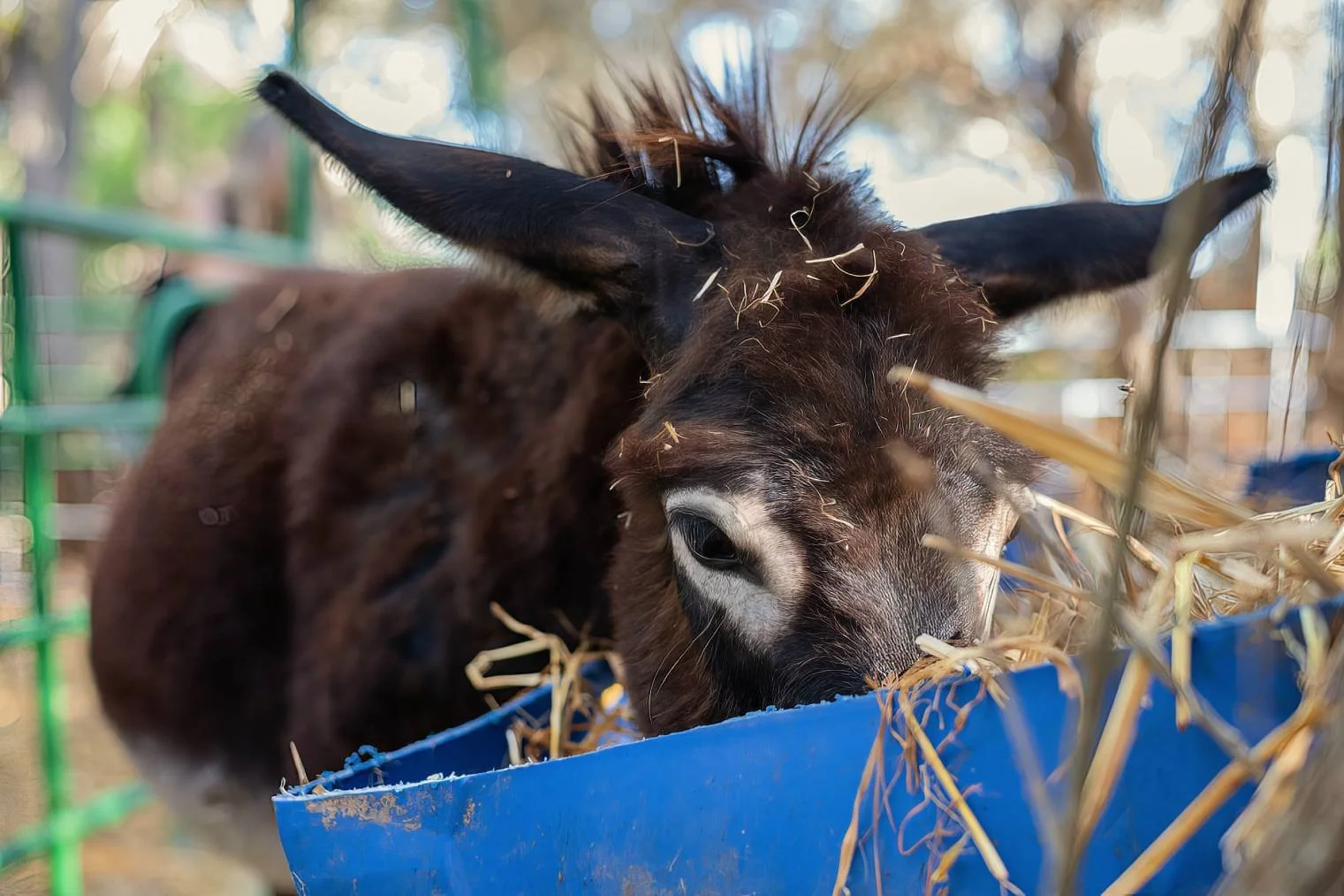
Donkeys are wonderful persons—they are filled with personality. This beautiful creature of God, rescued from neglect and abuse, now lives at a vegan anymal sanctuary in Israel. (We Animals Media)
Exodus 23:5
When you see the donkey of one who hates you struggling under its burden and you would hold back from setting it free, you must help to set it free.
This narrative is about one of Earth’s many sensitive and intelligent donkeys who is exploited as a beast of burden, in this case by a man named Balaam. Many donkeys lived in human communities in biblical times and were often kept and exploited for transport. Numbers 22 focuses specifically on the thoughts and feelings of one such donkey, a jenny (female donkey—English translations tend to reduce her to “it,” the status of an inanimate object, a slight that is corrected herein).
This portion of the text begins when Balak (king of Moab and enemy of the Jewish people) commissions Balaam (a gentile “seer” or prophet) to curse the Israelites, who are camped nearby. Balaam heads out on his donkey. As they travel, the jenny sees an angel standing in the footpath with sword drawn, so she swerves. Her rider cannot see the angel and becomes irritated, striking her as he steers her back onto the path. The angel relocates, this time standing between two walls, directly in the middle of the walkway. The donkey swerves again, but in negotiating the tight space, she scrapes Balaam’s foot against one of the walls. He is yet more irritated and strikes her again. Finally, the angel stands so that the donkey cannot pass. The jenny sees that she is in a hopeless position, caught between an Angel of God and Balaam’s wrath, so she simply lies down in the path.
It is easy to imagine Balaam’s humiliation as he sits astride a donkey who is lying in a public path, apparently refusing to carry her rider any further. He strikes the donkey again. Then, in solidarity with the mistreated and exploited anymal, “the Lord opened the mouth of the donkey,” and in speaking through the donkey, God questions not only Balaam’s cruelty, but his injustice to the jenny he rides: “What have I done to you, that you have struck me these three times?” (22:28).
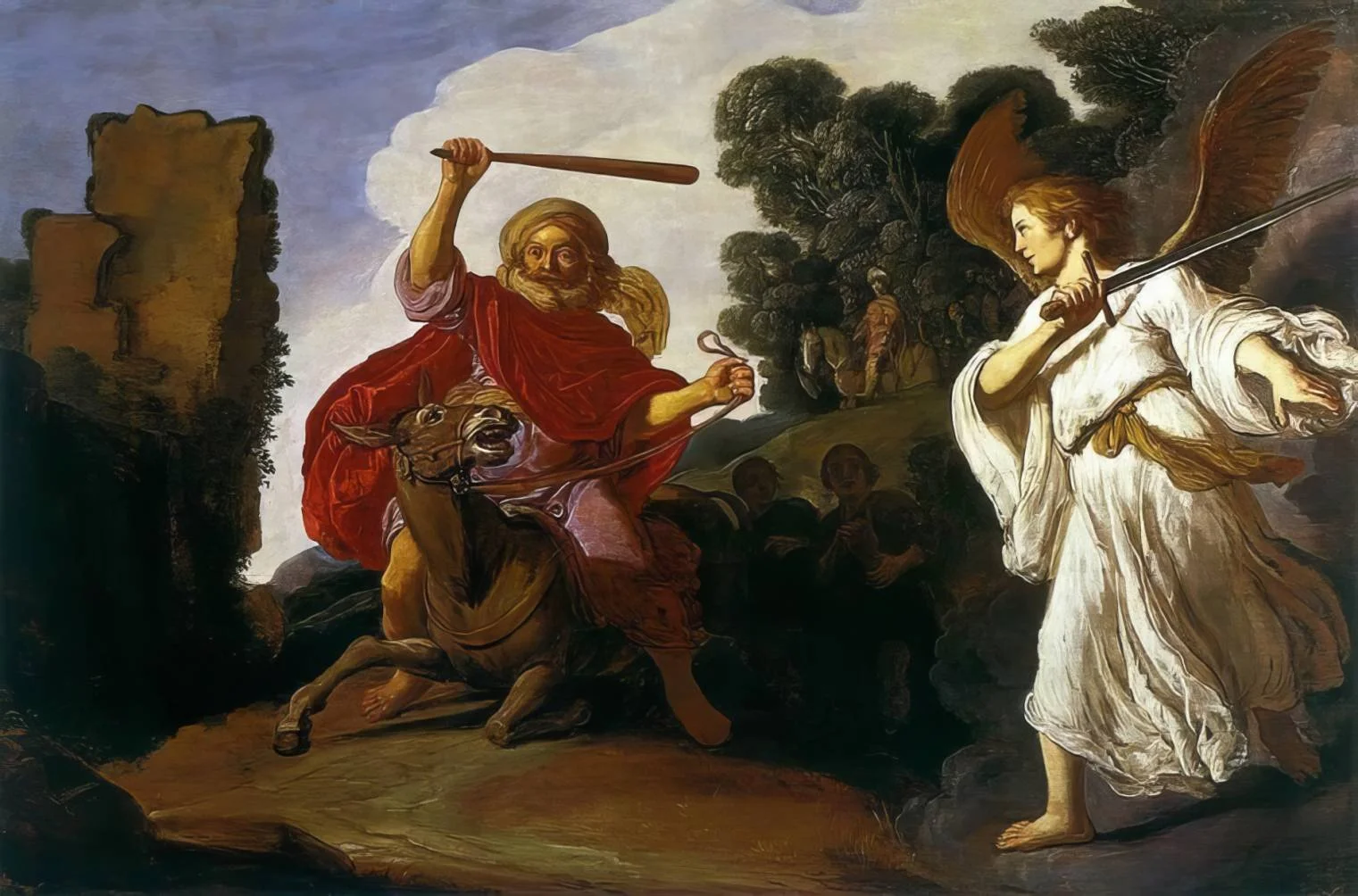
Balaam is humiliated and angry when the donkey he rides lies down in the path.(“Balaam and the Angel,” Pieter Lastman, Netherlands, 1622, Wikimedia Commons)
Balaam, full of pride and violence, threatens the donkey in response: “Because you have made a fool of me! I wish I had a sword in my hand! I would kill you right now!” (22:29). His words expose full power over the little laboring donkey—is sense of dominion and entitlement, including a willingness to kill the donkey he rides. Balaam’s angry violence highlights the complete and unjust power that humankind too often wields over anymals, and the importance of compassion and mercy where anymals are concerned.
For a second time, God challenges both Balaam’s cruelty and his injustice, speaking through the donkey, in solidarity with the donkey, challenging Balaam by reminding him of the donkey’s goodness and of their long-term relationship, which he appears to have forgotten: “Am I not your donkey, which you have ridden all your life to this day? Have I been in the habit of treating you this way?” (22:30). Faced with the truth, Balaam backs down and replies, “No.”
God then allows Balaam to see the angel, who speaks directly to Balaam and is also in solidarity with the donkey, further challenging his cruel dominance and unjust abuse with a blunt question: “Why have you struck your donkey these three times?” (22: 32). The angel continues: If this laboring jenny had “not turned away from me, surely just now I would have killed you and let [her] live” (22:33). The angel’s words demonstrate a recognition of the goodness and worthiness of the donkey, who perceived and did her best to move around the angel, and was all the while subjected to the cruel and unjust power of the man who “owns” her—though anymals are God’s and not ours.
Proverbs 12:10
The righteous know the needs of their animals,
but the mercy of the wicked is cruel.
Hearing the words of the angel and knowing that the donkey saved his life, Balaam is at last humbled. He does not again threaten the donkey, and he abandons his mission to curse the Israelites. But God instructs him to continue his journey and speak only the words that God puts into his mouth, just as the donkey has faithfully done (22:29). And so, he does.
Finally Balaam is able to see the angel, who tells him that the good donkey, whom he has mistreated, saved his life. (“Balaam and the Angel,” Gustav Jaeger, Germany, 1836, Wikimedia Commons)
Numbers 22 reminds humankind that donkeys are thinking, feeling individuals with intelligence and agency and that domesticated, working, farmed anymals are not ours, they are individuals with their own interests and insights—they are creatures of God. In this narrative, the donkey is spiritually elevated compared to her rider, able to see what he cannot, and endowed with the integrity to respond as needed to what she sees, even in the face of abuse. Balaam, in contrast, cannot see the angel of the Lord and he is irritable, filled with pride, and abusive toward the little donkey that bears his weight, carrying him so that he will not have to do his own walking. In this story, the donkey is the shining star, while the man is a dim bulb.
In Numbers 22, God takes the side of the donkey, speaking through her, reminding Balaam that his long-term relationship with the donkey carries moral expectations (that do not include beating or killing the donkey). Numbers 22 recalls Balaam’s abuse of the donkey as a matter of justice. The voice of God reminds readers of the expectation of compassion and mercy, including compassion and mercy for anymals whom we think we “own” and whom we misrepresent as “ours,” or as “domesticated,” “working,” or as “livestock” (literally, “living merchandise”). In Numbers 22, the voice of God reminds readers that the Creator is sensitive and attentive to anymals and notices when we fail to serve God, in the image of God. (For more on ethics and anymals, see Sacred Texts.)
Numbers 22 calls humankind to rethink our cruel exploitation of “working” anymals. This includes rethinking any financial support we provide if we choose products from those who buy, sell, and kill anymals, or exploit them for labor, science, entertainment, or on behalf of consumer taste preferences. The story of Balaam and the donkey is an impassioned plea on behalf of every exploited anymal.
Psalms 145:9
The LORD is good to all,
and his compassion is over all that he has made.

A caretaker shares time with donkeys at a vegan anymal sanctuary in Nepal. (We Animals Media)
Saints
(Hagiographies)
Galatians 3:28
There is no longer Jew or Greek; there is no longer slave or free; there is no longer male and female, for all of you are one in Christ Jesus.
According to hagiographies, which record the lives of saints (those recognized as the most exemplary Christians), Christians known to be strong in their faith sometimes lived in mixed-species communities with foxes, lions, otters, badgers, hares, deer, donkeys, and innumerable other living creatures. Hagiographies honor each anymal as a creature of God, complete with individuality, portraying a fox or an otter as spiritually challenged, devout, willful, or generous. Those who are holy recognize the anymals with whom they live as a brother or sister in faith, and as worthy of a saint’s time and attention.
Psalms 148:7-10
Praise the LORD from the earth,
you sea monsters and all deeps,
fire and hail, snow and frost,
stormy wind fulfilling his command!
Mountains and all hills,
fruit trees and all cedars!
Wild animals and all cattle,
creeping things and flying birds!
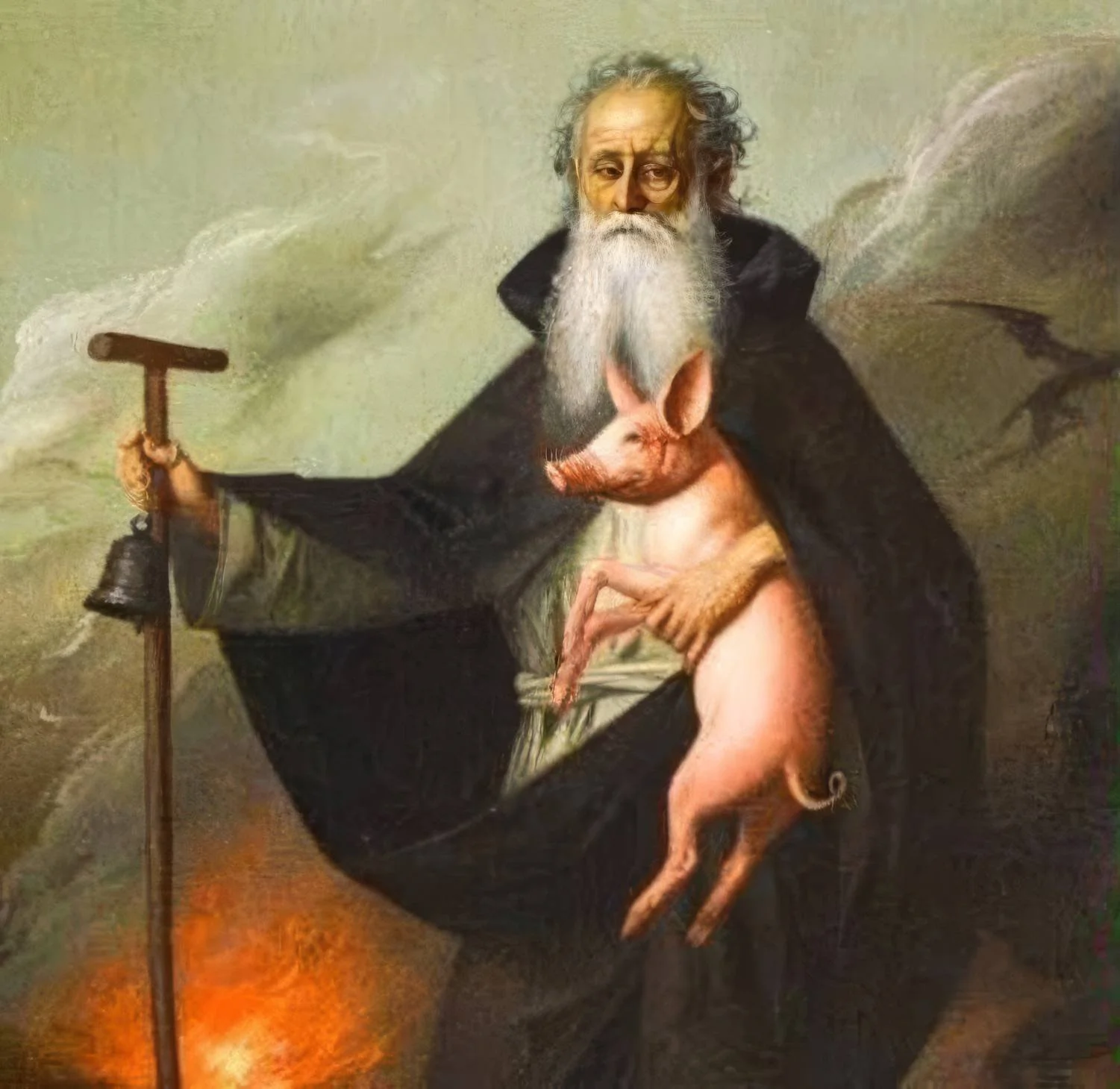
Saint Anthony the Great of Egypt (“The Father of Monks”) with the pig that he healed, who became his constant companion. (Random Times)
Hagiographies tell readers that, no matter what the species, Christian saints follow in the footsteps of Jesus, doing good deeds of love and mercy, and tending to the needs of those whom most people believe to be outside of our moral circle and unworthy of our tender and attentive care. Bartholomew rescued a chick who was lodged in a rock crevice. Saint Columba took responsibility for a wind-driven crane. Saint Martin de Porres fed rats and mice at the edge of his garden and created a hospital for lost dogs and cats; Saint Bernard of Corleone also healed sick and injured anymals. Christian saints serve God amid creation, as the Creator would do or have them do, guarding and protecting God’s creatures, living among and serving the needs of anymals. The ethical foundations that guide these stories are explored more fully in Sacred Texts.
Matthew 5:7
Blessed are the merciful, for they shall receive mercy.
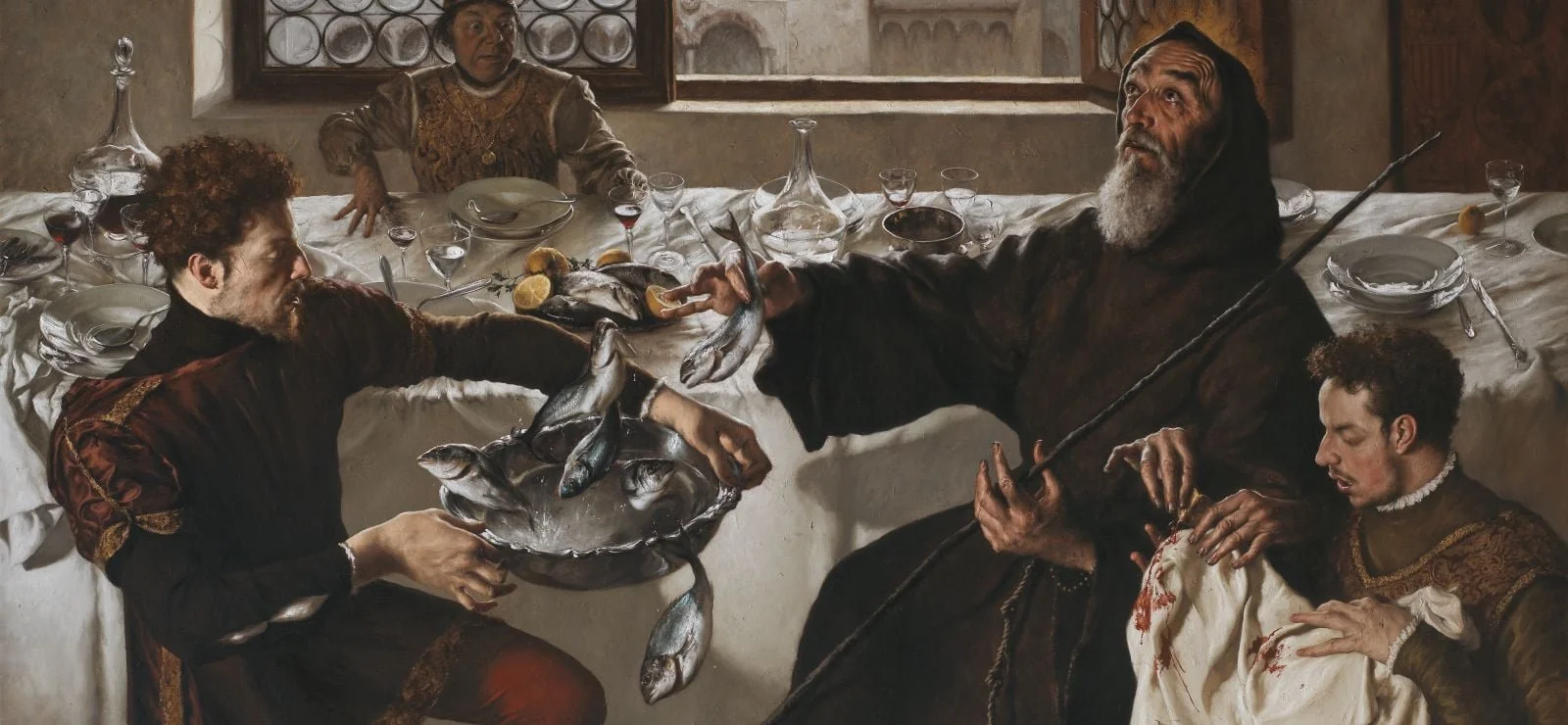
Most renowned among saints caring for anymals, Saint Francis tended, healed, and released wounded anymals; he extricated a rabbit from a trap, claimed turtle doves who were being taken to the market to be sold, and when his friend was caught and fried, he restored a pan of fishes to life.
Saint Francis reviving his friend, who happened to be a fish.
("I miracoli di San Francesco di Paola" (The Miracles of St. Francis of Paola), Giovanni Gasparro, 2015.)
Perhaps the best-known anymal story of Saint Francis is that of taming the wolf of Gubbio, who was eating human beings. When Saint Francis arrived to solve the problem, the wolf lay down at his feet. He admonished the wolf for frightening and eating God’s creatures, and his admonishments are just as true for omnivores and vegetarians who frighten and eat God’s creatures. In the end, the wolf agreed not to harm any living beings, and the people promised to feed the wolf. (Like human beings, dogs thrive on a well-balanced vegan diet.) Two years later, when the wolf passed, the community of Gubbio sincerely mourned the loss of their noble friend. This story invites reflection: Some Christians understand that peace is extended to all beings and connected to what we choose to eat. We also help restore peace by choosing a vegan life. The ethical dimensions of diet are explored more fully in Food Ethics.
Genesis 1:29
I have given you every plant yielding seed that is upon the face of all the earth and every tree with seed in its fruit; you shall have them for food.

Saint Francis admonished the wolf of Gubbio for frightening and eating God’s creatures, reestablishing peace, as we also do when we choose a vegan life. (From The Franciscans in America, Francis Dent, United States, 1903, Wikimedia Commons)
Foxes tend to be particularly colorful characters in literature, and this is just as true in hagiographies. Saint Moling took in a fox as a disciple, but the fox consumed a monastery hen. Having been admonished for the deed, the penitent fox snatched a replacement from a nearby nunnery. The patient Saint Moling instructed the fox to gently return the hen and to take an example from the other residents and live peacefully, which does not permit the eating of God’s creatures. Saint Ciaran ministered to five anymals and as with the fox who lived with Saint Moling, the fox was particularly challenged by discipleship. He slunk off to the wildlands to chew on a Bible, only to be pursued by hounds who forced him back to Saint Ciaran for penance. The fox again abandoned discipleship, this time wandering off to chew the saint’s shoe so that Father Ciaran had to send brother badger out to retrieve the wayward fox. Both Saint Moling and Saint Ciaran lived with and ministered to anymals, tending to the needs of all who came, no matter what their species.
2 Corinthians 1:3–4
Blessed be the God and Father of our Lord Jesus Christ… who consoles us in all our affliction, so that we may be able to console those who are in any affliction.
Blessed be the God and Father of our Lord Jesus Christ… who consoles us in all our affliction, so that we may be able to console those who are in any affliction.
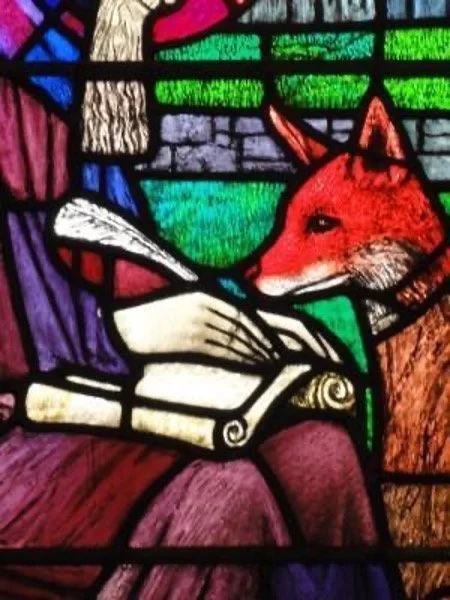
Saint Moling and one of his disciples, a fox. (Catholic Ireland)
A donkey and a lion were Saint Jerome’s companions. After he pulled a thorn from the lion’s paw, the lion chose to stay with the saint, serving as protector for the cloister donkey. One day, the donkey went missing, and Saint Jerome concluded that the lion had eaten the donkey. He did not accuse the lion directly but instructed the brothers to make a harness so that the lion might do the donkey’s work. When not working, the innocent lion searched tirelessly for the donkey, who had been stolen by thieves. When the lion approached, the thieves fled, abandoning not only the donkey but also a string of camels. The lion, the donkey, and the camels returned to the monastery, adding a few more anymals to Saint Jerome’s extended and diverse monastic community.
Matthew 10:8
Cure the sick; raise the dead; cleanse those with a skin disease; cast out demons. You received without payment; give without payment.

Saint Jerome and his companions, a lion (with a thorn not yet out of his paw) and a donkey.(“Jerome in the Wilderness,” Giovanni Bellini, Italy, 15th Century, Wikimedia Commons)
In dread of hunters, anymals sought refuge with saints. Hares took shelter with Saints Cuthbert, Anselm, Francis, and Philip. A hunted boar found refuge with Saint Kevin of Glendalough. Stags escaped the bloodlust of hunters by sheltering with saints such as Giles, Godric, and Maedoc. A deer came to Saint Giles for protection, and the saint was mistakenly shot by the hunters. A stag dashed into Saint Maedoc’s hermitage when he was in prayer. The saint threw the corner of his cloak over the stag’s antlers to protect him, and the hunters and dogs ran by the hermitage without seeing the exhausted, frightened deer.
Colossians 3:12-15
Clothe yourselves with compassion, kindness, humility, meekness, and patience…. Above all, clothe yourselves with love, which binds everything together in perfect harmony. And let the peace of Christ rule in your hearts.

Saint Giles was shot by a hunter while protecting a deer.(“Saint Giles and the Hind,” artist unknown, c. 1500, Wikimedia Commons)
When a hunted hare dashed into a thicket of brambles, desperately seeking shelter, Saint Melangell crawled into the brambles to protect the hare. When the hunter, Prince of Powys, found Saint Melangell praying and protecting his small, frightened quarry, he was impressed by her piety and courage in standing up for the small hare against whoever might show up, likely with a weapon in hand. The prince rewarded Saint Melangell by gifting her his lands as an anymal sanctuary, and the prince gave up hunting.
It would seem impossible to imagine Jesus hunting. Christians who disrupt hunts participate in a long tradition of protecting God’s vulnerable creatures from the violence and bloodlust of hunters. Today, those who hunt could choose a vegan life, and could more easily and cheaply grow or buy vegan foods than invest in sport-killing. (For more on hunting, see the chapter on hunting in Eating Earth and the chapter on environment in Vegan Ethics: AMORE.)
Hosea 2:18
I will make for you a covenant on that day with the wild animals, the birds of the air, and the creeping things of the ground, and I will abolish the bow, the sword, and war from the land, and I will make you lie down in safety.

Saint Kevin with a blackbird and a deer.
(Glendalough Hermitage Centre)

Saint Melangell, Welsh patron saint of animals, protecting the hunted hare. (Green Canticle)
The Gospels tell us that Jesus pulled fishers from the sea, while hagiographies tell us that he pulled hunters from the forest. Before his conversion, Saint Eustace was a hunter. Jesus appeared in the horns of a stag, turning the bloodthirsty deer-slayer into a servant of God and a hunter of humankind, Saint Eustace.
1 John 4:8
…love is from God; everyone who loves is born of God and knows God. Whoever does not love does not know God, for God is love.

Jesus appears in the form of a stag to Saint Eustace. (University of California, Irvine)
Jonah 1:17
But the LORD provided a large fish to swallow up Jonah, and Jonah was in the belly of the fish three days and three nights.
In Scripture, anymals work with God. Hagiographies recall anymals assisting saints, sometimes stepping in where humankind has failed. Anymals raised and harbored Saint Keneth Cenydd of Wales after humankind rejected and abandoned him because of his physical deformities. He lived high in the trees in a bird’s nest where a hind nurtured him with her milk. When grown, he chose to remain with the anymals, building a hut by the sea. When a healer heard of a deformed youth living among the anymals he restored Keneth’s body, but Keneth told the healer that his “infirmity” was a blessing: Because he was deformed, he had lived among the anymals. His natural body was restored, and he lived happily with the anymals for the rest of his days.
Saints are exemplary Christians, recognized as particularly close to God. Hagiographies remind Christians that many saints lived in company with and tended to the needs of anymals as if the Peaceable Kingdom were already at hand (Isaiah 11:8–9 and Matthew 6:10). Saints in these stories serve God amid creation by following in the footsteps of Jesus, looking to the needs of those whom others overlook as beneath moral consideration—and we are all called to be saints (1 Corinthians 1:2).
1 Corinthians 1:2
…to those who are sanctified in Christ Jesus, called to be saints….

Genesis Snake
(Genesis 3)
Psalm 24:1
The earth is the LORD’s and all that is in it,
the world, and those who live in it.
Snakes have much more reason to fear humankind than humankind has to fear snakes, yet snakes suffer tremendously because humans fear them. Many people kill even the most harmless snakes as a matter of habit. As a result, more than half of the world’s snakes are either threatened or near threatened, while we lack data in many cases to know which creatures are at risk of extinction. We do know that God is sole proprietor of creation, and that we do not have license to harm or destroy anything that has been made; we are tasked with serving God by protecting and tending what God has made.
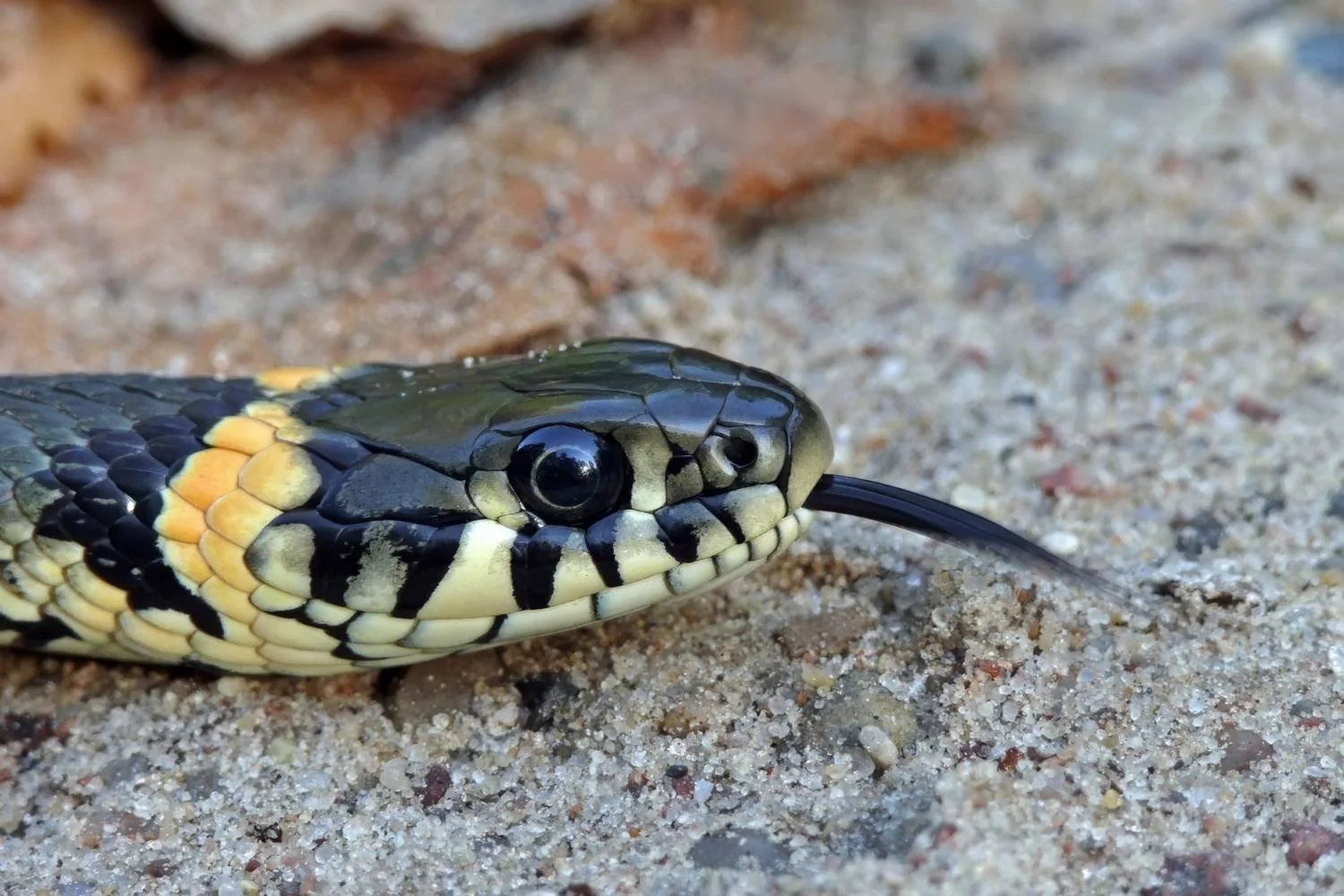
For no legitimate reason, many human beings feel a visceral dislike for snakes, and hastily destroy even non-venomous species, such as this little grass snake. (Wikimedia Commons)
What do scriptures say about snakes that might help us to rethink our unjustified dislike, harm, and destruction of these slender citizens of the Earth? A close look at the snake narrative in Genesis 3 seems a good place to start.
The story of the snake in Genesis 3 has long been interpreted from a reptile-averse point of view, accusing the snake of deliberately and deceitfully convincing the first human beings to disobey God, bringing about the Fall, which caused humankind to be cast from the Garden of Eden. A fresh read, free of conventional, cultural distaste for reptiles, questions this traditional interpretation.
Those who interpret scriptures tend to associate the snake with evil and with the Fall.. In this Rembrandt image, the snake is depicted as a powerful dragon, hovering over the first human beings, who look unintelligent and disoriented.
(“The Fall of Man,” Rembrandt Van Rijn, Holland, c. 1510, 1st Art Gallery)
Genesis 3:1
Now the serpent was more crafty than any other wild animal that the LORD God had made. He said to the woman, “Did God say, ‘You shall not eat from any tree in the garden’?”
Genesis 3 tells of neighbors, a snake and a human being, who pause to chat in the Garden of Eden. The snake is described as “crafty,” a translation of the Hebrew word, ’arum, which appears elsewhere in Scriptures. For example, ’arum describes the intelligence of David (1 Samuel 23:22), where the same word is translated with positive connotations, as “cunning.” ’Arum also appears in the Book of Job, translated with positive connotations as “crafty,” reminding humankind to be humble before God, no matter how intelligent we might think ourselves to be—an important lesson where anymals are concerned. ’Arum also shows up eight times in Proverbs (12:16, 12:23, 13:16, 14:8, 14:15, 14:18, 22:3, 27:12), where the word, always with strongly positive connotations, is translated as “prudent” or “clever.” Here are three examples:
Proverbs 12:16
Fools show their anger at once,
but the prudent ignore an insult.Proverbs 13:16
The clever do all things intelligently,
but the fool displays folly.Proverbs 22:3 and 27:12
The clever see danger and hide;
but the simple go on, and suffer for it.
’Arum, tells readers that the snake was exceptionally intelligent. In Scriptures, ‘arum is a positive attribute.
As the conversation unfolds between the woman and the snake (who is male in the Hebrew writing), the snake asks if God has told humans that they may not eat from a particular tree. The first woman replies that God has prohibited the consumption of fruit from a specific tree, lest they die (Genesis 3:3). The snake corrects her: “You will not die; for God knows that when you eat of it your eyes will be opened, and you will be like God, knowing good and evil” (Genesis 3:4–5). Apparently, the woman desires to know good and evil because she eats fruit from the forbidden tree.
Genesis 3:6
So when the woman saw that the tree was good for food, and that it was a delight to the eyes, and that the tree was to be desired to make one wise, she took of its fruit and ate; and she also gave some to her husband, who was with her, and he ate.
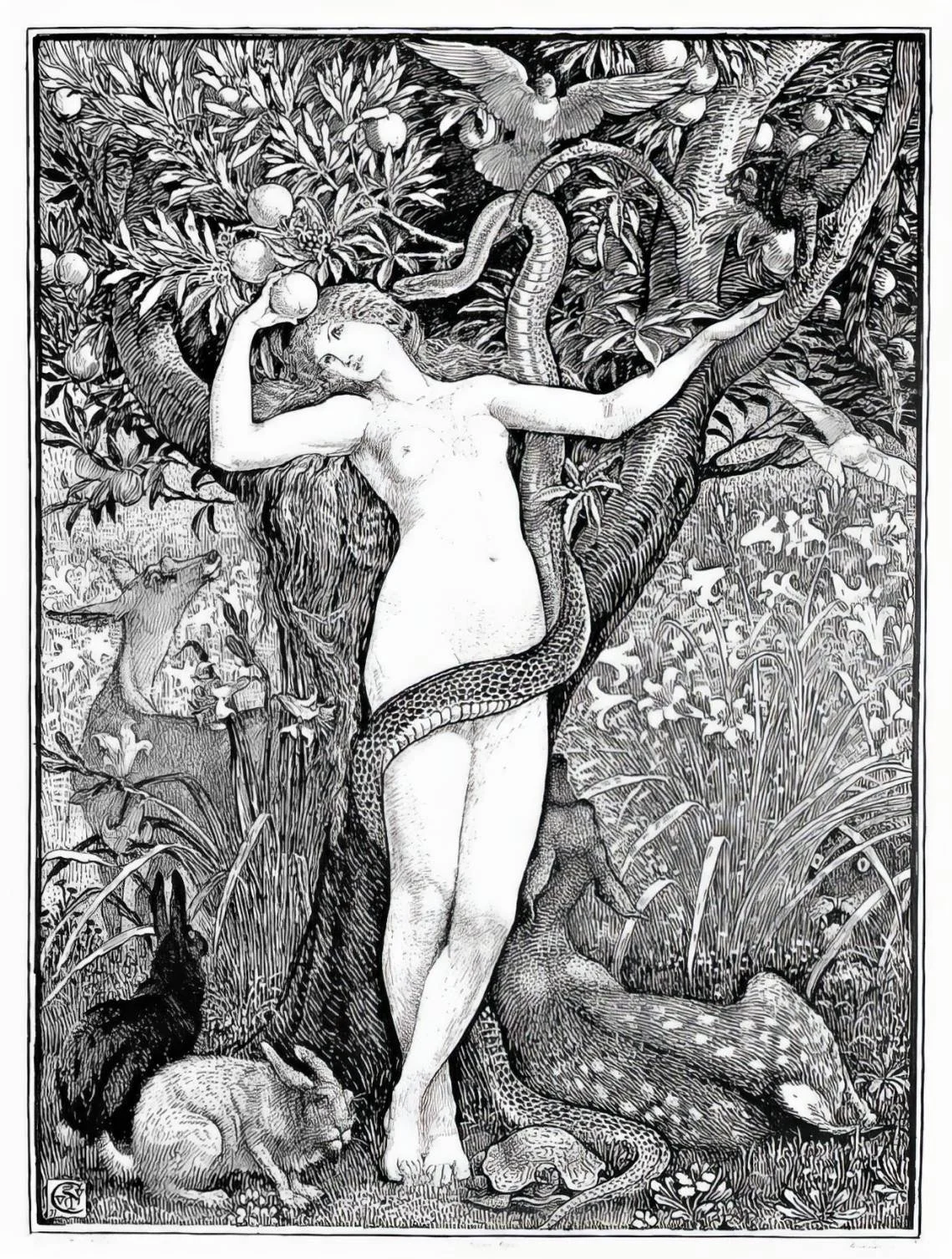
The snake in this image is portrayed in a conventional fashion, as aggressive and sly, slithering across a naked (vulnerable) woman to whisper evil into her ear—information that will cause the Fall. While a common take on Genesis 3, this is not true to the narrative.
(“Eve Taking the Forbidden Fruit,” unknown artist, Paris Iconographic Collections, no date, Wikimedia Commons.)
Genesis 3:10-11
He said, “I heard the sound of you in the garden, and I was afraid, because I was naked, and I hid myself.” He said, “Who told you that you were naked? Have you eaten from the tree of which I commanded you not to eat?”
Obviously, the first woman understands the snake to be a good source of information—and she is right. The snake had more knowledge and spoke the truth: After eating the forbidden fruit, the “eyes of both were opened, and they knew that they were naked” (Genesis 3:7). The Creator, of course, is displeased that the two humans have disobeyed. When questioned, the man blames both God for providing a woman, and the woman for sharing the fruit: “The woman whom you gave to be with me, she gave me fruit from the tree, and I ate” (Genesis 3:12). The woman blames the snake: “The serpent tricked me, and I ate” (Genesis 3:13). It is a poor showing for humankind.
The snake has enough integrity to hold silence before God, despite false accusations. According to the Genesis narrative, the snake did not trick the first human beings. Nor did the snake tell the first woman to eat the forbidden fruit. The snake knows and speaks the truth: By eating the forbidden fruit, humankind would not die but would gain knowledge, becoming a little more like God (Genesis 3:5).
Rather than place responsibility where it belongs, squarely on the shoulders of the first human beings, each of whom chose to taste the forbidden fruit, those interpreting this text have preferred to rest blame primarily on the snake, and secondarily on the woman—as if the first man were a lifeless pawn, unable to think or act for himself. In any event, God is displeased with what has transpired, and all are punished.
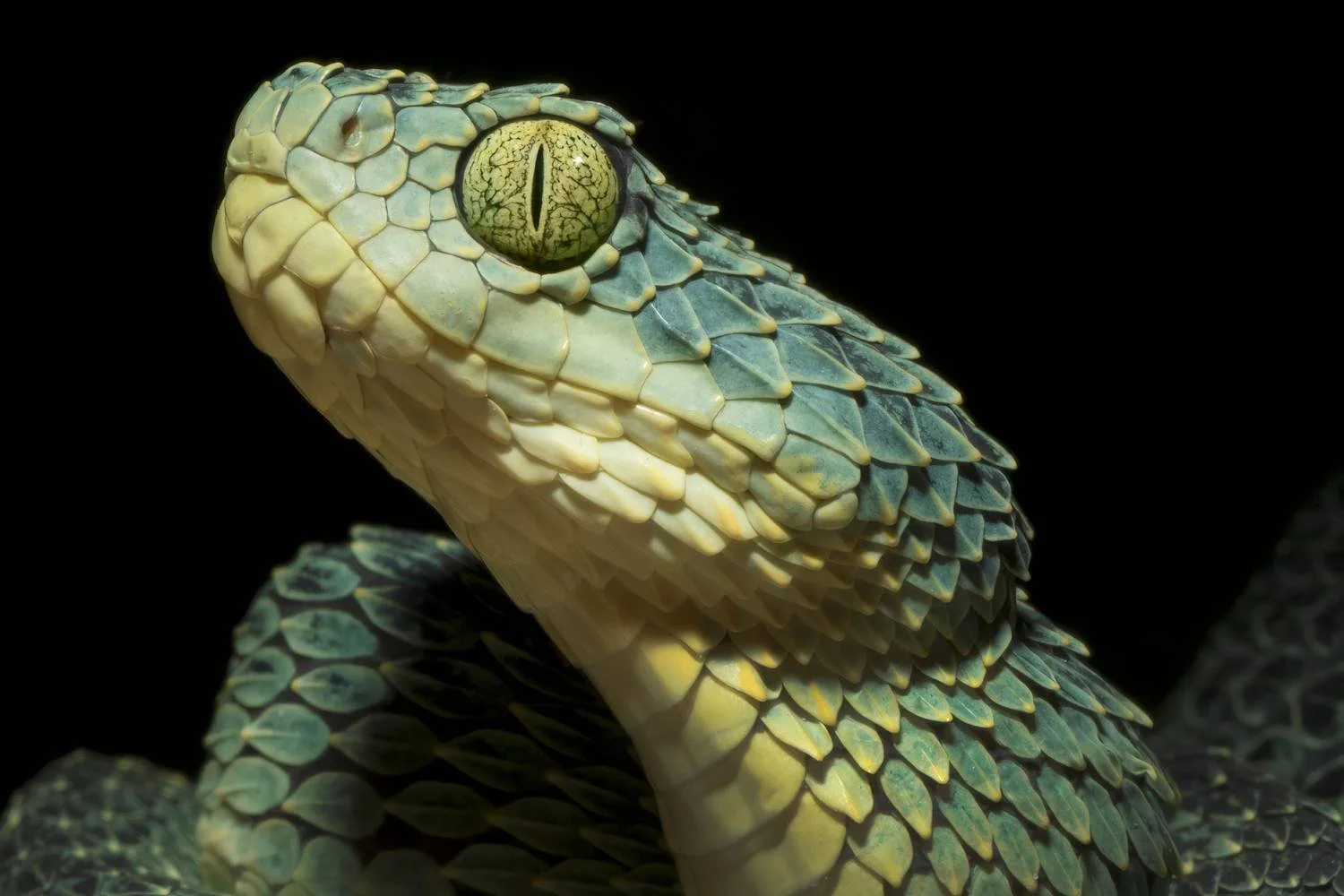
Bush Vipers are venomous, but they are also shy and reclusive, hiding in the tropical rainforests of Africa. (Save the Snakes)
Genesis 3:14-19
God said to the serpent,
“Because you have done this,
cursed are you among all animals
and among all wild creatures;
upon your belly you shall go,
and dust you shall eat
all the days of your life.
I will put enmity between you and the woman
and between your offspring and hers;
he will strike your head,
and you will strike his heel.”To the woman he said,
“I will make your pangs in childbirth exceedingly great;
in pain you shall bring forth children,
yet your desire shall be for your husband,
and he shall rule over you.”And to the man he said,
“Because you have listened to the voice of your wife
and have eaten of the tree
about which I commanded you,
‘You shall not eat of it,’
cursed is the ground because of you;
in toil you shall eat of it all the days of your life;
thorns and thistles it shall bring forth for you;
and you shall eat the plants of the field.
By the sweat of your face
you shall eat bread
until you return to the ground,
for out of it you were taken;
you are dust,
and to dust you shall return.”
The most severe punishment falls on all life—death: “you are dust, and to dust you shall return” (Genesis 3:19), and the snake has traditionally been blamed. But one might reasonably wonder why God even punishes the snake, who merely spoke the truth: Eve would not die from eating the fruit, but her eyes would “be opened” (Genesis 3:5).
The most reasonable answer seems to be that, In the eye of God, the first human beings were akin to ignorant and gullible children in comparison with the highly intelligent snake. Moreover, this narrative indicates that God intended human beings to remain in their initial state of comparative ignorance. Through God’s punishment, the snake is held accountable for providing human beings with a taste of knowledge, indicating that God is displeased with this turn of events. Considering what humankind has done with intelligence—weaponry of mass destruction, climate change, species extinctions, vivisection, and cloning—the wisdom of the Creator is everywhere apparent.
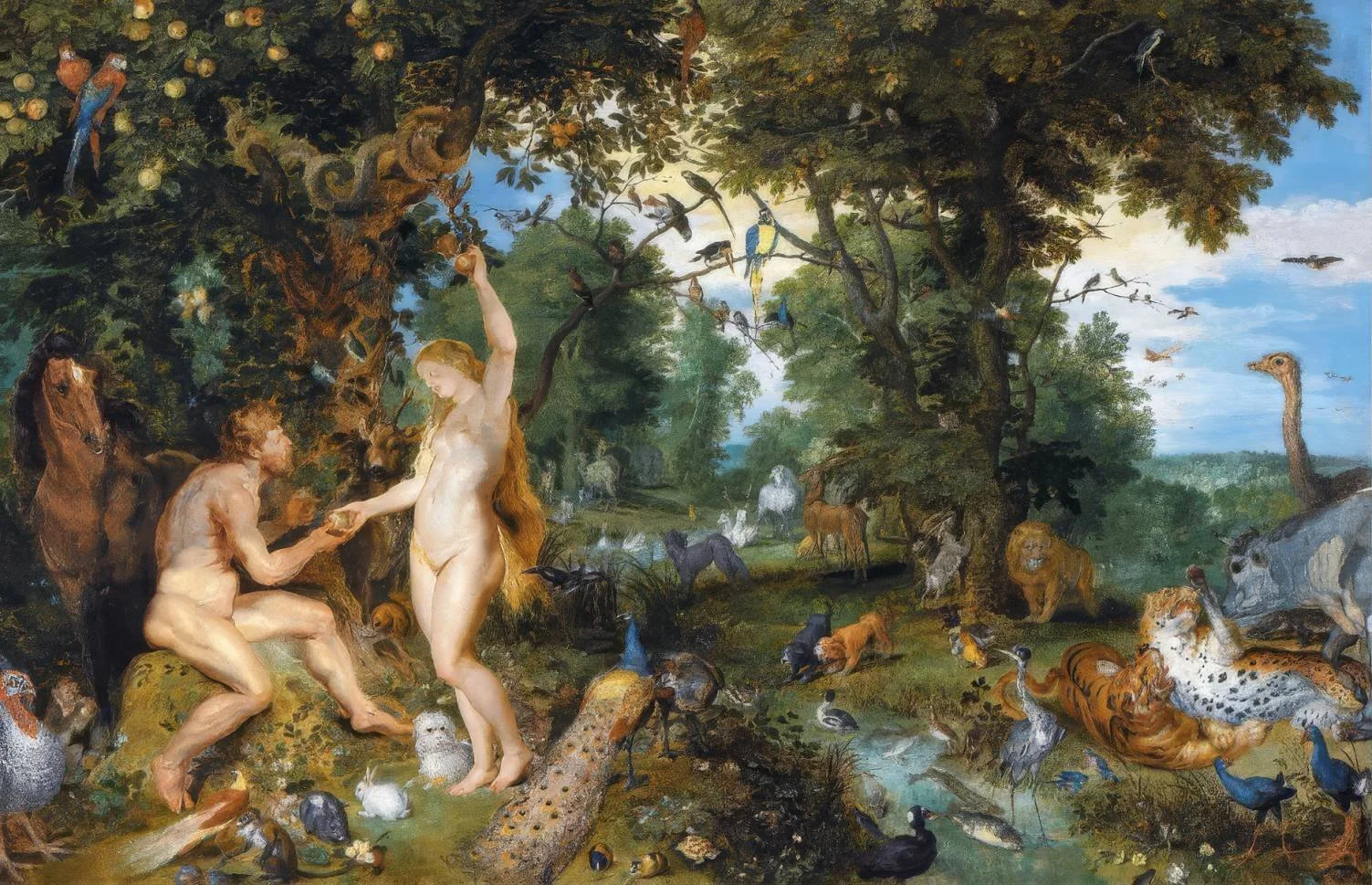
Earthly creatures together in the Garden of Eden, with the first humans choosing to disobey God by eating the forbidden fruit. (“The Fall of Man,” Peter Paul Rubens and Jan Brueghel the Elder, Belgium, c. 1615, Wikimedia Commons)
Deuteronomy 28:15
But if you will not obey the LORD your God… all these curses shall come upon you.
Most fundamentally, Genesis 3 reminds humankind of the importance of obedience and the ill effects of disobedience. Regarding human-anymal relations, Genesis 3 also reminds humankind that snakes are intelligent and thinking individuals, they are our neighbors, and enmity between human beings and snakes is contrary to the Creator’s original intent. Enmity between human beings and snakes is not what God prefers: God established a world of perfect peace, a world of interspecies kinship, where snakes and anymals shared company as amiable neighbors in the Garden of Eden. This, then, is the ideal world created by God, which Christians are called to help restore.
God’s punishment does not require enmity between snakes and humankind any more than men are required to toil amid thorns. But it is our Christian duty to avoid harming anymals and to be kind to anymals. We are to make choices that reduce anymal suffering. We can begin by relocating snakes as needed, instead of killing them, or let these graceful, intelligent creatures of God go their way. Genesis 3 provides key pointers on rightful relations with snakes, and on rightful relations with all of creation.
Micah 6:8
He has told you, O mortal, what is good,
and what does the LORD require of you
but to do justice and to love kindness
and to walk humbly with your God?
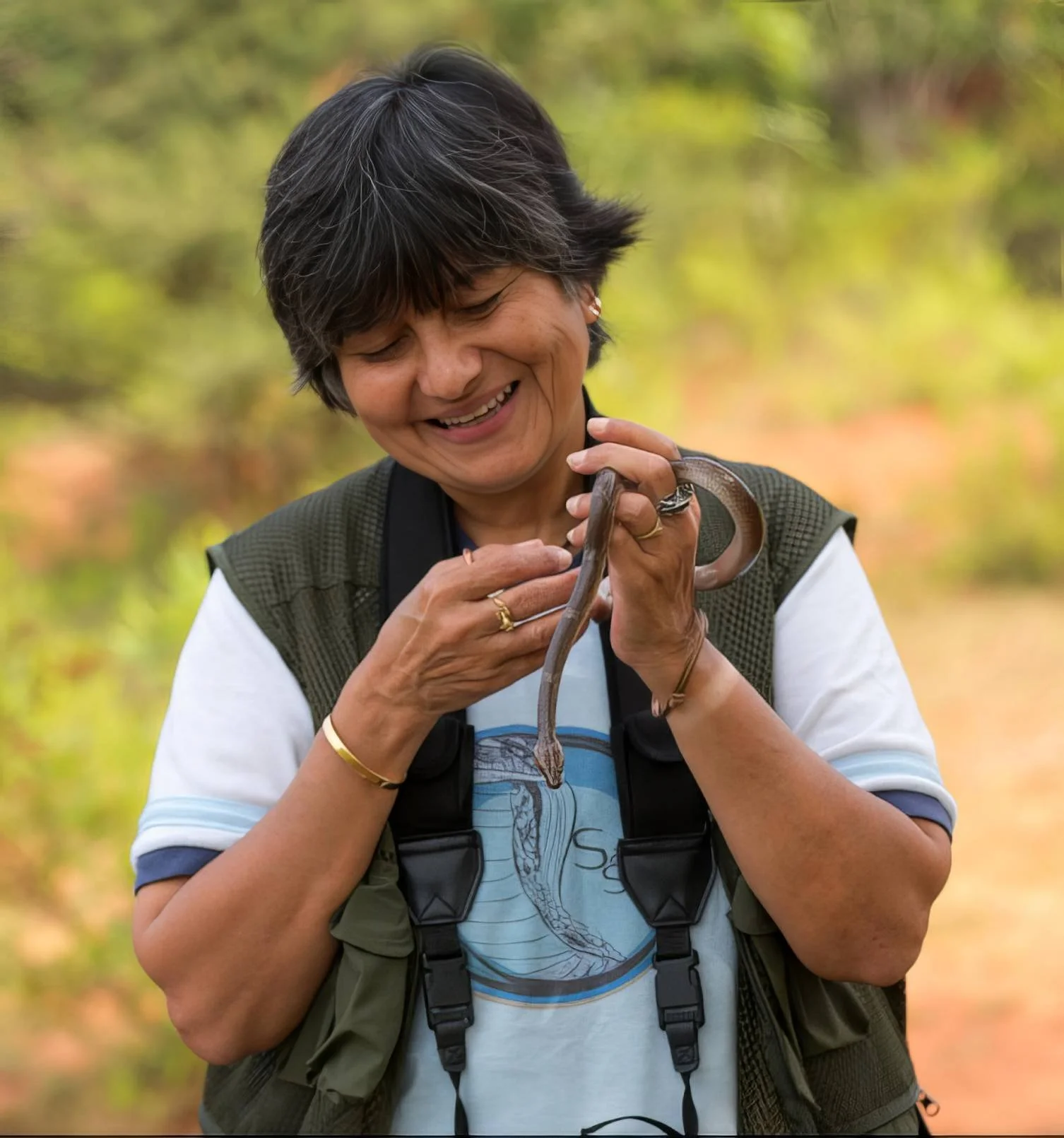
A snake expert pauses to enjoy the majesty of a wolf snake. (Save the Snakes)
Summary:
Animals as Moral & Spiritual Beings
Job 12:7–8
Ask the animals, and they will teach you,
the birds of the air, and they will tell you;
ask the plants of the earth, and they will teach you,
and the fish of the sea will declare to you….
The donkey in Numbers 22 is sensitive and intelligent; God speaks through the laboring donkey to admonish a man who mistreats her. Hagiographies recall anymals who show volition, initiative, sensitivity, and intelligence, and remind readers that exemplary Christians lived in community with anymals just as they would live among humankind. Genesis 3 presents a snake as intelligent, cordial, and neighborly, reminding that God intends all living creatures to live peaceably with one another.
Anymal narratives in sacred texts remind humankind what we already know but often choose to overlook: Anymals are marvelous creatures of God, and as humble servants of God (and as fellow creatures of God), we owe them compassion, kindness, and mercy. Through the Creator, we owe anymals our respect.

St Anthony with anymals, including a pig he cured who became his constant companion. (Allcreatures.org.)

Saint Anthony of the Great of Egypt (“The Father of Monks”) with the pig whom he healed, and who became his constant companion. (“Saint Anthony the Great,” Louis-Victor Gesta, France, 19th century, Wikimedia Commons)