Sacred Texts:
Core Teachings
& Animals
Animals & Religion is designed for those who believe that sacred writings have moral authority and are the best way to understand how we ought to live. This website is for those who, with fresh eyes, would like to explore core sacred texts to better understand rightful relations between humankind and anymals.
Christianity is a path of grace, a journey that offers new opportunities and new insights with the passing of each day. Visitors to the Animals & Religion Website are invited to engage with the material thoughtfully and prayerfully, to return to Scripture, to recall how certain sacred texts have been read, taught, and lived in your religious community, and to ponder how these ancient, holy writings might speak anew in contemporary times.
Hebrews 4:12
Indeed, the word of God is living and active.
This section explores core Scriptures, focusing on the Gospels and Genesis, to prepare a moral foundation for human-anymal relations amid industrialized anymal exploitation and ecological crisis.
NEW TESTAMENT
-
Salvation for All
God made Flesh
Humble Servant of the Oppressed
Healing a Syrophoenician
Present with All Suffering
Stirred to Righteous Indignation
-
Love
Humility
Mercy
Service
Peace
Generosity/Sharing
HEBREW BIBLE
-
Kinship: Sixth Day
Kinship: Nephesh Chayyah
In the Image of God
Vegan Dominion
Duties Assigned by God
Shared Purpose: One Community
Creation as Good/Holy
Restoring the Peaceable Kingdom
-
Nature/Habitat is Good/Holy
Sole Proprietor
Fully Invested—Compassionate and Attentive
In Covenant with Anymals/Earth
New Testament
Colossians 3:12
Clothe yourselves with compassion, kindness, humility, meekness, and patience.
The Gospels, central to the New Testament, record the life and teachings of Jesus. Christians are to model their lives on the life of Jesus, whose teachings provide core Christian ethics.
Jesus
John 1:14
And the Word became flesh and lived among us.
Jesus, humble servant who suffered with all who suffered, was God made flesh, born to bring salvation for all. Jesus, the perfect moral exemplar, defied cultural norms and customary boundaries and was moved to righteous indignation in the face of corruption.
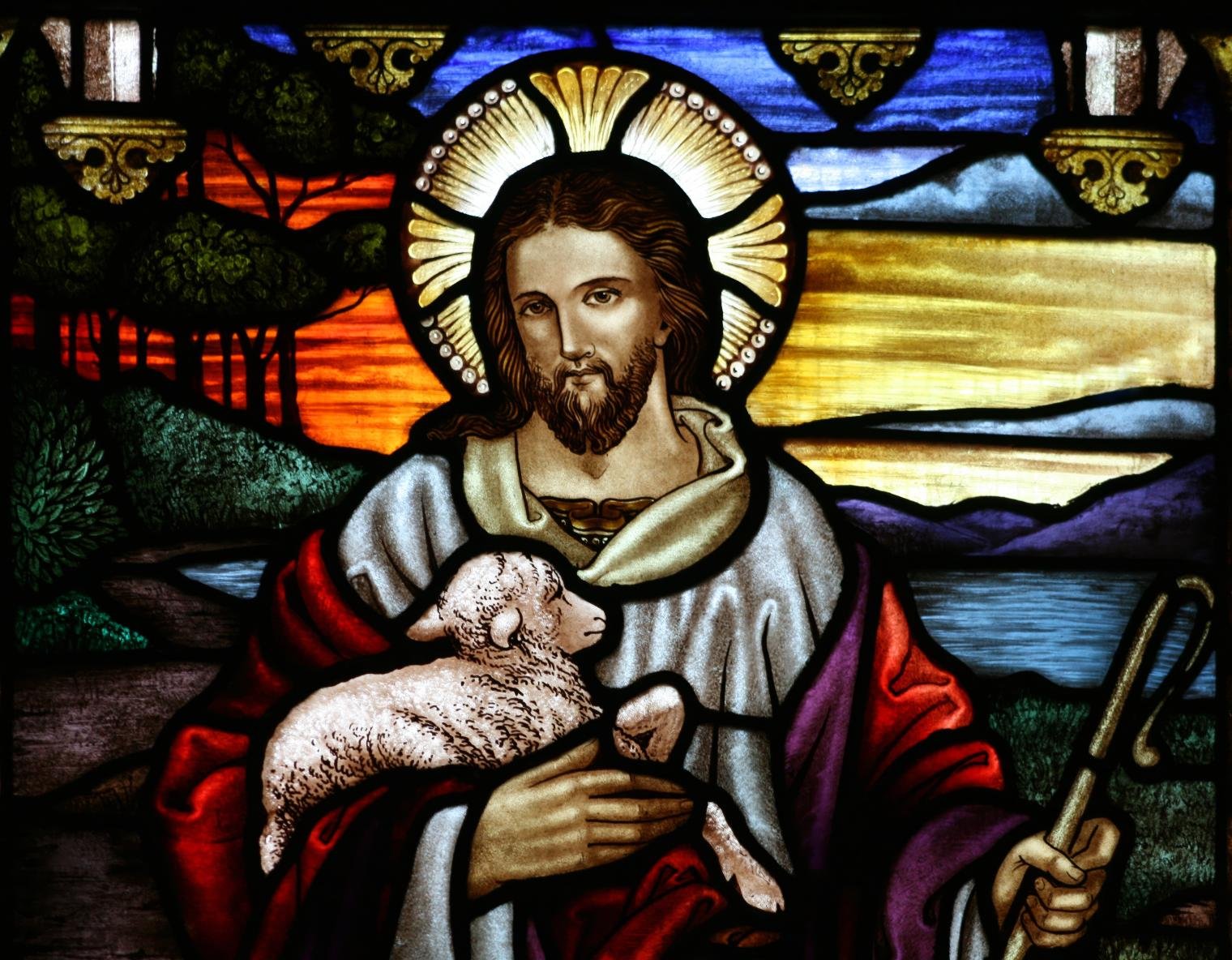
Jesus tended to the needs of those thought unworthy of his efforts and stood up against contemporary injustice and greed. (Stained glass of Jesus, Australia, Wikimedia Commons)
Salvation for All
Romans 8:21
Creation itself will be set free from its enslavement to decay and will obtain the freedom of the glory of the children of God.
Many Christians have been taught, or simply assume, that Jesus died only for humankind, but others have asked the question, “How could a just and compassionate God permit sentient anymals to suffer without redemption while saving only one creature among many?” Indeed, the New Testament teaches Christians that all of creation has eternal significance. Jesus died so that all might be redeemed; all that has been created will be reconciled, which of course includes anymals.
Colossians 1:19–20
For in him all the fullness of God was pleased to dwell, and through him God was pleased to reconcile to himself all things, whether on earth or in heaven, by making peace through the blood of his cross.
If this were but the one life that has been granted to anymals, and they could find no salvation after the sufferings of this life, would it not be yet more important for Christians to do whatever they could to make the lives of anymals as long and pleasant as possible?
Ephesians 1:8-10
With all wisdom and insight he has made known to us the mystery of his will, according to his good pleasure that he set forth in Christ, as a plan for the fullness of time, to gather up all things in him, things in heaven and things on earth.
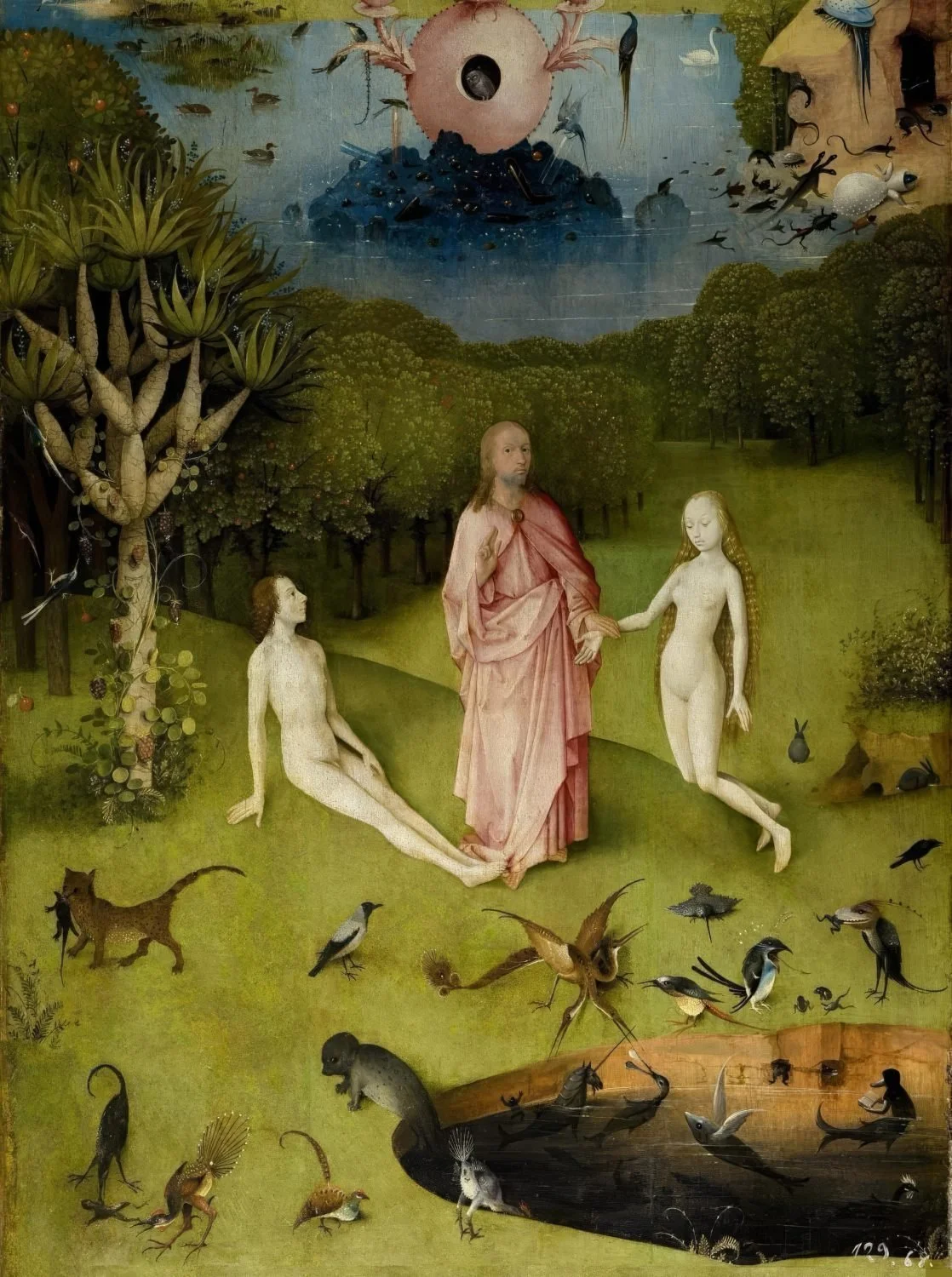
All of us live in a fallen world filled with suffering and bloodshed; Jesus died for all of creation. (“Garden of Earthly Delights,” Hieronymous Bosch, Netherlands, 1500 AD, Wikipedia Commons)
God Made Flesh
John 1:14
The Word became flesh and lived among us.
Jesus was born as a living being, embodied, in the flesh; Jesus suffered and died, though he rose from the dead. Christians often focus on the importance of “God made man” while failing to notice that he was just as much “God made living creature.”
Luke 2:12
…a child wrapped in bands of cloth and lying in a manger.
Though born a male in Judea, his birth, suffering, death, and resurrection are relevant for all men and all women, and inasmuch as his sex and race do not limit the scope of salvation, nor does his specific species limit those for whom he lived and died. Dominican theologian Meister Eckhart (1210–1328) writes, “God is equally near in all creatures.” No matter what the particulars of the birth of Christ, baby Jesus was born in the flesh so that all living, suffering, dying creatures might find salvation.
Colossians 1:16–17
In him all things in heaven and on earth were created, things visible and invisible… all things have been created through him and for him. He himself is before all things, and in him all things hold together.

Jesus was born a man of Jude, but he lived and died for all of creation.
(“Jesus bearing the Cross in Santi” Giovanni e Paolo, Alvise Vivarini, Italy, c.1474, Wikimedia Commons)
Humble Servant of the Oppressed
Mark 9:35
Whoever wants to be first must be last of all and servant of all.
Jesus, the perfect Christian moral exemplar, shows humankind how to live. Though powerful beyond human comprehension, the Gospels portray Jesus as a force of humble servitude, attentive to the needs of those most marginalized and oppressed. Jesus saw to the needs of lepers, who were considered unclean and, as such, were social outcasts, outside society and beneath human civilization. Jesus shows Christians that, whatever one’s culture may teach, those who are most in need are those rightly served with attentive care.
Luke 4:18
The Spirit of the Lord is upon me,
because he has anointed me
to bring good news to the poor.
He has sent me to proclaim release to the captives
and recovery of sight to the blind,
to set free those who are oppressed….
Few are as desperately in need of Christian care as anymals, who suffer on factory farms and in science labs, in breeding facilities and on transport trucks. Christians are to follow the example of Jesus by caring for those who are ostracized, enslaved, and disregarded, whether the oppressed are cows headed for slaughter, dogs in medical laboratories, or foxes chased to their deaths by hunters.
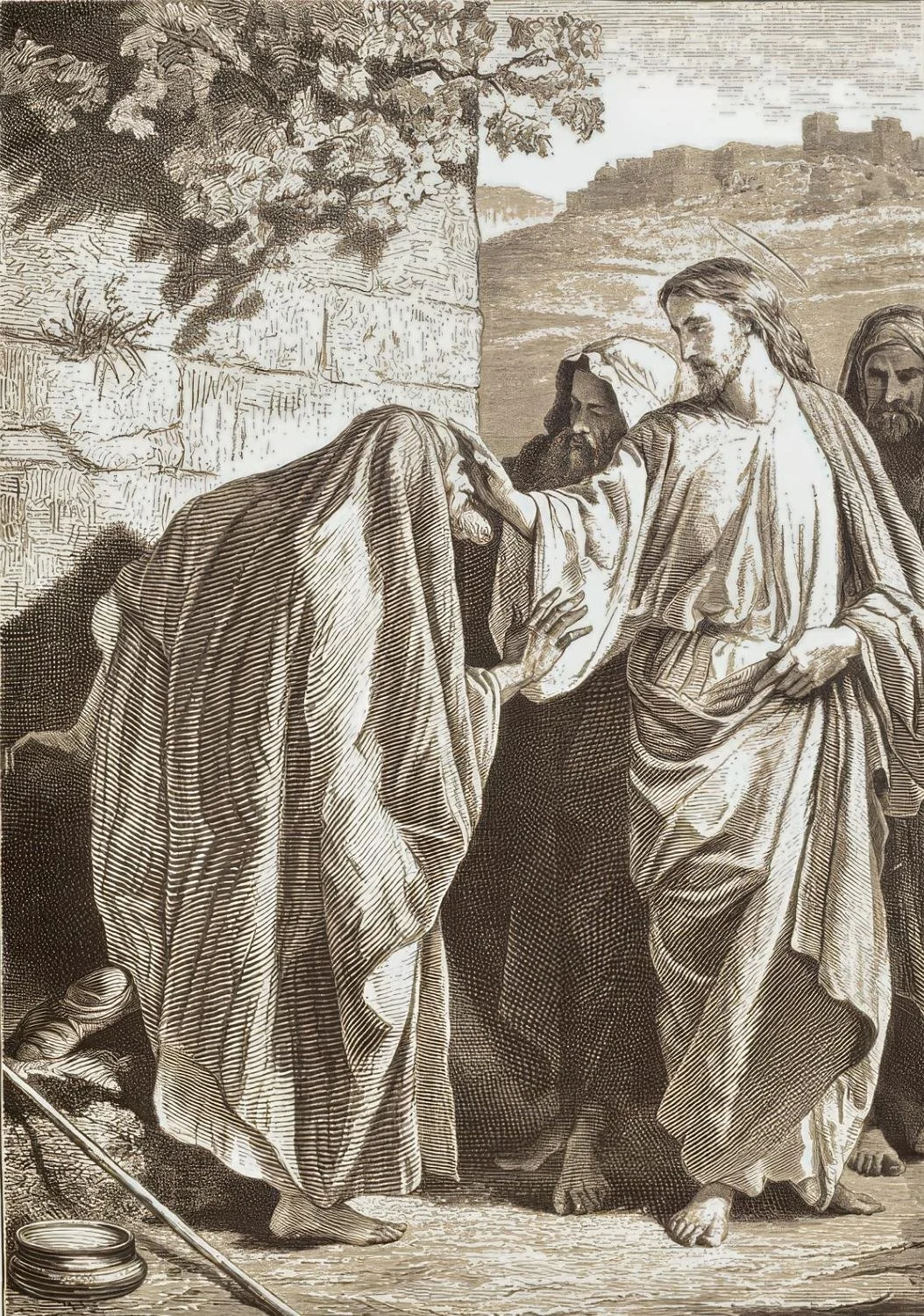
The life of Jesus calls Christians to tend to the needs of those whom others consider unworthy.
(“Jesus Heals the Leper,” Alexandre Bida, France, 19th century, Wikimedia Commons)
Healing a Syrophoenician
Mark 7:25-30
A woman whose little daughter had an unclean spirit immediately heard about him, and she came and bowed down at his feet. Now the woman was a gentile, of Syrophoenician origin. She begged him to cast the demon out of her daughter. He said to her, “Let the children be fed first, for it is not fair to take the children’s food and throw it to the dogs.” But she answered him, “Sir, even the dogs under the table eat the children’s crumbs.” Then he said to her, “For saying that, you may go—the demon has left your daughter.” And when she went home, she found the child lying on the bed and the demon gone.
Some Christians argue that anymals are not the sorts of creatures that we are called to save, and with so much need in the world, why should we put our time, finances, or energy into anymals? One might respond to this in a handful of ways: because their suffering is so great, because they are so powerless, because they are harmed and killed in numbers that are simply inconceivable, because anymals are truly “the least of these” (Matthew 25:40), and because we are collectively responsible for the sufferings brought to anymals by humankind. One might also say, because Jesus healed the Syrophoenician woman’s child.
Being Syrophoenician, this particular woman was from a different community, and held a different faith. She was not devoted to Jesus, or his teachings, or the Christian God, and she was not interested in converting. Nonetheless, she asked Jesus to heal her daughter. Jesus at first refused, noting that the Children of God should be served with the bread of life, that the bread of life should not be wasted on a pagan. Carrying forward Jesus’ food metaphor, she reminded Jesus that even the most lowly ultimately get a few scraps when food is placed on the table. Jesus is moved by her faith in his healing powers and he heals her child.
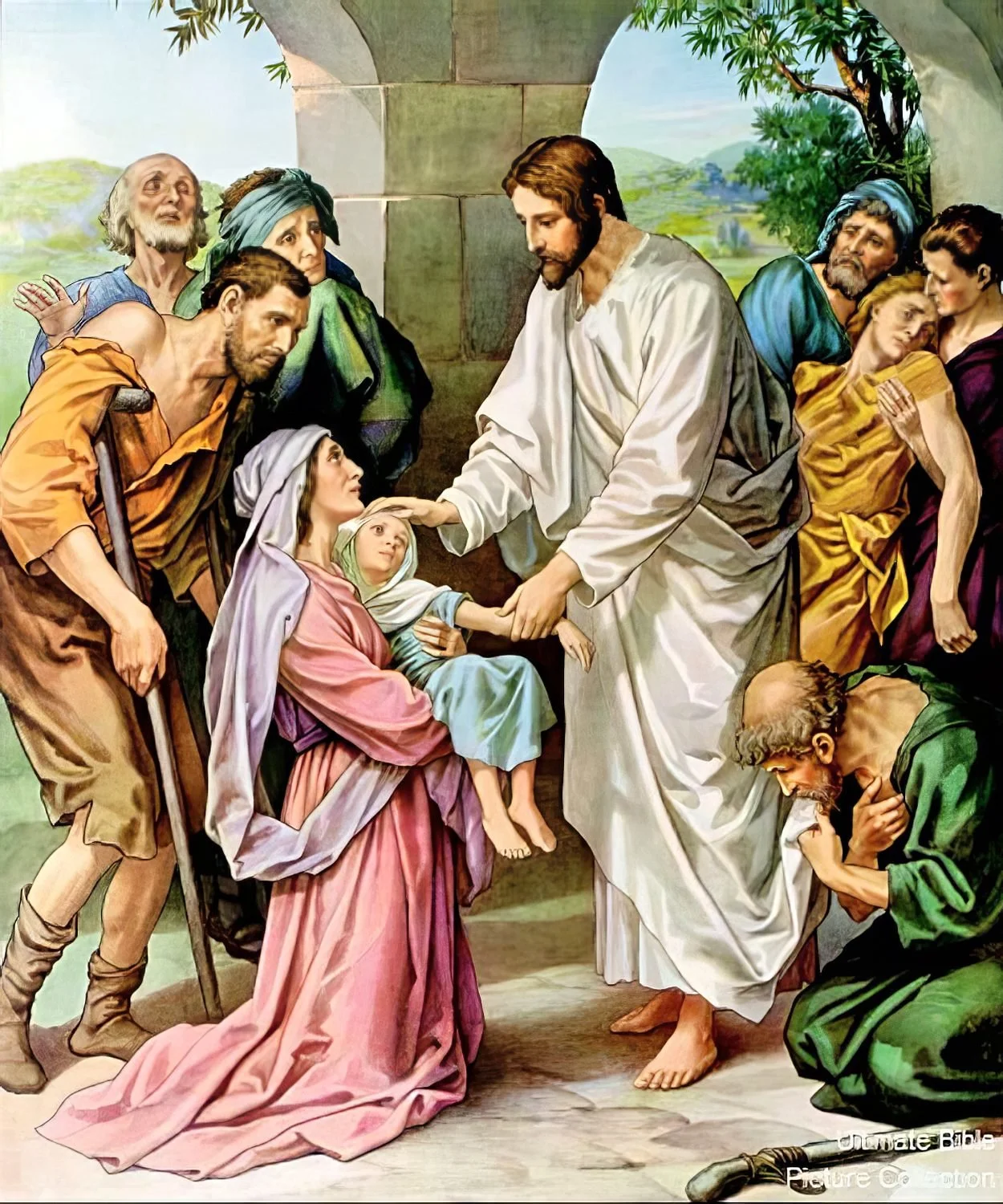
Jesus heals a Syrophoenician child, someone that his community viewed as outside of his moral circle.
(womeninthebible.net)
In this story, as so often in his life, Jesus rises above the cultural context in which he lived, a context in which cultural boundaries separated lepers, servants and the enslaved, the poor, women, dogs, and those from culturally distinct communities. Jesus touches impure lepers (Mark 1:40–45, Matthew 8:1–4, Luke 5:12–16), the blind (Matthew 9:27–31, Mark 8:22–26, John 9:1–7, Mark 10:46–52), and corpses (Luke 7:11–17); he heals on the Sabbath (Mark 3:1–6, par. Matt 12:9–14; Luke 6:6–11). Jesus shows that compassion is more important than keeping cultural boundaries in place, restoring not only health and life, but their dignity as God’s creations.
Mark 7:8
You abandon the commandment of God and hold to human tradition.
Contemporary cultural norms place anymals outside of our moral circle. They are considered too lowly to be worthy of our attentive care. But the example set by Jesus in the story of the Syrophoenician woman reminds us that we are called to rise above the restrictive norms of our culture, expand our heartstrings, and help all who are in need. Jesus showed us that doing what is right in the sight of God means tending to those in need, no matter who “those” might be.
Acts 5:29
We must obey God rather than any human authority.
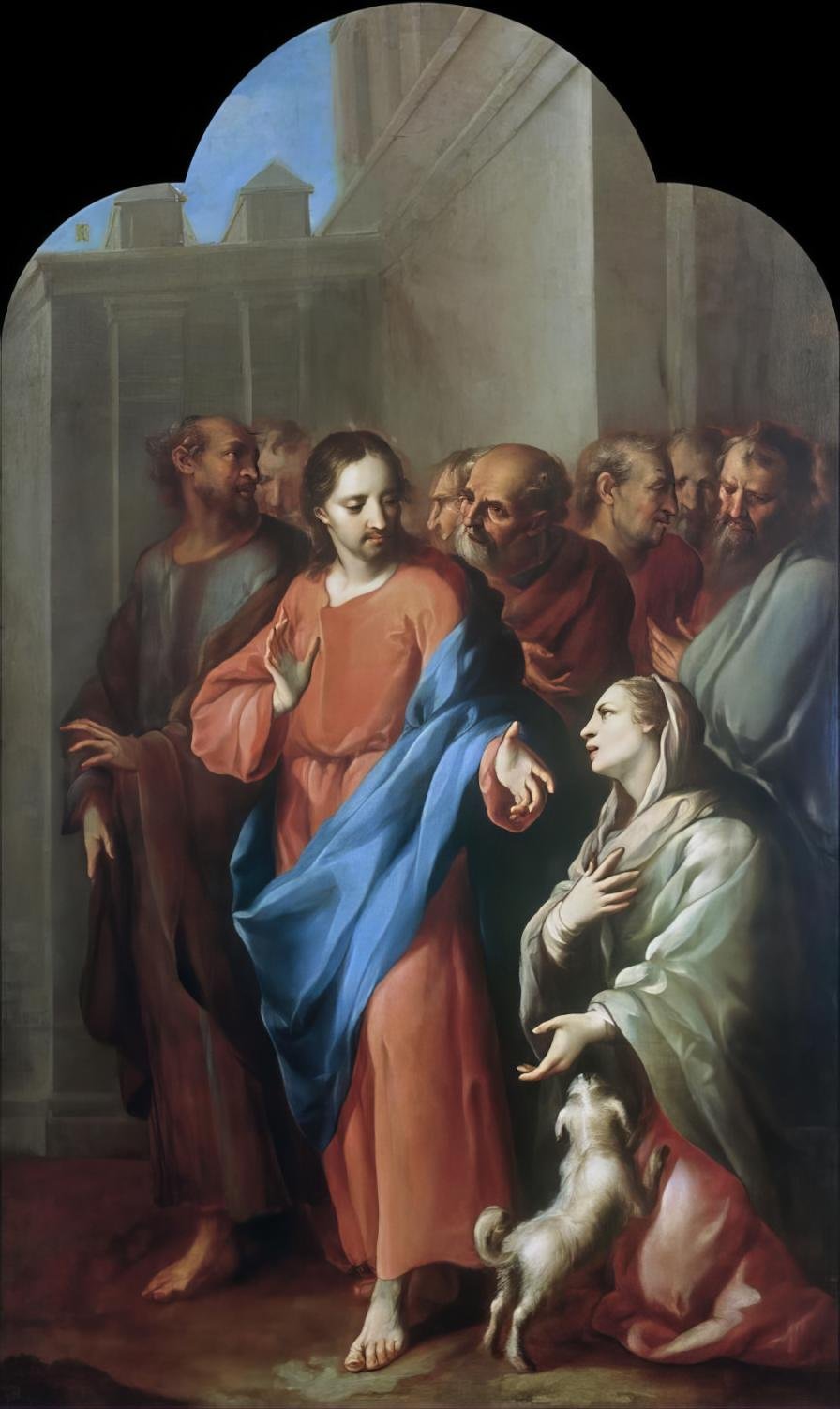
Jesus saw to the needs of those whom his culture considered outcasts or too lowly for consideration—those thought to be unworthy of the time and care that Jesus provided.
(“Jesús con la Mujer Enferma” /“Jesus with the Sick Woman,” Juan Rodríguez Juárez, Mexico, c. 1700, Wikimedia Commons)
Present with All Suffering
2 Corinthians 1:7
We know that as you share in our sufferings, so also you share in our consolation.
Suffering is central to the life of Jesus, culminating in his betrayal and death on the cross. The New Testament teaches that Jesus is present in all suffering (2 Corinthians 1:7). If we create or allow suffering, whether in a feedlot, puppy mill, laboratory, breeding facility, or in our backyard, we bring Jesus into that suffering. Do we want to increase the suffering of our savior, or help to reduce that suffering by making different choices at the supermarket and, for example, speaking out against anymal testing facilities and dog breeders?

Jesus suffers for and with creation.
(“Ecce Homo” or “Behold the Man,” Italy, c. 1500, artist unknown, Wikimedia Commons)
Stirred to Righteous Indignation
John 2: 14-15
In the temple he found people selling cattle, sheep, and doves and the money changers seated at their tables. Making a whip of cords, he drove all of them out of the temple, with the sheep and the cattle. He also poured out the coins of the money changers and overturned their tables.
Jesus, the perfect moral exemplar for Christians, shows us what to do in this world, in the here and now. Born to bring a new era, Jesus was an activist on behalf of the marginalized and downtrodden, on behalf of “the least of these” (Matthew 25:40). He aggressively disrupted those who defiled God’s temple, those profiteering from anymal enterprises on temple grounds. Jesus was unwilling to comply and unwilling to look away from injustice and corruption. With righteous indignation, he challenged and disrupted the comfort of normalcy that tends to settle over wrongdoing in every community, and Christians are to model their lives on the life of Jesus. (For more on the righteous anger of Jesus, see Activism, Jesus as Liberationist.)
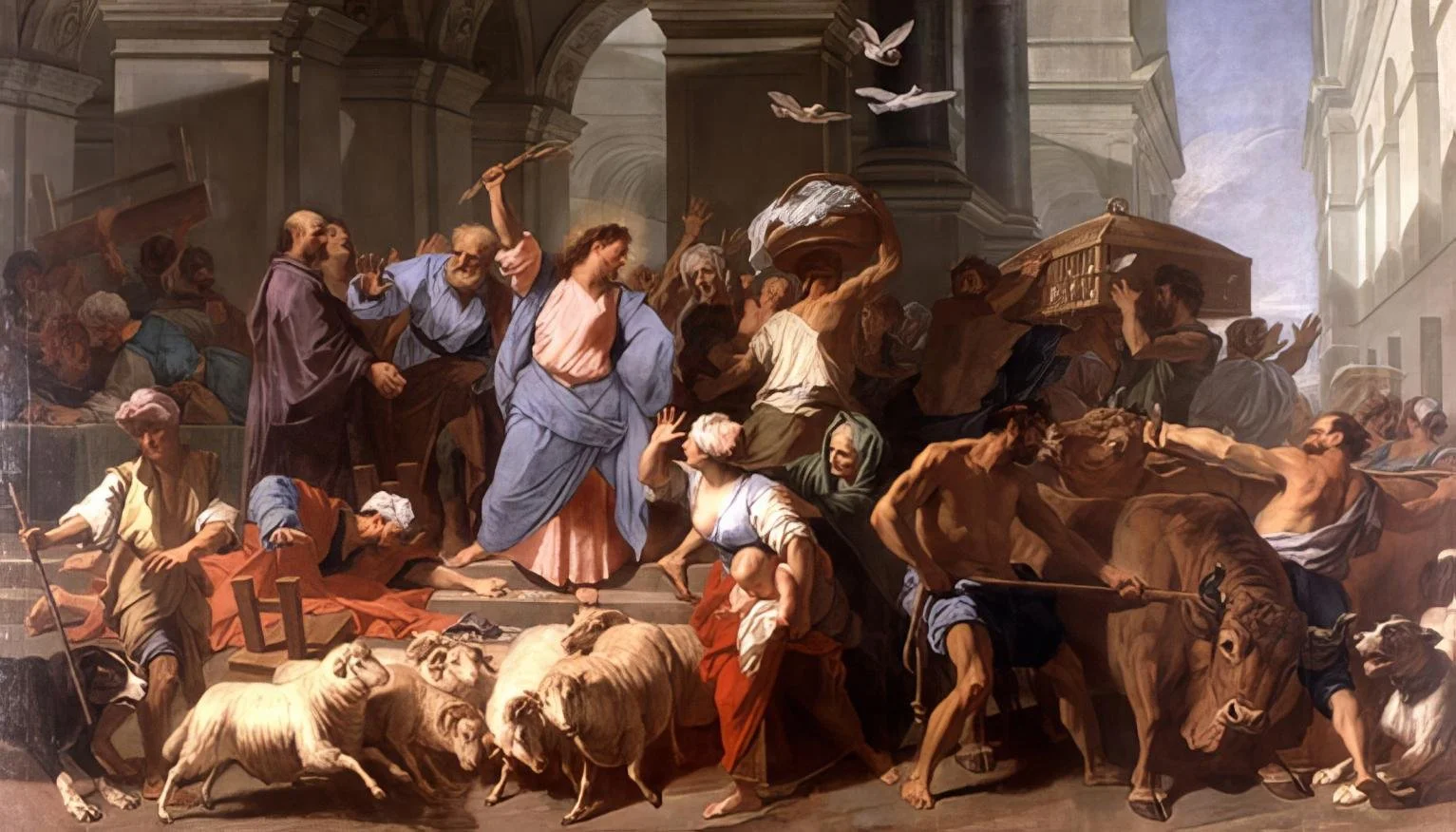
Jesus drove profiteers and their exploited anymals out of the temple.
(“Les Marchands Chassés du Temple,” Jean Jouvenet, France, 1706, Wikimedia Commons)
Core Christian Ethics
Galatians 5:22–23
The fruit of the Spirit is love, joy, peace, patience, kindness, generosity, faithfulness, gentleness, and self-control.
The Gospels teach ethics through the words and life of Jesus. His example and his words are affirmed elsewhere in the New Testament.
Love
1 John 4:8 and 1 John 4:16
God is love.
Love defines God: “God is love.” Love was central to the life and ministry of Jesus, whose love was all-inclusive, generous, and risky. Christ-like love originates in the munificence of God’s love, is expressed in the world, and connects us back to the divine. Jesus boldly expanded the moral circle outward to include Samaritans, prostitutes, tax collectors, lepers, and servants. Following his example, Paul extended the circle of love to gentiles.
Love is limitless and cannot be depleted. Christianity asks the faithful to love those whom others find unworthy, those rejected by mainstream culture. Some Christians argue that love is wasted on anymals, but Christians are expected to consciously expand their capacity for and expressions of love. All-inclusive, generous, risky love rightly extends to all of God’s creation, all of God’s creatures. Justice extends Christian love outward toward every creature of God and rightly leads us to help those who suffer alongside the road, or those who will be spared if we choose vegan foods (no flesh, dairy, or eggs). Whatever righteous actions are done for “the least of these” are done for Jesus (Matthew 25:40).
Catechism of the Catholic Church 2418
It is contrary to human dignity to cause animals to suffer or die needlessly.
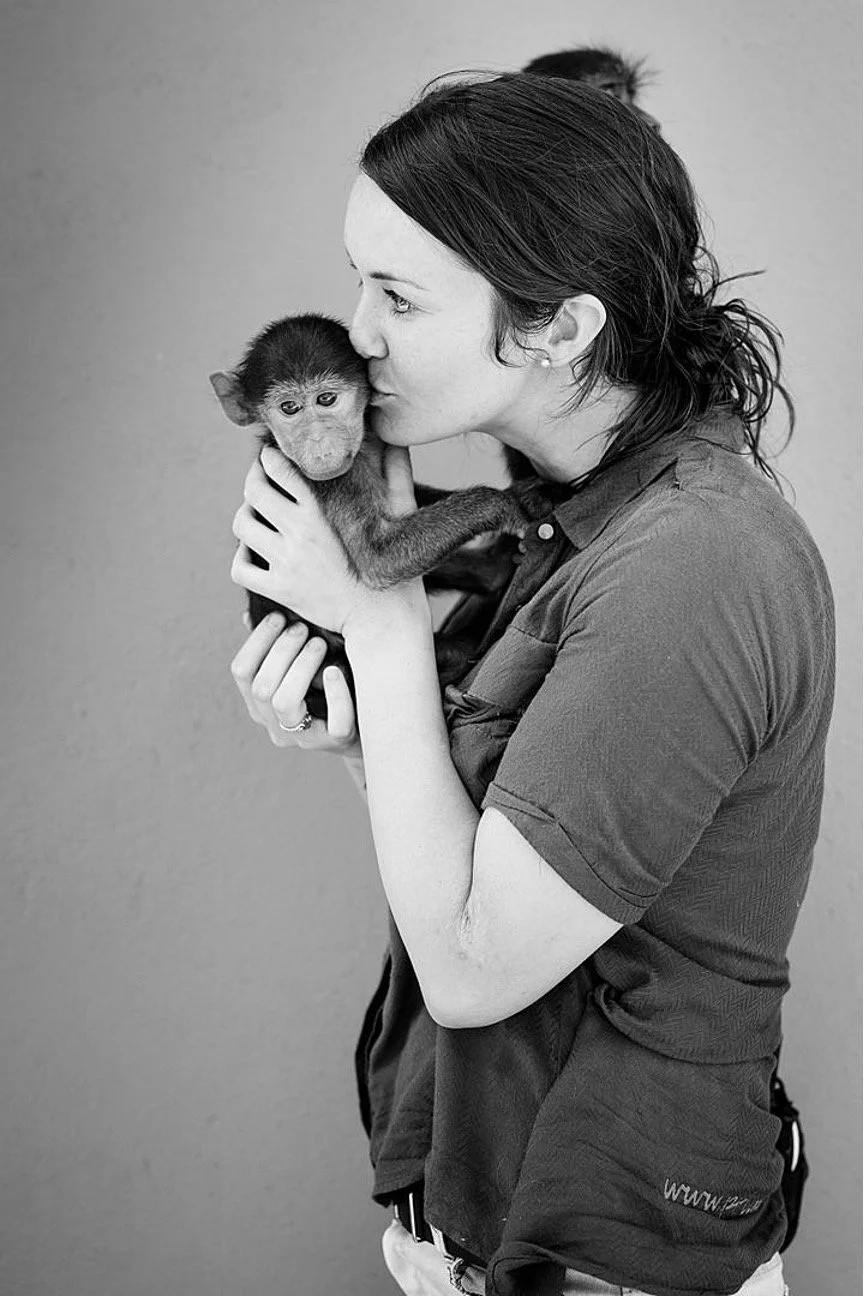
At a sanctuary in South Africa, a caretaker tenderly provides love-needs for an orphaned baboon, whose mother was shot or trapped as “vermin.” (We Animals Media)
Humility
James 4:6
God opposes the proud,
but gives grace to the humble.
Humility brings the understanding that anymals are not ours, but God’s, an understanding that forbids harming and destroying anymals for profit or pleasure, to satisfy our taste in food or fashion, or because we believe anymal experimentation benefits humankind, though there are far better methods, methods that comply with core Christian texts because they do not harm and destroy innocent lives. Profit can never be a legitimate measure of the value of God’s creatures, who must never be counted by the pound. Humility leads humankind to respect what is God’s, and when we humble ourselves to welcome, tend, and receive innocents, we welcome, tend, and receive Jesus (Matthew 18: 3–5).
Matthew 18: 4-5
Whoever becomes humble like this child is the greatest in the kingdom of heaven. Whoever welcomes one such child in my name welcomes me.
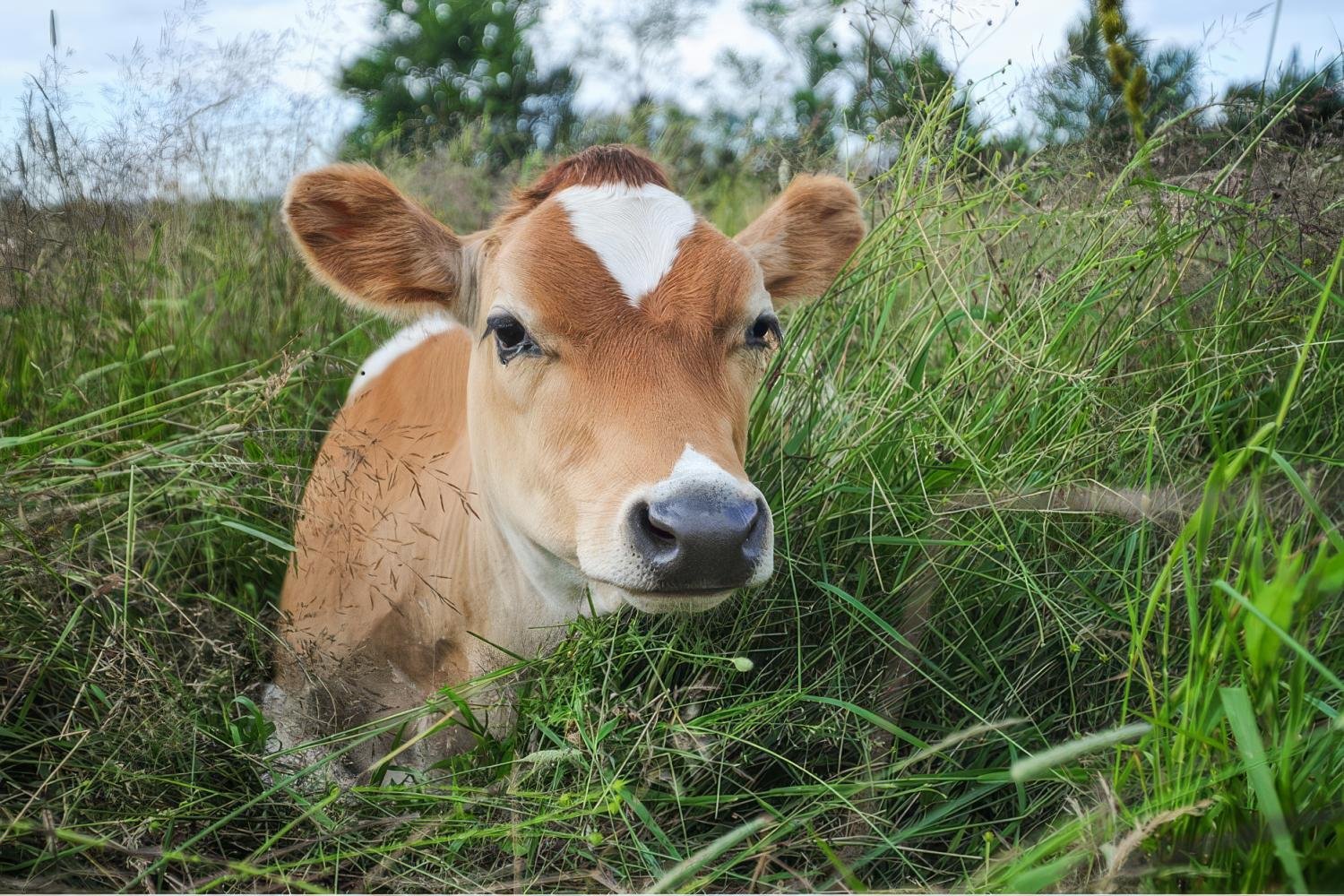
Through humility we are able to recognize other living creatures as God’s, not ours. This calf, rescued from the United States dairy and flesh industries, is now sheltered in a sanctuary. (We Animals Media)
Mercy
Matthew 5:7
Blessed are the merciful, for they will receive mercy.
Humankind has complete power over trillions of anymals. We control their pregnancies, births, whether or not they stay with their mothers, whether or not we physically alter their bodies with sharp blades or hot irons, where they are confined, whether or not they find any comforts in life, and how long they live. These trillions of anymals depend on our mercy just as we depend on God’s mercy. While we may not witness the deprived lives and mass deaths of farmed anymals or homeless cats and dogs, we control their lives and deaths with our purchasing power, with what we choose to eat and whether or not we choose to adopt when seeking a companion. When we pay for leather, wool, flesh, dairy, or eggs, we pay for suffering and premature death. When we buy a dog, hamster, cat, lizard, bird, or snake, we pay for homeless pets to remain homeless.
Righteous mercy pulls at our heartstrings, seeking the door to the Christian heart, hoping to find enough love to draw the faithful to rethink what they cause with their purchasing power, to rethink how we might best protect these vulnerable anymals in our daily lives—every hen trapped in a battery cage, every sow confined in a tiny farrowing crate, every anymal hoping for a home.
Luke 6:36
Be merciful just as your Father is merciful.
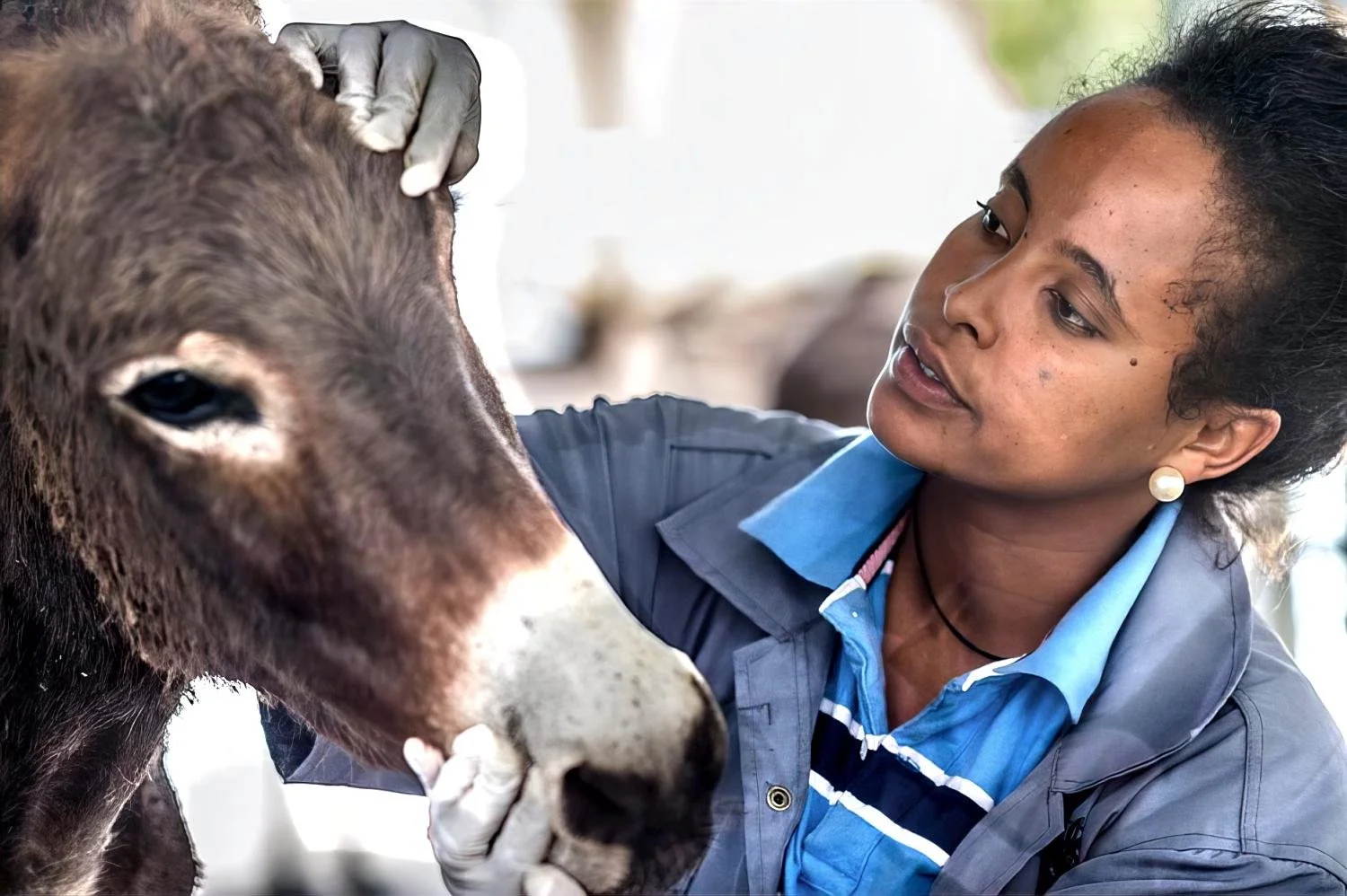
Anymals are dependent on us as we are dependent on God, and mercy calls Christians to see to their needs. In this photo a veterinarian tends a donkey at a free clinic in Ethiopia. (We Animals Media)
Service
Ephesians 6:8
Whatever good we do, we will receive the same again from the Lord.
Jesus washed the feet of his disciples, healed lepers, and walked among the bedraggled poor. Above all else, Jesus served the needs of those who were overlooked and sidelined, those that his culture conditioned him to see as lowly outcastes unworthy of the attention of those fortunate enough not to be among them (Mark 7:24). Jesus pushed the boundaries of moral consideration outward, tending and ministering to gentiles, sinners, tax collectors, slaves, women, even healing the child of a Syrophoenician woman. Jesus did not say come to me only if you are considered worthwhile by others, he said, “Come to me, all you who are weary and are carrying heavy burdens, and I will give you rest” (Matthew 11:28), and there are few humans as weary and overburdened as the anymals.
Romans 2:13
It is not the hearers of the law who are righteous in God’s sight but the doers of the law who will be justified.
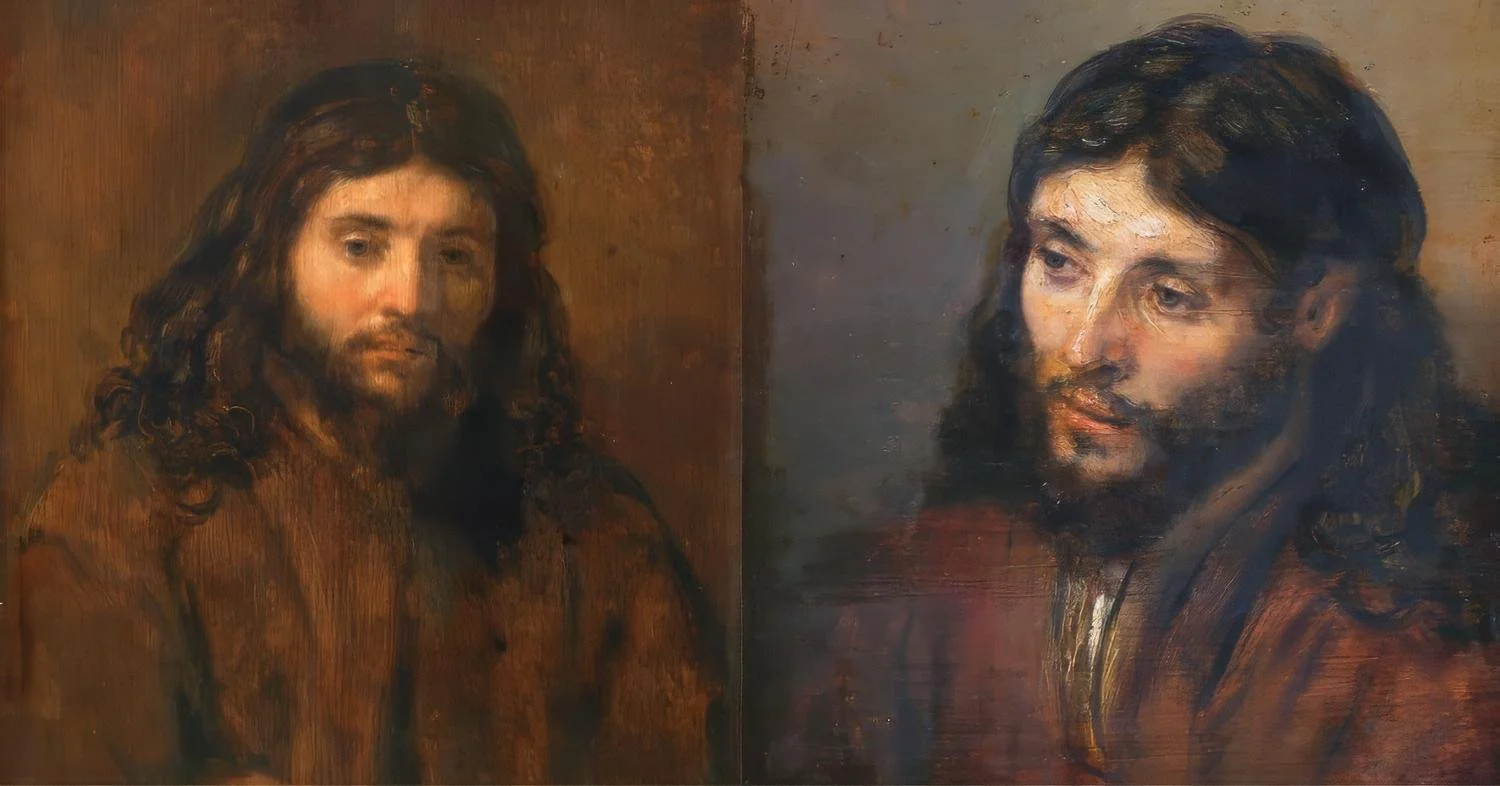
Unless stirred to righteous indignation, Jesus is portrayed as gentle and kind, as especially attentive to the needs of those his culture taught were unworthy of his time and energy.
(“Portraits of Christ,” Rembrandt van Rijn, Holland, 1648, Wikipedia.)
Christians are expected to follow the example set by Jesus. Christians are called to serve all who are weary and downtrodden, even those whom others believe to be unworthy of love, mercy, and tender care. In so doing, we serve God. We may be unlikely to see enslaved people or lepers in our communities, but the downtrodden are everywhere apparent. Anymals are often thought too lowly for even a modicum of compassion. Inasmuch as Christians fail to serve the needs of anymals, whether they be homeless, trapped in the tyranny of exploitation and profit, or neglected and abused in a neighbor’s yard, they fail to follow in the footsteps of Jesus: “Come to me, all you who are weary and are carrying heavy burdens, and I will give you rest” (Matthew 11:28, italics added).
Psalm 116:12
What shall I return to the LORD
for all his bounty to me?

Serving those most in need, a caretaker sees to the needs of a street dog in Thailand—a discounted and overlooked stray, downtrodden and marginalized by the larger community. (We Animals Media)
Peace
Matthew 5:9
Blessed are the peacemakers, for they will be called children of God.
Peace is a central theme for Christianity. Christians are called to help restore a deep and pervasive peace. As with love and mercy, peace is unlimited. The Christian quest for peace is not intended to be restricted to a certain few humans or a certain few species. The peace of Christ and the perfect peace of Christianity are intended for all of God’s creatures. (For more on the tendency to focus on the afterlife at the expense of serving God in this life, see Discord.)
Colossians 3:15
And let the peace of Christ rule in your hearts….
Christians work with God to restore peace on Earth when they speak up on behalf of anymals, step forward to help anymals in need, and change their own lives to protect anymals. By making vegan choices at the grocery store (avoiding flesh, dairy, and eggs), every Christian can help to restore peace “on earth as it is in heaven” (Matthew 6:10).
Luke 19:42
If you, even you, had only recognized on this day the things that make for peace!
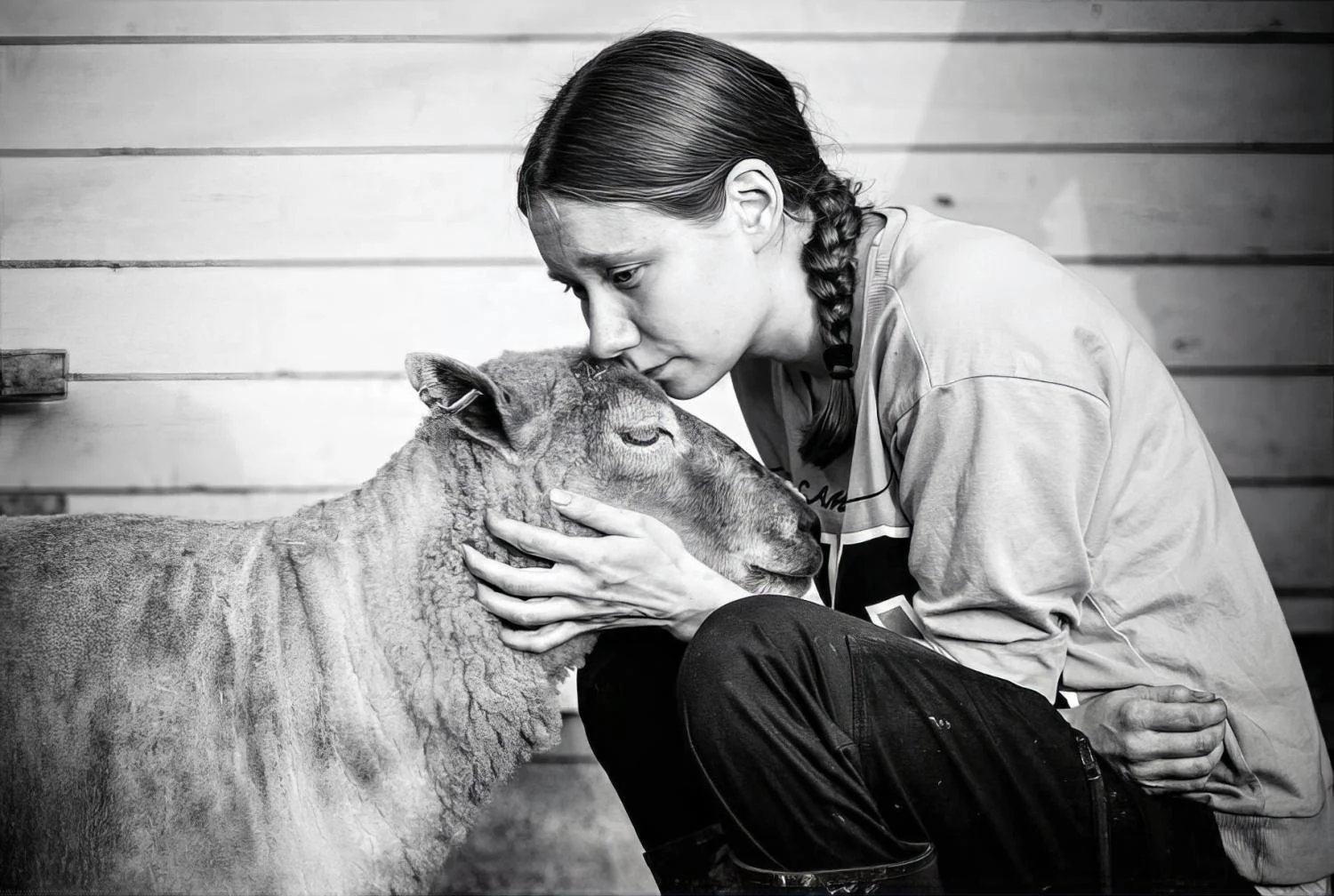
Sanctuaries are places of peace, one of the very few places where peace is felt across species. Look online for a vegan anymal sanctuary near where you live. (We Animals Media)
Generosity/Sharing
Luke 6:38
Give, and it will be given to you…. for the measure you give will be the measure you get back.
Christians are to share generously, and through sharing, travel the path to salvation. Generosity expresses Christian love, mercy, and peacemaking. To share is to understand that we are all God’s creatures, that we are all “one in Christ Jesus” (Galatians 3:28), and in giving to “the least of these” (Matthew 25:40), we give to Jesus and we turn our lives toward God.
Matthew 5:16
Let your light shine before others, so that they may see your good works and give glory to your Father in heaven.
People die of hunger, hunger-related health problems, and from a lack of clean drinking water every second of every day. Generosity and sharing are critically important, and choosing a vegan life is sharing. Farmed anymals are bred, kept, and slaughtered on behalf of consumers who buy meat, dairy, and eggs. Worldwide, countless numbers of farmed anymals consume extraordinary quantities of grain and water. If we choose to share non-vegan foods with those who are hungry, we exacerbate food shortages, and thereby work against our own ends. When we choose a vegan diet, we choose not to enhance the profits of those who force anymals to be bred and give birth—only to be slaughtered; this means that the grains and water otherwise fed to farmed anymals can satisfy human communities in need. When we share vegan foods, we succeed twice over. Generosity, sharing, and righteousness call Christians to choose a vegan life. (For more information and sources on ethics and food choice, see the book, Vegan Ethics: AMORE.)
1 Timothy 6:18
As for those who in the present age are rich…. They are to do good, to be rich in good works, generous, and ready to share, thus storing up for themselves the treasure of a good foundation for the future, so that they may take hold of the life that really is life.
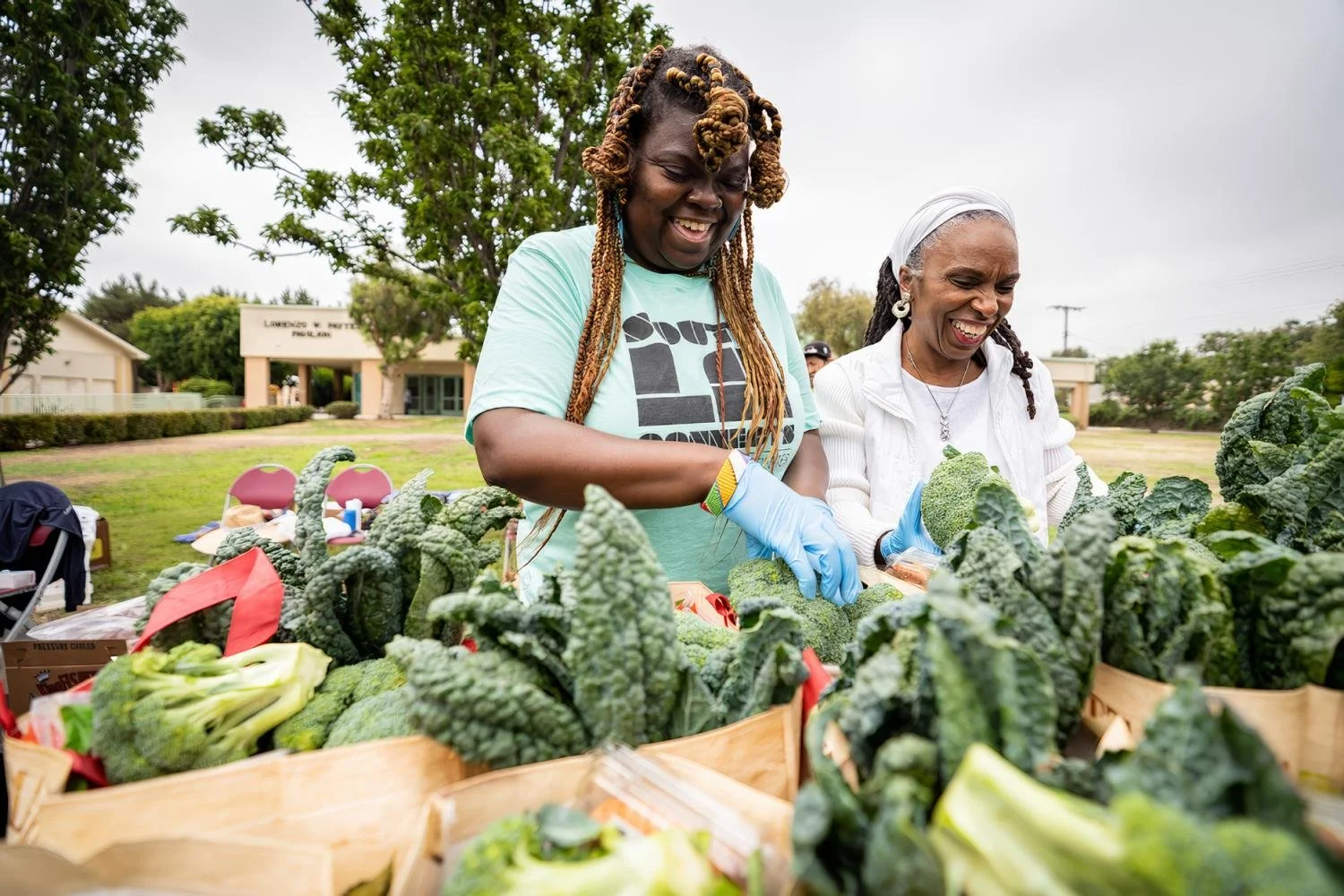
Sharing helps others to see how delicious vegan foods are while also making sure that whatever food we have reaches as many people as possible. Above, anymal activists package fresh vegetables for communities in need. (We Animals Media)
The Hebrew Bible
Genesis 9:13-15
I have set my bow in the clouds, and it shall be a sign of the covenant between me and the earth…. I will remember my covenant that is between me and you and every living creature.
The Hebrew Bible (Old Testament) reveals God’s intentions for creation and provides a window into the nature of God; both are important for the Christian understanding of our relationship with anymals.
Creation
Genesis 1:31
God saw everything that he had made, and indeed, it was very good.
Genesis 1 and 2 record the world as created by God, a perfect world before the sin of disobedience led to the Fall (Genesis 3). This perfect world is a world of kinship and community across species, a world of perfect and total peace. Genesis speaks of the unity of creation and the expectation of a return to the Peaceable Kingdom, as initially created by God.
Kinship: Sixth Day
Genesis 1:24-26
And God said, “Let the earth bring forth living creatures of every kind: cattle and creeping things and wild animals of the earth of every kind.” And it was so. God made the wild animals of the earth of every kind, and the cattle of every kind, and everything that creeps upon the ground of every kind. And God saw that it was good.
Then God said, “Let us make humans....
The Genesis creation narrative shows our place among living creatures: Land animals were created on the 6th day (including humans). Due to cultural bias and the tendency toward human exceptionalism, many people misread this narrative, coming away with the idea that only humankind is created on the 6th day, but Genesis is clear: Humankind was created on the 6th day; God created humankind as a land animal.
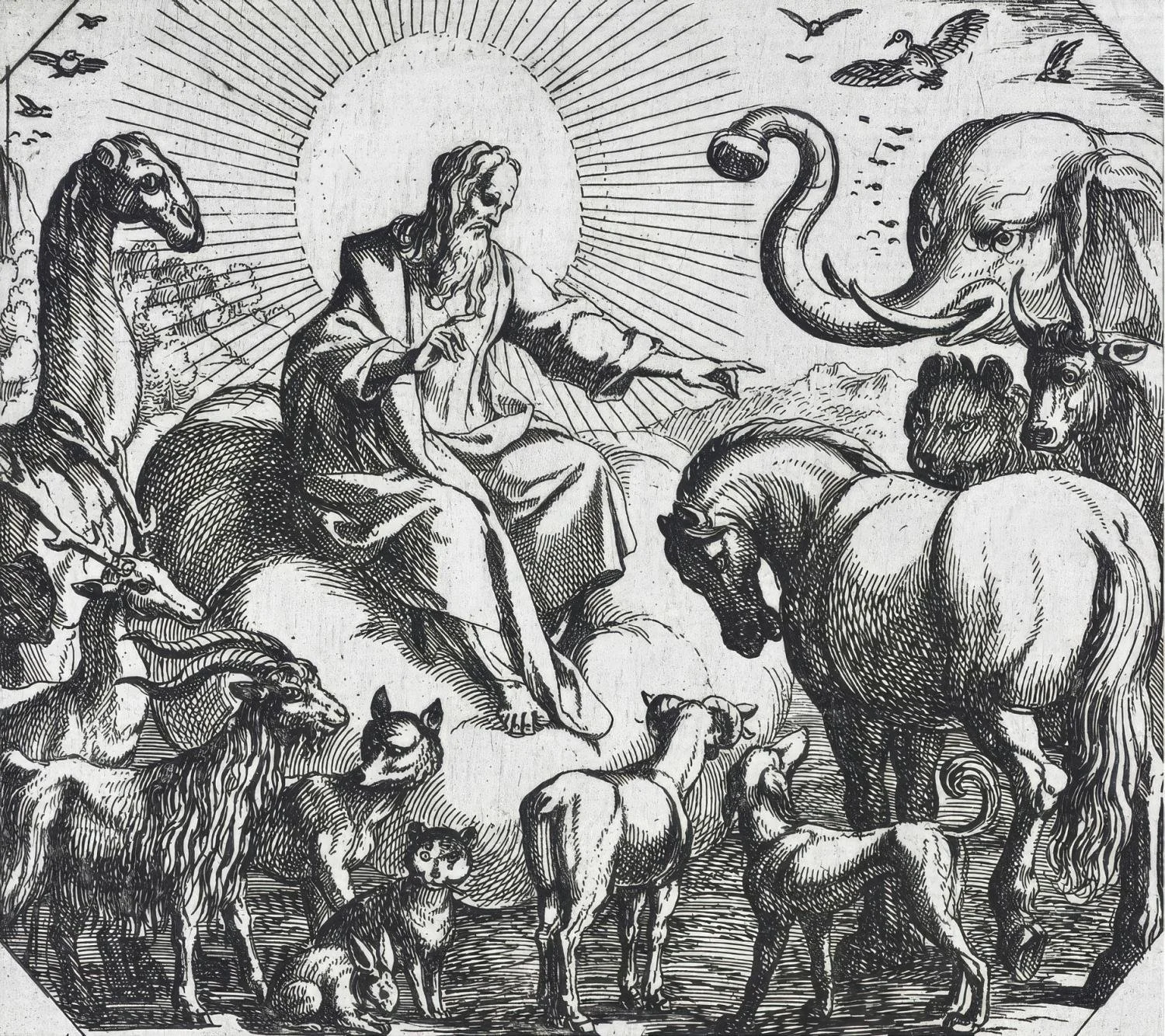
Humankind is created on the sixth day along with land anymals, though many misread this portion of Genesis, as this artist, who portrayed only anymals, likely did.
(“God Creating the Animals,” Antonio Tempesta, Italy, c. 1600, Wikimedia Commons)
Kinship: Nephesh Chayyah
Genesis 1:30
And to every beast of the earth, and to every bird of the air, and to everything that creeps on the earth, everything that has the breath of life.…
Every living creature is referred to in the same way in Genesis 1:30—in Hebrew, as “nephesh chayyah.” This is what distinguishes animals from plants, this is what animates sentient beings and creates conscious life. Sea creatures and birds are granted this special quality in Genesis 1:20–21; land anymals are granted this special quality in Genesis 1:24–25. In Genesis 1:27, human beings are created, and in Genesis 1:30, the term nephesh chayyah is used to refer to all living, breathing creatures, including human beings.
Unfortunately, many English Bibles incorrectly translate these Hebrew words of Genesis 1, creating the false idea that these passages provide human beings with something that other creatures were not given. This is not the case: God gifted “nephesh chayyah” to all animate life, complete with sentience and will, including creatures of the water, of the air, and of the land (including humankind). Whatever is written elsewhere in sacred texts, the original Hebrew in Genesis 1 is clear: Animals are distinct from plants in that we are all equally living creatures who are endowed with nephesh chayyah.
Ecclesiastes 3:19
For the fate of humans and the fate of animals is the same; as one dies, so dies the other. They all have the same breath, and humans have no advantage over the animals.
There are some noteworthy distinctions between humankind and anymals: We have been given the Hebrew Bible and the New Testament, and the choice to be obedient or disobedient, loving or cruel, generous or selfish and narrow in our religious practice. These differences do not permit the exploitation of anymals—on the contrary: Religious practice leads Christians to feel a deep compassion for all of God’s creatures, for all nephesh chayyah, perhaps especially for those who, due to no fault of their own and contrary to core teachings in sacred texts, have been excluded by many people of faith from the human moral circle.
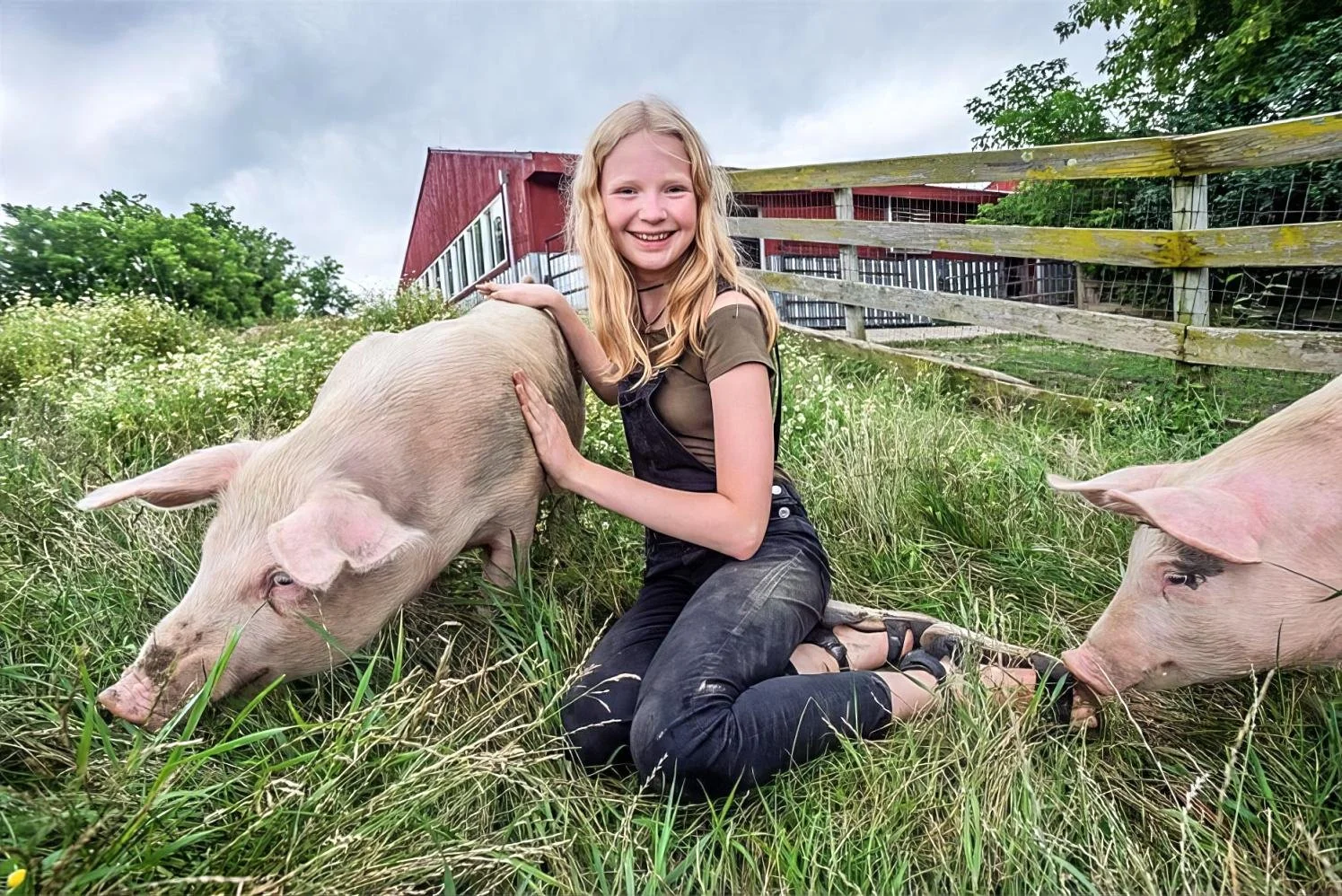
A young person, perhaps for the first time, meets anymals and feels the joy of kinship across species. If not rescued and brought to sanctuary, these pigs would have been slaughtered in their adolescence to be sold as bacon and pork. (We Animals Media)
In the Image of God
Genesis 1:26
Then God said, “Let us make humankind in our image….”
While Genesis 1 shows us that there is nothing unique to humankind about nephesh chayyah, human beings are given something unique and special in the creation narrative: We are made “in the image of God.” Many Christians have taken this to mean that humankind is godlike, that we have the right to rule over everything and to do so at our pleasure and for our benefit, that we have God-like power amid creation. Genesis 1 teaches that humankind was created in the “image” (slm/tzelem) of God. While some Christians take this to mean that humankind is entitled to rule the Earth like all-powerful, all-knowing gods, this assessment is tainted with hubris and self-interest.
Proverbs 11:2
When pride comes, then comes disgrace, but wisdom is with the humble.
We can look to history and the region to discover what this phrase might mean. Scholars find this same phrase in ancient texts in nearby Egypt, where “image” or “likeness” refers to servitude and responsibilities to God on Earth in God’s absence. In this context, to be made in the image of God is to be created to work on this Earth in God’s likeness, which is to say, in God’s stead, on behalf of the Creator, as the Creator would do (or have us do). Not exactly a license for selfish or harmful dominance of anymals. The image that these words cast is that of faithfully imaging the Creator.
Ezekiel 33:31–32
They come to you as people come, and they sit before you as my people, and they hear your words, but they will not obey them. For flattery is on their lips, but their heart is set on their gain…. They hear what you say, but they will not do it.
Scripture is clear. Scripture tells us that humankind is a living creature among living creatures, made on the 6th day with land animals. The universe is God’s glory and not our glory. Pride leads to destruction (Proverbs 16:18): Humility and serving God are core Christian ethics, central to righteousness. Christian service is rightly and always conducted on behalf of and for God. To be made in the image of God is our special gift amid all of creation: Our special gift is to humbly and diligently serve God amid creation on behalf of the Creator, as God would do.
James 4:10
Humble yourselves before the Lord, and he will exalt you
Vegan Dominion
Genesis 1:26-31
Then God said, “Let us make humans in our image, according to our likeness, and let them have dominion over the fish of the sea and over the birds of the air and over the cattle and over all the wild animals of the earth and over every creeping thing that creeps upon the earth.”
So God created humans in his image,
in the image of God he created them;
male and female he created them.God blessed them, and God said to them, “Be fruitful and multiply and fill the earth and subdue it and have dominion over the fish of the sea and over the birds of the air and over every living thing that moves upon the earth.” God said, “See, I have given you every plant yielding seed that is upon the face of all the earth and every tree with seed in its fruit; you shall have them for food. And to every beast of the earth and to every bird of the air and to everything that creeps on the earth, everything that has the breath of life, I have given every green plant for food.” And it was so. God saw everything that he had made, and indeed, it was very good.
When we are made in the image of God, humankind is also given dominion, told to fill and subdue the Earth, and told what to eat. We are given a vegan diet: “every plant yielding seed” and “every tree with seed in its fruit” (1:29). This is affirmed in Genesis 2:16: As soon as the man is placed in the garden (2:15), he is told that he may eat the fruit of “every tree” (2:16) except one (2:17). Genesis 1 and 2 agree: God has told living creatures what to eat, and we are to eat only vegan foods. Humankind, made in the image of God (Genesis 1:26), made to serve God amid creation, is instructed to be vegan, and only as vegans, we are told to subdue the Earth and have dominion.
God created a world of peace and harmony, of kinship and community, where no anymal was to be exploited or slaughtered for food. According to the creation narrative, God chose a vegan life for every living creature. “Dominion,” “subdue” the Earth, and being made “in the image of God” explicitly do not entitle humankind to eat flesh, dairy, or eggs. (For more on what Christians are to eat, see Food Ethics.)
Duties Assigned by God
Genesis 2:15
The LORD God took the man and put him in the garden of Eden to till it and keep it.
Genesis 2:15 clarifies what we are to do, in the image of God, as vegan servants of God amid creation. English translations usually say that humankind is to “till” (’abad) and “keep” (shamar) the land, but these translations do not properly convey the Hebrew meaning. ’Abad is better translated as “to serve” or “to work,” with work being that of a servant, as translated in Joshua 24:15: “choose this day whom you will serve.” This translation affirms what we already know through the life of Jesus: Humankind was created not as a master but as a servant of God. Shamar means “protect” or “guard,” and is translated in Numbers 6:24 as a proactive, emotionally invested version of “keep”: “The Lord bless you and keep you.” Numbers 6:24 conveys the full meaning of shamar, a loving, tender, protective guardianship.
Genesis 2 recalls God creating the land. Man is created next, specifically to serve the land by guarding and protecting what God has made. Plant life was not created until man was made to tend the land. Having created man to do the necessary care-taking, God created a Garden and then “took the man and put him in the garden of Eden to serve it and protect it” (2:15). In Genesis 2:15 we are created to serve/work the land by guarding and protecting (with tender care) the ground/soil/land that God had made. At this point in the Genesis 2 creation story, anymals were not yet created.
Christians often believe that God has given humankind a special authority amid creation, but we are God’s vegan servants (Genesis 1:29–30 and 2:16). We are made in the image of God (Genesis 1:26) to serve and protect the land on God’s behalf, guarding and lovingly tending what God has made (Genesis 2:15).
Luke 4:8
Worship the Lord your God, and serve only him.
Shared Purpose—One Community
Genesis 2:18-22
Then the Lord God said, “It is not good that the man should be alone; I will make him a helper as his partner.” So out of the ground the Lord God formed every animal of the field and every bird of the air, and brought them to the man to see what he would call them; and whatever the man called every living creature, that was its name. The man gave names to all cattle, and to the birds of the air, and to every animal of the field; but for the man there was not found a helper as his partner. So the Lord God caused a deep sleep to fall on the man, and he slept; then he took one of his ribs and closed up its place with flesh. And the rib that the Lord God had taken from the man he made into a woman and brought her to the man. Then the man said,
“This at last is bone of my bones
and flesh of my flesh;
this one shall be called Woman,
for out of Man this one was taken.”
Genesis 2 recalls that God created anymals and woman for the same purpose, so that man would not be alone and as a “helper as his partner,” revealing a deep kinship across species. Anymals were not found suitable to be Adam’s “helper as his partner.” So, God made woman specifically for this purpose. No earthly hierarchy is indicated; humans are neither above nor separate from other living creatures. Animals (including humans) form one community in God’s perfect, original creation.
Humankind was created to serve God, in the image of God. Man was placed in the garden to guard, protect (with loving, sustaining care), and serve the needs of God’s garden. Woman and anymals are both created to keep the first man company, and woman is his helper and partner.

The anymals and the first woman were created so that Adam would not be alone. The first woman was created to be Adam’s “helper as his partner” in serving God by serving creation.
(“God Creating Adam and Eve,” unknown artist, Italy, c. 1600, Wikimedia Commons)
Creation as a Unified Good
Genesis 1:31
God saw everything that he had made, and indeed, it was very good.
Before human beings are created, God declares light, vegetation, dark, and all living creatures of the sea, sky, and land to be “good” (Genesis 1:4, 10, 12, 18, 21, 25). Genesis 1 conveys the goodness of creation in God’s view, both with and without humankind. This tells us that we are not necessary to the goodness of what God has created, and we are not in any way “more good” than anything else that has been made.
Isaiah 6:3
Holy, holy, holy is the LORD of hosts; the whole earth is full of his glory.
The Hebrew word used for “good” is singular: Creation, though of many parts, is a single entity, existing by and through the Creator. Only God stands apart. Humility allows humankind to live in the knowledge that we have nephesh chayyah and that we are beautiful and wonderful, as is everything that God has created. We are creatures of the Earth, creatures of the Earth, part of the unity that God created: matter amid matter, life amid life, creatures among creatures.
Psalm 103:14
For he knows how we were made; he remembers that we are dust.

Creation, both from and of God, is all one unity and is “very good.”
(“A Storm in the Rocky Mountains, Mt. Rosalie,” Albert Bierstadt, United States, 19th century, Wikimedia Commons)
Restoring the Peaceable Kingdom
Isaiah 11:6-9
The wolf shall live with the lamb,
the leopard shall lie down with the kid,
the calf and the lion and the fatling together,
and a little child shall lead them.
The cow and the bear shall graze,
their young shall lie down together;
and the lion shall eat straw like the ox.
The nursing child shall play over the hole of the asp,
and the weaned child shall put its hand on the adder's den.
They will not hurt or destroy
on all my holy mountain;
for the earth will be full of the knowledge of the Lord
as the waters cover the sea.
God created vegan creatures (including humankind) to live together in community, without predation, in a world of perfect peace and harmony. The latter prophets remind humankind that we are headed back to this perfect vegan peace, the Peaceable Kingdom. Isaiah eloquently speaks to the work necessary to restore the knowledge of God that is reflected in a world of peace, a world where humankind “will not hurt or destroy on all my holy mountain; for the earth will be full of the knowledge of the Lord” (Isaiah 11:9).
Many Christians look only to salvation, neglecting their earthly duties to God, but Christians are to do the will of God by serving God amid creation, by working to restore justice and peace on Earth, in the here and now, as Jesus did. We are to restore God’s kingdom here on Earth (Matthew 6:10).
Matthew 6:10
Your kingdom come.
May your will be done,
on earth as it is in heaven.
There are many overlooked ways to serve God. We serve God when we make sure that church food pantries are stocked with food for dogs and cats, when we pause to help anymals in need, and when we choose a vegan life. All of us can help to restore peace through prayer, reflection, and by making necessary changes.
James 1:22
Be doers of the word, and not merely hearers who deceive themselves.
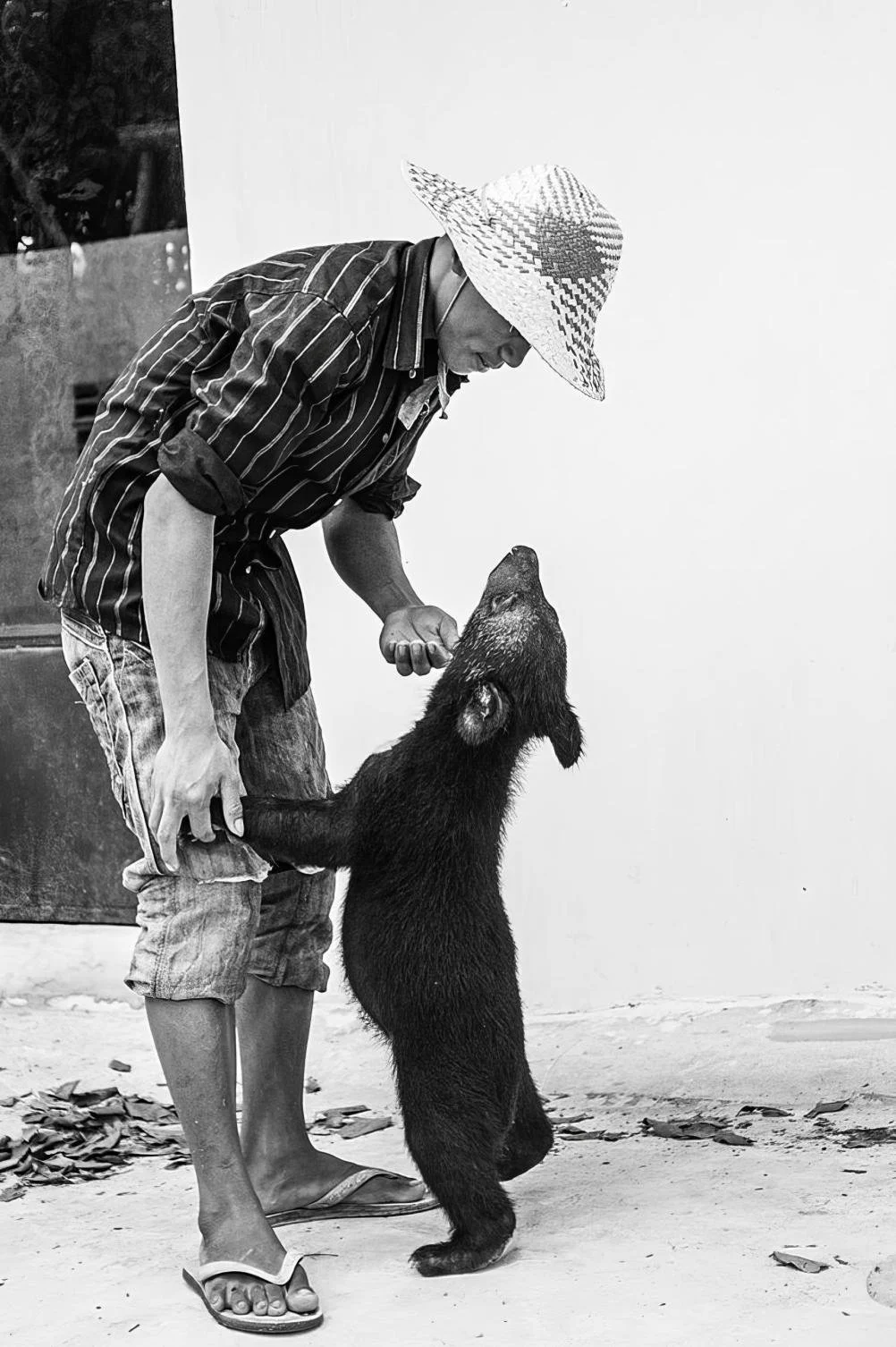
Christians are to work to reestablish peace on earth. We are responsible to heal the harm that we cause anymals. In this picture, a moon bear cub, whose mother was killed or captured, comes to her caretaker at a Cambodian sanctuary, hoping that he will fulfill the simple but essential needs that her mother would have fulfilled. (We Animals Media)
The Creator
Psalms 104:24-25
O LORD, how manifold are your works!
In wisdom you have made them all;
the earth is full of your creatures.
There is the sea, great and wide;
creeping things innumerable are there,
living things both small and great.
For humankind to serve in the image of God (as God would do), by guarding and protecting the land on behalf of the Creator (Genesis 2:15), it is important to understand more about the Creator and the Creator’s relationship with all that has been made.
Creation is Good/Holy
Genesis 1:24-25
God said, “Let the earth bring forth living creatures of every kind: cattle and creeping things and wild animals of the earth of every kind.” And it was so.
God made the wild animals of the earth of every kind and the cattle of every kind and everything that creeps upon the ground of every kind. And God saw that it was good.
The value of creation lies in and with God: That which has been created is of, by, and with God and is therefore inherently good and holy. God repeatedly proclaims creation to be good before humankind is created. Sacred writings tell us that God is neither distant nor purposefully separate from creation, that the Earth is sacred. An angel of the Lord appears in a flaming bush (Exodus 3:2), God speaks through a laboring donkey (Numbers 22), and “the Lord answered Job out of the whirlwind (Job 38:1–2 and 40:6).
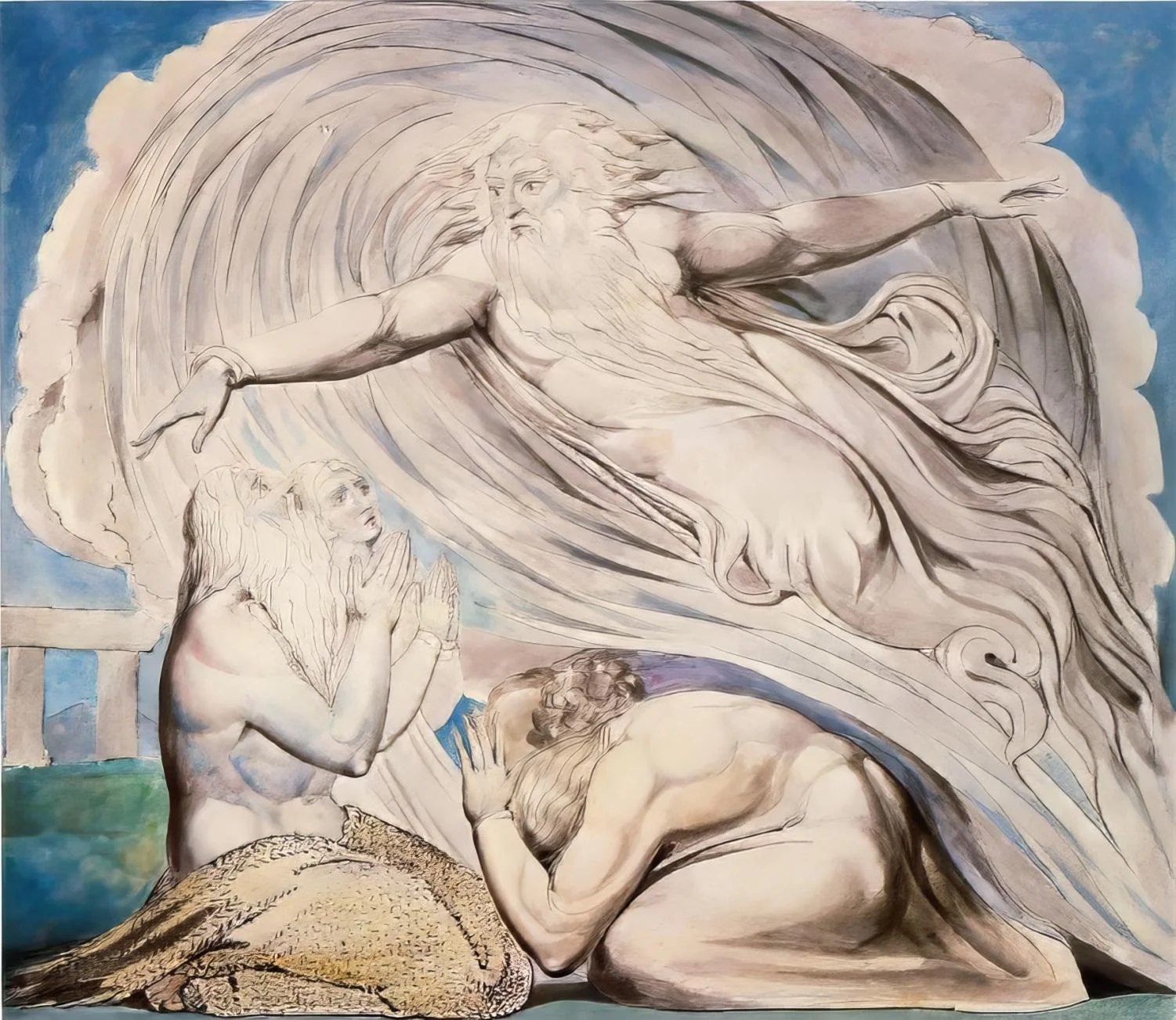
In the Book of Job, God speaks to Job from a whirlwind.
(“The Lord Answering Job Out of the Whirlwind,” William Blake, England, 1805, Wikimedia)
Sacred texts indicate that the Creator/Sustainer is present on Earth (most directly, among the Israelites), and that God has demanded that we show respect for the natural world: God orders humankind not to pollute or defile the land and explicitly notes that bloodshed both pollutes and defiles the land.
Numbers 35:33–34
You shall not pollute the land in which you live; for blood pollutes the land, and no expiation can be made for the land, for the blood that is shed in it, except by the blood of the one who shed it. You shall not defile the land in which you live, in which I also dwell; for I the Lord dwell among the Israelites.
Adam was placed in the garden to guard and protect the land, and Scriptures warn that the land will punish humanity for disobedience, for failing to do God’s will. While God may be patient with our tendency toward selfish and destructive ways, the land is apparently less tolerant when humankind violates God’s law and will “vomit” humankind from the lands where we live.
Leviticus 18:25-28:
Thus the land became defiled… and the land vomited out its inhabitants. But you shall keep my statutes and my ordinances and commit none of these abominations, either the native-born or the alien who resides among you (for the inhabitants of the land, who were before you, committed all of these abominations, and the land became defiled); otherwise the land will vomit you out for defiling it, as it vomited out the nation that was before you.

God sent Adam and Eve out of the Garden of Eden; the land can also expel humankind for disobedience—for defiling the land with blood. (“Expulsion from the Garden of Eden,” Cole Thomas, United States, 1828, Wikimedia Commons)
Sole Proprietor
Deuteronomy 10:14
Heaven and the heaven of heavens belong to the Lord your God, the earth with all that is in it.
All of creation belongs completely and exclusively to God. The Bible reminds: “For every wild animal of the forest is mine, the cattle on a thousand hills (Psalms 50:10); “The land is mine; with me you are but aliens and tenants” (Leviticus 25:23). Neither the land nor the anymals are ours: Anymals are God’s, God designed this world to be vegan, and God has told us: “I know all the birds of the air, and all that moves in the field is mine” (Psalm 50:10–11).
Romans 11:36
For from him and through him and to him are all things.
We are creatures of God, servants of God who have been instructed to serve, guard, and protect the land in God’s image (as the Creator would do). The creation narrative tell us that we were not made to harm or destroy anymals–on the contrary. Bloodshed is not what God intended for humankind or for Earth.
Psalms 24:1
The earth is the Lord’s and all that is in it,
the world, and those who live in it.
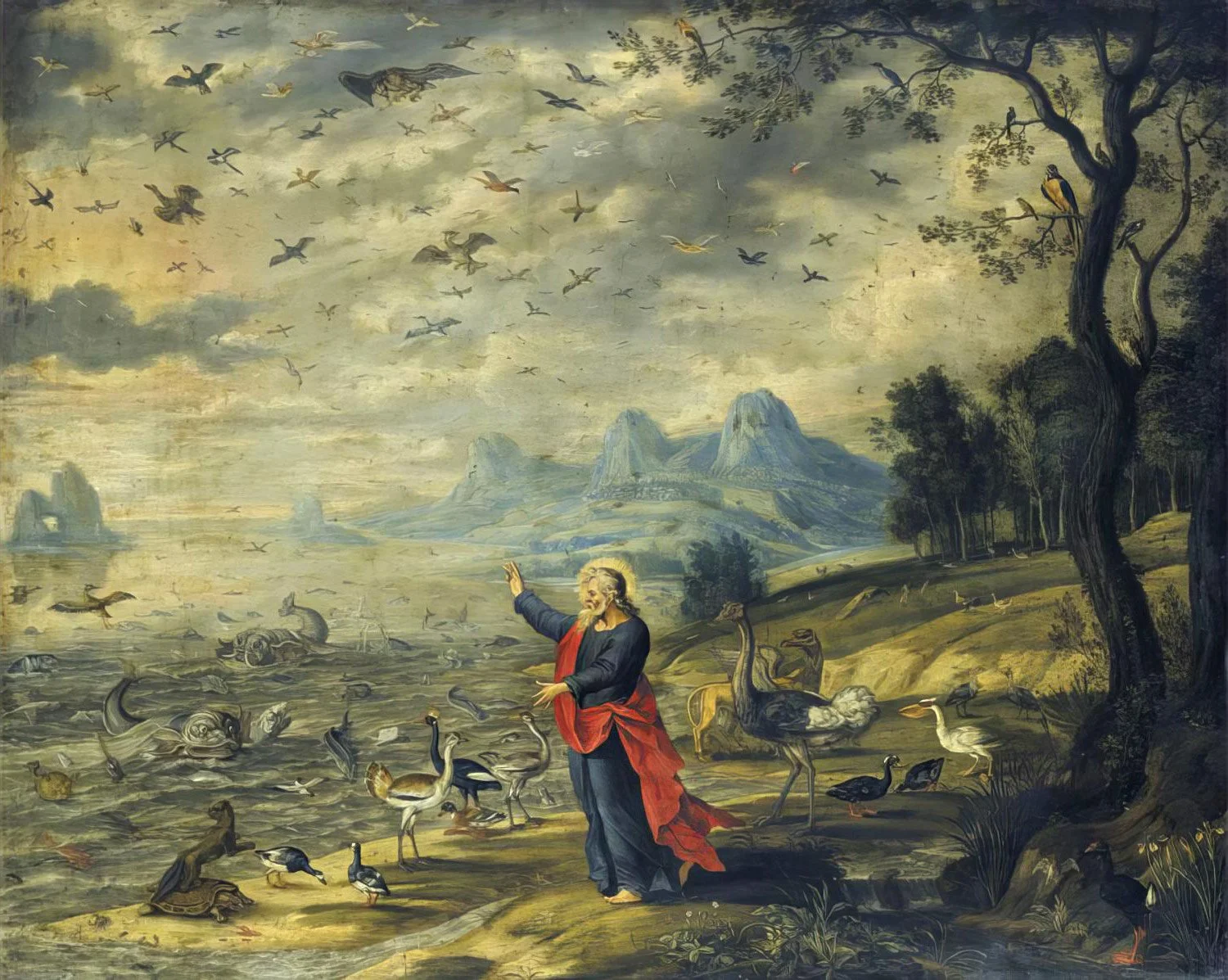
God is sole proprietor of creation.
(“Creation of Birds and Fish,” Izaak van Oosten, Flanders/Belgium, 17th Century, Wikimedia )
Fully Invested—Compassionate and Attentive
Psalm 145:8-9 and 15–16
The Lord is gracious and merciful,
slow to anger and abounding in steadfast love.
The Lord is good to all,
and his compassion is over all that he has made.
It is important to distinguish between the peaceful, benevolent, munificent Creator and that same God after human disobedience, after violence fills the Earth (Genesis 33–6). Genesis records God’s initial plan for creation, a plan of peace and kinship between all species, a plan for sharing company and tending the land that produced every green thing and the fruits of trees for food. Sacred texts, particularly Psalms, frequently describe God’s nature as benevolent and munificent, portraying the Creator as a gentle caretaker for all of life, a God who cares about and for each living being. Holy writings also show that anymals understand that they are in a relationship with their protective, nurturing God: They cry out to their Creator in times of need so that their needs may be met.
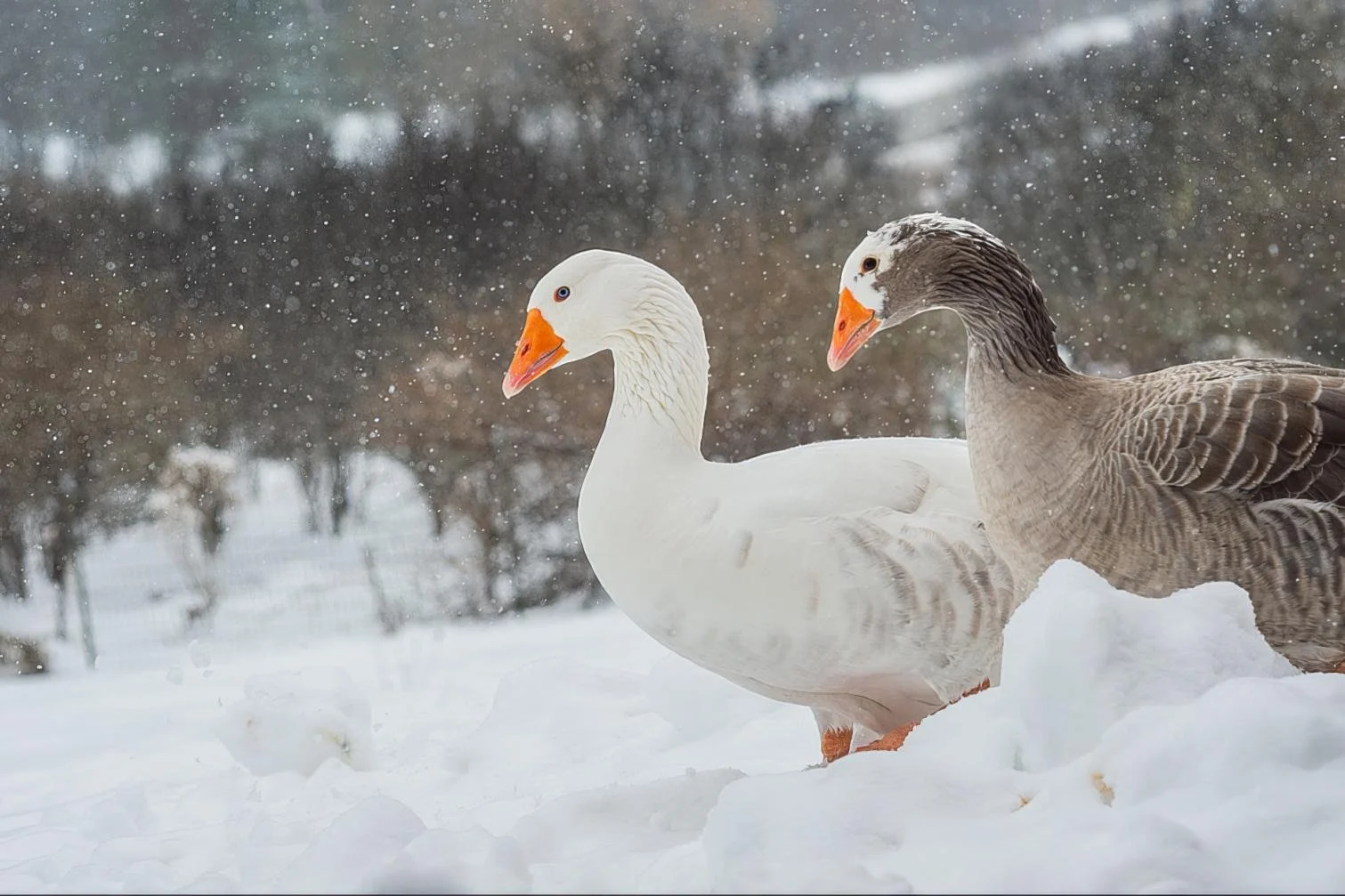
All of creation is from and of God. All that God has made carries something God’s purpose and majesty.
(We Animals Media)
Psalm 104:25-29
Living things both small and great....
These all look to you
to give them their food in due season.
Humankind tends to be selfish, but Scripture does not support a narrow, selfish approach to life or Earth. To serve God in the image of God, we are expected to tend the land in the image of God (as God would do) (Genesis 1:26). This does not permit exploiting anymals as petri dishes, enslaving them for entertainment, cutting them up for science, or destroying their lives for fashion, taste habits, or sport. Nor does it permit looking the other way while trillions of anymals are exploited and slaughtered in food industries. If we are to serve a righteous and benevolent Creator who cares about every living creature, we will need to assist anymals in need, whether with computers, cameras, telephone calls, boots on the ground, or our own loving hands. Whether they be injured, homeless, abused, or enslaved in laboratories or on farms, Christians are called to hear the cries of anymals, not hide our eyes or carry on as if all were well for God’s creatures.
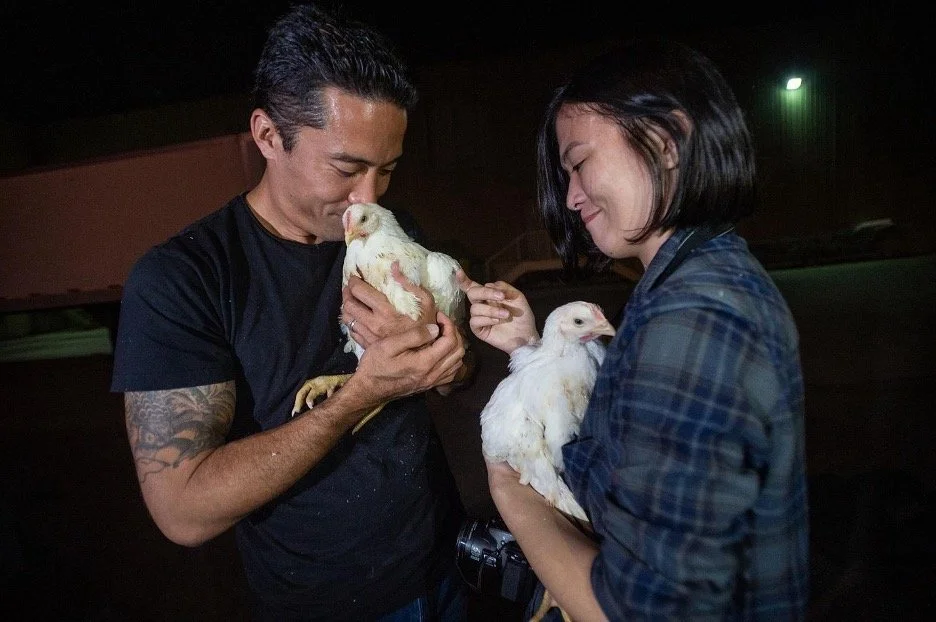
Serving God amid creation, anymal activists rescue adolescent hens from a truck outside a Canadian slaughterhouse.
(We Animals Media)
In Covenant with Anymals/Earth
Genesis 9:8-15
Then God said to Noah and to his sons with him, “As for me, I am establishing my covenant with you and your descendants after you, and with every living creature that is with you, the birds, the domestic animals, and every animal of the earth…. I have set my bow in the clouds, and it shall be a sign of the covenant between me and the earth…. I will remember my covenant that is between me and you and every living creature of all flesh.”
God’s rainbow covenant is established with “every living creature” and with the Earth itself (Genesis 9: 8–17), underscoring the divine connection with and investment in all that has been made. God’s rainbow covenant reinforces the unity and importance of all of creation, and the Creator’s ongoing commitment as Sustainer of all that has been made. The rainbow covenant reminds Christians that to serve God is to serve the land, by guarding and protecting (on behalf of God) all that has been made. Most fundamentally, this calls us to prayer, to ask for guidance, and to seek an open heart so that we can explore and work toward change as needed.
Titus 1:16
They profess to know God, but they deny him by their actions.
An awareness of contemporary practices is important if we are to understand the terrible breach of responsibilities that anymal industries represent. Anymals suffer from artificial, forced pregnancy through the snatching of young, from a lifetime of tight confinement to long transport on an open truck (in any weather conditions), and when they arrive at the slaughterhouse, while still in adolescence, they must first watch others be killed as they move toward their death. Undercover footage from around the world exposes the atrocities of anymal industries. Whether circuses or aquariums, dog breeding or horse racing, medical laboratories or product testing, whether meat, dairy, or eggs, anymals exploited by humankind are handled, kept, and killed in ways that it would seem impossible for any Christian to accept, let alone attempt to justify.
Proverbs 1:22
How long, O simple ones, will you love being simple? How long will scoffers delight in their scoffing and fools hate knowledge?
While it takes time to gather the necessary information to understand the depth of the problem, once we have seen the cruelties and indifference hidden behind the closed doors of massive industrialized, mechanized, anymal operations, it is easy to see why core Christian texts teach that we are to protect anymals. In truth, the whole matter is quite simple from a faith point of view: serving God and respecting God does not permit indifference to suffering or the unnecessary destruction of life. From a Christian view, once we are aware of what industries try to conceal, the suffering and bloodshed that come with our food, clothing, entertainment, and medications, then anymal exploitation becomes fundamentally unacceptable. Anymals are not ours to exploit and desecrate; they are God’s beautiful, sentient creatures. Respect for anymals accompanies respect for God.
Genesis 9:15
I will remember my covenant that is between me and you and every living creature of all flesh, and the waters shall never again become a flood to destroy all flesh.

Scriptures teach that the Creator, a loving and attentive God, remains invested in everything that has been made.
(“God Creating the Animals of the World,” Izaak van Oosten, Flanders/Belgium, 17th century, Wikimedia Commons)
Summary
Matthew 25:40
Just as you did it to one of the least of these… you did it to me.
The New Testament records the life of Jesus and conveys core Christian ethics, including love, humility, mercy, service, peace, generosity, and sharing. As the quintessential moral exemplar, Jesus models service to God, often through attentive care to those considered beneath his moral consideration. Genesis reminds readers that God created a perfect, peaceful, vegan world, a place of kinship across species, where we are to serve God by lovingly protecting the land. The Hebrew Bible also reminds that God is the sole proprietor, indwelling, fully invested, attentive toward all living creatures, and in covenant with all of creation.
Hosea 2:18
I will make for you a covenant on that day with the wild animals, the birds of the air, and the creeping things of the ground.
Many Christians now assume that humankind is somehow more important to God than the rest of creation, sometimes behaving as if creation were merely a backdrop for the human quest for salvation. Some Christians assert that only human beings can be saved, and it is therefore a waste of love and care to care about anymals or this wondrous Earth. While it is certainly possible to find a passage here and there that might seem suitable to defend a selfish, narrow, egocentric view, selfishness and human arrogance deny a God-centered Christianity.
2 Peter 3:15-16
Paul wrote to you according to the wisdom given him, … which the ignorant and unstable twist to their own destruction, as they do the other scriptures.
Christianity is a path of grace, a journey that offers new opportunities and new insights with the passing of each day. A fresh examination of sacred texts and fundamental Christian ethics invites people of faith to rethink both their relationship with anymals more generally and their consumer habits. Even without a close and scholarly examination of texts, it would seem fundamentally unchristian for someone who is both sincere in faith and informed about contemporary anymal exploitation to argue that Christianity encourages or permits such indifference and cruelty to life.
Matthew 5:16
Let your light shine before others, so that they may see your good works and give glory to your Father in heaven.
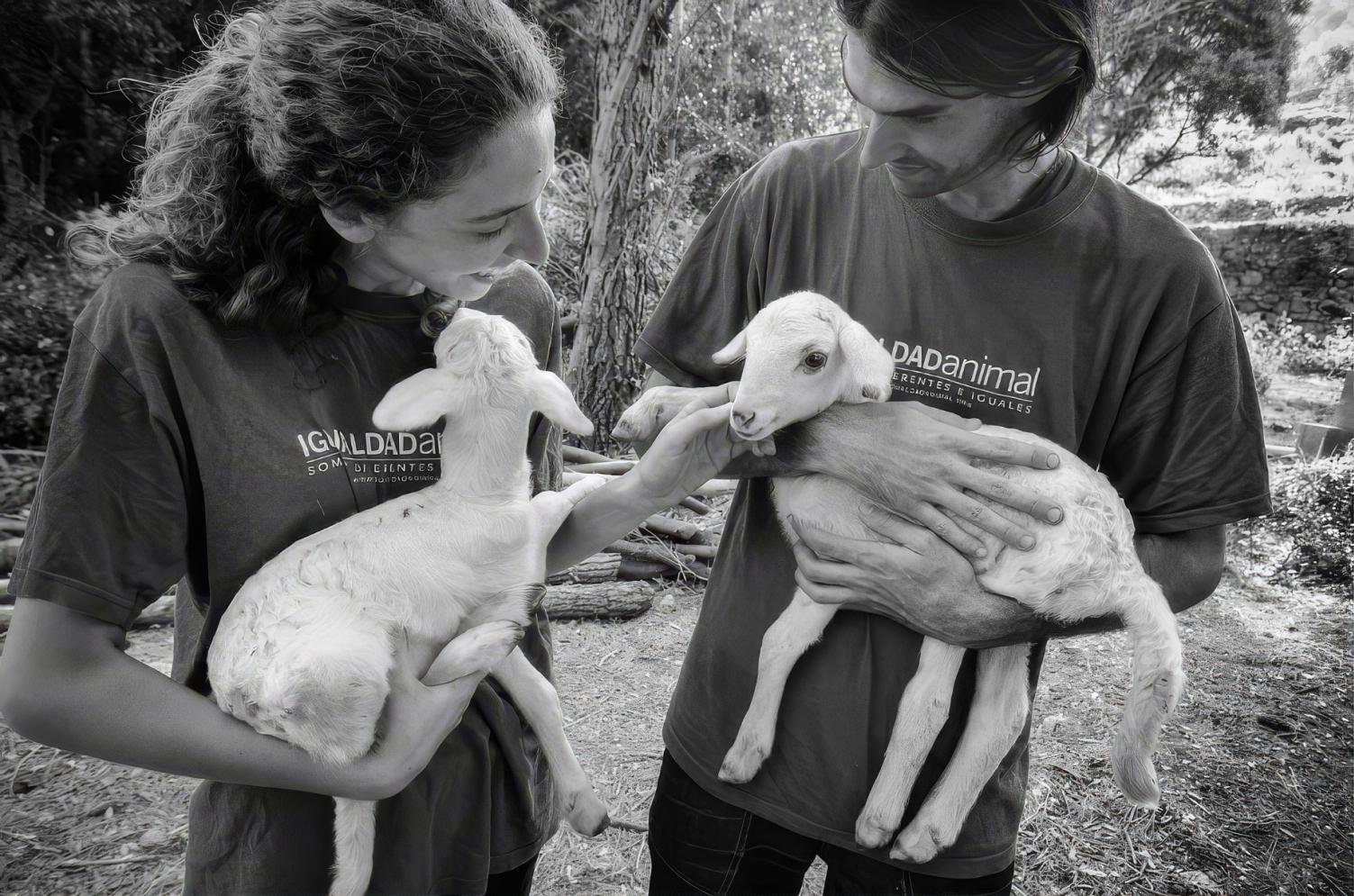
Living up to core Christian ethics, following the example of Jesus and teachings in the creation narrative, two activists delight in the beauty of life as they hold two baby goats freshly rescued from Spain’s milk and meat industries. (We Animals Media)