Saints
(Hagiographies)
-
-
-
-
Animals as moral and spiritual beings
Galatians 3:28
There is no longer Jew or Greek; there is no longer slave or free; there is no longer male and female, for all of you are one in Christ Jesus.
According to hagiographies, which record the lives of saints (those recognized as the most exemplary Christians), Christians known to be strong in their faith sometimes lived in mixed-species communities with foxes, lions, otters, badgers, hares, deer, donkeys, and innumerable other living creatures. Hagiographies honor each anymal as a creature of God, complete with individuality, portraying a fox or an otter as spiritually challenged, devout, willful, or generous. Those who are holy recognize the anymals with whom they live as a brother or sister in faith, and as worthy of a saint’s time and attention.
Psalms 148:7-10
Praise the LORD from the earth,
you sea monsters and all deeps,
fire and hail, snow and frost,
stormy wind fulfilling his command!
Mountains and all hills,
fruit trees and all cedars!
Wild animals and all cattle,
creeping things and flying birds!
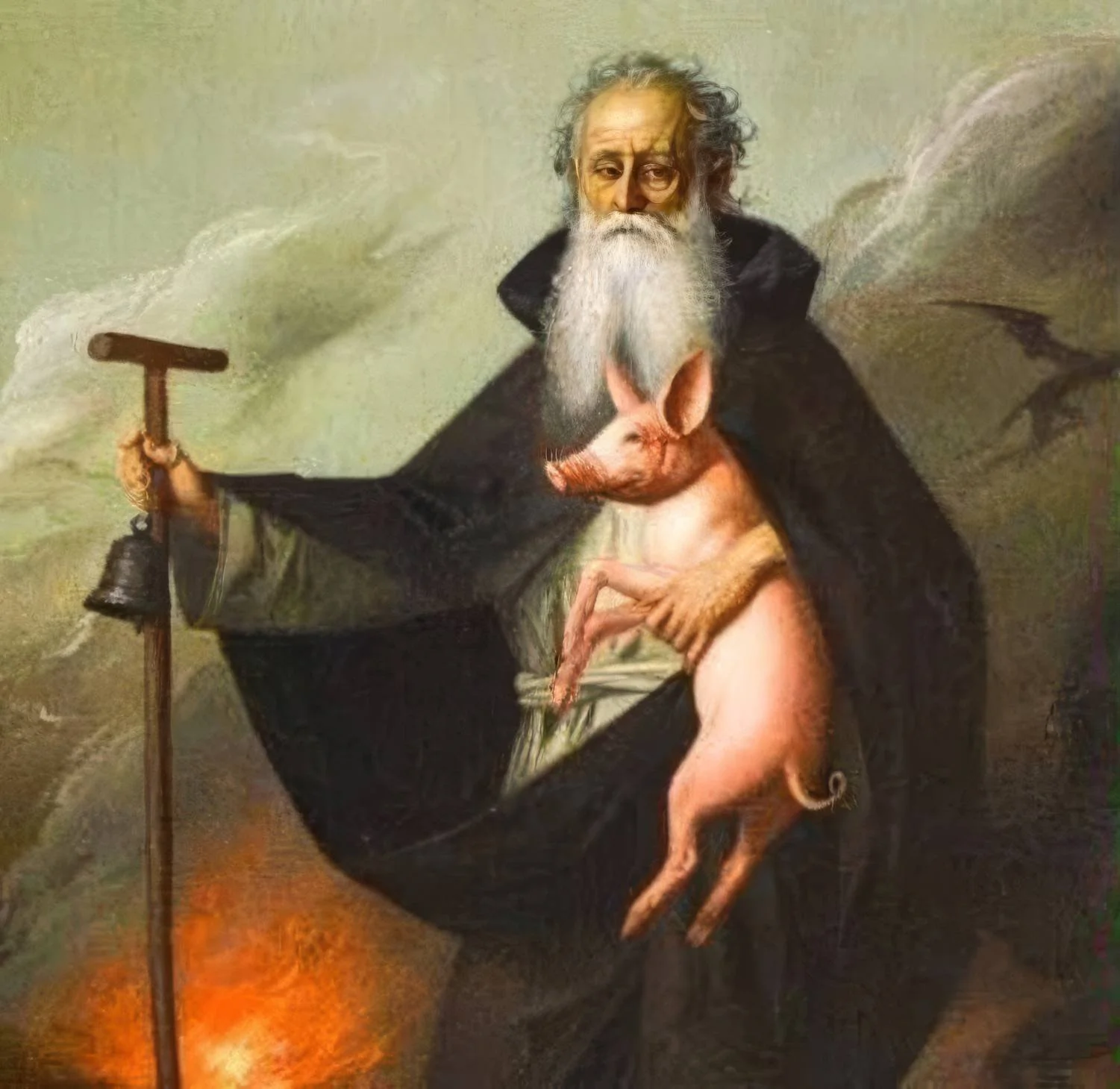
Saint Anthony the Great of Egypt (“The Father of Monks”) with the pig that he healed, who became his constant companion. (Random Times)
Hagiographies tell readers that, no matter what the species, Christian saints follow in the footsteps of Jesus, doing good deeds of love and mercy, and tending to the needs of those whom most people believe to be outside of our moral circle and unworthy of our tender and attentive care. Bartholomew rescued a chick who was lodged in a rock crevice. Saint Columba took responsibility for a wind-driven crane. Saint Martin de Porres fed rats and mice at the edge of his garden and created a hospital for lost dogs and cats; Saint Bernard of Corleone also healed sick and injured anymals. Christian saints serve God amid creation, as the Creator would do or have them do, guarding and protecting God’s creatures, living among and serving the needs of anymals. The ethical foundations that guide these stories are explored more fully in Sacred Texts.
Matthew 5:7
Blessed are the merciful, for they shall receive mercy.
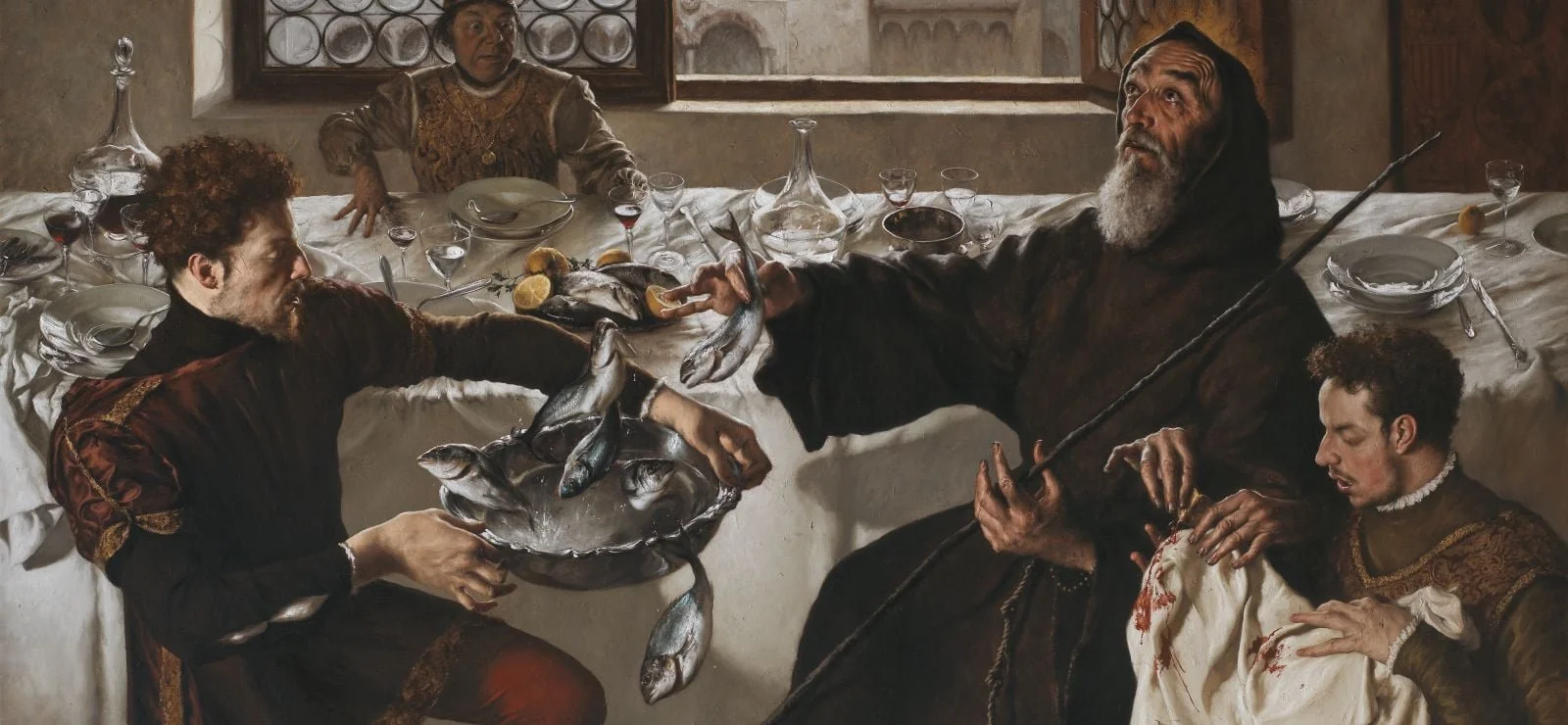
Most renowned among saints caring for anymals, Saint Francis tended, healed, and released wounded anymals; he extricated a rabbit from a trap, claimed turtle doves who were being taken to the market to be sold, and when his friend was caught and fried, he restored a pan of fishes to life.
Saint Francis reviving his friend, who happened to be a fish.
("I miracoli di San Francesco di Paola" (The Miracles of St. Francis of Paola), Giovanni Gasparro, 2015.)
Perhaps the best-known anymal story of Saint Francis is that of taming the wolf of Gubbio, who was eating human beings. When Saint Francis arrived to solve the problem, the wolf lay down at his feet. He admonished the wolf for frightening and eating God’s creatures, and his admonishments are just as true for omnivores and vegetarians who frighten and eat God’s creatures. In the end, the wolf agreed not to harm any living beings, and the people promised to feed the wolf. (Like human beings, dogs thrive on a well-balanced vegan diet.) Two years later, when the wolf passed, the community of Gubbio sincerely mourned the loss of their noble friend. This story invites reflection: Some Christians understand that peace is extended to all beings and connected to what we choose to eat. We also help restore peace by choosing a vegan life. The ethical dimensions of diet are explored more fully in Food Ethics.
Genesis 1:29
I have given you every plant yielding seed that is upon the face of all the earth and every tree with seed in its fruit; you shall have them for food.

Saint Francis admonished the wolf of Gubbio for frightening and eating God’s creatures, reestablishing peace, as we also do when we choose a vegan life. (From The Franciscans in America, Francis Dent, United States, 1903, Wikimedia Commons)
Foxes tend to be particularly colorful characters in literature, and this is just as true in hagiographies. Saint Moling took in a fox as a disciple, but the fox consumed a monastery hen. Having been admonished for the deed, the penitent fox snatched a replacement from a nearby nunnery. The patient Saint Moling instructed the fox to gently return the hen and to take an example from the other residents and live peacefully, which does not permit the eating of God’s creatures. Saint Ciaran ministered to five anymals and as with the fox who lived with Saint Moling, the fox was particularly challenged by discipleship. He slunk off to the wildlands to chew on a Bible, only to be pursued by hounds who forced him back to Saint Ciaran for penance. The fox again abandoned discipleship, this time wandering off to chew the saint’s shoe so that Father Ciaran had to send brother badger out to retrieve the wayward fox. Both Saint Moling and Saint Ciaran lived with and ministered to anymals, tending to the needs of all who came, no matter what their species.
2 Corinthians 1:3–4
Blessed be the God and Father of our Lord Jesus Christ… who consoles us in all our affliction, so that we may be able to console those who are in any affliction.
Blessed be the God and Father of our Lord Jesus Christ… who consoles us in all our affliction, so that we may be able to console those who are in any affliction.
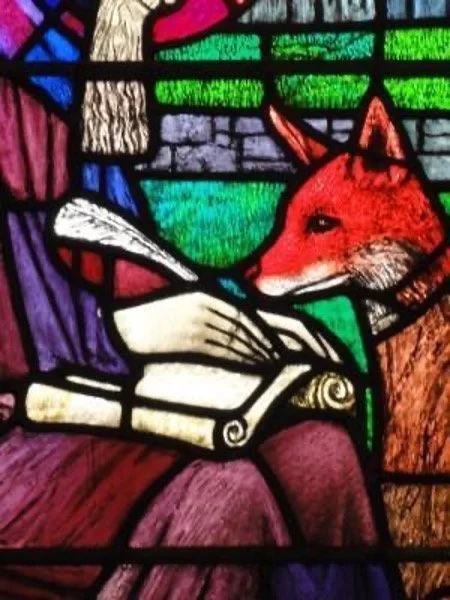
Saint Moling and one of his disciples, a fox. (Catholic Ireland)
A donkey and a lion were Saint Jerome’s companions. After he pulled a thorn from the lion’s paw, the lion chose to stay with the saint, serving as protector for the cloister donkey. One day, the donkey went missing, and Saint Jerome concluded that the lion had eaten the donkey. He did not accuse the lion directly but instructed the brothers to make a harness so that the lion might do the donkey’s work. When not working, the innocent lion searched tirelessly for the donkey, who had been stolen by thieves. When the lion approached, the thieves fled, abandoning not only the donkey but also a string of camels. The lion, the donkey, and the camels returned to the monastery, adding a few more anymals to Saint Jerome’s extended and diverse monastic community.
Matthew 10:8
Cure the sick; raise the dead; cleanse those with a skin disease; cast out demons. You received without payment; give without payment.

Saint Jerome and his companions, a lion (with a thorn not yet out of his paw) and a donkey.(“Jerome in the Wilderness,” Giovanni Bellini, Italy, 15th Century, Wikimedia Commons)
In dread of hunters, anymals sought refuge with saints. Hares took shelter with Saints Cuthbert, Anselm, Francis, and Philip. A hunted boar found refuge with Saint Kevin of Glendalough. Stags escaped the bloodlust of hunters by sheltering with saints such as Giles, Godric, and Maedoc. A deer came to Saint Giles for protection, and the saint was mistakenly shot by the hunters. A stag dashed into Saint Maedoc’s hermitage when he was in prayer. The saint threw the corner of his cloak over the stag’s antlers to protect him, and the hunters and dogs ran by the hermitage without seeing the exhausted, frightened deer.
Colossians 3:12-15
Clothe yourselves with compassion, kindness, humility, meekness, and patience…. Above all, clothe yourselves with love, which binds everything together in perfect harmony. And let the peace of Christ rule in your hearts.

Saint Giles was shot by a hunter while protecting a deer.(“Saint Giles and the Hind,” artist unknown, c. 1500, Wikimedia Commons)
When a hunted hare dashed into a thicket of brambles, desperately seeking shelter, Saint Melangell crawled into the brambles to protect the hare. When the hunter, Prince of Powys, found Saint Melangell praying and protecting his small, frightened quarry, he was impressed by her piety and courage in standing up for the small hare against whoever might show up, likely with a weapon in hand. The prince rewarded Saint Melangell by gifting her his lands as an anymal sanctuary, and the prince gave up hunting.
It would seem impossible to imagine Jesus hunting. Christians who disrupt hunts participate in a long tradition of protecting God’s vulnerable creatures from the violence and bloodlust of hunters. Today, those who hunt could choose a vegan life, and could more easily and cheaply grow or buy vegan foods than invest in sport-killing. (For more on hunting, see the chapter on hunting in Eating Earth and the chapter on environment in Vegan Ethics: AMORE.)
Hosea 2:18
I will make for you a covenant on that day with the wild animals, the birds of the air, and the creeping things of the ground, and I will abolish the bow, the sword, and war from the land, and I will make you lie down in safety.

Saint Kevin with a blackbird and a deer.
(Glendalough Hermitage Centre)

Saint Melangell, Welsh patron saint of animals, protecting the hunted hare. (Green Canticle)
The Gospels tell us that Jesus pulled fishers from the sea, while hagiographies tell us that he pulled hunters from the forest. Before his conversion, Saint Eustace was a hunter. Jesus appeared in the horns of a stag, turning the bloodthirsty deer-slayer into a servant of God and a hunter of humankind, Saint Eustace.
1 John 4:8
…love is from God; everyone who loves is born of God and knows God. Whoever does not love does not know God, for God is love.

Jesus appears in the form of a stag to Saint Eustace. (University of California, Irvine)
Jonah 1:17
But the LORD provided a large fish to swallow up Jonah, and Jonah was in the belly of the fish three days and three nights.
In Scripture, anymals work with God. Hagiographies recall anymals assisting saints, sometimes stepping in where humankind has failed. Anymals raised and harbored Saint Keneth Cenydd of Wales after humankind rejected and abandoned him because of his physical deformities. He lived high in the trees in a bird’s nest where a hind nurtured him with her milk. When grown, he chose to remain with the anymals, building a hut by the sea. When a healer heard of a deformed youth living among the anymals he restored Keneth’s body, but Keneth told the healer that his “infirmity” was a blessing: Because he was deformed, he had lived among the anymals. His natural body was restored, and he lived happily with the anymals for the rest of his days.
Saints are exemplary Christians, recognized as particularly close to God. Hagiographies remind Christians that many saints lived in company with and tended to the needs of anymals as if the Peaceable Kingdom were already at hand (Isaiah 11:8–9 and Matthew 6:10). Saints in these stories serve God amid creation by following in the footsteps of Jesus, looking to the needs of those whom others overlook as beneath moral consideration—and we are all called to be saints (1 Corinthians 1:2).
1 Corinthians 1:2
…to those who are sanctified in Christ Jesus, called to be saints….