
The Donkey & Balaam
(Numbers 22)
-
-
-
-
Animals as moral and spiritual beings
Deuteronomy 22:4
You shall not see your neighbor’s donkey or ox fallen on the road and ignore it; you shall help to lift it up.
Anyone who has spent time with donkeys is likely to know them as intelligent, sensitive, social, and inquisitive. They pause to think before they act, they remember what has befallen them, and they are likely to hold a well-deserved grudge against anyone who mistreats them.
Despite their sensitivity and intelligence, human beings have overburdened and beaten donkeys and forcibly bred them to produce more donkeys for work or profit, and to provide nursing milk to be sold for human consumption. In some communities, they are slaughtered, and their bodies are sold for flesh (for profit). Those creating Asian “medicine” exploit their boiled hides to gather an “elixir,” while those developing “modern” medicines exploit the blood of donkeys for serum for heart valve research.
As with anymals more generally, sinful selfishness and a lack of compassion have prevented people from respecting God’s donkeys—anymals are not ours, but God’s. As servants of a loving Creator, we owe them kindness.
James 5:11
…the Lord is compassionate and merciful.
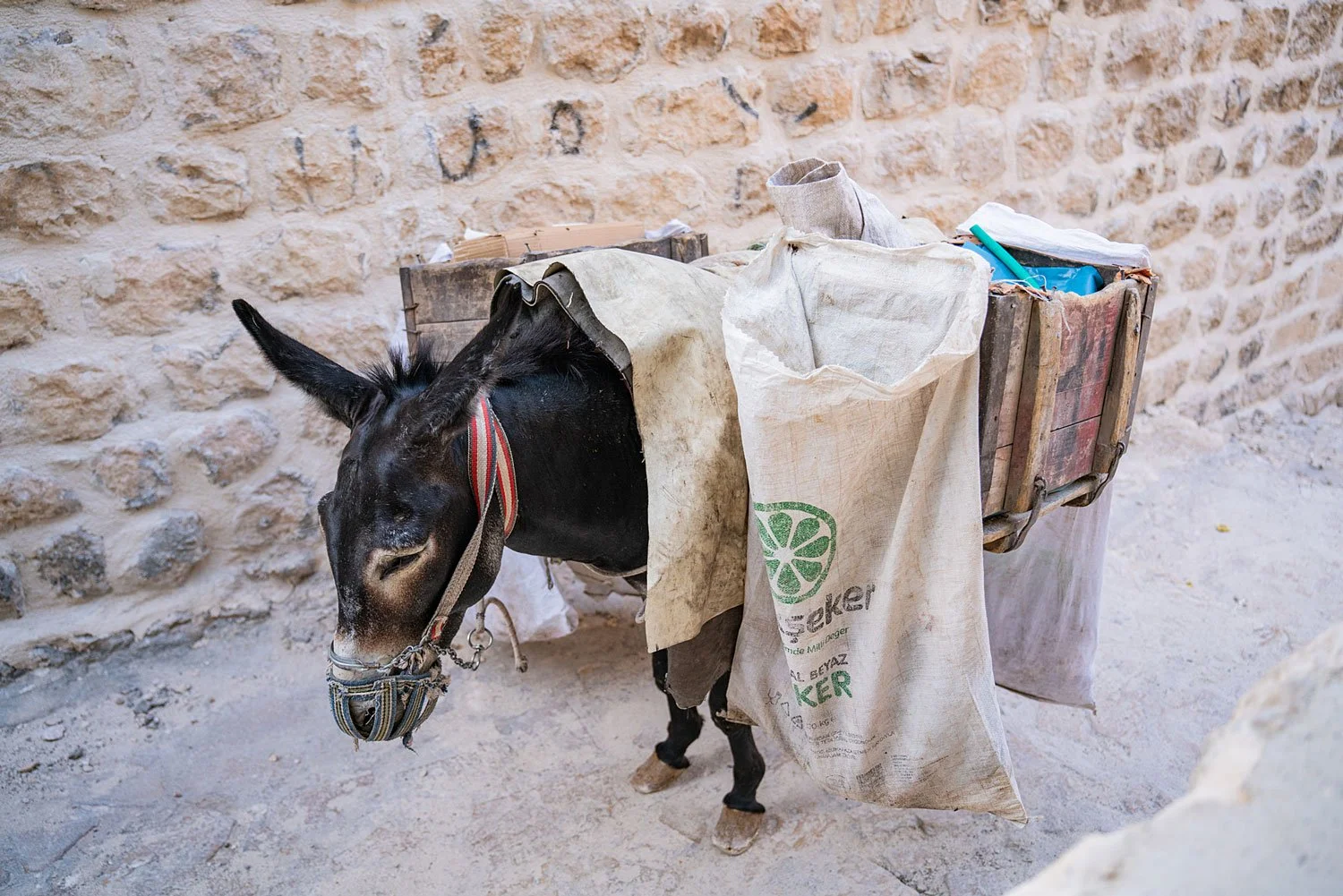
A donkey used for municipal garbage collection stands on a city street bearing a heavy load of bags and large sacks. (We Animals Media)
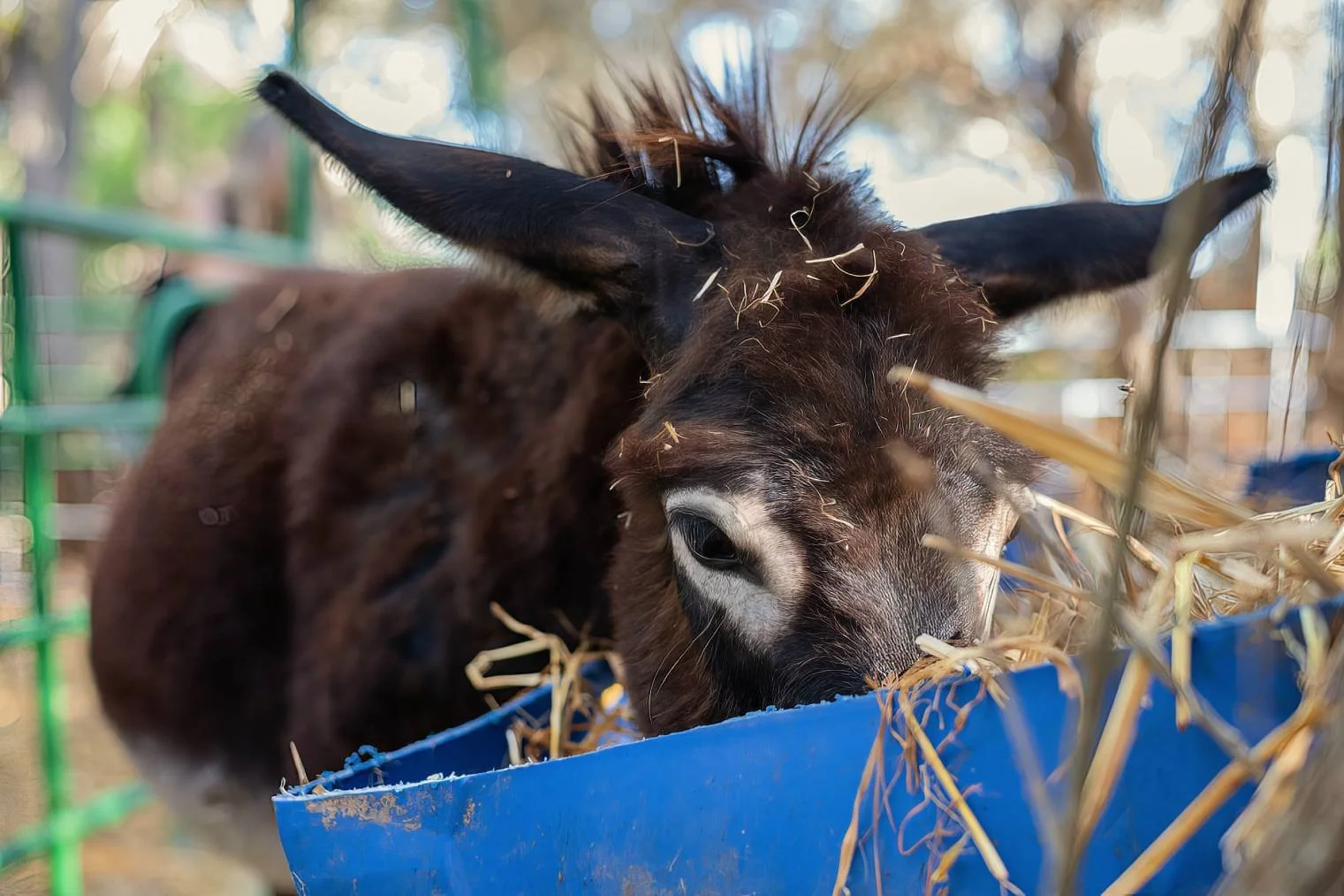
Donkeys are wonderful persons—they are filled with personality. This beautiful creature of God, rescued from neglect and abuse, now lives at a vegan anymal sanctuary in Israel. (We Animals Media)
Exodus 23:5
When you see the donkey of one who hates you struggling under its burden and you would hold back from setting it free, you must help to set it free.
This narrative is about one of Earth’s many sensitive and intelligent donkeys who is exploited as a beast of burden, in this case by a man named Balaam. Many donkeys lived in human communities in biblical times and were often kept and exploited for transport. Numbers 22 focuses specifically on the thoughts and feelings of one such donkey, a jenny (female donkey—English translations tend to reduce her to “it,” the status of an inanimate object, a slight that is corrected herein).
This portion of the text begins when Balak (king of Moab and enemy of the Jewish people) commissions Balaam (a gentile “seer” or prophet) to curse the Israelites, who are camped nearby. Balaam heads out on his donkey. As they travel, the jenny sees an angel standing in the footpath with sword drawn, so she swerves. Her rider cannot see the angel and becomes irritated, striking her as he steers her back onto the path. The angel relocates, this time standing between two walls, directly in the middle of the walkway. The donkey swerves again, but in negotiating the tight space, she scrapes Balaam’s foot against one of the walls. He is yet more irritated and strikes her again. Finally, the angel stands so that the donkey cannot pass. The jenny sees that she is in a hopeless position, caught between an Angel of God and Balaam’s wrath, so she simply lies down in the path.
It is easy to imagine Balaam’s humiliation as he sits astride a donkey who is lying in a public path, apparently refusing to carry her rider any further. He strikes the donkey again. Then, in solidarity with the mistreated and exploited anymal, “the Lord opened the mouth of the donkey,” and in speaking through the donkey, God questions not only Balaam’s cruelty, but his injustice to the jenny he rides: “What have I done to you, that you have struck me these three times?” (22:28).
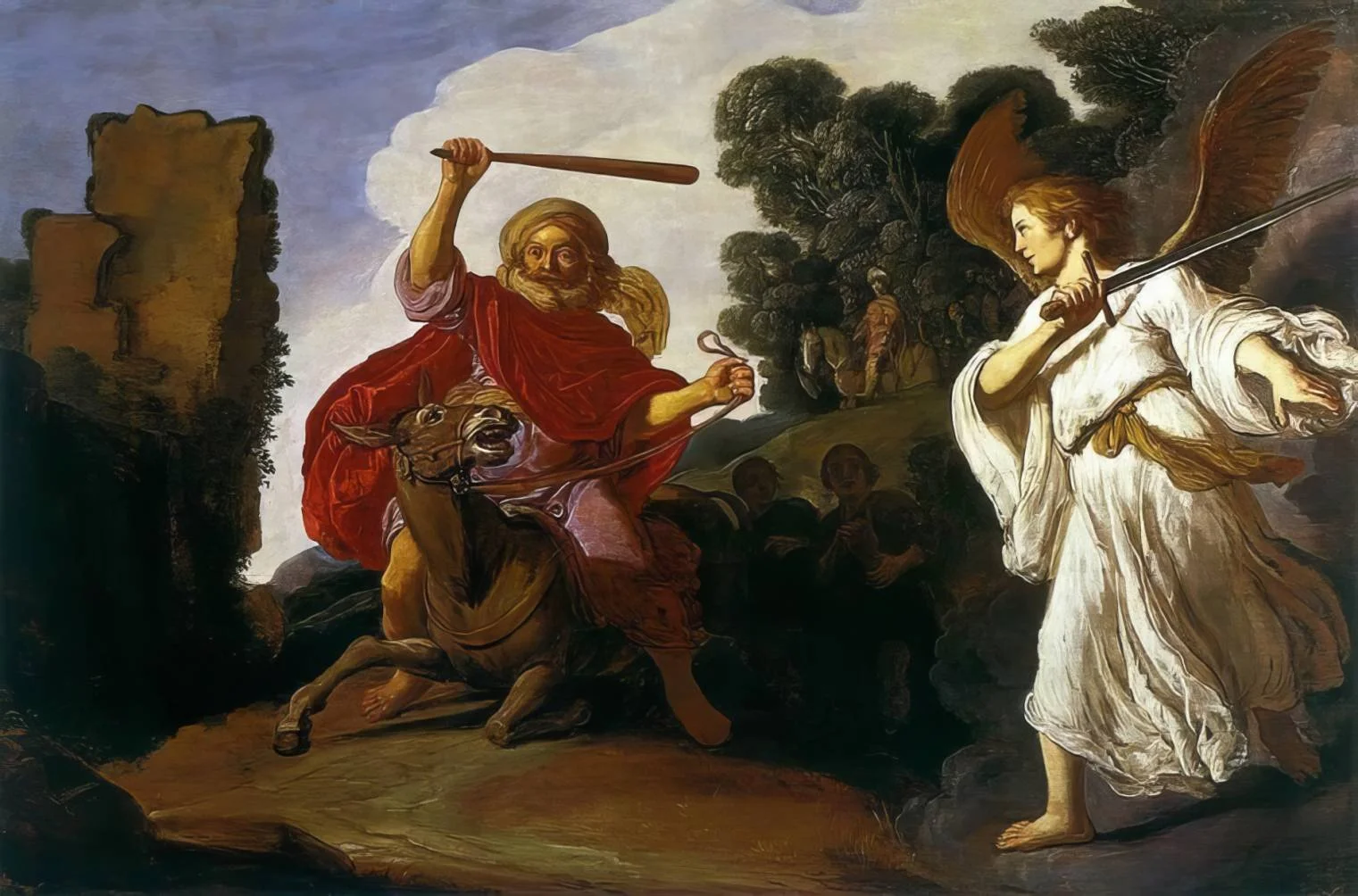
Balaam is humiliated and angry when the donkey he rides lies down in the path.(“Balaam and the Angel,” Pieter Lastman, Netherlands, 1622, Wikimedia Commons)
Balaam, full of pride and violence, threatens the donkey in response: “Because you have made a fool of me! I wish I had a sword in my hand! I would kill you right now!” (22:29). His words expose full power over the little laboring donkey—is sense of dominion and entitlement, including a willingness to kill the donkey he rides. Balaam’s angry violence highlights the complete and unjust power that humankind too often wields over anymals, and the importance of compassion and mercy where anymals are concerned.
For a second time, God challenges both Balaam’s cruelty and his injustice, speaking through the donkey, in solidarity with the donkey, challenging Balaam by reminding him of the donkey’s goodness and of their long-term relationship, which he appears to have forgotten: “Am I not your donkey, which you have ridden all your life to this day? Have I been in the habit of treating you this way?” (22:30). Faced with the truth, Balaam backs down and replies, “No.”
God then allows Balaam to see the angel, who speaks directly to Balaam and is also in solidarity with the donkey, further challenging his cruel dominance and unjust abuse with a blunt question: “Why have you struck your donkey these three times?” (22: 32). The angel continues: If this laboring jenny had “not turned away from me, surely just now I would have killed you and let [her] live” (22:33). The angel’s words demonstrate a recognition of the goodness and worthiness of the donkey, who perceived and did her best to move around the angel, and was all the while subjected to the cruel and unjust power of the man who “owns” her—though anymals are God’s and not ours.
Proverbs 12:10
The righteous know the needs of their animals,
but the mercy of the wicked is cruel.
Hearing the words of the angel and knowing that the donkey saved his life, Balaam is at last humbled. He does not again threaten the donkey, and he abandons his mission to curse the Israelites. But God instructs him to continue his journey and speak only the words that God puts into his mouth, just as the donkey has faithfully done (22:29). And so, he does.
Finally Balaam is able to see the angel, who tells him that the good donkey, whom he has mistreated, saved his life. (“Balaam and the Angel,” Gustav Jaeger, Germany, 1836, Wikimedia Commons)
Numbers 22 reminds humankind that donkeys are thinking, feeling individuals with intelligence and agency and that domesticated, working, farmed anymals are not ours, they are individuals with their own interests and insights—they are creatures of God. In this narrative, the donkey is spiritually elevated compared to her rider, able to see what he cannot, and endowed with the integrity to respond as needed to what she sees, even in the face of abuse. Balaam, in contrast, cannot see the angel of the Lord and he is irritable, filled with pride, and abusive toward the little donkey that bears his weight, carrying him so that he will not have to do his own walking. In this story, the donkey is the shining star, while the man is a dim bulb.
In Numbers 22, God takes the side of the donkey, speaking through her, reminding Balaam that his long-term relationship with the donkey carries moral expectations (that do not include beating or killing the donkey). Numbers 22 recalls Balaam’s abuse of the donkey as a matter of justice. The voice of God reminds readers of the expectation of compassion and mercy, including compassion and mercy for anymals whom we think we “own” and whom we misrepresent as “ours,” or as “domesticated,” “working,” or as “livestock” (literally, “living merchandise”). In Numbers 22, the voice of God reminds readers that the Creator is sensitive and attentive to anymals and notices when we fail to serve God, in the image of God. (For more on ethics and anymals, see Sacred Texts.)
Numbers 22 calls humankind to rethink our cruel exploitation of “working” anymals. This includes rethinking any financial support we provide if we choose products from those who buy, sell, and kill anymals, or exploit them for labor, science, entertainment, or on behalf of consumer taste preferences. The story of Balaam and the donkey is an impassioned plea on behalf of every exploited anymal.
Psalms 145:9
The LORD is good to all,
and his compassion is over all that he has made.
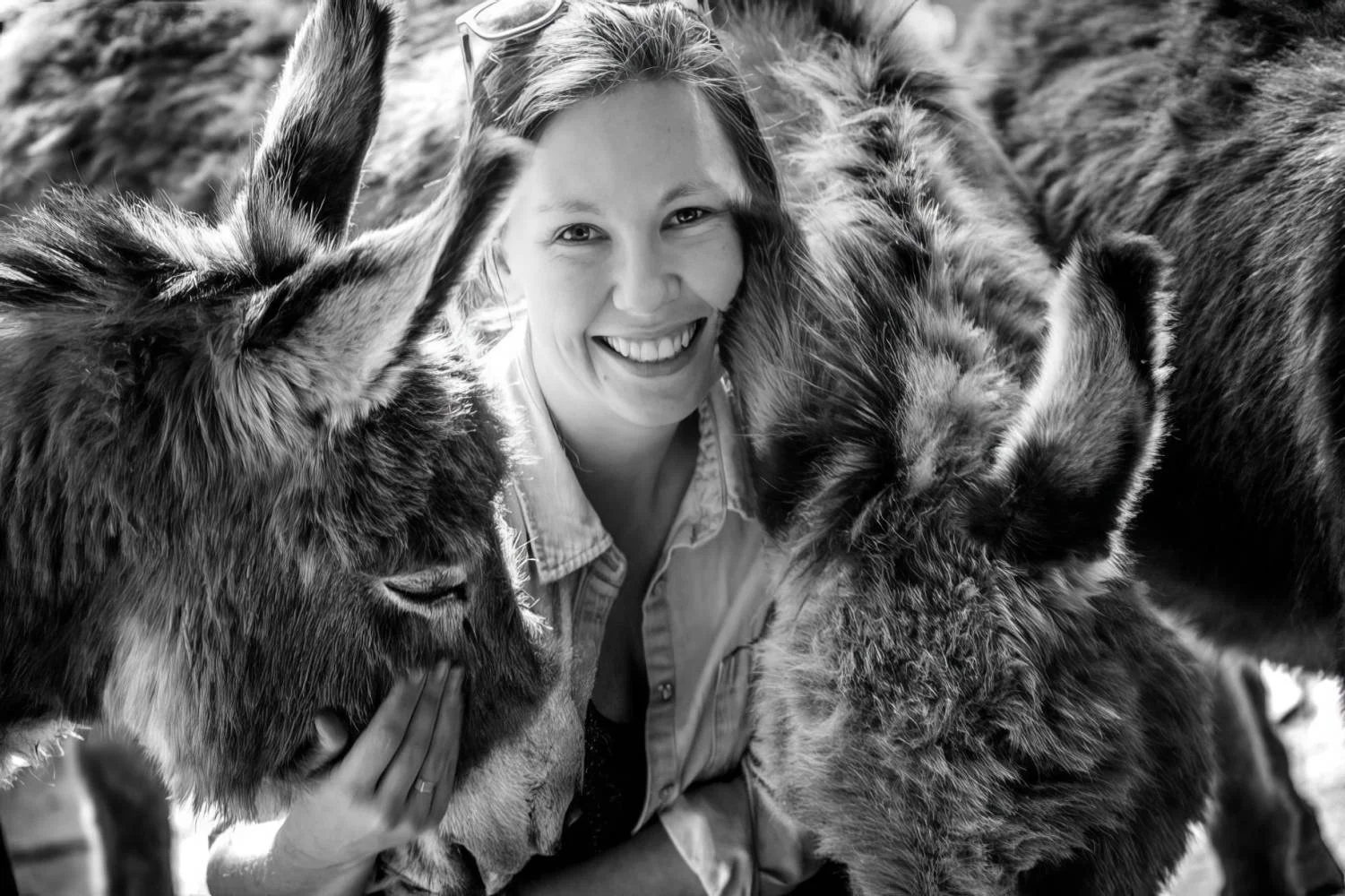
A caretaker shares time with donkeys at a vegan anymal sanctuary in Nepal. (We Animals Media)