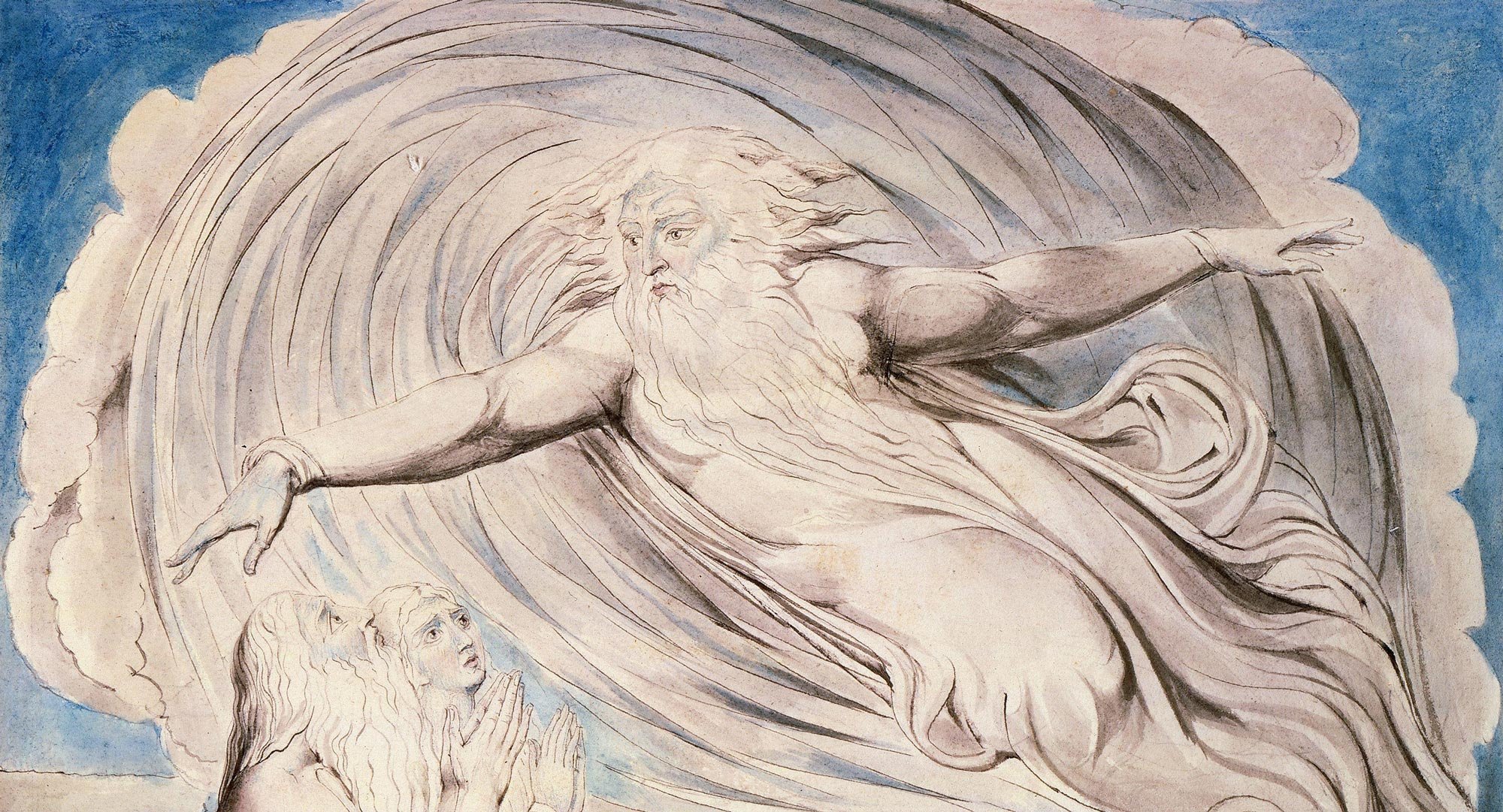
The Creator & Animals
(The Hebrew Bible)
Psalms 104:24-25
O LORD, how manifold are your works!
In wisdom you have made them all;
the earth is full of your creatures.
To serve in the image of God (as God would do) by guarding and protecting the land on behalf of the Creator (Genesis 2:15), it is important to understand more about the Creator and the Creator’s relationship with all that has been made.
Nature / Habitat
is Good / Holy
Genesis 1:24-25
God said, “Let the earth bring forth living creatures of every kind: cattle and creeping things and wild animals of the earth of every kind.” And it was so.
God made the wild animals of the earth of every kind and the cattle of every kind and everything that creeps upon the ground of every kind. And God saw that it was good.
The value of creation lies in and with God: Being of God, that which has been created is inherently good and holy. God repeatedly proclaims creation to be good before humankind is created. Sacred texts describe God as neither distant nor purposefully separate from creation: An angel of the Lord appears in a flaming bush (Exodus 3:2); God speaks through a laboring donkey (Numbers 22) and answers Job out of a whirlwind (Job 38:1–2 and 40:6). Creation is sacred.
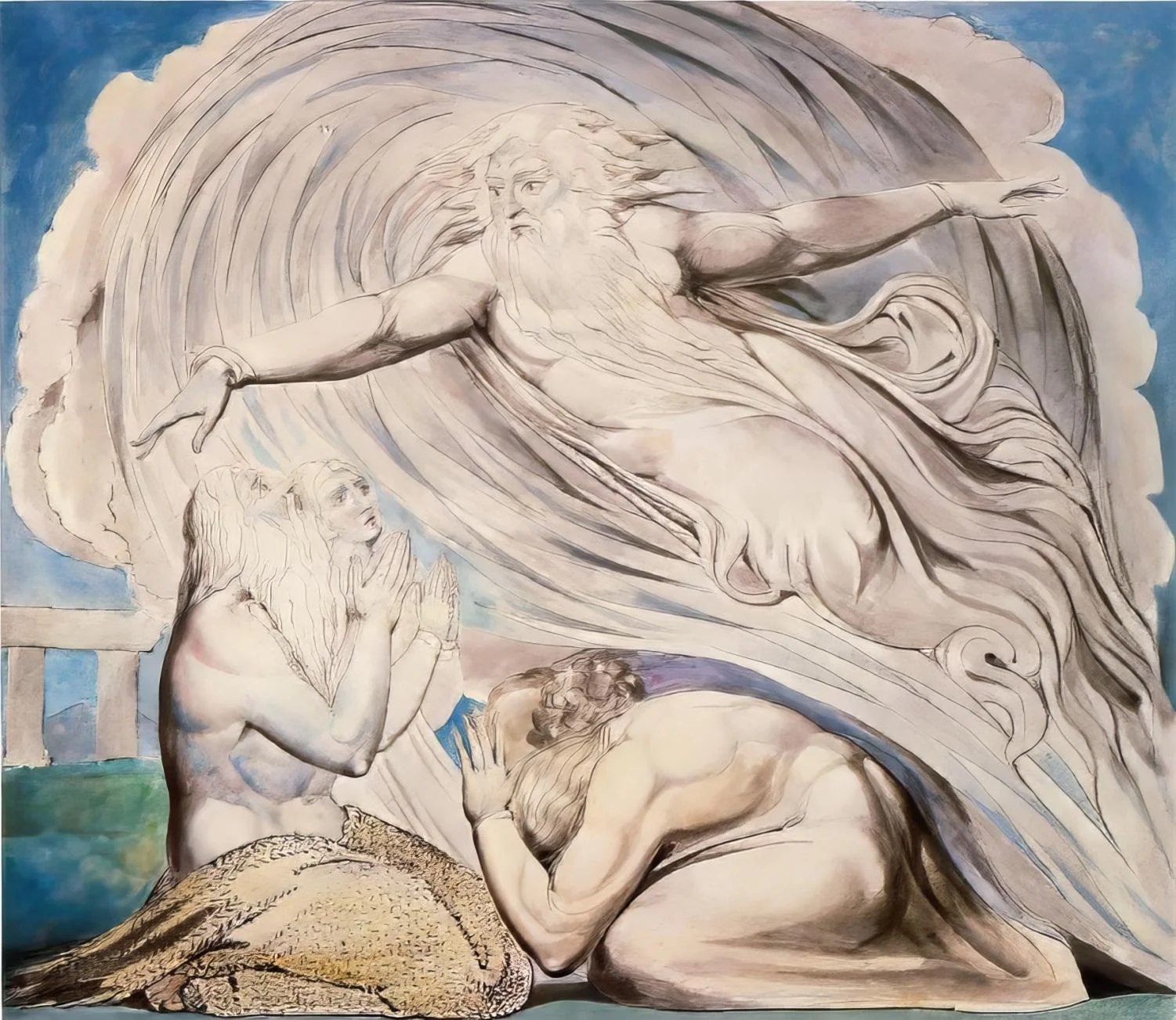
In the Book of Job, God speaks to Job from a whirlwind.
(“The Lord Answering Job Out of the Whirlwind,” William Blake, England, 1805, Wikimedia)
Sacred texts indicate that the Creator/Sustainer is present on Earth (most directly, among the Israelites), and that God demands respect for the natural world. God orders humankind not to pollute or defile the land and explicitly notes that bloodshed both pollutes and defiles the land.
Numbers 35:33–34
You shall not pollute the land in which you live; for blood pollutes the land, and no expiation can be made for the land, for the blood that is shed in it, except by the blood of the one who shed it. You shall not defile the land in which you live, in which I also dwell; for I the Lord dwell among the Israelites.
Adam was placed in the garden to guard and protect the land, and Scriptures warn that the land will punish humankind for disobedience, for failing to do God’s will. While God may be patient with our tendency toward selfish and destructive ways, the land is apparently less tolerant of violations of God’s law and will “vomit” humankind from the lands where we live.
Leviticus 18:25-28
Thus the land became defiled… and the land vomited out its inhabitants. But you shall keep my statutes and my ordinances and commit none of these abominations, either the native-born or the alien who resides among you (for the inhabitants of the land, who were before you, committed all of these abominations, and the land became defiled); otherwise the land will vomit you out for defiling it, as it vomited out the nation that was before you.
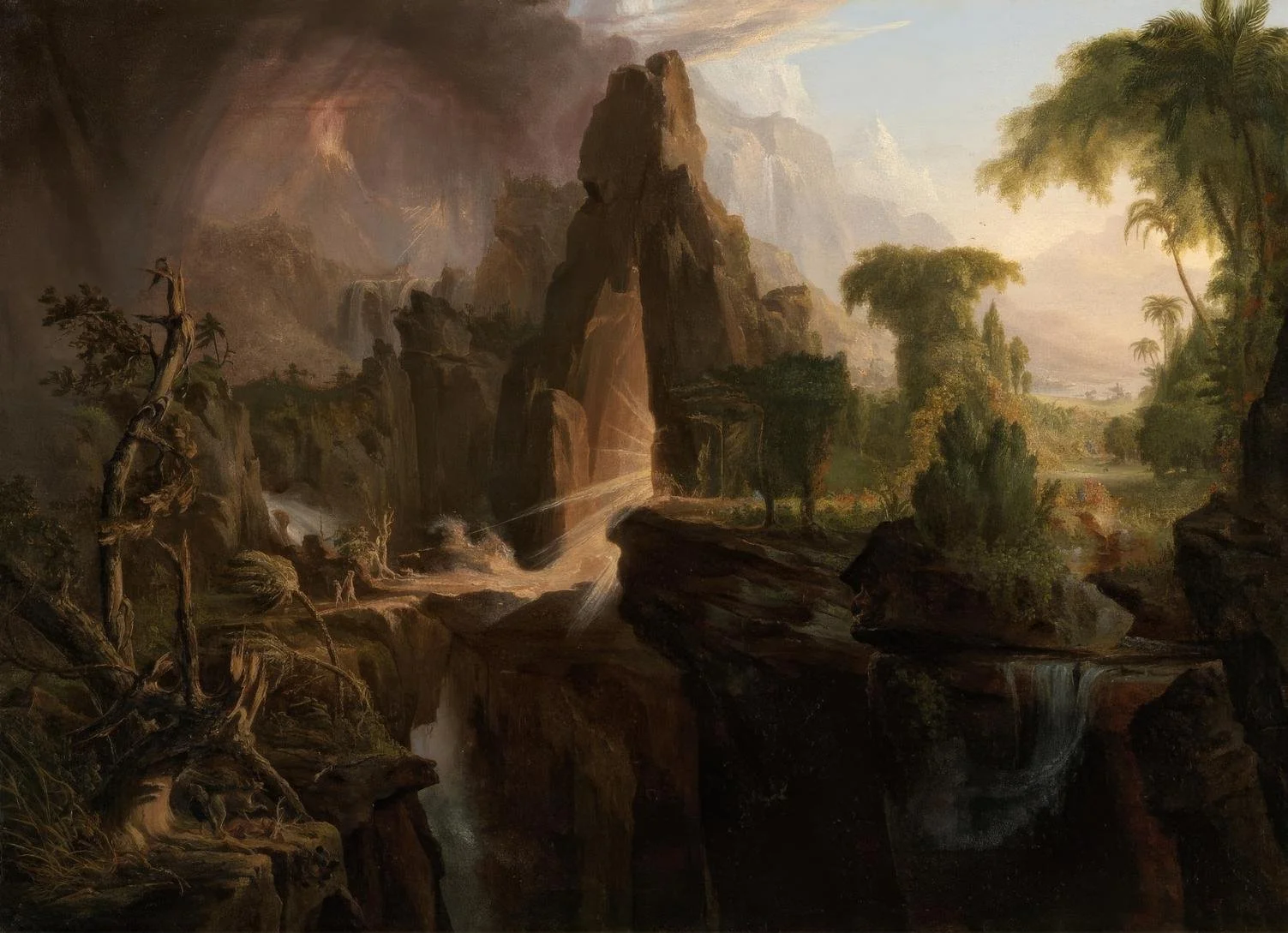
God sent Adam and Eve out of the Garden of Eden; the land can also expel humankind for disobedience—for defiling the land with blood. (“Expulsion from the Garden of Eden,” Cole Thomas, United States, 1828, Wikimedia Commons)
Sole Proprietor
Deuteronomy 10:14
Heaven and the heaven of heavens
belong to the Lord your God,
the earth with all that is in it.
All of creation belongs completely and exclusively to God. The Bible reminds: “For every wild animal of the forest is mine, the cattle on a thousand hills” (Psalms 50:10); “The land is mine; with me you are but aliens and tenants” (Leviticus 25:23). Neither the land nor the anymals are ours: Anymals are God’s, God designed this world to be vegan, and God has told us: “I know all the birds of the air, and all that moves in the field is mine” (Psalm 50:10–11).
Romans 11:36
For from him and through him and to him are all things.
We are creatures of God, servants of God who have been instructed to serve, guard, and protect the land in God’s image (as the Creator would do). The creation narrative tell us that we were not made to harm or destroy anymals–on the contrary. Bloodshed is not what God intended for humankind or for Earth.
Psalms 24:1
The earth is the Lord’s and all that is in it,
the world, and those who live in it.
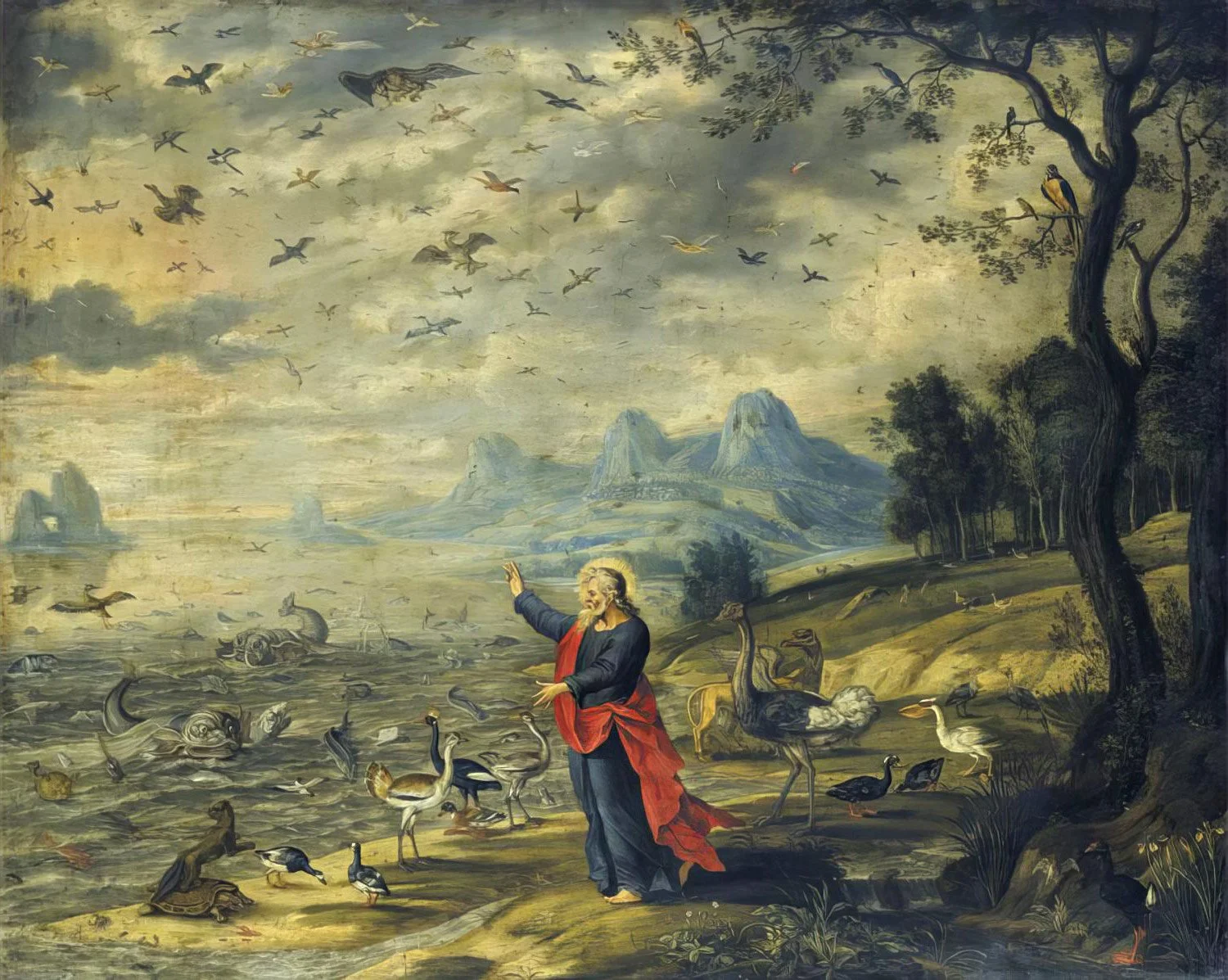
God is sole proprietor of creation.
(“Creation of Birds and Fish,” Izaak van Oosten, Flanders/Belgium, 17th Century, Wikimedia )
Fully Invested—
Compassionate & Attentive
Psalm 145:8-9, 15–17
The Lord is gracious and merciful,
slow to anger and abounding in steadfast love.
The Lord is good to all,
and his compassion is over all that he has made….The eyes of all look to you,
and you give them their food in due season.
You open your hand,
satisfying the desire of every living thing.
The LORD is just in all his ways
and kind in all his doings.
It is important to distinguish between the peaceful, benevolent, munificent Creator and that same God after human disobedience, after violence fills the Earth (Genesis 33–6). Genesis records God’s initial plan for creation, a plan of peace and kinship between all species, a plan for sharing company and tending the land that produced every green thing and the fruits of trees, which living creatures are given as food. Sacred texts, particularly Psalms, frequently describe God’s nature as benevolent and munificent, portraying the Creator as a gentle caretaker for all of life, a God who cares about and for each living being. Holy writings also show that anymals understand that they are in a relationship with a protective, nurturing God: They cry out to their Creator in times of need so that their needs may be met.
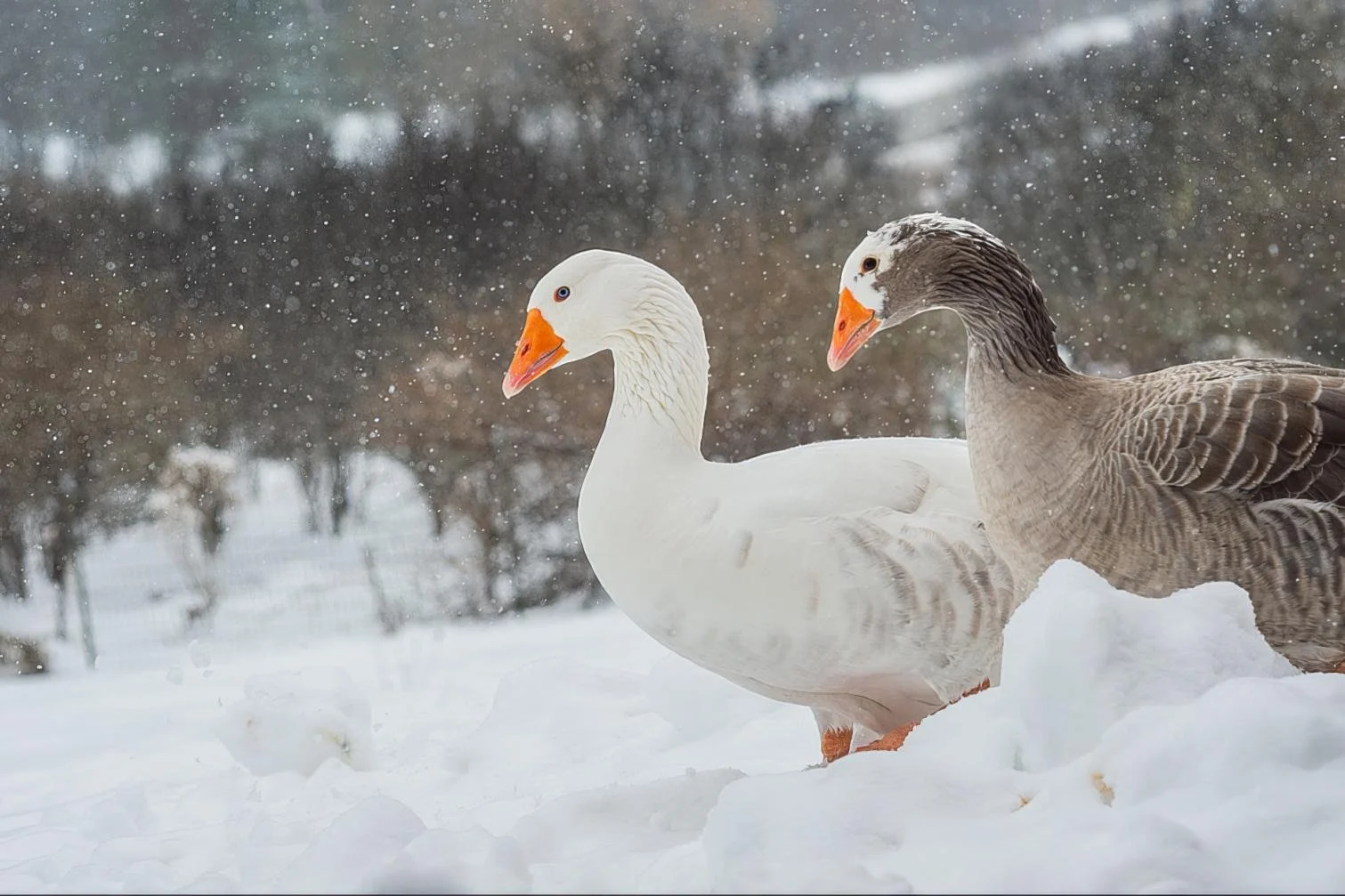
All of creation is from and of God. All that God has made carries something God’s purpose and majesty.
(We Animals Media)
Psalm 104:25-29
Living things both small and great....
These all look to you
to give them their food in due season.
Humankind tends to be selfish, but Scripture does not support a narrow, selfish approach to life or the Earth. To serve God in the image of God, we are expected to tend the land as God would do (Genesis 1:26). This does not permit exploiting anymals as petri dishes, enslaving them for entertainment, cutting them up for science, or destroying their lives for fashion, taste habits, or sport. Nor does it permit looking the other way while trillions of anymals are exploited and slaughtered in food industries. To serve a righteous and benevolent Creator who cares about every living creature, we must assist anymals in need, whether with computers, cameras, telephone calls, boots on the ground, or our own loving hands. Whether they be injured, homeless, abused, or enslaved in laboratories or on farms, Christians are called to hear the cries of anymals, not hide our eyes or carry on as if all were well for God’s creatures.
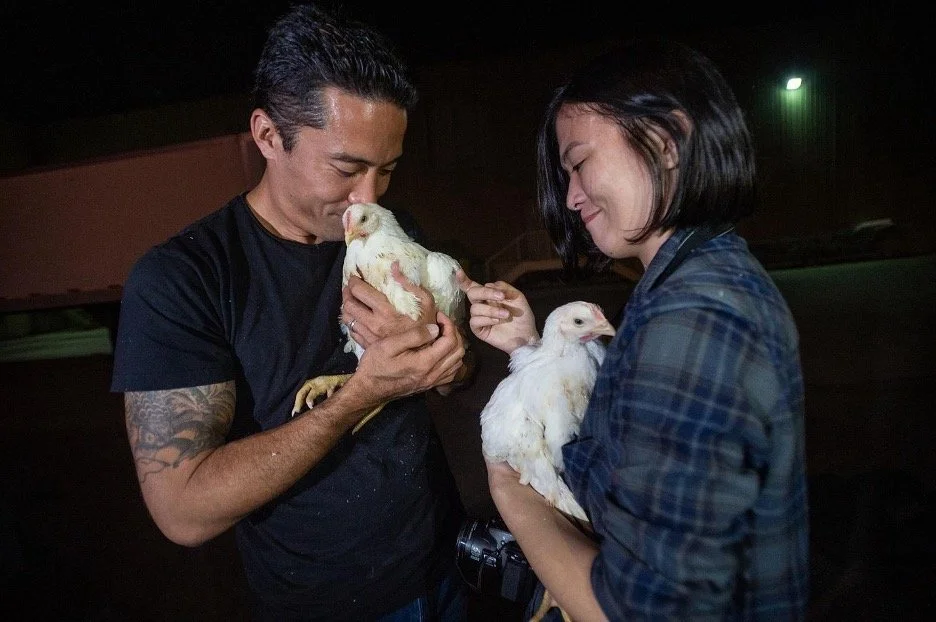
Serving God amid creation, anymal activists rescue adolescent hens from a truck outside a Canadian slaughterhouse.
(We Animals Media)
In Covenant with Animals / Earth
Genesis 9:8-15
Then God said to Noah and to his sons with him, “As for me, I am establishing my covenant with you and your descendants after you, and with every living creature that is with you, the birds, the domestic animals, and every animal of the earth…. I have set my bow in the clouds, and it shall be a sign of the covenant between me and the earth…. I will remember my covenant that is between me and you and every living creature of all flesh.”
God’s rainbow covenant is established with “every living creature” and with the Earth itself (Genesis 9: 8–17), underscoring the divine connection with and investment in all that has been made. This covenant reinforces the unity and importance of all of creation, and the Creator’s ongoing commitment as Sustainer of all that has been made. The rainbow covenant reminds Christians that to serve God is to serve the land, by guarding and protecting (on behalf of God) all that has been made. Working with God, we can bring change.
Titus 1:16
They profess to know God, but they deny him by their actions….
To understand the terrible breach of responsibilities that anymal industries represent, we must know something of contemporary practices in the food, science, entertainment, and clothing industries. Anymals suffer from artificial, forced pregnancy through the snatching of young, from a lifetime of tight confinement and socially disruptive relocations, only to be killed when profits dictate, (which means adolescence, in the food industry, where they first watch others be killed as they move toward their dismemberment). Undercover footage from around the world exposes the atrocities of anymal industries. Whether circuses or aquariums, dog breeding or horse racing, medical laboratories or product testing, whether the meat, dairy, or egg industries, anymals exploited by humankind are handled, kept, and killed in ways that it would seem impossible for any Christian to accept, let alone perpetuate or attempt to justify.
Proverbs 1:22
How long, O simple ones, will you love being simple?
How long will scoffers delight in their scoffing
and fools hate knowledge?
While it takes time to gather the necessary information to understand the depth of the problem, once we have seen the cruelties and indifference hidden behind the closed doors of massive industrialized, mechanized, anymal operations, it is easy to see why core Christian texts teach that we are to protect anymals. In truth, the whole matter is quite simple from a faith point of view: serving God and respecting God does not permit indifference to suffering or the unnecessary destruction of life, especially as a matter of routine practice on such a massive scale. From a Christian view, once we are aware of what industries try to conceal, the suffering and bloodshed that come with our food, clothing, entertainment, and medications, then anymal exploitation becomes fundamentally unacceptable. Anymals are not ours to exploit and desecrate; they are God’s beautiful, sentient creatures. Respect for anymals accompanies respect for God.
Genesis 9:15
I will remember my covenant that is between me and you and every living creature of all flesh….

Scriptures teach that the Creator, a loving and attentive God, remains invested in everything that has been made.
(“God Creating the Animals of the World,” Izaak van Oosten, Flanders/Belgium, 17th century, Wikimedia Commons)