Easter
Celebrating the Gift of Eternal Life
John 11:25-26
I am the resurrection and the life. Those who believe in me, even though they die, will live, and everyone who lives and believes in me will never die.
Easter lies at the heart of Christian hope and faith.
Easter honors the gift of eternal life, paid for with the blood of our Savior, and God’s gifts of renewal and forgiveness. While celebrating the resurrection, Easter looks to the future with a faith that lives at the very core of our hearts: Our own salvation, our return to God, an eternity with our Savior.
Human beings don’t often think about traditions because they are simply part of our lives, built into the calendar of life, but Christians are called to live thoughtfully. If believers pause to reflect, it seems counterintuitive that a holy day honoring the gift of eternal life would be celebrated by harming and destroying life. Nonetheless, this is certainly one outcome of some common Easter traditions.
John 1:36
Look, here is the Lamb of God!
Easter, the central feast of the Christian year, celebrates Christ’s victory over death and the promise of liberation from the bondage of death and decay. In many Christian communities worldwide, this feast features a meat dish—lamb.
Lamb at the Christian feast of Easter carries a symbolic reference to Christ—the Lamb of God gave his life to atone for sin and reconcile all of creation to God (Colossians 1:20). The lamb recalls the innocence of Jesus, and his gentle manner: Free of sin, he died for our sins.
John the Baptist comments that Jesus “is the Lamb of God who takes away the sin of the world” (John 1:29).
1 Corinthians 5:7
For our paschal lamb, Christ, has been sacrificed.
Luke 22:44
In his anguish he prayed more earnestly, and his sweat became like great drops of blood falling down on the ground.
1 Peter 2:24
He himself bore our sins in his body on the cross, so that, having died to sins, we might live for righteousness; by his wounds you have been healed.
Lamb & Ham

Jesus suffered and died for all—the final sacrifice. Though undeserving, we can show our respect for God with obedience—God has commanded us to guard and protect creation as the Creator would do. (“The Crucifixion,” Bartolomé Estebán Murillo, Spain, c. 1675, The Metropolitan Museum of Art)
Jesus suffered and died for all—the final sacrifice. Though undeserving, we can show our respect for God with obedience—God has commanded us to guard and protect creation as the Creator would do. (“The Crucifixion,” Bartolomé Estebán Murillo, Spain, c. 1675, The Metropolitan Museum of Art)
The choice of lamb also recalls events in Hebrew Scriptures—God freeing the Israelites from slavery in Egypt. The blood of the Passover lamb marked the Israelite homes and protected their firstborn, while Passover commemorates God’s deliverance of the Israelites from slavery in Egypt (Exodus 12:3-13; Leviticus 23:4-5).
Exodus 12:13
The blood shall be a sign for you on the houses where you live: when I see the blood, I will pass over you, and no plague shall destroy you when I strike the land of Egypt.
Exodus 12:21-23
Then Moses called all the elders of Israel and said to them, “Go, select lambs for your families, and slaughter the Passover lamb. Take a bunch of hyssop, dip it in the blood that is in the basin, and touch the lintel and the two doorposts with the blood in the basin. None of you shall go outside the door of your house until morning. For the LORD will pass through to strike down the Egyptians; when he sees the blood on the lintel and on the two doorposts, the LORD will pass over that door and will not allow the destroyer to enter your houses to strike you down.
Christians may wish to reflect on what it means to serve lamb at Easter: The meat of a lamb does not merely represent the death of innocents—it is the death of innocents. In faithful reflection, the lambs that humankind eats have not chosen to die, they have been taken from their mothers and sent to slaughter. This invites Christians to consider whether familiar Easter customs reflect the celebration’s themes of life, mercy, and renewal.
Mothering is a beautiful gift from God that ought to be honored and respected. Anyone who has bonded with young can perhaps feel for a sheep whose lamb is taken (and for lambs taken from their mothers). The prophet Isaiah (49:15) asks, “Can a woman forget her nursing child?”
James 2:13
For judgment will be without mercy to anyone who has shown no mercy; mercy triumphs over judgment.
Worldwide, vast numbers of lambs are killed for Easter feasts. Italy alone slaughtered more than 328,000 lambs for the 2024 Easter season. It is difficult to conceive of this number of little lives lost, or of their desperate, distressed, and grieving mothers.
Lambs are gentle and helpless in the hands of humankind. They are creatures of God—God’s and not ours. People of faith owe them kindness and respect. Choosing to eat lamb condemns innocents—both mothers and their young—to a sad fate: Premature and painful separation for both, and for the lambs, a restricted and dismal life before a very early death, fates that none of us would be likely to choose for ourselves.
Perhaps the depth of sorrow that Christians feel on recalling the unjust crucifixion of Christ can help to turn our hearts away from the slaughter of lambs.
Mark 15:34
My God, my God, why have you forsaken me?
Proverbs 6:16-17
There are six things that the LORD hates, seven that are an abomination to him: haughty eyes, a lying tongue, and hands that shed innocent blood….
Picture of a lamb
In some places, lamb is replaced with ham.
Pigs are also God’s creatures. The pork industry, which produces ham sold for Easter, is notorious for cramped and dirty quarters. Though it is a sad truth, one that many may prefer not to consider, on buying meat—whether from pigs or sheep—consumers pay to break the bond of mother and young. Consumers who feast on ham or lamb pay for misery and slaughter.
Picture of a pig
When living as companions in homes and at sanctuaries, when they have adequate space and are treated kindly, pigs tend to be inquisitive, clean, and friendly. They make excellent companions and share company readily, consistent with the biblical account of animals being created not in isolation, but in relationship with humankind (Genesis 2: 18-19).
Luke 6:36
Be merciful, just as your Father is merciful.
Picture of a pig
Matthew 23:37
How often have I desired to gather your children together as a hen gathers her brood under her wings….
Eggs, which symbolize new life, resurrection, and the opening of the tomb, are also common at Easter feasts and egg hunts.
Chickens who are bred and kept to produce eggs for eating are all kept in extremely tight confinement. At eighteen weeks, these hens are moved into cages that offer roughly half a square foot per hen, though a hen’s wingspan is roughly 2.5 feet. Nonetheless, these cages house three to ten birds.
The little crowded cages, where hens lay eggs to be sold for cooking, are piled on top of one another in giant sheds. Selective breeding, together with controlled lighting and feeding, causes hens to lay 280-300 eggs per year, compared with 10–15 eggs per year from their wild ancestor, the red junglefowl of India. Cages are designed so that eggs roll out of the cage and away on a conveyor belt.
As they mature, their egg production slows and they are sent to slaughter at about one and a half years of age, though healthy hens that are well cared for can live ten to fifteen years, or more. Replacement hens are grown from chicks who are hatched in commercial incubators in a separate industry.
In these industries, birds are considered an expendable source of profit—easy and cheap to replace. So easy and cheap to replace that sick or injured hens are simply killed. They receive no veterinary care.
Hens and their chicks never meet in the contemporary egg industry, or in the industry that hatches chicks to be sold as novelties for Easter. Hens forced to lay supermarket eggs, and hens whose fertile eggs are taken and hatched for sale at hardware stores, are never permitted to hatch their eggs, let alone tend their chicks.
Jesus comments on the tender care of a mother hen (Matthew 23:37). Christians are called to reflect on all aspects of our life—how does an Easter feast with eggs on the table, an egg-hunt, or a photo shoot with a hen’s tiny chick, reflect faith in Jesus?
While consumers may not fully understand how purchases or traditions harm God’s creatures, they do. Only we can change what we buy, no one else can do this for us.
2 Corinthians 6:4-6
…as servants of God we have commended ourselves… in purity, knowledge, patience, kindness, holiness of spirit, genuine love…
Eggs at Easter
A mother hen tends to her chicks, as God intended. (We Animals Media)
Matthew 5:7
Blessed are the merciful, for they will receive mercy.
Chicks symbolize spring, new life, and spiritual renewal.
Pictures and likenesses of chicks are often part of Easter displays and merchandise. Live chicks are also marketed—sold, gifted, dyed with bright colors, and misused for Easter photo shoots.
Uncounted numbers of chicks are purchased as Easter gifts, as novelties—as something for our enjoyment as opposed to a life, one of God’s little creatures.
Some people intend to raise the chick to produce eggs, but properly tending God’s fragile babies is best left to their mothers—and some chicks turn out to be roosters, and instead of laying eggs, they crow loudly every morning, and throughout the day.
In our hearts, Christians understand that chicks are not rightly used as future egg dispensers or novelties; they are a hen’s precious babies—and they are God’s, not ours. If humankind will only listen, we can hear these animals crying for mercy.
1 John 4:8 (and 1 John 4:16)
God is love.
Chicks & Bunnies
Picture of a chick
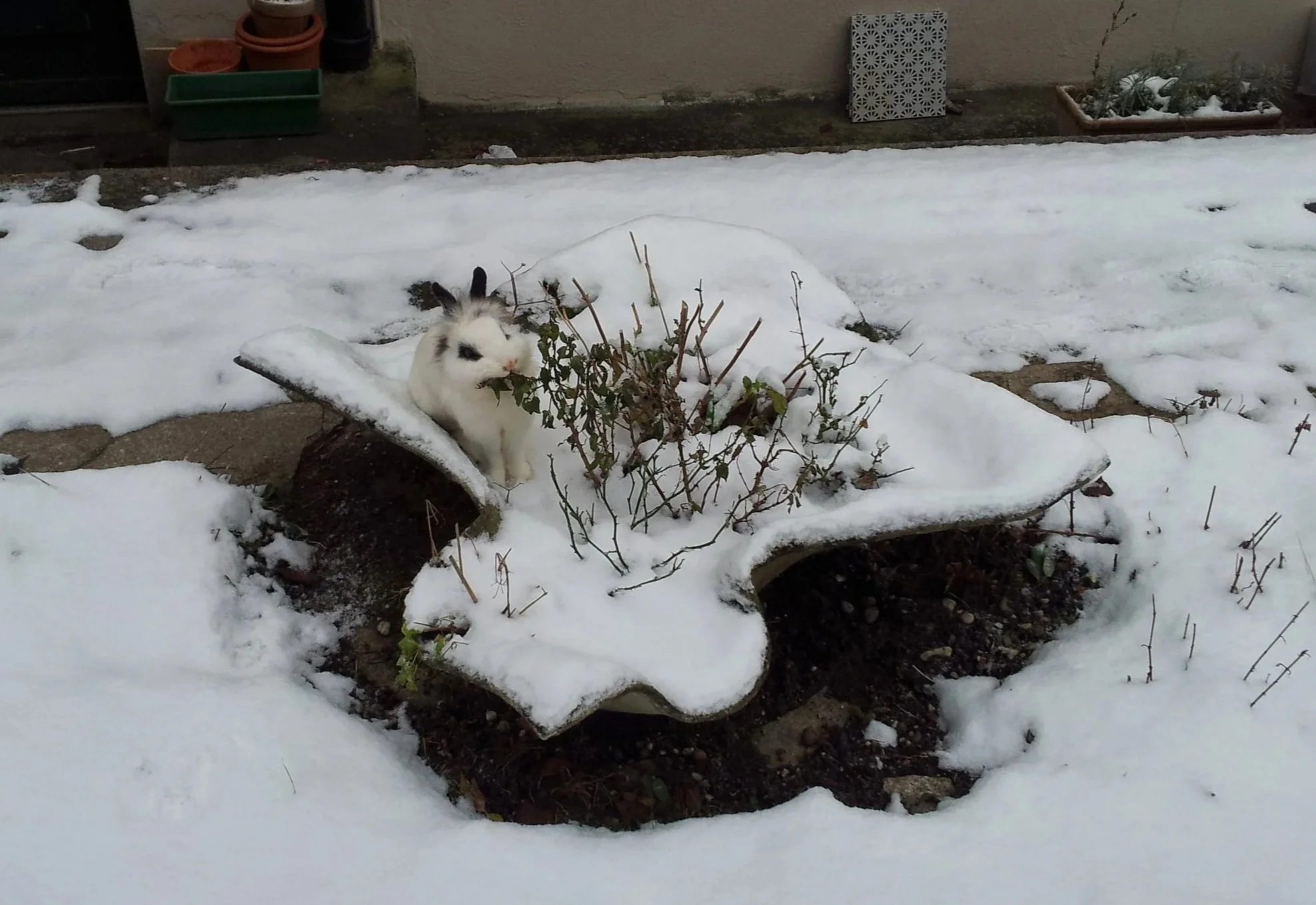
Bunnies also symbolize spring, fertility, gentleness, and new life, and like chicks, are common Easter images—especially the Easter Bunny. As with chicks, some people buy and gift bunnies as novelties or misuse them in displays or Easter photo shoots. Rabbits are highly social and benefit from rabbit companionship, and young rabbits depend heavily on maternal care.
Christians are called to respect life—animals are God’s and not ours. Christians are called to respect mothering, to show compassion for mothers and their young. Willfully separating mothers from their young—when we can choose otherwise—falls short of the love and mercy that is central to Christianity.
Parents understand that babies are fragile and vulnerable. They require warmth, the food their mother provides, and sometimes medical care. Babies also need to share company with their own kind—and God intends them to grow up: Babies require a long-term commitment.
Most of all, babies need their mothers.
Galatians 5:22–23
… the fruit of the Spirit is love, joy, peace, patience, kindness, generosity, faithfulness, gentleness, and self-control.
Picture of a bunny
Philippians 4:13
I can do all things through him who strengthens me.
Easter celebrates life. Faithful practice invites Christians to respect life throughout our Easter celebrations, including mothers who bring new life and the mother-child bond.
Genesis 1 presents a peaceful world, as created by God, where all living creatures are sustained by plant foods. Recalling the world as God intended, Christians can choose not to buy the lives of chicks, bunnies, lambs, or piglets, insisting that young stay with their mothers, where they belong.
Christians have the joy of thinking about new ways to celebrate life—eternal life—at Easter, and animals rightly play a role in our celebrations—the Bible tells us that Jesus died for all of creation, which means that animals also share the joy of the hope of salvation (Colossians 1:19–20, Romans 8:20-21, Ephesians 1:8-10). (For more on this topic, see Salvation for All in our first chapter.)
Our Easter festivities can and should not only respect but protect the innocents. In choosing a Genesis 1 feast, we remember that “through him God was pleased to reconcile to himself all things (Colossians 1:19–20 ). We can remember on this special day that God “saves humans and animals” alike (Psalm 36:6).
Colossians 1:20
… through him God was pleased to reconcile to himself all things, whether on earth or in heaven, by making peace through the blood of his cross.
Mark 10:14
…it is to such as these that the kingdom of God belongs.
Sharing Joy with Animals
Picture of an animal, I suggest a bunny