Aligning Faith & Leisure
Bullfighting & Other Sports that Harm Animals
James 3:18
And the fruit of righteousness is sown in peace by those who make peace.
What Christians do as leisure is part of faithful living.
Bullfighting, pitting animals against one another, racing animals, rodeos, hunting, and fishing, are leisure activities that depend on animals.
How might we determine if these sports are acceptable to God?
Catechism of the Catholic Church 2418
It is contrary to human dignity to cause animals to suffer or die needlessly.
1 John 2:6
…whoever says, “I abide in him,” ought to walk in the same way as he walked.
In Europe, bullfighting developed in predominantly Catholic cultures and became closely associated with Catholic feast days. Spanish conquest and colonialism later spread both Catholicism and bullfighting through much of Latin America.
Most of Spain’s population identifies as Christian, as do strong majorities in every other nation that permits bullfighting, except France, where Christians constitute slightly less than half the population. Perhaps even more disconcerting, some clergy continue to support and bless bullfighting.
Bullfights are often held during festivals honoring patron saints, embedding this sport in the Christian calendar. Matadors pray to protector saints before entering the bullfighting arena, but on reflection, it seems odd that the one who has come with sword in hand, the one who is not destined to die in the arena, should seek protection.
Genesis 49:6
Simeon and Levi are brothers; weapons of violence are their swords. May I never come into their council; may I not be joined to their company, for in their anger they killed men, and at their whim they hamstrung oxen.
Spanish bullfighting festivals honor Our Lady of Charity in Illescas, Saint Peter Regalado in Valladolid, and Saint Isidore the Farmer in Madrid. The Virgin of the Macarena in Seville is especially venerated by matadors.
Our Lady of Charity of El Cobre is the beloved patroness of Cuba. In Illescas, Spain, a distinct image of Our Lady of Charity is the town’s patroness, and bullfights are held during her festival. After more than 400 years of Spanish rule, the U.S. military government prohibited bullfighting in 1899; an independent Cuba retained the prohibition. The Virgin of the Macarena in Seville, venerated since the seventeenth century, is considered a patroness of matadors, who turn to her for protection.
There is no scriptural basis for connecting Our Lady of Charity with bullfighting.
Bullfighting, like many sports that misuse animals, is a lucrative industry. In Spain alone, bullfighting has been estimated to have an economic impact of about €1.45 billion, attracting millions of spectators annually. The Bible does not teach Christians to obey God only if there are no costs. The church is called to show the way, to take a moral stand, even if the masses—or the powerful and wealthy—do not want to hear the Word of God.
When large sums of money and human pride are at stake, and human beings are in charge, these comparatively lesser human interests will always override even the most basic interests of God’s creatures.
Luke 1:46-47
And Mary said,
My soul magnifies the Lord,
and my spirit rejoices in God my Savior….
Bullfighting & the Church
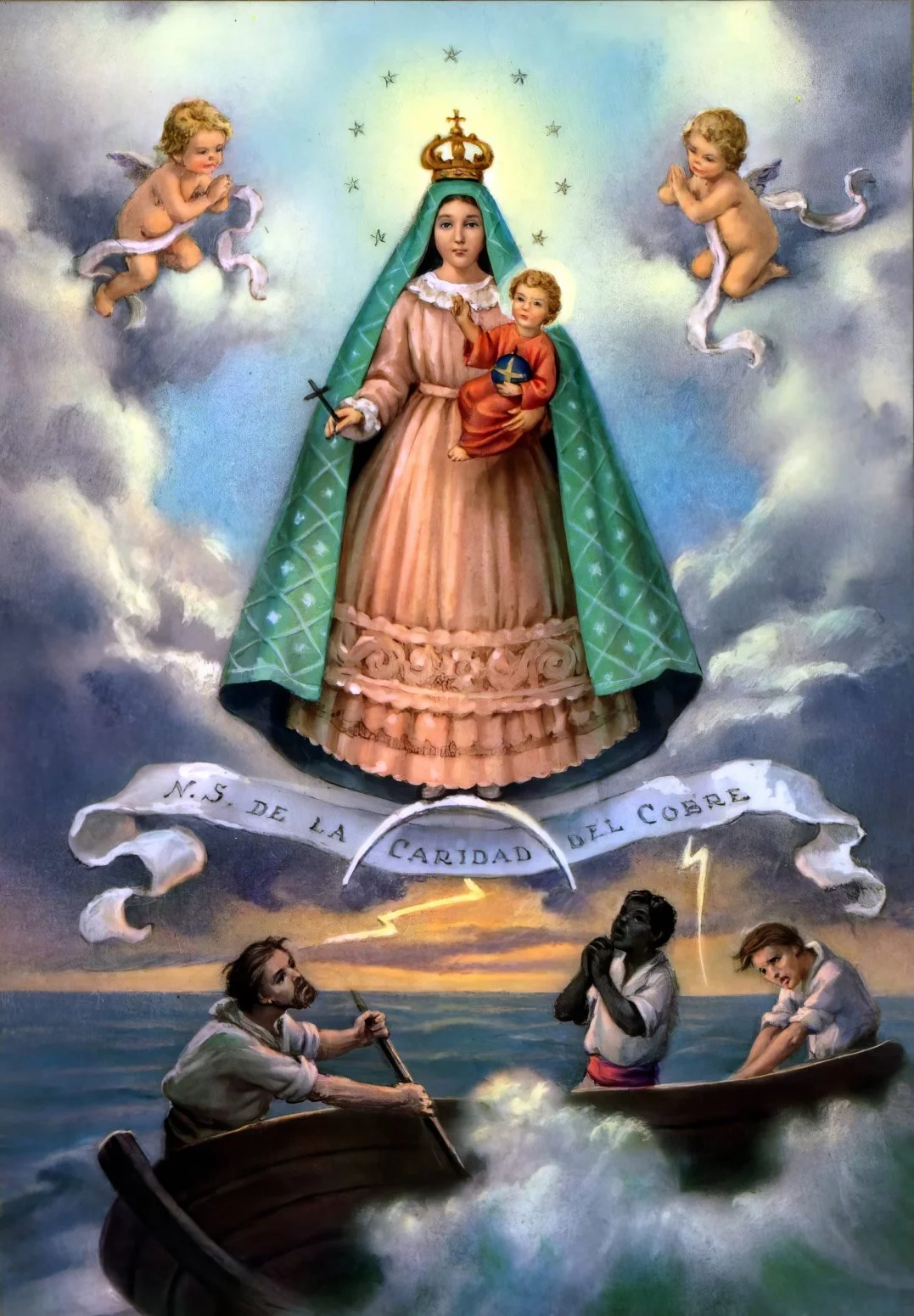
There is no scriptural or theological connection between Our Lady of Charity and bullfighting, but she is considered patroness for matadors. Bloodsports would seem an unlikely association with any Christian saint. (“Our Lady of Charity,” c. 1898, Wikimedia Commons)
Hebrews 4:12
Indeed, the word of God is living and active and sharper than any two-edged sword, piercing until it divides soul from spirit, joints from marrow; it is able to judge the thoughts and intentions of the heart.
No matter how manly and powerful a bull may appear to humankind, he is innocent—just a bull as God made him, wanting to live out his life with his own kind, as God intended.
Bulls forced into bullfighting are bred for aggression and raised in herds. They are separated from their community, forced into trucks and transported, then unloaded in radically different and entirely unfamiliar surroundings.
At some festivals, bulls are driven through public streets to the bullfighting arena, a practice known as the running of the bulls, or encierro. Participants run in front of the disoriented, nervous bulls through chaotic streets crowded with people. This sport is all about foolhardy courage, and sometimes people are wounded or killed.
The running of the bulls is central to the festival of San Fermín, named for a co-patron saint of Navarre, traditionally regarded as a late third-century Christian martyr. There is no theological or scriptural reason for connecting San Fermín with the running of bulls, or with bullfighting.
Proverbs 12:10
The righteous know the needs of their animals, but the mercy of the wicked is cruel.
Pope Francis, Laudato Si'
…every act of cruelty towards any creature is contrary to human dignity.
The Bullfighting Ritual

Add a picture
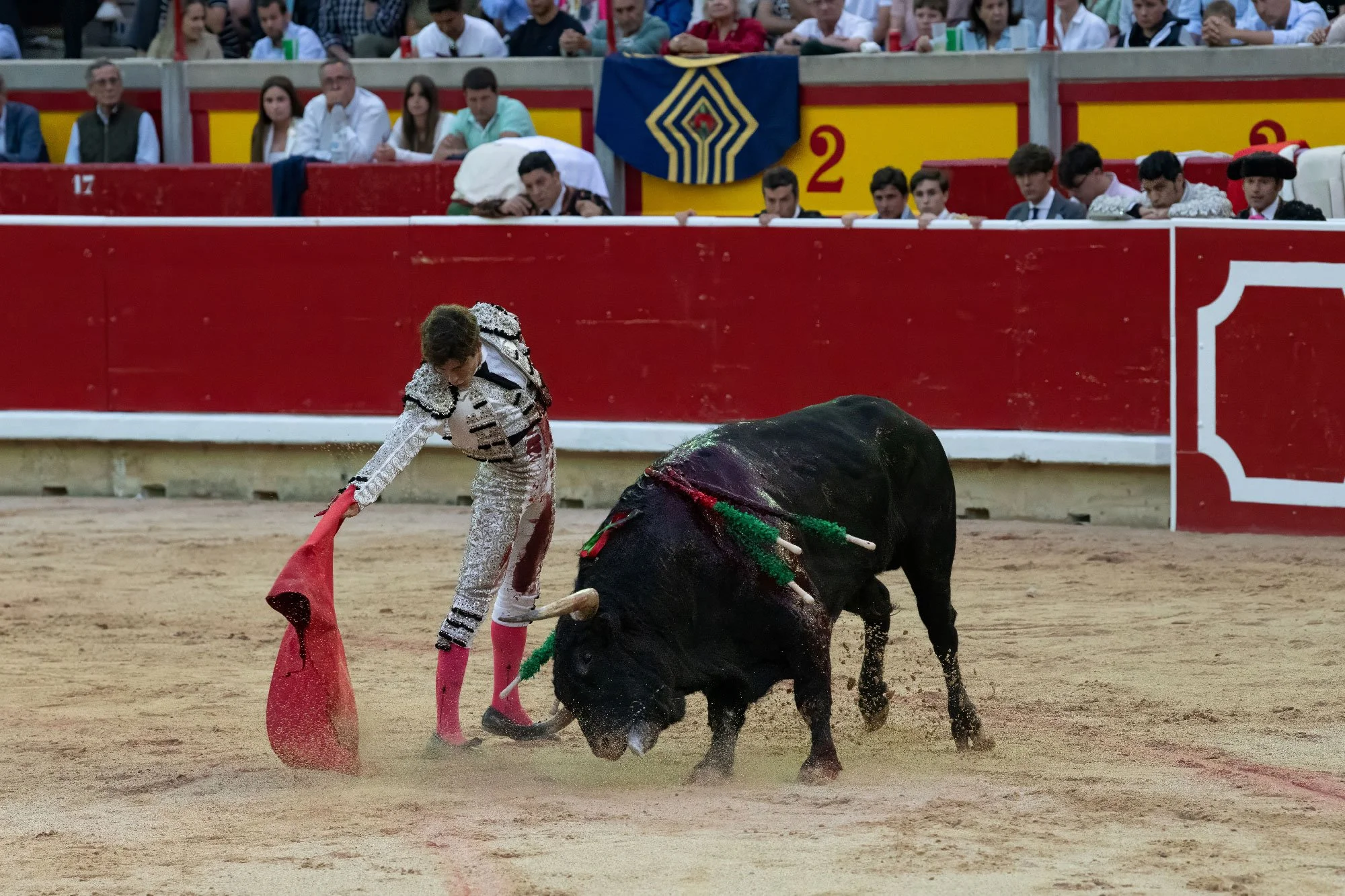
Bullfighting is not what many imagine. In a sermon delivered on Good Friday (2017) at Saint Mark’s Church in Philadelphia, Father Sean Mullen described this debilitating and unjust process:
Father Sean Mullen
There in the center of the sandy ring is the bull: strong, and brave, and noble in his power and his beauty. It is important to remember that the bull has done nothing wrong….
First, the picadors confront him on horseback, piercing him with their lances, drawing the first blood from the bull, and weakening him. Next, come the banderilleros, who jab their barbed banderillas into his flesh. There is more blood now, and a weaker bull….
Now the bull is bleeding; you can see his neck and back and sides stained red. His powerful neck has been weakened, and his head is carried lower now. The Spanish call this state “aplomado.” “When he is aplomado,” Hemingway writes, “he has been made heavy, he is like lead; he has usually lost his wind… he no longer carries his head high… he has obviously been beaten…
As this description shows, the bull, who has no choice whether or not to be part of the bullfight, is first wounded, damaged, weakened, and tormented by picadors and banderilleros, only then does the matador move in for a kill.
The bull must feel both frightened and angry before the matador even begins. It would seem difficult for the Christian heart to feel no sympathy for these large and suffering creatures of God, whose lives are deliberately sacrificed for the pleasure and profits of humankind, who are forced into an almost entirely hopeless situation where they will die a slow death.
Even then, the bull suffers, despite all the help given by picadors and banderilleros: The matador’s first thrust usually misses the mark, and multiple stabs are the norm. Bulls may die from blood loss or asphyxiation caused by damage to the lungs and airways; the spinal cord may then be cut to make the bull collapse. A veterinary review describes conscious death through blood loss or asphyxiation and characterizes the final stage as a slow dying process, and no doubt a painful one.
Psalm 73:6
… pride is their necklace; violence covers them like a garment.
Add a picture
Proverbs 11:17
Those who are kind reward themselves, but the cruel do themselves harm.
Bullfighting and the running of the bulls are entertainments, amusements—bloodsports—that breach core Christian teachings, such as the call for mercy, peace, and respect for life. Those who attend bullfighting choose to watch men wound, again and again, and ultimately kill, one of God’s magnificent creatures—an individual who suffers mightily in the process, and who has almost no hope of survival.
Some popes have had the courage to publicly oppose bullfighting. In De Salute Gregis Dominici (1567), Pope Pius V condemned bullfighting as bloody and shameful, as contrary to Christian duty and charity. He prohibited clergy from attending bullfights, imposed excommunication on both rulers who permitted bullfights and any clergy who attended, and denied church burial to anyone killed in a bullfight. In 1586, Pope Sixtus V reinforced this opposition in Nuper siquidem and prohibited clergy from attending bullfights.
Proverbs 4:23
Keep your heart with all vigilance, for from it flow the springs of life.
Faithful Opposition & Alternatives
In the Vatican, a painting of Pope St. Pius V. (unknown artist and date, Italy, Wikimedia)
Many Christians feel tension between core Scriptures and what they see in bullfighting. Some are working to ban bullfighting in their communities, states, and nations. In Mexico, bullfighting has been challenged using animal-cruelty laws, putting an end to these bloody spectacles in some states and prohibiting the wounding and killing of bulls in Mexico City.
Others have found a faithful path leading to other forms of fun.
The San Fermin in Nueva Orleans, a takeoff on the San Fermín festival in Pamplona, attracts thousands. Participants, dressed in white with red sashes, run through New Orleans fleeing “bulls,” represented by roller-derby skaters, who “gore” (swat) runners with plastic Wiffleball bats.
This secular festival provides an apt contemporary replacement that causes no stress or harm to animals. Unlike bullfighting, the festival raises money for Beth’s Friends Forever, a local charity supporting women who are fighting cancer, aligning with Christian virtues such as generosity, sharing, and service.
Ecclesiastes 8:15
So I commend enjoyment, for there is nothing better for people under the sun than to eat and drink and enjoy themselves, for this will go with them in their toil through the days of life that God gives them under the sun.
Picture from San Fermin of Nueva Orleans
Psalms 24:1
The earth is the LORD’s and all that is in it ….
Bullfighting is just one of many sports that harm God’s creatures.
Dog fighting, cockfighting, bearbaiting, goose pulling, and badger-baiting are bloodsports—these forms of entertainment harm and destroy animals. At fights, such as between dogs or cocks, or between dogs and bears, animals are forced into conflict so that onlookers can watch them damage and kill one another. Injured animals frequently receive no veterinary care; in dogfighting, losing dogs are often abandoned or killed, even brutally executed; cockfights commonly kill one or both birds.
Rodeos harm horses and cattle. Rodeo attendees watch calves as they are roped and yanked off of their feet at high speeds so that their legs can be tied. Animals and human participants can both be injured.
Races involving pigeons, camels, horses, or dogs—including the Iditarod—can cause injury and death. Because they are pushed to their limits, many animals forced to race end up with broken bones or chronic injuries and are frequently discarded. Though these animals are bred for racing, only a small minority become successful racers, and owners discard the rest. Many horses bred for racing end up in the meat industry.
Psalm 145:9
The LORD is good to all, and his compassion is over all that he has made.
Sports & God’s Creatures
Horses are socially complex and bond firmly with their herd. Mercy does not permit buying and selling them as if it did not matter where or with whom they live. (We Animals Media)
Genesis 1 presents plants as God’s original food provision for humanity, suggesting that this is what the Creator intended and preferred. When humankind has plenty of other food options, and can choose to eat something else, hunting and fishing become bloodsports: Animals suffer and die for the sake of pastime and sport.
Hosea 2:18
I will make for you a covenant on that day with the wild animals, the birds of the air, and the creeping things of the ground, and I will abolish the bow, the sword, and war from the land, and I will make you lie down in safety.
picture of an animal
picture of an animal
Suffering and loss of life are the expectation when humankind drops hooks or nets into the water. Creatures of the waterways suffer from living out of sight, and often out of mind. They also lack the familiar fuzzy appeal of many other animals. But fishes are God’s creatures.
Though they do not cry out in pain, or even grimace, fishes are sentient. Sentience is essential to protect fishes from harm as they move about underwater. Pain tells animals to move away, to be cautious, to back off.
Underwater ecosystems are among the most damaged places on Earth, perhaps in part because we cannot see these fragile parts of creation. Many fish species are critically endangered, many are at risk of extinction, all caused by humankind’s activities.
Fishing harms fishes. Catch and release also tends to leave fishes unable to survive. And hooks and nets are indiscriminate—they catch non-target species by mistake, including rare and protected species. Cycles of stocking and depleting favored fish species also damages ecosystems, crowding out native species, and depleting food supplies when stocks are high.
Waterways and the edges of waterways are particularly fragile aspects of creation. When fishers walk across these landscapes and into waterways, they damage plants and small animals. When a fishing line breaks, the plastic line and hook survive more or less indefinitely, harming and frequently killing birds, reptiles, and fishes when they become entangled.
Once entangled in fishing line, or caught on fishhooks, animals have little chance of survival. It is likely that both she and her chicks perished because of this fishing line. With one parent hopelessly tangled in fishing line, it is unlikely that she or her chicks survived. (We Animals Media)
Christian hunters and fishers may indicate that their primary interest is securing time with God, time in the beauty of creation, time to marvel at all that God has made, and time to unwind and get away from civilization. It is easy to be close to God and nature without carrying a weapon or fishing pole, and without killing God’s creatures—hiking, biking, boating, or just walking peacefully with Jesus.
For many Christians it is difficult to imagine Jesus out for a day of hunting, carrying a gun, hoping to kill one of God’s creatures. It is also difficult to imagine Jesus baiting a line or watching fish slowly die in a bucket.
This vision of Jesus as a sportsman is contrary to what the Gospels tell us about our Savior—he healed, he was attentive, and he spoke on behalf of those whose lives were marginalized. Christians are called to walk in the footsteps of our Savior, and growing plants in a community garden provides an excellent way of walking quietly and peacefully with God while spending time with others.
For more on the fishing industry, see Industrialized Fishing in the next chapter, or the book, Eating Earth.
Galatians 1: 10
Am I now seeking human approval or God’s approval? Or am I trying to please people? If I were still pleasing people, I would not be a servant of Christ.
The Bible does not teach Christians to enjoy sport at the expense of the lives of God’s innocent creatures. The Bible is very clear that some things are not acceptable, including cruelty and the wanton destruction of life.
On reflection, bloodsports stand in stark opposition to core Christian teachings of love, mercy, and respect for God. It is disrespectful to value the lives of God’s animals according to how well they compete in our games, or to consider them expendable for our entertainment. Such sports are an apt example of sinful hubris.
Modeling our lives on the life of Jesus leads us to help rather than harm the innocents—those who have no swords, no guns, no understanding of what is happening to them at the hands of humankind. Jesus has shown us how to serve God, how to live with compassion and love, how to respect life—Christians are called to be healers, to help those others find unworthy of care.
The faithful respect God by respecting creation.
For more on fishing, hunting, animals, and the Earth, see Eating Earth. Our next chapter explores Living the Gospel in daily life—how what we do each day affects God’s creatures, focusing on food choices. Our final segment, Advocacy, introduces both historical and contemporary voices that bear witness for animals from a Christian perspective.
Romans 12:2
Do not be conformed to this age, but be transformed by the renewing of the mind, so that you may discern what is the will of God—what is good and acceptable and perfect.
Matthew 5:7
Blessed are the merciful, for they will receive mercy.
Faithful Practice & Sport
The Gospels point Christians away from bloodsports, including hunting and fishing, for those who have plenty of other food options. (“Salvator Mundi,” Quentin Metsys, Flemish, Belgium, c. 1500)