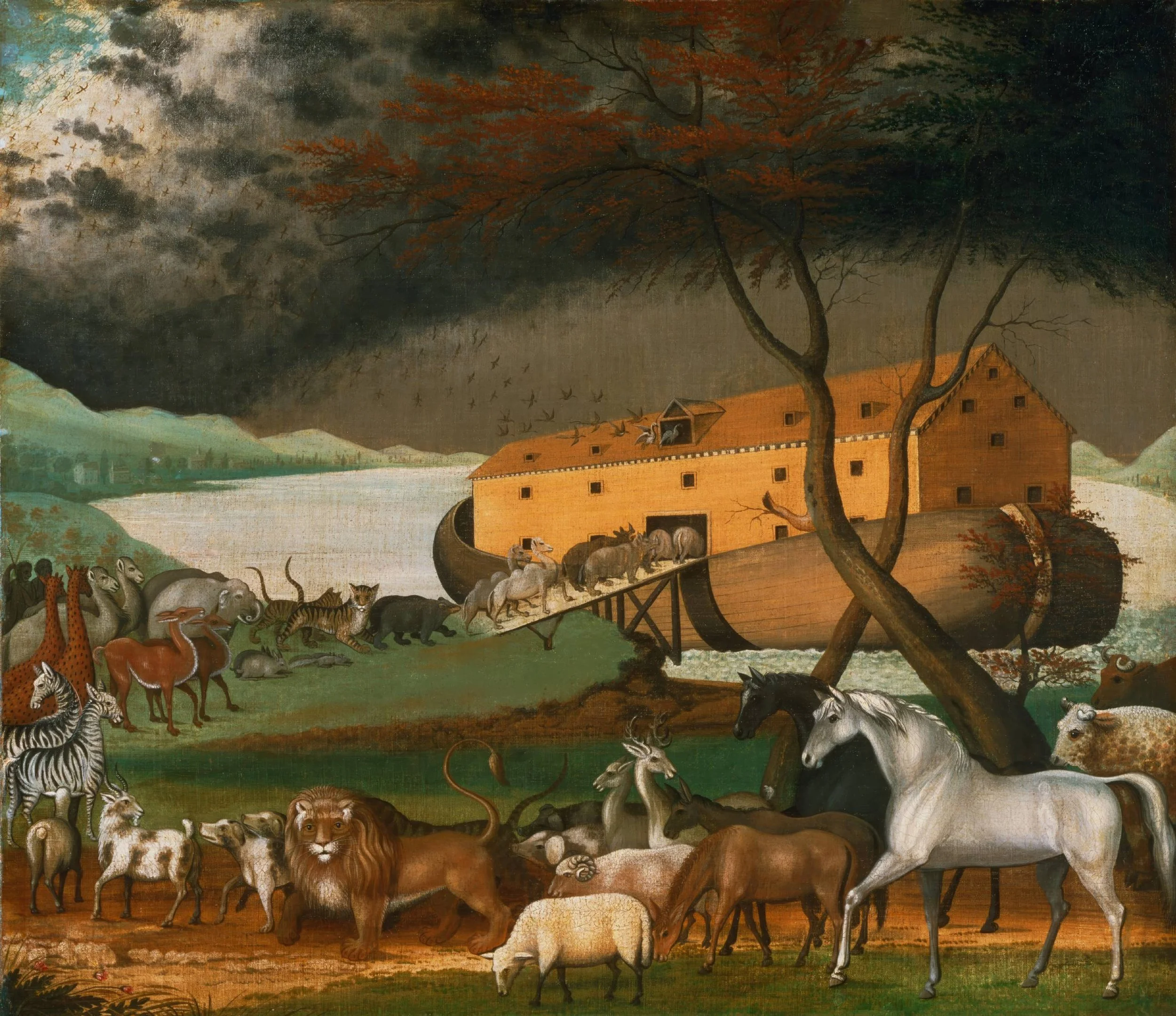
Genesis 9:3 in Context
Corruption, Serving God, and Christian Love
Genesis 1:29
God said, “See, I have given you every plant yielding seed that is upon the face of all the earth and every tree with seed in its fruit; you shall have them for food.Genesis 9:3
Every moving thing that lives shall be food for you, and just as I gave you the green plants, I give you everything.
Genesis 6:11-13
Now the earth was corrupt in God’s sight, and the earth was filled with violence. And God saw that the earth was corrupt, for all flesh had corrupted its ways upon the earth. And God said to Noah, “I have determined to make an end of all flesh, for the earth is filled with violence because of them; now I am going to destroy them along with the earth.”
Humankind cannot know all the reasons why God ordained a diet of plants in Genesis 1:29. That said, it is increasingly clear that eating meat, dairy, and eggs carries a very high price for animals, and also for the planet and humankind.
To explore this topic, we turn to Genesis, to see how this change came about—from a plant diet commanded by God in Genesis 1 to a world where uncounted Christians accept, as a matter of course and largely without question, eating meat, dairy, and eggs.
Violence is important to the unfolding of this change. When the Earth became “filled with violence” (Genesis 6:11), Scriptures tell us that God brought judgment in the form of a great flood, destroying almost all of what had been made (Genesis 6:17). It is difficult to imagine any stronger statement against violence.
Psalm 11:5
The LORD tests the righteous and the wicked, and his soul hates the lover of violence.
Colossians 3:12
Therefore, as God’s chosen ones, holy and beloved, clothe yourselves with compassion, kindness, humility, meekness, and patience.
Violence is Corruption
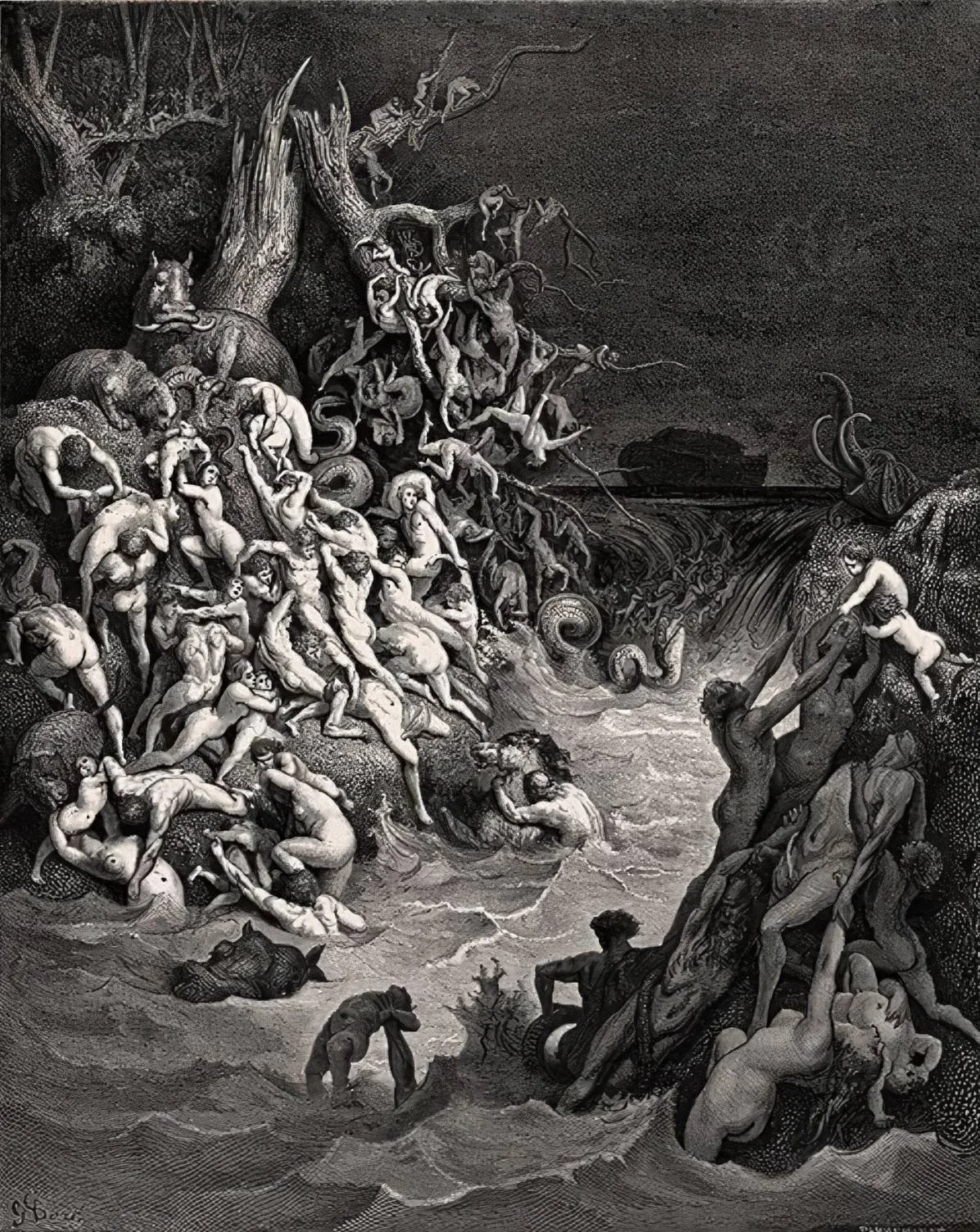
Seeing that corruption/violence had filled the earth, God brought a great flood. (“Flood Destroying the World,” Gustave Doré, France, 1866, Wikimedia Commons)
Genesis 6:11-13 links violence and corruption to the point where readers may see violence as corruption—a corruption of the peaceful Genesis 1 world created by God (Genesis 1:29-30 and 2:16).
Merriam-Webster dictionary defines corruption as “a departure from the original plan or from what is pure or correct.” Violence is defined as something that will “hurt, damage, or kill someone or something,” intentionally or unintentionally, whether the harm be physical or mental.
In our daily lives, it is important for Christians to remember that God strongly dislikes violence and corruption.
The Bible also warns against hypocrisy (Matthew 23:25-26)—against believing/saying one thing while doing another. Jesus addresses this lack of integrity directly and frequently, calling for alignment between faith professed and the way we live.
Woe to you, scribes and Pharisees, hypocrites! For you clean the outside of the cup and of the plate, but inside they are full of greed and self-indulgence. You blind Pharisee! First clean the inside of the cup and of the plate, so that the outside also may become clean.
Warnings against hypocrisy invite each of us to examine the space that we sometimes unintentionally develop between core Christian teachings and how we live the Gospels.
Blind spots can persist between faith and living the Gospels for many reasons, such as routines and habits, cultural worldviews and mainstream practices, and because change can be difficult. Faithful discernment asks us to explore whether we apply mercy, compassion, and care consistently, keeping an eye to God’s creatures—even when doing so challenges widely accepted practices.
What at first may seem demanding, uncomfortable, unusual, or even undesirable, with reflection and by giving something a fair trial, become a simple and natural expression of faith as we walk with Jesus. With this type of commitment and willingness to adjust, we bring our daily choices and behaviors into closer alignment with what core beliefs.
Faithful reflection helps us to understand animal agriculture as violence and as a corruption of what God intended for Earth and living creatures, a corruption of the peaceful world that God created in Genesis 1.
James 1:22
But be doers of the word and not merely hearers who deceive themselves.

On Mother’s Day, pregnant women in India protest the separation of cows from their young in the dairy industry. (PETA)
1 Peter 1:15-16
…as he who called you is holy, be holy yourselves in all your conduct, for it is written, “You shall be holy, for I am holy.”
Genesis 9 tells Christians that God has given us “everything” to eat, but in a biblical context, is this the best choice that Christians can make? We may eat meat, dairy, and eggs, but is it what Christians ought to do?
God created a peaceful world where we were to eat only plants (Genesis 1:29-30 and 2:16). God told us what we are to eat in Genesis 1. The Bible tells us that God made creation without predation.
If God created the world to be peaceful, and if God created living beings to eat only plants, then is this not what God prefers? Given this, how do we walk most faithfully with God?
Genesis 9 permits eating meat, dairy, and eggs, but the Bible clearly teaches that we may not eat literally “everything.” To eat everything would conflict with core Christian ethics. We are not to eat endangered animals—as servants of God, we are to protect and tend what God has made. Waste and garbage were not made for us to eat, nor was tar or petroleum. We may eat these, but it is not what God has told us is preferred.
1 Corinthians 6:19
Or do you not know that your body is a temple of the Holy Spirit within you, which you have from God, and that you are not your own?
1 Corinthians 3:16-17
Do you not know that you are God’s temple and that God’s Spirit dwells in you? If anyone destroys God’s temple, God will destroy that person. For God’s temple is holy, and you are that temple.
The tone of Genesis 9 reaffirms this truth, and the importance of God’s Genesis 1 plan for sustenance. Leading up to the point where God grants “everything” as food, the Creator tells humankind that this change brings “fear and dread” to the animals—between animals and humankind.
Genesis 9:2-3
The fear and dread of you shall rest on every animal of the earth and on every bird of the air, on everything that creeps on the ground and on all the fish of the sea; into your hand they are delivered. Every moving thing that lives shall be food for you, and just as I gave you the green plants, I give you everything.
Fear and dread were not part of the Earth as created by God. Genesis and Biblical ethics tell us that God created, commanded, intended, and thereby prefers a peaceful world. We were created as one community, set on this planet to live as kin, keeping one another company. We were created with land animals on the 6th day, we share nephesh chayyah, and Genesis 2 tells us that animals and the first woman were created so that the first man would not be alone—we were created to share company. We were given plants as food (Genesis 1:29). God created a peaceful, harmonious world, free of fear and dread.
Eating “everything”

What about a very nice vegan food picture here.
There is yet more to dissuade the faithful from eating meat, dairy, and eggs. Immediately after granting that we may eat “everything,” Genesis provides life-protecting restrictions against eating flesh with its blood (Genesis 9:4).
Eating flesh always entails eating blood: Blood is pumped throughout all bodies, all meats, which includes the flesh of mollusks, fishes, and crustaceans. Because flesh inevitably retains some blood, this restriction may be understood to effectively reverse what has just been permitted, banning the eating of flesh of any kind.
Genesis 9:4
Only, you shall not eat flesh with its life, that is, its blood.
Blood, important for circulating oxygen, runs through all flesh, including the flesh of fishes, reptiles, mollusks (hemolymph), birds, and mammals. (We Animals Media)
God provided abundant plant foods. The Bible tells Christians that God intended, commanded, and prefers a Genesis 1 diet. The Creator permits eating “everything” only after humankind has proven both disobedient and violent.
Christians are called to follow Jesus, to love and compassion, to serve God in our daily lives here on Earth. Jesus has shown us how to tend to the needs of those others assume to be beneath our attention and our care.
Today, given the cruelty of modern animal agriculture, we are invited to revisit Scripture, especially the first chapters of Genesis, and Christian ethics in the Gospels, and to ponder how our food choices affect God’s creatures, and whether or not what we eat is a reflection of our faith.
Genesis 1:29
God said, “See, I have given you every plant yielding seed that is upon the face of all the earth and every tree with seed in its fruit; you shall have them for food.”
Faithful discernment, pausing to reflect, prayer and quiet meditation—all of these help us to discern what God asks of us. We also need some understanding of what goes on behind closed doors. We need to understand how the meat, dairy, and egg industries affect animals—what happens to God’s creatures before we buy their flesh, milk products, and eggs?
From a practical point of view, choosing a Genesis 1 diet asks that we shop for plant foods, and when we do, this is what we have on our shelves and in our lunchboxes, cars, and backpacks. While full realization and change may take time, Christian discernment asks not only what is permitted, but also what actions will best reflect love, mercy, and responsibility.
Choosing plant foods is a practical way to express Christian values.
John 14:15
If you love me, you will keep my commandments.
Picture octopus
Cruelty is forbidden. Faithful Christians are invited back to a Genesis 1 diet, to avoid meat, dairy, and eggs. If we choose to eat animal products, we pay for a great deal of suffering, and we pay to bring animals to a very early death.
God does not approve of cruelty. Jesus has shown us kindness and compassion.
Lamentations 3:22
The steadfast love of the LORD never ceases, his mercies never come to an end….
Genesis 49:6
May I never come into their council; may I not be joined to their company, for in their anger they killed men, and at their whim they hamstrung oxen.

A demonstration encouraging a Genesis 1 diet on International Peace Day in India. (PETA)
Luke 4:8
Worship the Lord your God, and serve only him.
It is not possible to “serve two masters” (Luke 16:13, Matthew 6:24), and Christians are called to serve God, not wealth or the flesh.
Faithful decisions cannot reasonably be based on culture, habit, or the satisfaction of personal preferences. Christian decisions are rightly rooted in Scripture, and a close, personal relationship with Jesus.
Throughout life we are to strive to become holy and perfect. We are to work, day by day, to bend our lives to God’s will—to move past our willful ways and yield to the will of God.
1 Peter 1:16
You shall be holy, for I am holy.
Matthew 5:48
Be perfect, therefore, as your heavenly Father is perfect.
Matthew 6:10
May your kingdom come. May your will be done on earth as it is in heaven.
In God’s perfect world, all creatures lived peacefully in community, without violence or bloodshed. God created a perfect world, providing “every green plant for food” (Genesis 1:29).
Scriptures tell us that we are headed back to God’s Peaceable Kingdom, to the world that the Creator intended, where humankind will not harm any of God’s beautiful creatures (Isaiah 11:9, Matthew 6:10; and the life of Jesus).
Isaiah 11:6-9
The wolf shall live with the lamb;
the leopard shall lie down with the kid;
the calf and the lion will feed together,
and a little child shall lead them.The cow and the bear shall graze;
their young shall lie down together;
and the lion shall eat straw like the ox.The nursing child shall play over the hole of the asp,
and the weaned child shall put its hand on the adder’s den.They will not hurt or destroy
on all my holy mountain,
for the earth will be full of the knowledge of the LORD
as the waters cover the sea.
Christians are invited to work with God, to restore peace. Choosing to buy eggs, dairy, or meat pays for violence, suffering, and bloodshed. Choosing a Genesis 1 diet is to choose peace, as Genesis 1 shows us that God intended.
When we seek grace and spiritual discernment, in time, we can better see cultural conditioning that has established our comfortable habits, our go-to food choices. With grace, we are able to gain enough separation from culture and habits to choose what we would like to eat, to better see what food choices best reflect our faith.
When we move away from eating meat, dairy, and eggs, we serve God here on earth by showing mercy and love at every meal.
Luke 6:36
Be merciful, just as your Father is merciful.
Serving God’s interests
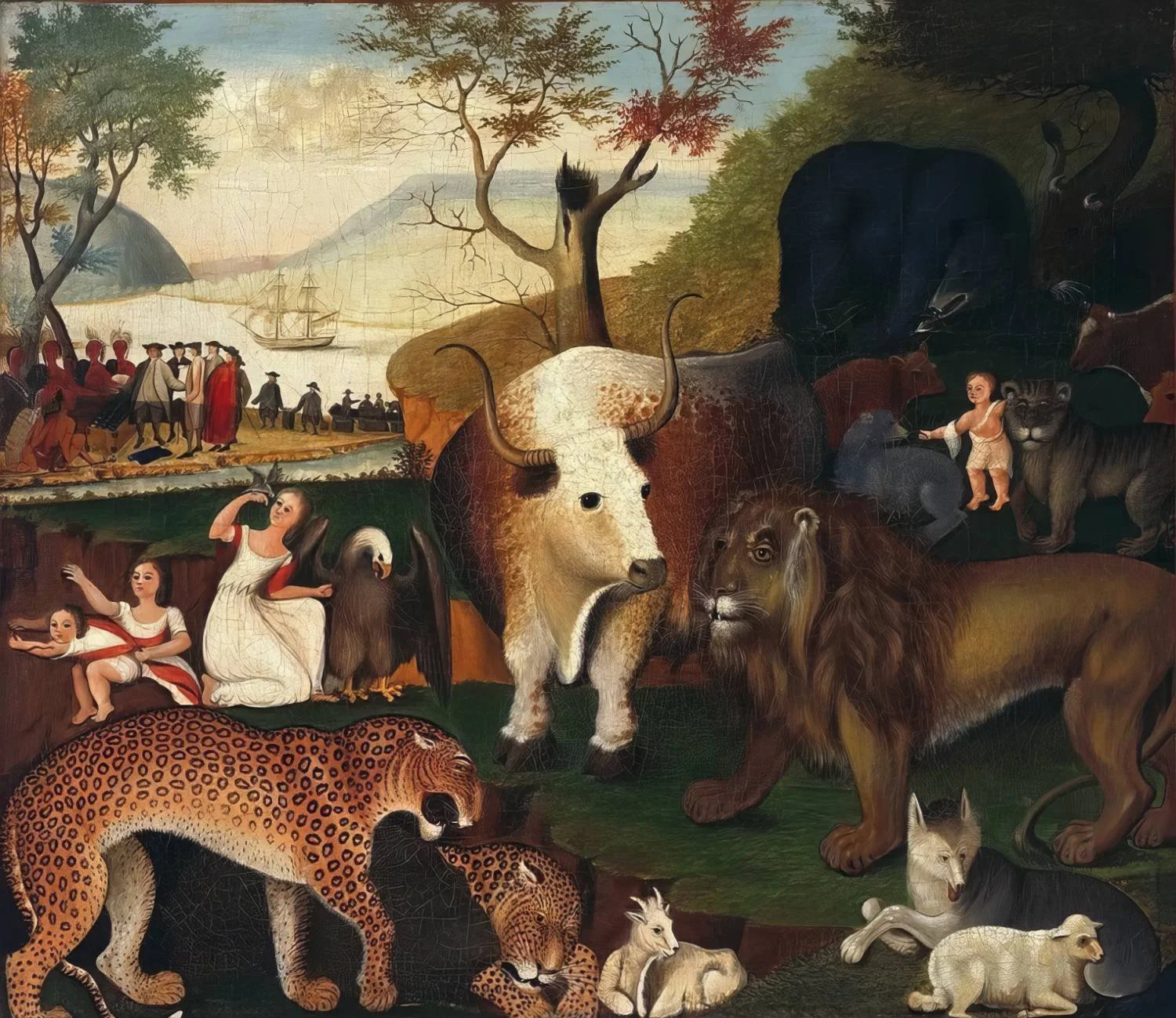
The creation narrative teaches that God created a world of peace, where all creatures lived in community—without predation—and that we are headed back to this great peace. (“The Peaceable Kingdom,” Edward Hicks, United States, 1820s, Wikimedia Commons)
1 John 4:8 and 1 John 4:16
God is love.
In his time on Earth, Jesus lived the perfect Christian life, a life filled with acts of compassion and kindness. Jesus showed us what generous love looks like, love that reaches beyond cultural barriers. Our Savior modeled self-sacrificing service toward those his peers deemed too lowly to be worthy of his tender care.
Jesus expanded the moral circle by refusing to participate in exclusion and indifference. He served those others could not be bothered with, those others would not touch. Jesus showed us that it is not our place to decide that some are worthy of our time and energy, that some deserve compassion and care, while others do not.
God is sole proprietor of all that exists. The Bible tells us that our Creator cares for every living being. Christians are called to love expansively. We are to serve God by tending all of this groaning creation.
We may wonder whether, because animals eat one another, we are entitled to eat them. But Christians are not called to model our behavior on the lives of hyenas and alligators. We are to look to Jesus. We are called to love, and to serve God by caring for creation.
1 Corinthians 13:13
And now faith, hope, and love remain, these three, and the greatest of these is love.
When Christians clearly see how the production and consumption of meat, dairy, and eggs harms God’s creatures, compassion steers us toward a Genesis 1 diet.
To create dairy products, newborn calves are taken from their mothers and sent to slaughter. To produce eggs, hens are kept in tiny, crowded cages until they are sent to slaughter. To market flesh of any kind, there must be bloodshed—and the blood shed is that of God’s creatures.
We are invited to explore different choices. When Christians learn of the suffering perpetuated by the purchase of eggs, dairy, or flesh of any kind, the expansive and generous Christian heart begins the process of finding new ways both at home and for church.
Catechism of the Catholic Church 2418
It is contrary to human dignity to cause animals to suffer or die needlessly.
Ecclesiastes 3:1
For everything there is a season and a time for every matter under heaven….
Each of us must discern, in our own time and way, how to faithfully and obediently serve God by guarding and protecting creation as God has told us to do (Genesis 2:15). The beauty and power of Scripture, combined with reflection and prayer, guide Christians as we discover all that love and responsibility ask of us. We are called to faithfully examine our daily lives to assess where our choices cause harm to animals, and with grace, change accordingly.
To explore what the Bible has to say about animals and what is expected of us, see Teachings.
1 John 4:19
We love because he first loved us.
Expanding the Moral Circle
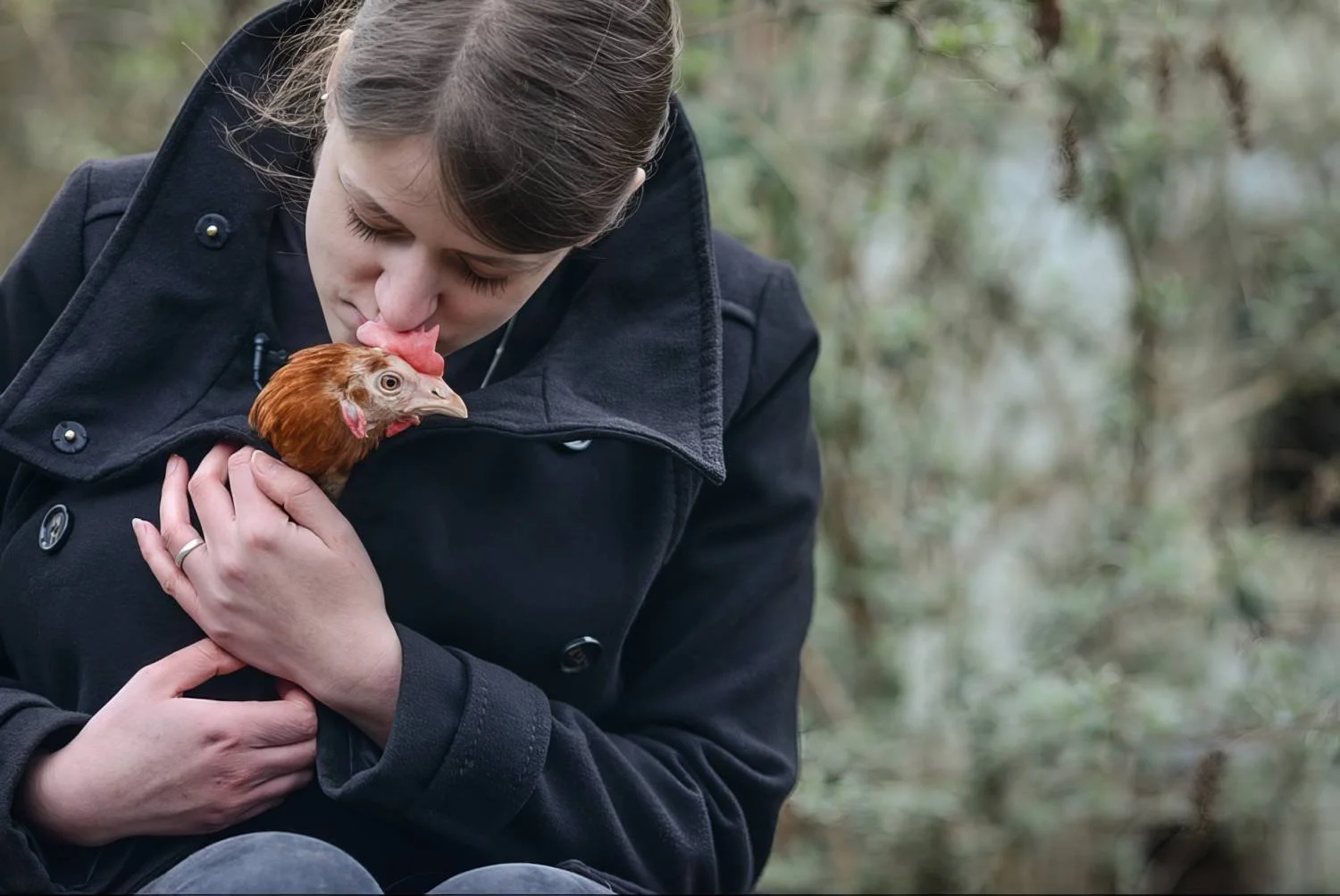
At a sanctuary in Denmark, a hen rescued from the egg industry is provided with loving care while awaiting adoption. (We Animals Media)