Peter’s Vision
Peter’s Vision
False Assertion
Peter’s Vision teaches that we can and should eat all foods that God has given, including anymals.
Acts 10:9–16
Peter went up on the roof to pray. He became hungry and wanted something to eat; and while it was being prepared, he fell into a trance. He saw the heaven opened and something like a large sheet coming down, being lowered to the ground by its four corners. In it were all kinds of four-footed creatures and reptiles and birds of the air. Then he heard a voice saying, “Get up, Peter; kill and eat.” But Peter said, “By no means, Lord; for I have never eaten anything that is profane or unclean.” The voice said to him again, a second time, “What God has made clean, you must not call profane.” This happened three times, and the thing was suddenly taken up to heaven.
Peter’s Vision
Counterpoint #1
Today, Peter’s Vision calls for a vegan diet.
1 Corinthians 6:12
“All things are lawful for me,” but not all things are beneficial.
Peter’s vision does not require Christians to kill and eat living creatures, but it does call Christians to remove barriers that block the spread of the Good News of salvation. In Peter’s time, Jews were forbidden to eat pagan food or dine in pagan homes, yet the apostles were tasked with making “disciples of all nations” (Matthew 28:18–20). Peter’s vision indicates that a change is necessary for this to happen, as is clear by the end of the story: Peter breaks with common conventions and receives gentiles as guests, who thereby received the Holy Spirit (Acts 10:44).
Acts 10:44-45
While Peter was still speaking, the Holy Spirit fell upon all who heard the word. The circumcised believers who had come with Peter were astounded that the gift of the Holy Spirit had been poured out even on the gentiles….
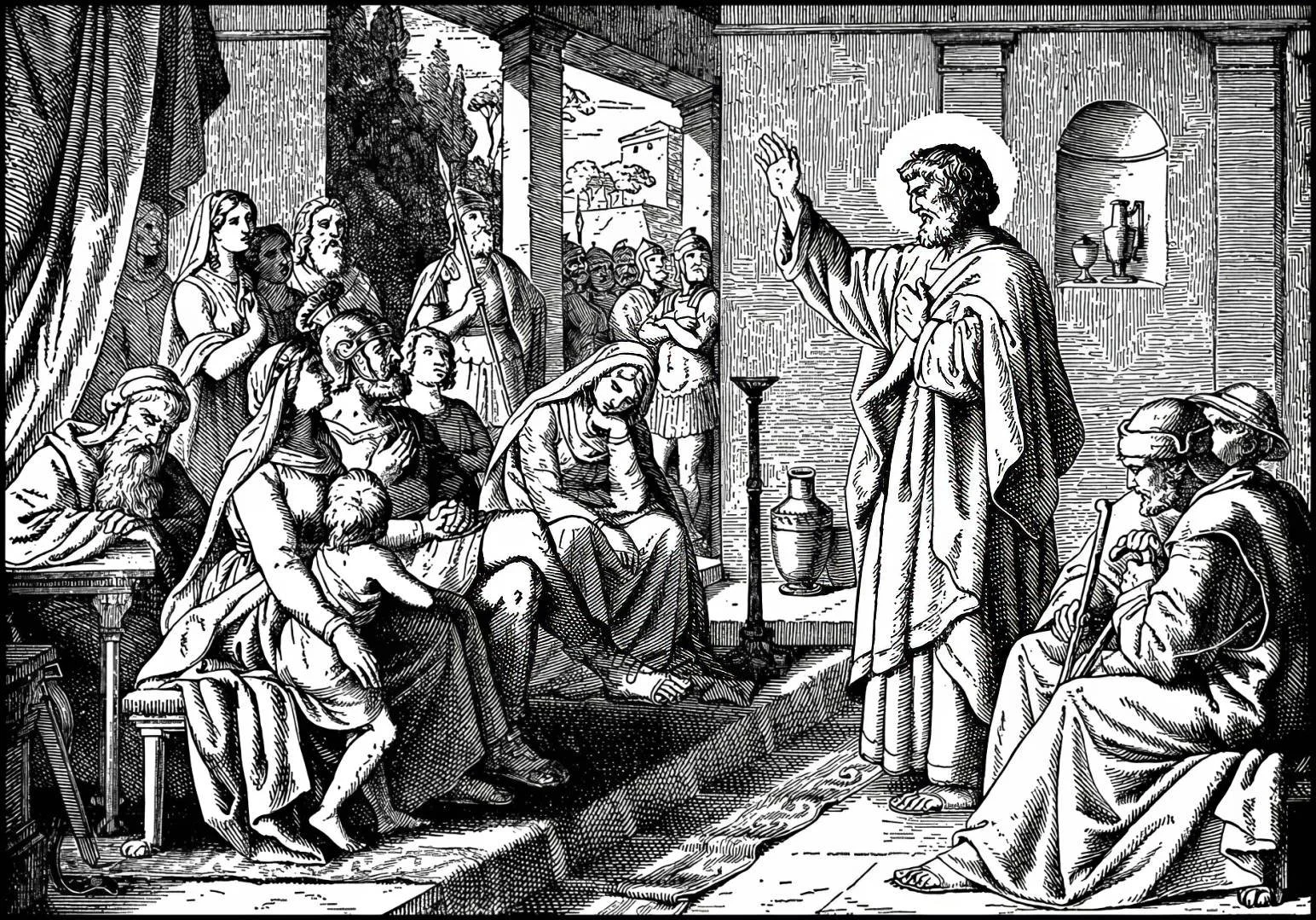
Peter broke with convention to reach all for whom Jesus died. Today, churches are called to kick the convention of eating meat, dairy, and eggs in order to attract and hold vegans. (“Peter Preaches to Jews and Gentiles,” ClipArt Etc.)
Today, many vegans have left their churches because they feel alienated by sermons that ignore mass suffering and anymal deaths on factory farms and in laboratories, because ministers and priests ignore the health and environmental problems caused by omnivory and vegetarianism, because they are overtly and repeatedly excluded from after-service milk and cookies, Sunday afternoon barbeques, and ice-cream socials, and also because some vegans don’t choose to be around the smell or sight of flesh, dairy, or eggs.
To understand your brothers and sister in Christ, try to imagine how you might feel watching someone eating the flesh of the young and the innocent, or smelling such things while you are eating. Perhaps this can offer some understanding for those accustomed to eating anymal products as to what some vegans may feel when eating around omnivores and vegetarians.
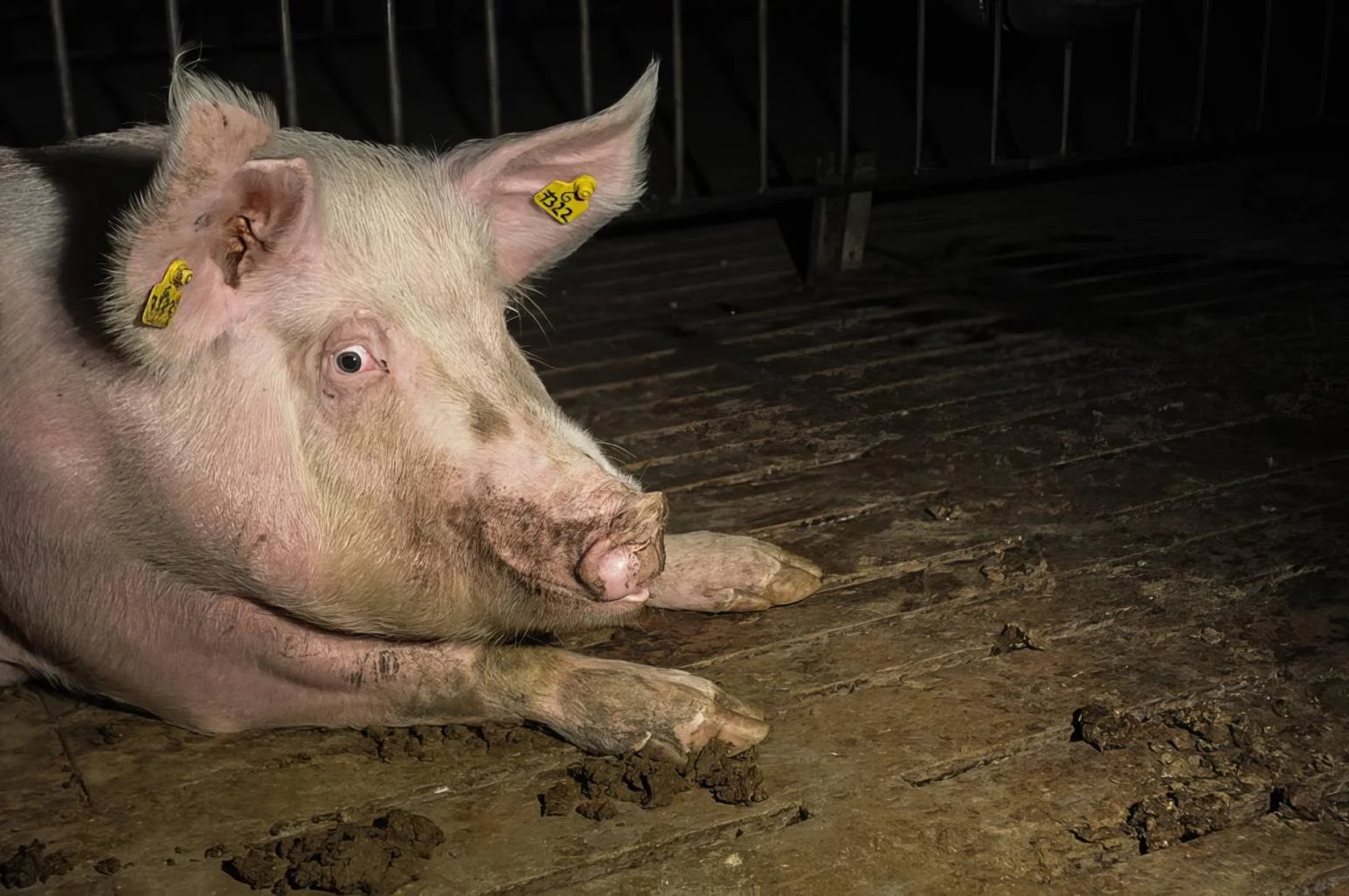
Pig confined in an industrial farming facility. (We Animals Media)
Matthew 23:13
But woe to you…. For you lock people out of the kingdom of heaven…. and when others are going in, you stop them.
Peter’s vision indicates that it is permissible to eat flesh, but we already know this from Genesis 9; we also already know that what is permitted is not necessarily preferred. Peter’s vision, which addresses the problem of barriers blocking the spread of Christianity, warns against food choices that cause division or exclusion. Given that everyone eats vegan foods while vegans do not eat non-vegan foods, to avoid driving vegans from the fold, Peter’s vision challenges churches, at a minimum, to always accommodate vegans. Churches wishing to be sure that they never drive even one vegan from the fold will need to discuss how best to shift to a fully vegan church—a church that can always welcome every vegan to any church function.
Saint Peter (“Saint Peter,” Pompeo Batoni, Italy, 18th Century. Wikimedia.)
Peter’s Vision
Counterpoint #2
1 Corinthians 8 and Romans 14 affirm that Peter’s Vision calls for a vegan diet.
1 Corinthians 8:8-13
“Food will not bring us close to God.” We are no worse off if we do not eat, and no better off if we do. But take care that this liberty of yours does not somehow become a stumbling block to the weak…. Therefore, if food is a cause of their falling, I will never eat meat, so that I may not cause one of them to fall.
Paul warns the faithful not to eat foods that might cause others to stray from the path of salvation (in his day, foods that had been “offered to idols,” 1 Corinthians 8:4). Such foods are not forbidden. They are to be excluded because they might cause someone to stray or prevent someone from receiving the Good News. It is good not to eat or serve anything that might drive people from the fold. Romans 14 provides the same caution.
Romans 14:15–21
If your brother or sister is being injured by what you eat, you are no longer walking in love. Do not let what you eat cause the ruin of one for whom Christ died.... For the kingdom of God is not food and drink but righteousness and peace and joy in the Holy Spirit.... Let us then pursue what makes for peace and for mutual upbuilding. Do not, for the sake of food, destroy the work of God. Everything is indeed clean, but it is wrong to make someone stumble by what you eat; it is good not to eat meat or drink wine or do anything that makes your brother or sister stumble.
Nowadays, congregations that serve anymal products risk alienating vegans, and in so doing “sin against” vegans and “sin against Christ” (1 Corinthians 8:12). Today, choosing to serve anymal products is choosing to “destroy the work of God” (Romans 14:20) both literally (killing anymals and harming the Earth) and figuratively (blocking the spread of the Word of God to vegans). Peter’s vision, Romans 14:15–21, and 1 Corinthians 8:8–13 all remind Christians of the importance of inclusivity, which now calls Christians to build vegan-friendly churches. Perhaps the easiest way to begin serving vegan food in church gatherings is to initially allow that you don’t have to be vegan, but the food does, overtly granting time for each church member to make their own personal transition.
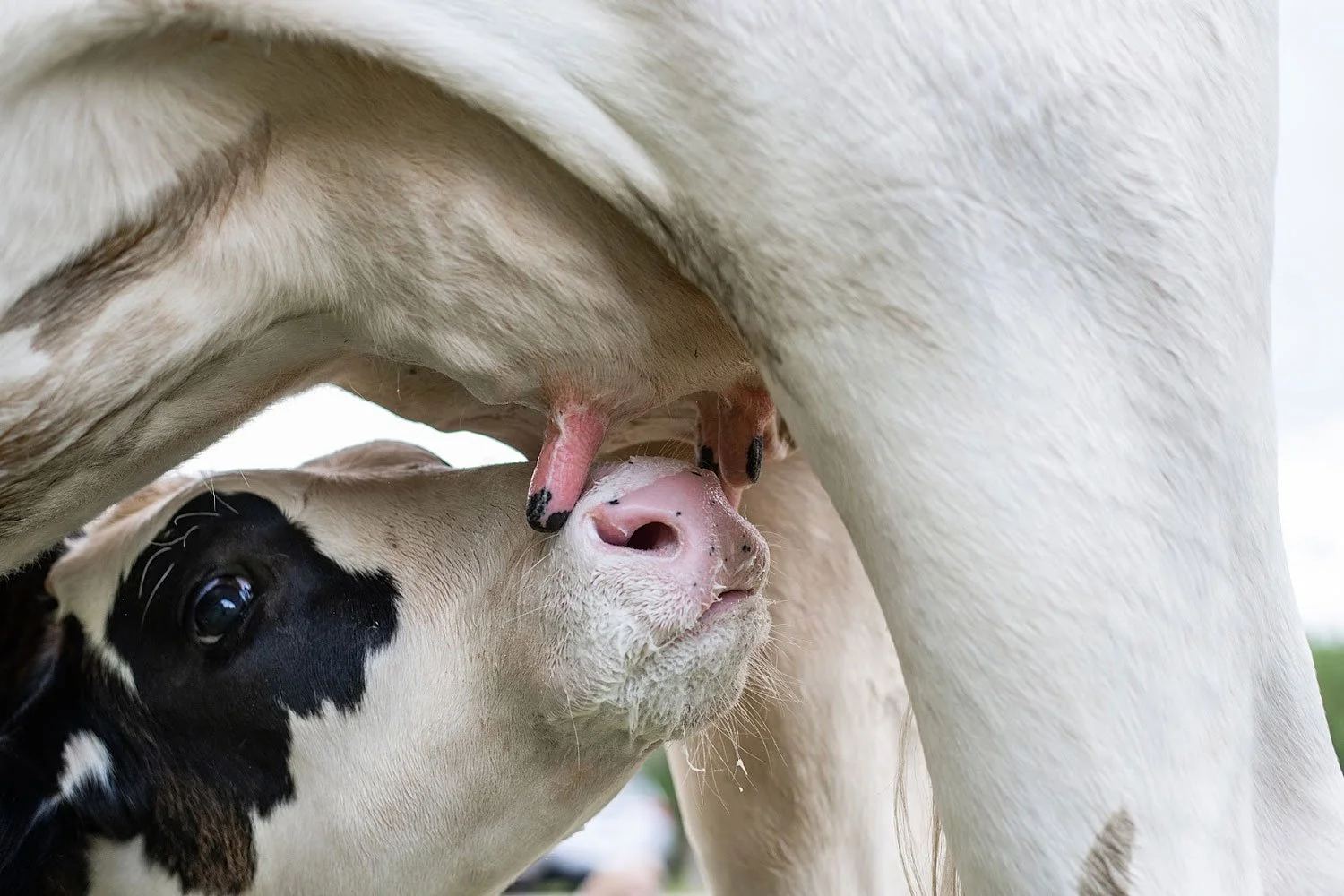
A calf at a sanctuary comes to mama for milk, reminding us who cow's milk is for. (We Animals Media)
Peter’s Vision
Counterpoint #3
Mark 7 also indicates that Peter’s Vision now calls for a vegan diet.
Mark 7: 18-21
Do you not see that whatever goes into a person from outside cannot defile, since it enters, not the heart but the stomach, and goes out into the sewer?” (Thus he declared all foods clean.) And he said, “It is what comes out of a person that defiles. For it is from within, from the human heart, that evil intentions come.
Jesus taught that bodily functions are not a reasonable focus for Christian ethics, which are rightly rooted in the heart and expressed in good works, in following the example set by Jesus, in serving God by attending to the needs of those whom others find too insignificant to be worthy of attentive care, including both anymals and vegans.
Vegan food
Matthew 25:40
Truly I tell you, just as you did it to one of the least of these brothers and sisters of mine, you did it to me.
Vegans are a small percentage of the population in every nation, perhaps easily overlooked by congregations—but not by God. Fortunately, it is easy to provide food that everyone can eat: vegan cookies and plant milks, nuts and vegan crackers, nondairy fudgesicles and pancakes, or pizza, lasagna, spaghetti, and cupcakes made without anymal products. (Yum!) And on reflection, we may realize that to exclude those who come to us would be a failure of care that is absolutely a breach of core Christian ethics. When we fail to accommodate vegans, instead of spreading the Good News, we unwittingly spread bad news: “We are not prepared to receive you into our flock or share hospitality with you; we do not intend to accommodate your sensitivity to suffering or to honor the depth of your compassion; we do not and will not accommodate vegans in this church!” Seen from this light, it is much easier to understand why so many vegans have left their churches, and why, on seeing these sensitive souls for who they are, given time to adjust and bring about change, churches will almost surely adjust food offerings to facilitate the spread of the Good News of Jesus.
Matthew 18:5
“Whoever welcomes one such child in my name welcomes me.”

Sensitive to the sufferings and death of newborn calves, and the pains of mother cows when their young are taken, an Australian activist stands up against dairy. (Kai Weinbeck, PETA)
Mark 7:8–9
You abandon the commandment of God and hold to human tradition.
As we prepare to share food with everyone in our congregations, it might be helpful to remember that vegans act from a place of love that is quintessentially Christian. Vegan foods do not entail forced impregnation, the separation of mothers from their young, or bloodshed. Vegan foods do not treat God’s creatures as if they were endowed with life only to serve human appetites, only to produce milk, meat, and eggs for profit, and to satisfy our acquired, cultural taste preferences. As we see their hearts more clearly, it becomes easier to be inclusive for these children of God.
Leviticus 19:34
The stranger who resides with you shall be to you as one of your citizens; you shall love him as yourself.
Peter’s Vision
Testimonials from Christian Vegans
It can be really difficult being a Christian animal rights activist in a non-vegan world. When you hear fellow Christians using the Bible to justify the torture and harm that animals needlessly experience every day, it can leave your faith shaken. (Pride Goes Before Destruction)
Every time I attended my small group, the issue of veganism was raised and I was teased. I never once raised the issue, it was always the meat eaters who wanted to provoke and make jokes. It was like being back on a school playground.” (Sarx: For All God’s Creatures)
As a vegan Christian, I spent ten or so years feeling like I was a pretty big freak. At church, I was the only vegan. In the animal protection world, I was one of only a tiny handful of Christians…. It’s so tempting to leave, to disengage from this tradition and these communities who have failed again and again to see us and love us well. (CreatureKind)
A hog roast was planned for a church social event. I was a regular server… but I explained to the pastor that I didn’t feel comfortable serving at a hog roast. I did, however, say I would help serve a vegan option if it was made available. The pastor was furious and told me ‘Jesus has made everything clean. If you want to forbid yourself from eating pork, become a Muslim.’” (Sarx: For All God’s Creatures)
Today’s followers of Jesus have a duty to engage seriously with animal concerns, and after much prayer and contemplation, my conclusion was to become vegan. (Evangelical Alliance)
I was horrified when the woman working there tore the hook from the fish’s mouth and blood shot out. I never realized that fish had blood, red like ours. The violent removal of the hook didn’t kill the fish, however, so the woman held him (her?) by the tail and smashed the body hard on the stainless-steel table. There was more blood, and then, stillness. She handed me my “prize” in a baggy. I was horrified. I knew that a life had left this earth because of me, but I also knew that if I told the priest in confession that I’d committed murder, he’d tell me that I hadn’t. There was nowhere to go for absolution. (Fish Feel)
Caring and advocating for animals, and endeavouring to live compassionately, can be a lonely and disheartening experience in a world in which the plight of so many suffering sentient beings seems to be lowest on any political and religious agenda, and does not seem to matter in the lifestyle choices of most people around us. (Catholic Concern for Animals)
Change is vital to ensuring the ongoing relevance of the Christian voice within a wider society which is becoming ever more concerned about the way we treat animals. So what practical steps can clergy and members of Christian communities take in making churches a welcoming place for vegans? Our vegan vicars came up with a long list of action points including ensuring there is always provision for vegans at church functions, avoiding attractions such as hog roasts during summer fairs, providing vegan wine for communion services, holding an annual St Francis Day/Animal Blessing service, welcoming local vegan groups to use their spaces for potluck suppers, running a vegan stall at a church fȇt,e and including animals within prayers and preaching. (Sarx: For All God’s Creatures)
My pastor never expounded on the message of true compassion. I veered from my roots through the years, and coming home to my love for Christ is elevated by my study of vegan messages in the Bible - the truth. (Creation Care Church)
Fishes
The plural for “fish” reminds that fishes are not a single entity, but many individuals, each of whom is a sentient (endowed with a central nervous system, visibly reacting to pain) individual created by God.
Fishes
False Assertion
Jesus served fishes, helped people to catch fishes, and ate fish flesh, so it must be okay to kill and eat anymals.
Matthew 14:19-20 (also Matthew 15:36-37 and Mark 6:36-44 and 8:1-9)
Taking the five loaves and the two fish, he looked up to heaven and blessed and broke the loaves and gave them to the disciples, and the disciples gave them to the crowds. And all ate and were filled….
John 21:5-6 (also Luke 5:4-6 and John 21:13)
Jesus said to them, “Children, you have no fish, have you?” They answered him, “No.” He said to them, “Cast the net to the right side of the boat, and you will find some.” So they cast it, and now they were not able to haul it in because there were so many fish.
Luke 24:42-43
They gave him a piece of broiled fish, and he took it and ate in their presence.
Jesus showed his wounds and ate fish from a nearby pan in order to demonstrate that he had defeated death. (“The Resurrected Christ,” Sandro Botticelli, Italy, 1480, Wikimedia Commons)
Fishes
Counterpoint #1
Industrialized fishing is a breach of core Christian ethics.
Eating fishes from the Sea of Galilee 2000 years ago is not the same as choosing to eat fishes in the 21st century. When Jesus lived, there were comparatively fewer people, far fewer food options, fishing methods were simpler and less destructive, and fishing was important for subsistence.
Romans 10:2
…they have a zeal for God, but it is not based on knowledge.
Many serious moral concerns surround industrialized fishing, concerns that did not exist in biblical times. Every day, fishers, including family fishing boats, set hundreds of miles of nets and hundreds of miles of lines riddled with hooks into the homes of the water-creatures (of God). Industrialized fishing entangles endangered turtles, whales, seals, dolphins, and innumerable other unintended sea creatures who drown and are counted only by the pound. Today, hundreds of thousands of hooks catch whatever species grabs ahold, including endangered fishes and endangered birds. Hundreds of thousands of people choose to buy fishes, even people who live hundreds of miles from where fishes swim, people who have a wide variety of other foods to choose from. Industrialized fishing endangers fish populations and water ecosystems—God’s creation.
A comprehensive analysis of industrialized fishing and ecological harm appears in Eating Earth.
Genesis 2:15
The LORD God took the man and put him in the garden of Eden to till it and keep it. (The original Hebrew translates as “to serve and protect it.”)
Cultural patterns are not what matter in sacred texts. What matters is the example set by Jesus and core Christian ethics. This means that, rather than ask, “What did Jesus eat?” Christians might instead ask, “What would Jesus eat today?”
The ethical foundations that guide this question are explored more fully in Sacred Texts.
A loon, responsible for feeding and tending a small chick, has become tangled in someone’s barbs, hooks, and lost fishing line, almost surely causing the death of both mother and young. (We Animals Media)
Fishes
Counterpoint #2
In Scripture, food and eating are often metaphors.
Matthew 5:6
Blessed are those who hunger and thirst for righteousness, for they will be filled.
Food metaphors, common in the New Testament and particularly in the teachings of Jesus (also see John 4:31-38, John 6:27, 2 Corinthians 9:10, 1 Peter 2:2-3), are not about food or eating and are not meant to be taken literally. These metaphors convey spiritual messages, perhaps about faith and obedience, salvation and eternal life, trust in God and the vacuity of worldly pursuits, or the core importance of spreading the Good News to eager ears. Food metaphors record aspects of the culture from the place and time of Jesus, cultural details that are irrelevant to the teachings of the Bible. Cultural norms do not justify any particular behavior for Christians. Knowing this and still focusing on these details and asserting that they hold moral importance, is to not only overlook, but misrepresent, the deep and important messages of the New Testament.
John 6:35
I am the bread of life. Whoever comes to me will never be hungry, and whoever believes in me will never be thirsty.
Scriptures that mention fishing or eating fishes do not encourage or justify fishing or eating fishes, whether now or 2000 years ago, let alone encouraging or justifying omnivory or vegetarianism. The plight of oceans and fishes is different now from what it was when there were only a couple hundred million people on a very large planet. Now there are more than eight billion human beings on the planet and uncounted and growing numbers of boats, nets, and hooks riddling the Earth’s fresh and salty waters. Making matters worse, many fishers use illegal methods, methods that are against the law because of the damage they do to ecosystems and endangered sea life, but it is impossible for authorities to patrol the Earth’s vast waters. Today’s fishing mega-fleets destroy not only God’s creatures, but God’s waterways, even causing extinctions—the permanent disappearance of God’s creatures. Ignorance can explain–but not justify–actions.
In a bucket on a family fishing boat in Italy, a small fish struggles to live while dying from asphyxiation. (We Animals Media)
Proverbs 1:7
The fear of the LORD is the beginning of knowledge.
Both obedience and service to God require Christians to learn and understand what is happening in contemporary food industries, and if we learn that our food choices harm God’s creatures and God’s good Earth, we are called to reflect on how best to align actions with Christian ethics. For people of sincere faith, though sometimes needing a bit of time, it is not particularly difficult to choose something else to put on our plates. The Christian ethics that guide faithful action are explored more fully in Sacred Texts.
Activists help to fill in for a dearth of officers patrolling the world’s seas. In this photo an illegal Japanese whaling vessel blasts activists, ultimately sinking their small boat. (Photo We Animals Media)
Fishes
Counterpoint #3
The risen Christ eating a piece of a cooked fish has nothing to do with food ethics.
Luke 24:36-42
While they were talking about this, Jesus himself stood among them and said to them, “Peace be with you.” They were startled and terrified, and thought that they were seeing a ghost. He said to them, “Why are you frightened, and why do doubts arise in your hearts? Look at my hands and my feet; see that it is I myself. Touch me and see; for a ghost does not have flesh and bones as you see that I have.” And when he had said this, he showed them his hands and his feet. While in their joy they were disbelieving and still wondering, he said to them, “Have you anything here to eat?” They gave him a piece of broiled fish, and he took it and ate in their presence.
The Gospel of Luke reports that Jesus ate a piece of broiled fish as a means of demonstrating that he had risen from the dead, that he was again embodied “flesh and bones.” Eating is basic to our physical existence, so Jesus asks for food—not fishes specifically, just whatever someone might provide, so that he could prove that he was again embodied. In Jesus’s time and place, fishes were a common food, but Luke 24:42 is not a lesson about what we may or may not eat, and Luke 24:36–42 does not justify eating fishes, let alone eating cows, pigs, turkeys, sheep, chickens, nursing milk, or anymals’ reproductive eggs. To purposefully interpret these passages as a lesson in best food practices in the hope of defending one’s culture or habits is to trivialize the life of Jesus, who brought the Good News: Jesus defeated death.
Jesus showed his wounds and ate whatever happened to be in nearby pan in order to demonstrate that he had defeated death. The specifics of what he ate are irrelevant to what Scriptures tell us about Jesus—he has risen. (“Christ's Appearance to Mary Magdalene After the Resurrection,” Alexander Ivanof, Russia, 1834, Wikimedia Commons)
Jesus wore sandals and spoke Aramaic; Jesus did not eat fast food or drive a car. Jesus drank wine, and yet many of today’s Christians choose to abstain. To argue that Christians ought to do as Jesus did only when he ate a morsel of fish, particularly given that Scriptures indicate that he did so only because such food was what happened to be nearby, and only to prove that he had risen from the dead (not a likely scenario for any of us), makes no sense. The cultural particulars of the day that are incidentally recorded in sacred texts are not moral injunctions; they do not tell Christians what they should or should not do.
Exodus 23:2
You shall not follow a multitude in wrongdoing.
Also worth noting, Jesus did not kill even one fish by eating a bite of cooked fishes randomly from a nearby pan. If we go fishing or purchase fishes, that is not how it plays out: When we choose to eat fishes, we either kill fishes or cause fishes to be killed. Today, Christians are called to devote time to prayer and reflection, to use faithful discernment to seriously ponder food ethics in light of sacred texts and the life of Jesus, and with time and grace, to decide how best to align faith with practice. (For books on anymal agriculture and the environment, see Eating Earth: Environmental Ethics and Dietary Choice and Vegan Ethics: AMORE.)
James 2:17
So faith by itself, if it has no works, is dead.
Fish living and dying in the murky waters of aquaculture. (We Animals Media)
Fishes
Counterpoint #4
In multiplying dead fishes, Jesus does not kill even one anymal.
Matthew 15:34-37 (similarly Mark 8:1-9, also Matthew 14:15-21 and Mark 6:36-44)
Jesus asked them, “How many loaves have you?” They said, “Seven, and a few small fish.” Then … he took the seven loaves and the fish; and after giving thanks he broke them and gave them to the disciples, and the disciples gave them to the crowds. And all of them ate and were filled.
Fish was a common source of sustenance during Jesus’ time. The fishes caught with nets small enough to be pulled in by hand from wooden boats powered with oars and poles, sometimes with the help of sails. When it was time to eat, and the masses around Jesus were hungry, all that they could produce were a couple of dead fishes and five loaves of bread (Matthew 14:17). Jesus used these to create enough food for all who were present. In the process, Jesus did not kill even one fish. But when we buy or catch fishes, we are responsible for suffering and death, and we contribute to the destruction of imperiled sea ecosystems. Those who look to Jesus to justify eating fishes will need to serve up fishes without causing any loss of life, which is likely to be a considerable challenge for mere mortals. (To learn how fishing harms the planet and people, see Vegan Ethics: AMORE and Eating Earth: Environmental Ethics and Dietary Choice).
1 Corinthians 13:13
Faith, hope, and love remain, these three, and the greatest of these is love.
Jesus multiplied fishes who were already dead and fed the masses, not killing so much as one fish.
(“Miracle of the Loaves and Fishes,” Jan Rombouts, Belgium, c. 1525–30)
Fishes
Counterpoint #5
Jesus fills fishing nets only to draw men away from fishing.
Luke 5:4-11 (also John 21:5-6, 19)
…he said to Simon, “Put out into the deep water and let down your nets for a catch.” Simon answered, “Master, we have worked all night long but have caught nothing. Yet if you say so, I will let down the nets.” When they had done this, they caught so many fish that their nets were beginning to burst….
Then Jesus said to Simon, “Do not be afraid; from now on you will be catching people.” When they had brought their boats to shore, they left everything and followed him.
The miracle of full nets would have made a strong impression on fishing communities. Indeed, through this miracle, Jesus was able to redirect fishermen to a new occupation: spreading the Good News. The two Gospels that report the miracle of full nets (Luke 5:4–7 and John 21:5–6) do not sanction fishing or eating fishes, especially in contemporary times, let alone provide a defense for contemporary omnivory or vegetarianism. These passages can only legitimately be referenced according to what they say, teach, and intend: These passages can only legitimately be used to justify performing a miracle to stop fishers from fishing with the end goal of spreading the Good News of eternal salvation. The other two Gospels cut directly to this point, leaving out the miracle of full nets:
Matthew 4:18-22 (also in Mark, 1:16-18)
…they were fishers. And he said to them, “Follow me, and I will make you fishers of people.” Immediately they left their nets and followed him. As he went from there, he saw two other brothers... mending their nets, and he called them. Immediately they left the boat and their father and followed him.
Filling fishing nets was a miracle, and therefore raises some lesser but still relevant questions: Were these fishes materialized (not pre-existent) solely for the purpose of filling nets? If so, what are these “fishes”? Is this the same as killing fishes who have not been materialized to provide a miracle? Here again, it is quite possible that Jesus did not cause the deaths of any of the fishes who lived in the water where the men were fishing.
Jesus draws fishermen from fishing to spreading the Good News of salvation. (Argoikos Archival Library of History and Culture)
Swine of Gerasene
Swine of Gerasene
False Assertion
To free a possessed man, Jesus allowed evil spirits to enter pigs, who then die, so the lives of anymals are expendable for humankind, and we may eat them.
Luke 8:26-39
Then they arrived at the region of the Gerasenes, which is opposite Galilee. As he stepped out on shore, a man from the city who had demons met him. For a long time he had not worn any clothes, and he did not live in a house but in the tombs. When he saw Jesus, he cried out and fell down before him, shouting, “What have you to do with me, Jesus, Son of the Most High God? I beg you, do not torment me,” for Jesus had commanded the unclean spirit to come out of the man. (For many times it had seized him; he was kept under guard and bound with chains and shackles, but he would break the bonds and be driven by the demon into the wilds.) Jesus then asked him, “What is your name?” He said, “Legion,” for many demons had entered him. They begged him not to order them to go back into the abyss.
Now there on the hillside a large herd of swine was feeding, and the demons begged Jesus to let them enter these. So he gave them permission. Then the demons came out of the man and entered the swine, and the herd stampeded down the steep bank into the lake and was drowned.
When the swineherds saw what had happened, they ran off and told it in the city and in the country. Then people came out to see what had happened, and when they came to Jesus, they found the man from whom the demons had gone sitting at the feet of Jesus, clothed and in his right mind. And they became frightened. Those who had seen it told them how the one who had been possessed by demons had been healed. Then the whole throng of people of the surrounding region of the Gerasenes asked Jesus to leave them, for they were seized with great fear. So he got into the boat and returned. The man from whom the demons had gone out begged that he might be with him, but Jesus sent him away, saying, “Return to your home, and declare how much God has done for you.” So he went away, proclaiming throughout the city how much Jesus had done for him.
“The Demons and the Swine,” Visoki Dečani, Kosovo, 14th century, Pravoslavie)
Swine of Gerasene
Counterpoint #1
This story is not about the value of life.
The story of the Swine of Gerasene (Matthew 8:28–34, Mark 5:1–20, and Luke 8:26–39) tells of a man who is possessed by demons and, consequently, has become dangerous to the community, being “so fierce that no one could pass that way” (Matthew 8:28). When Jesus is about to expel the evil spirits, they request to be sent into a nearby herd of pigs. Jesus gives them permission, and they move into the pigs, who dash into nearby water and drown.
The story of the Swine of Gerasene records the miraculous powers of Jesus, affirming that we are right to put our faith in him and spread the Good News. New Testament narratives convey this important message in a variety of ways. In Matthew 21:18–22 (and Mark 11:12-14 and 20-25, Luke 13:6–9), for example, Jesus withers a fig tree and speaks of throwing mountains into the sea:
Matthew 21:18-22
In the morning, when he returned to the city, he was hungry. And seeing a fig tree by the side of the road, he went to it and found nothing at all on it but leaves. Then he said to it, “May no fruit ever come from you again!” And the fig tree withered at once. When the disciples saw it, they were amazed, saying, “How did the fig tree wither at once?” Jesus answered them, “Truly I tell you, if you have faith and do not doubt, not only will you do what has been done to the fig tree, but even if you say to this mountain, ‘Be lifted up and thrown into the sea,’ it will be done. Whatever you ask for in prayer with faith, you will receive.”
It would be extraordinary for a Christian to argue that these narratives disvalue fig trees, mountains, or nature more generally. Jesus spoke of his surroundings, whether seeds or fig trees or pigs, but his point was never about material objects; he taught of something much deeper. The parable of the Swine of Gerasene does not convey that pigs (or anymals, or creation more generally) are of lesser, little, or no value compared with any other life form. This miracle is presented to reveal the power of God, highlighting the critical importance of good works and faith in Jesus.
Hebrews 11:6
For without faith it is impossible to please him, for whoever would approach God must believe that he exists and that he rewards those who seek him.
Jesus withers a fig tree, showing onlookers his miraculous powers. (“Christus en het teken van de vijgenboom,” “Christ and the Withered Fig Tree,” Jan Luyken, Holland, 1703, Wikimedia Commons)
If the story of the Swine of Gerasene could be understood to disvalue the lives of pigs, then the story of Job could be taken to disvalue the lives of living beings in general, including humankind. In this story, many lives are destroyed in the process of reiterating the humble station of humankind and the importance of unwavering faith in God. At the outset, Satan and God talk, and Job is noted as a loyal servant of God, “blameless and upright” (1:8). Satan speaks first:
Job 1:9-12
“Does Job fear God for nothing? Have you not put a fence around him and his house and all that he has, on every side? You have blessed the work of his hands, and his possessions have increased in the land. But stretch out your hand now, and touch all that he has, and he will curse you to your face.” The Lord said to Satan, “Very well, all that he has is in your power; only do not stretch out your hand against him!”
The next passages parallel the story of the Swine of Gerasene and Jesusin that lives are lost because of a decision made by God, who permits Satan to test Job:
Job 1: 13-22
One day when his sons and daughters were eating and drinking wine in the eldest brother's house, a messenger came to Job and said, “The oxen were plowing and the donkeys were feeding beside them, and the Sabeans fell on them and carried them off, and killed the servants with the edge of the sword; I alone have escaped to tell you.” While he was still speaking, another came and said, “The fire of God fell from heaven and burned up the sheep and the servants, and consumed them; I alone have escaped to tell you.” While he was still speaking, another came and said, “The Chaldeans formed three columns, made a raid on the camels and carried them off, and killed the servants with the edge of the sword; I alone have escaped to tell you.” While he was still speaking, another came and said, “Your sons and daughters were eating and drinking wine in their eldest brother's house, and suddenly a great wind came across the desert, struck the four corners of the house, and it fell on the young people, and they are dead; I alone have escaped to tell you.”
Then Job arose, tore his robe, shaved his head, and fell on the ground and worshiped. He said, “Naked I came from my mother's womb, and naked shall I return there; the Lord gave, and the Lord has taken away; blessed be the name of the Lord.” In all this Job did not sin or charge God with wrongdoing.
Because God allows Satan to test Job, Job loses not only camels and donkeys, but also his servants and his children. While Job is ultimately blessed with another set of offspring (and even more wealth), those who have perished do not again walk the Earth. It would seem extremely unlikely for Christians to argue that these passages offer a lesson about the diminished value of some lives in comparison with others, or that this story disvalues either life in general, or the lives of humankind, in particular.
In the story of Job, human lives are lost because God accepts Satan’s challenge, but the story is not about the value of human life, but about faith in the one, true God. (“Job’s Sons and Daughters Overwhelmed by Satan,” William Blake, England, 1805, Wikimedia Commons)
As with the story of the Swine of Gerasene, this story from the Book of Job is not about the value of life. It is about God’s divine wisdom and power in comparison with our humble creaturely ignorance and vulnerability. This story teaches humility and to maintain unwavering faith: It is not ours to question (let alone challenge) God, but to obey and worship, no matter what befalls us. Similarly, the story of the Gerasenedemoniac speaks to the miraculous powers of God and the importance of putting full faith in Jesus.
Hebrews 11:1
Now faith is the assurance of things hoped for, the conviction of things not seen.
It is difficult for mere mortals to understand why God allowed Satan to kill Job’s family, or why Jesus allowed the demons to enter and destroy the pigs, but it is easy to understand the core message of each of these stories, which is not about the value of life, whether that of pigs or that of humankind. These stories are about the importance of faith in the one true God.
Romans 1:17
The one who is righteous will live by faith.
The story of Job, like the story of the Gerasene demoniac, does not speak to the value of life, but to the importance of Christian faith. (“Job,” Jules Bastien Lepage, France, 1886, Wikimedia Commons)
Swine of Gerasene
Counterpoint #2
The pigs’ presence is merely symbolic.
It is likely that the Gospel story of the Swine of Gerasene is more about politics than pigs. Scholars sometimes note that the swine represent the occupying Roman army, in what is effectively a story of resistance and political satire in which the pigs being possessed and running into the sea is a metaphor for driving out the unwelcome Roman military. Pigs were considered unclean in Jewish communities, and Gerasene was in a region dominated by gentile Romans. The writing recalls Roman occupation, such as the term for Roman forces, “legion,” which the demoniac gives as his personal name, and the description of “chains and shackles.” At the end, the pigs rush into the sea, drowning, as Pharaoh’s army drowned in the Red Sea in Exodus.
Occupying Romans destroy the temple of Jerusalem in 70 AD. (“The Destruction of The Temple of Jerusalem,” Francesco Hayez, Italy, 1867, Wikimedia Commons)
These passages reveal God taking a stand against oppression: In the latter story, the oppression of the Pharaoh, and in the Gospels, the oppression of the occupying Roman army. Jesus exposes the evil of oppressive domination, rejects imperial models of absolute power, teaches of an alternative reign grounded in justice and mercy, and proclaims liberation for the oppressed. A divine message against oppression does not encourage the slaughter of pigs—on the contrary.
Luke 4:18
The Spirit of the Lord is upon me,
because he has anointed me
to bring good news to the poor.
He has sent me to proclaim release to the captives
and recovery of sight to the blind,
to set free those who are oppressed.
From a Christian point of view, there is a more important symbolic meaning in the story of the Swine of Gerasene. Because they were unclean and forbidden, pigs were not kept by observant Jews: “And the pig, because it divides the hoof but does not chew the cud, is unclean for you. You shall not eat their meat, and you shall not touch their carcasses” (Deuteronomy 14:8, also Leviticus 11:7). Therefore, pigs are important to the intended message in the story of the Swine of Gerasene: Jesus was working either in a gentile community (perhaps Roman) or in a non-observant Jewish community. The presence of pigs reminds readers that the ministry of Jesus must not be restricted, that the reach of the Gospels must in no way be limited; followers of Jesus are to carry the Good News to all nations, all communities, all people. This story has nothing to do with the value of the lives of pigs. It does, however, speak to a vegan church (see above) so as to welcome and provide hospitality to omnivores, vegetarians, and vegans.
Matthew 28:19
Go therefore and make disciples of all nations….
Whether viewed as a political satire or as a message about the importance of faith in the one true God, the story of the Swine of Gerasene has nothing to do with the value of life. Pigs are God’s creatures and they make excellent companions—they are inquisitive, playful, intelligent, and friendly. (We Animals Media)
Sparrows
Sparrows
False Assertion
Jesus says that we are worth more than many sparrows, so anymals are not as important to God as we are, and we may eat anymals and anymal products.
Matthew 6:25-26 (also Luke 12:22–24)
Therefore I tell you, do not worry about your life…. Look at the birds of the air: they neither sow nor reap nor gather into barns, and yet your heavenly Father feeds them. Are you not of more value than they?
Luke 12:6-7 (also Matthew 10:29-31)
Are not five sparrows sold for two pennies? Yet not one of them is forgotten in God’s sight…. Do not be afraid; you are of more value than many sparrows.
Sparrows
Counterpoint #1
Scriptures also elevate some humans beings over others.
Four New Testament passages elevate humankind above sparrows, ravens, or birds more generally (Matthew 6:26 and 10:29-31, Luke 12:6-7 and 12:22–24). Other Scriptures elevate some human beings over other human beings. The people of Israel are exalted above other human beings: “For you are a people holy to the LORD your God; it is you the LORD has chosen out of all the peoples on earth to be his people, his treasured possession” (Deuteronomy 14:2). Priests are set apart and above the larger community (Numbers 16); kings are granted a privileged status (1 Samuel 24), as well as firstborn sons (Deuteronomy 21:17). The New Testament gives men authority over women (1 Corinthians 11:3 and 1 Timothy 2:12) and owners authority over those they enslave (Ephesians 6:5, also Exodus 21).
Deuteronomy 7:6
You are a people holy to the LORD your God; the LORD your God has chosen you out of all the peoples on earth to be his people, his treasured possession.
If we accept the supremacy of humans over birds, we must also accept other hierarchies established in Scripture. Alternatively, Christians can recognize these passages as nothing more than a record of the hierarchy and values of the day, where one’s own tribe was most important, where religious elites and kings were elevated above commoners, and where the wealthy lorded over the poor, men over women, and humans over anymals. But these passages are not moral dictates. These passages record the facts of the time, and Christians do not generally maintain these archaic social hierarchies–except where anymals are concerned.
Choosing not to maintain social hierarchies of biblical times is consistent with core Christian ethics that affirm the value of all of creation, through God, and coincide with the egalitarian teachings of Jesus. Jesus refused to accept any human being as beneath his care and attention, whether they were impure outcastes or the downtrodden poor, he overtly rejected the social hierarchy of the day, leading Paul to teach that “we, who are many, are one body in Christ” (Romans 12:5).(For more on Christian ethics, see Sacred Texts).
Galatians 3:28
There is no longer Jew or Greek; there is no longer slave or free; there is no longer male and female, for all of you are one in Christ Jesus.
The social hierarchy of the day is described and even affirmed in various Scriptures, but these descriptions are contrary to core Christian ethics. While the bible records the customs of the day, we need not sell five sparrows for two pennies, enslave other human beings, favor the eldest male child in our families, or view songbirds as lower and lesser than human beings. Instead, we can do as we have been instructed and shown in the life of Jesus: We can humbly serve God amid God’s creation by helping those who are marginalized by today’s hierarchy, including anymals.
Everything that exists is God’s and we respect God by respecting all that God has created, and like Jesus, by showing special attention to those who are marginalized, downtrodden, and exploited by the powerful.
(“The Creation,” artist unknown, United Kingdom, c. 1190, The Getty/Science Photo Library)
Sparrows
Counterpoint #2
Scriptures reject hierarchies and teach social justice.
Scripture is liberatory. While reflecting social realities of the time, again and again the arc of justice pushes beyond domination, hierarchy, and oppression, siding with the enslaved, the poor, the displaced, and the vulnerable. In the Hebrew Bible, the Israelites are liberated from bondage and slavery in Egypt (Exodus) and the prophet Isaiah states that God has sent him to aid the oppressed and free captives (61:1). Biblical law protects the vulnerable:
Exodus 22:21
You shall not wrong or oppress a resident alien….Exodus 22:22
You shall not abuse any widow or orphan.Leviticus 19:34
The alien who resides with you shall be to you as the native-born among you; you shall love the alien as yourself….Deuteronomy 27:19
Cursed be anyone who deprives an alien, an orphan, or a widow of justice….Isaiah 61:1
The spirit of the Lord GOD is upon me
because the LORD has anointed me;
he has sent me to bring good news to the oppressed,
to bind up the brokenhearted,
to proclaim liberty to the captives
and release to the prisoners…
to comfort all who mourn….
God liberated the Israelites from the oppression of the Egyptians. (“The Exodus from Egypt,” Jan Sadeler I, Flemish, 1585, Wikimedia Commons)
In the New Testament, Jesus carries the arc of liberation forward, inverting hierarchies and centering those marginalized:
Luke 14:13 (also see Luke 14:7–11)
But when you give a banquet, invite the poor, the crippled, the lame, and the blind.
Mark 9:35 (also Mark 10:44 and Matthew 19:30)
Whoever wants to be first must be last of all and servant of all.
Matthew 20:25–26
You know that the rulers of the Gentiles lord it over them… It will not be so among you, but whoever wishes to be great among you must be your servant.
Luke 6:20 (also James 2:5)
Blessed are you who are poor, for yours is the kingdom of God.
Matthew 20:16
So the last will be first, and the first will be last.
Jesus spoke up on behalf of the downtrodden and refused to comply with social norms of marginalization and exclusion. Jesus modeled inclusive love. He walked right through cultural barriers that rejected lepers, slaves, the poor (especially poor women), and those hailing from culturally distinct communities, healing all who came to him. He even broke the barriers that forbid healing on the Sabbath in order to help those who were marginalized, whether the blind, the paralyzed, or those who were ill.
Jesus healed those others would not touch because they were considered impure and treated as outcasts. (“Christ Healing the Paralytic at Bethesda,” Palma il Giovane, Italy, 1592, Wikipedia)
Sparrows
Counterpoint #3
Christians are called to assist those who are marginalized.
While there were social hierarchies in Biblical times, as seems to be the case in every age, Scripture teaches that this is not a license for exploitation or further marginalization but a call to work for change. Jesus renounced social hierarchies in word and deed: “The Son of Man came not to be served but to serve” (Mark 10:45).
Luke 4:18
The Spirit of the Lord is upon me,
because he has anointed me
to bring good news to the poor.
He has sent me to proclaim release to the captives
and recovery of sight to the blind,
to set free those who are oppressed….
Imitating Jesus, Christians are to serve the downtrodden. Scriptures that describe the marginalization of anymals are not a call to be cruel and indifferent, but to stand against this cultural norm, to lift up the oppressed and free the captives. Anymal exploitation demands a righteous response: Protect the vulnerable; heal the injured; release captives.
Jesus with a dove. (Tina LeCour, Fine Art America)
Sparrows
Counterpoint #4
Jesus identifies with the marginalized.
Matthew 25:40
Truly I tell you, just as you did it to one of the least of these… you did it to me.
Jesus identified personally with those considered lowly and lesser, with outcastes and the impure, with those suffering and downtrodden. To harm anymals is to work against God. To help the downtrodden is to work with and for God: “just as you did not do it to one of the least of these, you did not do it to me” (Matthew 25:45). When we help the oppressed, we work with God and when we open our hearts to the oppressed, we open our hearts to God: “Whoever welcomes one such child in my name welcomes me” (Matthew 18:5).
A hen rescued from the egg industry is well cared for and handled respectfully at a vegan anymal sanctuary in Australia. (We Animals Media)
Matthew 25:35–40
“…I was hungry and you gave me food, I was thirsty and you gave me something to drink, I was a stranger and you welcomed me, I was naked and you gave me clothing, I was sick and you took care of me, I was in prison and you visited me.” Then the righteous will answer him, “Lord, when was it…?” And the king will answer them, “Truly I tell you, just as you did it to one of the least of these brothers and sisters of mine, you did it to me.”
Whatever we do for those in need, whomever “those” might be, we do for and with God. When we serve the needs of anymals, we serve God.
Sparrows
Counterpoint #5
These passages have nothing to do with food ethics.
Scriptures record the marginalization and enslavement of songbirds but nothing asserts that we are therefore entitled to maintain this marginalization and oppression–on the contrary. Straight to the point, nothing about these passages speaks to food ethics. Nothing gives license to eat songbirds, let alone cows, pigs, dogs, or emus. In fact, nothing in this passage entitles human beings to oppress any anymals in any way. These passages merely record the norms of the day, which were disrespectful toward God’s little birds–the least of these (Matthew 25:40).
The point of each of these passages about birds, whether sparrows, ravens, or birds more generally, is to bring assurance and hope to humankind, to remind the faithful of God’s attentive, loving care: If God feeds every songbird, then we need not fret and worry because we, too, fall under the protective care of a loving God. In these passages about the cultural devaluing of birds, there is clearly no intent to entitle or further empower humankind to harm or exploit God’s little birds. These Scriptures show that God cares for those whom we consider unworthy, and therefore we might be comforted that we will not be forgotten.
These teachings of God’s expansive and attentive love, which mention birds, have too often led humankind to a haughty sense of human superiority, but scriptures warn of such arrogance: “God opposes the proud, but gives grace to the humble” (James 4:6). (For more on humility, see Sacred Texts and Discord.)
Psalm 84:3
Even the sparrow finds a home
and the swallow a nest for herself,
where she may lay her young,
at your altars, O LORD of hosts,
my King and my God.
In Malta, an anymal activist holds a small bird rescued from an illegal trap that was set to capture songbirds, who are eaten and enslaved as pets in many places around the world. (We Animals Media)
Summary:
A Scriptural Call to Vegan Living
James 4:17
Anyone, then, who knows the right thing to do and fails to do it, commits sin.
Six scriptural arguments frequently surface among Christians who hope to defend eating meat, dairy, and eggs, but each argument is defeated by a number of strong scriptural counterpoints. Even without these strong counterpoints, for those who know what occurs behind the closed doors of anymal industries and who are devout, it would seem irreligious to argue for or choose omnivory or vegetarianism—to defend or further such indifference to the sufferings and deaths of God’s living creatures. (To learn what occurs behind closed doors, seek undercover footage taken in anymal facilities in the nation where you live or view photos taken on site at We Animals Media.)
John 8:32
…you will know the truth, and the truth will make you free.
To move toward vegan, look online for recipes and locate vegan shops and restaurants with clearly marked vegan options. Check for vegan options in local stores or find recipes online for vegan versions of familiar foods—cheese and sausages, hamburgers and lasagna, or cookies and pies. Be sure to check social media sites for a local vegan group: You can probably also find a local vegan to take you shopping and show you the ropes for choosing plant milks, alternative cheeses, and vegan meats.
Bon Appétit!
Romans 12:2
Do not be conformed to this age, but be transformed by the renewing of the mind, so that you may discern what is the will of God—what is good and acceptable and perfect.
Rescued piglet Patsy reaches up to eat fresh green leaves in dappled sunshine, safe at a vegan anymal sanctuary. (We Animals Media.)
Image Credits
Genesis Diet:
Sacrifice:
Peter’s Dream: Domenico Fetti, “Peter's Vision of a Sheet with Animals.” (Courtesy of Wikimedia Commons.)
Jesus - Fishes & Fishing: Ernst Zimmerman, “Christ with the Fisherman” (1852-1901). (Courtesy of Anthony’s Fine Art/Antiques.)
Swine of Gerasene: Visoki Dečani. “The Demons and the Swine” (14th century). (Image courtesy of Pravoslavie.)