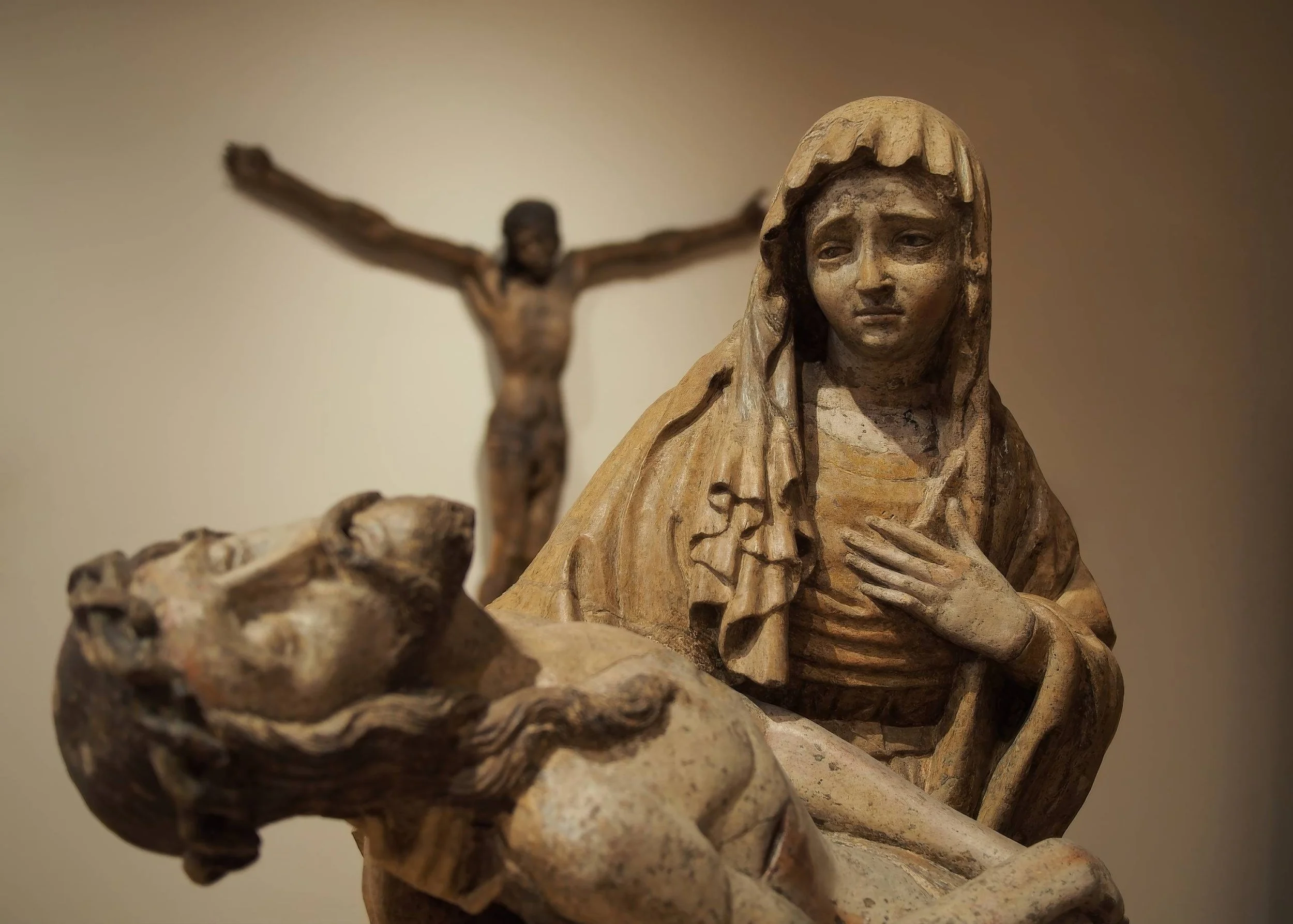
Animal Sacrifice & Food Ethics in Christianity
Can Ancient Practice Settle a Modern Question?
Does biblical animal sacrifice instruct the faithful to eat animals?
Genesis 8:20 (also, for example,Leviticus 1:1-17, 14:49-52, 22:26-30)
Then Noah built an altar to the Lord, and took of every clean anymal and of every clean bird, and offered burnt offerings on the altar.
Luke 2:24
[At the circumcision of Jesus] they offered a sacrifice … “a pair of turtledoves or two young pigeons.”
What is the relationship between animal sacrifice and what we eat?
Both flesh and grain offerings are prescribed in the Hebrew Bible, but that which is sacrificed is not thereby sanctioned for food. Ancient Hebrew sacrifices are irrelevant to food ethics today. If we turn to the Hebrew Bible to learn what we are to eat, the most obvious place to look is Genesis 1: God has given us a vegan diet.

Nothing about anymal sacrifice mirrors a contemporary meal; ancient Hebrew sacrifice is irrelevant to contemporary food ethics and to what Christians choose to eat.
(From Bible Pictures and What They Teach, Charles Foster, 1897, Wikimedia Commons)
Jewish animal sacrifice and Jesus on the cross
Hebrews 9:24-26
He has appeared once for all at the end of the ages to remove sin by the sacrifice of himself.
If asked, considering the remarkable sacrifice of Jesus, Christians are generally abundantly clear that biblical sacrifices are now useless, no longer necessary, and that attempting to focus on ancient blood sacrifice to justify contemporary eating habits is sacrilegious. The crucifixion of Jesus fully and completely replaced killing calves and lambs, offering salvation for all, rendering blood rituals not only pointless but unchristian. For people of faith, ritual sacrifice is obsolete, no longer relevant or prescribed. With this understanding, attempting to justify omnivory or vegetarianism by pointing to biblical descriptions of blood sacrifice is disingenuous at best, and at worst, hypocritical and irreligious—a denial of Christ’s sacrifice.
It is impossible for the blood of bulls and goats to take away sins. Only the sacrifice of Jesus can cleans sin. And we are not told to slaughter for salvation, but to obey, to have faith and do good works in this world.
Romans 12:1
…present your bodies as a living sacrifice, holy and acceptable to God, which is your reasonable act of worship.
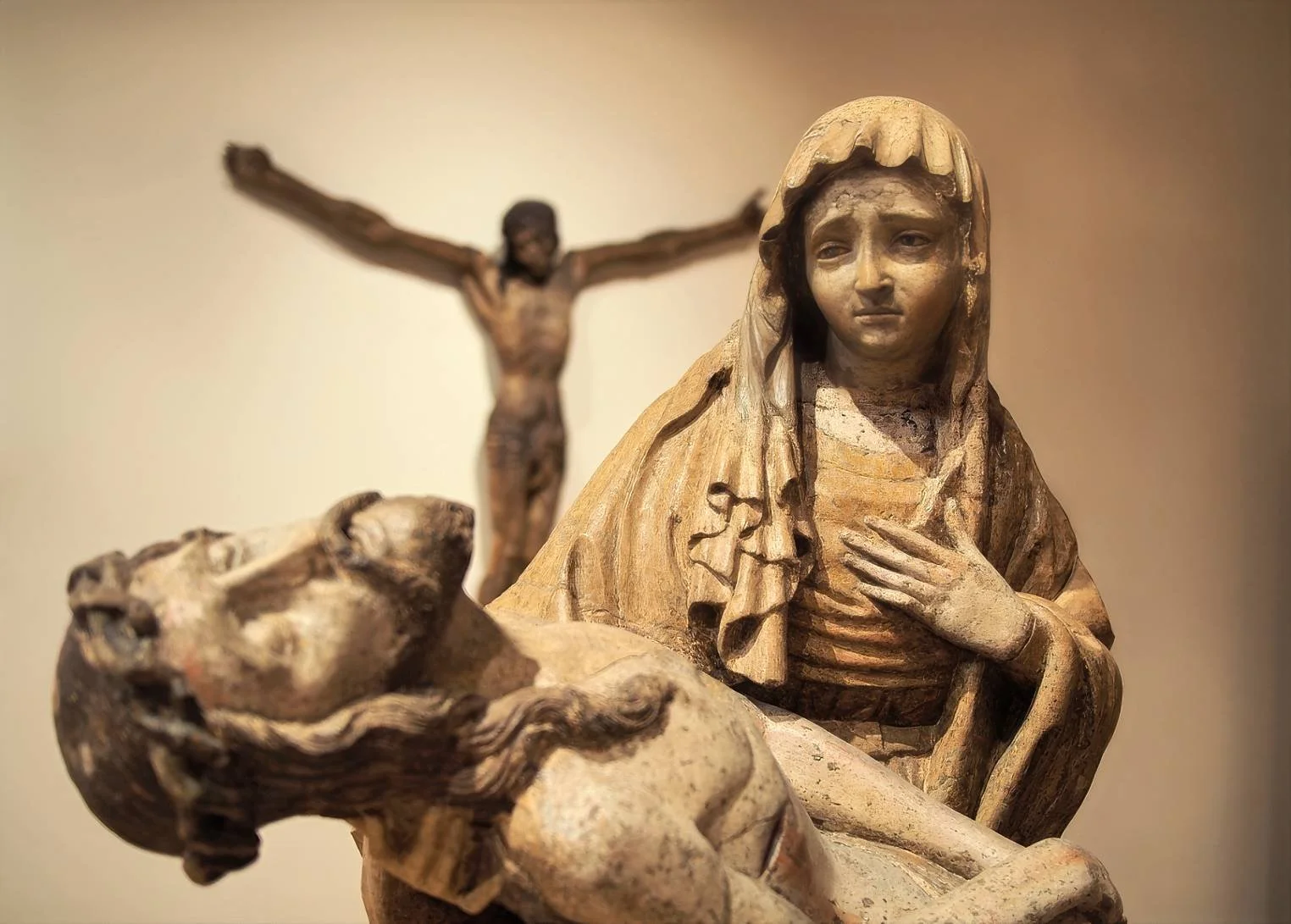
Jesus died on the cross, suffered and perished for all as the final sacrifice, making any additional sacrifices irrelevant, even irreligious. (“Passion of Jesus,” ”National Gallery of Slovenia, 14th-15th century, Wikkimedia Commons)
Christianity, the Creator, and animals as food
Psalm 50:10–11
I will not accept a bull from your house,
or goats from your folds.
For every wild animal of the forest is mine,
the cattle on a thousand hills.
I know all the birds of the air,
and all that moves in the field is mine.
Anymals are not ours to give because everything that exists is God’s. Humankind is neither instructed nor entitled to destroy what belongs to God. On reflection, it makes no sense to destroy what is God’s in hope of pleasing God: It makes no sense to destroy life in hope of pleasing the very One who created and sustains all life.
Christian are to serve God in the image of God (Genesis 1:26), which requires tenderly caretaking all of creation as God would do. We are not entitled to destroy that which is God’s, including the anymals.
For more about God and creation, and and what God has instructed humans to do, see Sacred Texts.
Psalms 24:1 (and Psalm 50:10–11)
The earth is the Lord’s and all that is in it,
the world, and those who live in it.Deuteronomy 10:14
Heaven and the heaven of heavens belong to the Lord your God, the earth with all that is in it.

All that exists is God’s. In ancient times, goats were sacrificed to the Gods, but in contemporary times, this goat was rescued from the flesh and milk industries and now lives at a vegan anymal sanctuary. (We Animals Media)
Exploring Jewish sacrifice in the Bible: the prophets and the final sacrifice
Matthew 9:13 and 12:7
Go and learn what this means, “I desire mercy, not sacrifice.”
Proverbs 21:3
To do righteousness and justice
is more acceptable to the Lord than sacrifice.
Across many chapters, we see a biblical evolution away from bloodletting. In Genesis, God challenges Abraham to show his obedience by sacrificing his son. Abraham obeys, but an angel of the Lord appears and stops Abraham before he kills his child (Genesis 22:11). (Abraham chooses to sacrifice a nearby sheep, though God does not tell him to do so.) Much later in the Tanakh, prophets speak against all forms of bloodletting.
Isaiah 1:11-17
What to me is the multitude of your sacrifices?
says the Lord;I have had enough of burnt offerings of rams
and the fat of fed beasts;I do not delight in the blood of bulls,
or of lambs, or of goats....Trample my courts no more!
Bringing offerings is futile;...When you stretch out your hands,
I will hide my eyes from you;
even though you make many prayers,
I will not listen;
your hands are full of blood.Wash yourselves; make yourselves clean;
remove the evil of your doings
from before my eyes;
cease to do evil,
learn to do good;
seek justice,
rescue the oppressed,
defend the orphan,
plead for the widow.
When we see this evolution away from blood sacrifice, we remember that we are called to serve God by giving our time and energy, by doing good works, by following the example of Jesus. Ancient Hebrew anymal sacrifice, denounced by later prophets and replaced by the final sacrifice of Jesus, does not provide a moral basis for omnivory or vegetarianism. Jewish Bloodletting rituals in the Hebrew Bible have nothing to do with Christian food ethic today.
Micah 6:6-8
“With what shall I come before the Lord,
and bow myself before God on high?Shall I come before him with burnt offerings,
with calves a year old?Will the Lord be pleased with thousands of rams,
with ten thousands of rivers of oil?Shall I give my firstborn for my transgression,
the fruit of my body for the sin of my soul?”He has told you, O mortal, what is good;
and what does the Lord require of youbut to do justice, to love kindness,
and to walk humbly with your God?

Bloodletting was common in ancient human communities, including human sacrifice, but the Hebrew Bible and the New Testament tell us that these rituals were replaced with nonviolent forms of supplication.
(“Abraham Sacrificing his Son, Issac,” Giambattista Pittoni, 1750s, From the Museum of Fine Arts in the United States, Wikimedia Commons)
What do Scriptures teach Christians about pleasing God?
Gen. 8:20-21 (also Leviticus 1:9)
Then Noah built an altar to the Lord, and took of every clean animal and of every clean bird, and offered burnt offerings on the altar. And when the Lord smelled the pleasing odor, the Lord said in his heart, “I will never again curse the ground because of humankind, for the inclination of the human heart is evil from youth; nor will I ever again destroy every living creature as I have done.
Do these passages teach Christians that the smell of burning flesh pleases the nose of God? Are we to understand that God has a physical nose, an animalian sense of smell, and takes pleasure in the odor from dead and roasted bodies? God is described in the Hebrew Bible as benevolent and life-sustaining, how can the smell of burning flesh please a God who is compassionate and invested in the life of every living creature?
A close read of Scriptures indicates that, as makes sense, the smell of flesh is not what pleases God: Seeing humankind remember God and give thanks pleases God. Genesis recalls God observing disobedience (Genesis 3) and violence (Genesis 6) in humankind; God laments that the “inclination of the human heart is evil from youth” (Genesis 8:21).
In this context, the smell of smoke pleases God not because humankind has slaughtered and burned animals, but because a wayward and morally challenged humanity has remembered God. Scriptures teach Christians to leave off bloodletting and instead, to be righteous and work for social justice.
Amos 5:21-25
I hate, I despise your festivals,
and I take no delight in your solemn assemblies.
Even though you offer me your burnt offerings and grain offerings,
I will not accept them;
and the offerings of well-being of your fatted animals
I will not look upon....
But let justice roll down like waters,
and righteousness like an ever-flowing stream.
In the larger context, Scripture is clear, particularly for Christians through teachings of the New Testament: We are to remember God with obedience and humility, by tending to the needs of one another and the land—not by slaughtering and burning innocents.
In any event, ritual sacrifice is not relevant to what Christians choose to eat, while nonviolence and living in peace remains relevant. To choose vegan foods is to protect the lives of God’s creatures, to share with those who are hungry, and also to protect creation.
For more on helping people and the planet in food choices, see Sacred Texts, Sharing; for more on Christian ethics and food choice, see the books Vegan Ethics: AMORE and Eating Earth.
1 Samuel 15:22
Surely, to obey is better than sacrifice.