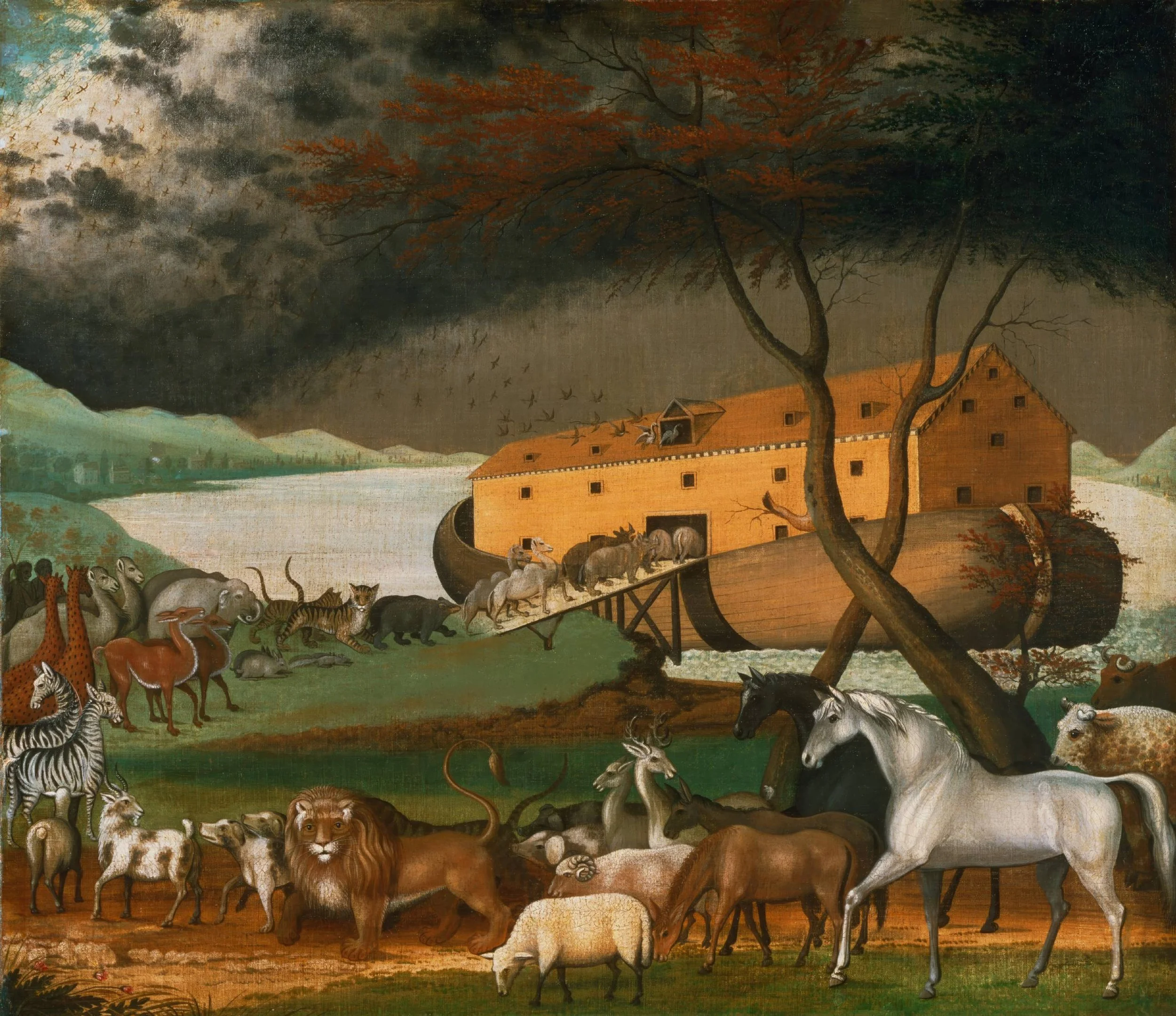
What Genesis Says About Eating & Animals
Reading Genesis 9:3 With Care and Context
Genesis 9:3—
can Christians eat “everything”?
Genesis 9:3
Every moving thing that lives shall be food for you; and just as I gave you the green plants, I give you everything.
What does the Bible teach Christians about God, violence, and corruption?
Genesis 6:11-13
Now the earth was corrupt in God’s sight, and the earth was filled with violence. And God saw that the earth was corrupt; for all flesh had corrupted its ways upon the earth. And God said to Noah, “I have determined to make an end of all flesh, for the earth is filled with violence because of them; now I am going to destroy them along with the earth.”
Humankind cannot know all the reasons why God created a vegan planet, but it is increasingly clear that omnivory and vegetarianism exact a very high price for animals, the planet, and for human beings. When the Earth became “filled with violence” (Genesis 6:11), Scriptures recall that God determined to destroy all that had been made (Genesis 6:17). It is difficult to imagine any stronger statement against violence.
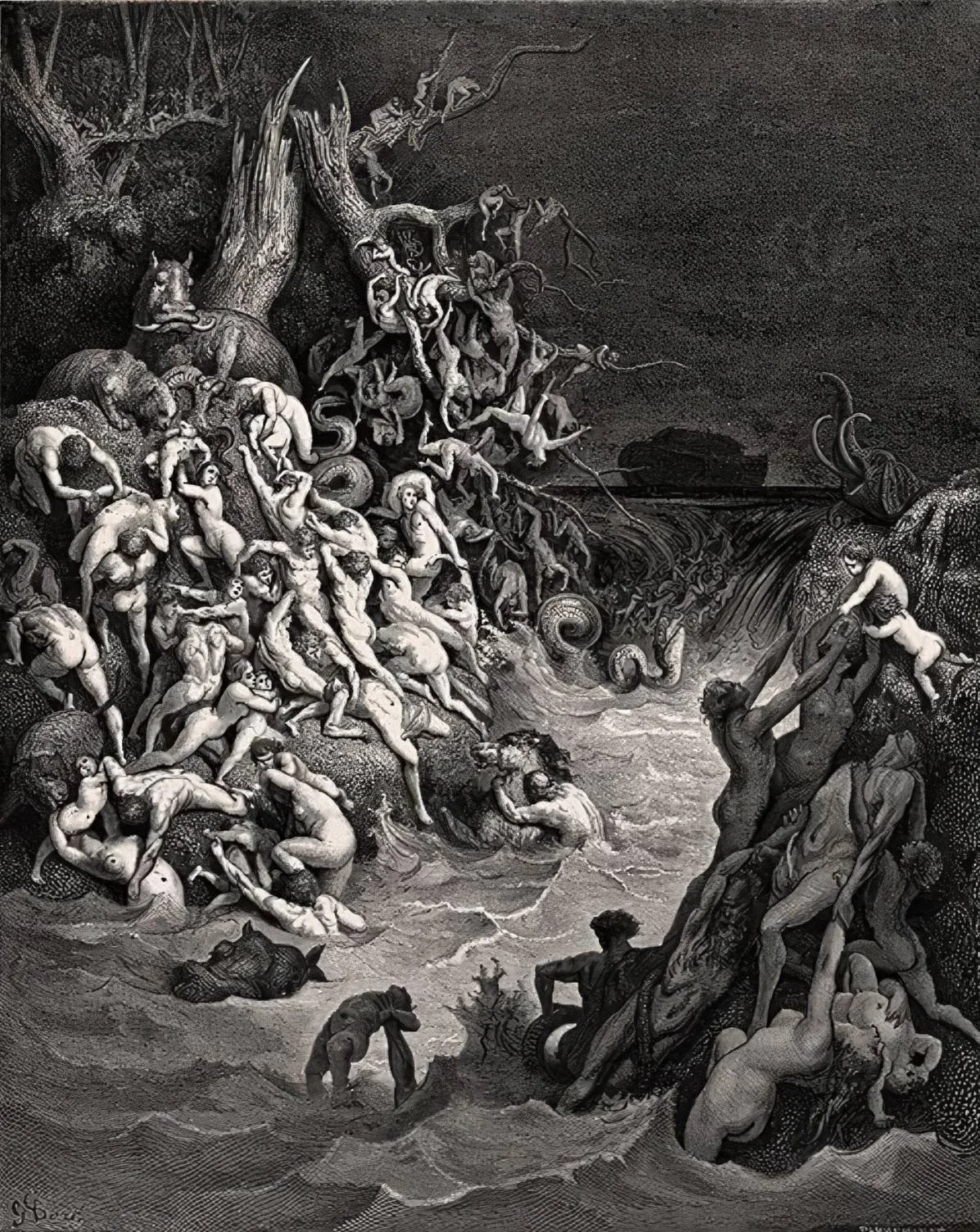
Seeing that corruption/violence had filled the earth, God determined to destroy all that had been made, bringing a Great Flood. (“Flood Destroying the World,” Gustave Doré, France, 1866, Wikimedia Commons)
“Violence” and “corruption” are used interchangeably in Genesis 6:11–13, indicating that violence is corruption, a corruption of the peaceful vegan world created by God (Genesis 1:29–30 and 2:16). Marriam-Webster defines corruption as “a departure from the original plan or from what is pure or correct,” and violence is defined as something that will “hurt, damage, or kill someone or something,” intentionally or unintentionally, whether the harm be physical or mental.
Animals in the meat, dairy, and egg industries are harmed both physically and mentally because they are forcibly impregnated, because their babies are taken just after birth or while still nursing, due to extreme confinement, and because they are slaughtered while still in their youth. On reflection, we can see that anymal agriculture is violence, and as such, it is a corruption of what God intended, a corruption of God’s peaceful, vegan world.

On mother’s day, pregnant women in India protest cruelty to cows in the dairy industry. (PETA)
Food, Christianity, and the Bible: exploring Genesis 9:3 in context
Genesis 9:2-3
The fear and dread of you shall rest on every animal of the earth, and on every bird of the air, on everything that creeps on the ground, and on all the fish of the sea; into your hand they are delivered. Every moving thing that lives shall be food for you, and just as I gave you the green plants, I give you everything.
God provided a vegan diet in the perfect, peaceful creation before the Fall (Genesis 1:29–30 and 2:16), but Genesis 9 permits eating meat, dairy, and eggs. The tone of Genesis 9 (“fear and dread”) conveys an important truth: Omnivory and vegetarianism are not what God created, commanded, intended, or prefers.
Eating “everything” (“kol”) that moves is problematic: This permits snacking on endangered sea tortoises and the neighbor’s pet goat—taken at full value, perhaps even one another. Yes, Genesis 9 tells us that we have the choice to eat every living creature (“kol remes”) but it is equally clear that this is not what God prefers.
Genesis 9:4
Only, you shall not eat flesh with its life, that is, its blood. For your own lifeblood I will surely require a reckoning: from every animal I will require it and from human beings.
Immediately after granting that we may eat “everything,” Genesis provides life-protecting restrictions against eating flesh with its blood (Genesis 9:4), effectively reversing what has just been permitted. Eating the flesh of fishes, birds, or mammals always entails eating blood: Capillaries run throughout flesh.
This restriction against eating flesh with its blood is intended to forbid cruelty—Christians may not eat living beings while still alive. Yet, if we choose to eat meat or dairy or eggs, we choose to cause a great deal of suffering, and we choose to bring many animals to a very early death.
God warns that there will be a “reckoning” for any life taken (Genesis 9:5). The foods we eat are almost always choices based on nothing more than habits, cultural conditioning, learned taste preferences.
Choosing to eat “everything” comes with a price because it is not what God intended, commanded, or prefers, and because God has provided abundant vegan foods. We may eat “everything,” but there will be consequences.
Important for circulating oxygen, all flesh has blood, including fishes, reptiles, mollusks (hemolymph), birds, and mammals. (We Animals Media)
Genesis 1:29
God said, “See, I have given you every plant yielding seed that is upon the face of all the earth and every tree with seed in its fruit; you shall have them for food.
By adding weighty repercussions, Genesis 9 reaffirms God’s preference that we live in a vegan world. God permits eating “everything” only after humankind has proven to be a disappointment—both disobedient and violent.
Christians who have other options to choose from, are invited to think about how food choices affect animals and to remember that we are called to serve God, to walk with Jesus, to be righteous—to be the best Christians that we can be.
Faithful discernment, pausing to reflect and pray, quiet meditation—all of these can help Christians to discern what God asks of us. Faithful discernment requires a measure of understanding with regard to what goes on behind the closed doors of industrialized animal agriculture. While full realization and change may take time, choosing a vegan life is not difficult. It is certainly not too much to ask on behalf of our Creator, who has both ownership and compassion for all living creatures.
John 14:15
If you love me, you will keep my commandments.

Demonstration against the violence of omnivory and vegetarianism on International Peace Day in India. (PETA)
The Word of God, Christian discipleship, and eating “everything”
Luke 4:8
Worship the Lord your God, and serve only him.
We are to serve God, not wealth or the flesh, and and certainly not ourselves. It is not possible to “serve two masters” (Luke 16:13, Matthew 6:24). Christian decisions are not rightly based on culture, habit, or the satisfaction of personal preferences. We are to work throughout our lives to become holy and perfect: “You shall be holy, for I am holy” (1 Peter 1:16); “Be perfect, therefore, as your heavenly Father is perfect” (Matthew 5:48). We are to work across time to bend our lives to God’s will–“May your will be done on earth as it is in heaven” (Matthew 6:10).
God created a perfect world, a vegan world–we were given “every green plant for food” (Genesis 1:29). In God’s perfect world all creatures lived peacefully in community, without violence or bloodshed. Scriptures teach that we are headed back to the Peaceable Kingdom, to the world that God clearly intended and prefers, where humankind will not “hurt or destroy on all my holy mountain” (Isaiah 11:9; also Matthew 6:10; and the life of Jesus). We are to work with God to help restore peace to the world.
Isaiah 11:6-9
The wolf shall live with the lamb,
the leopard shall lie down with the kid,
the calf and the lion and the fatling together,
and a little child shall lead them.The cow and the bear shall graze,
their young shall lie down together;
and the lion shall eat straw like the ox....They will not hurt or destroy
on all my holy mountain.
With deeper understanding, if we choose to buy meat, dairy, or eggs, we perpetuate suffering and bloodshed, and in so doing, we actively work against the will of God. If we take the necessary time to explore Christian ethics and anymal agriculture, if we seek grace and spiritual discernment, we can recognize the unholy effects of entrenched societal conditioning and resultant daily habits. Then we can choose what we will eat, whether to continue eating “everything” just because such foods are permissible, just because that is what others do and that is what we are accustomed to doing, or we can change what we eat to align our daily life with what Genesis tells us God intended. When we move away from eating anymal products, we serve God with mercy and love at every meal.
Luke 6:36
Be merciful just as your Father is merciful.
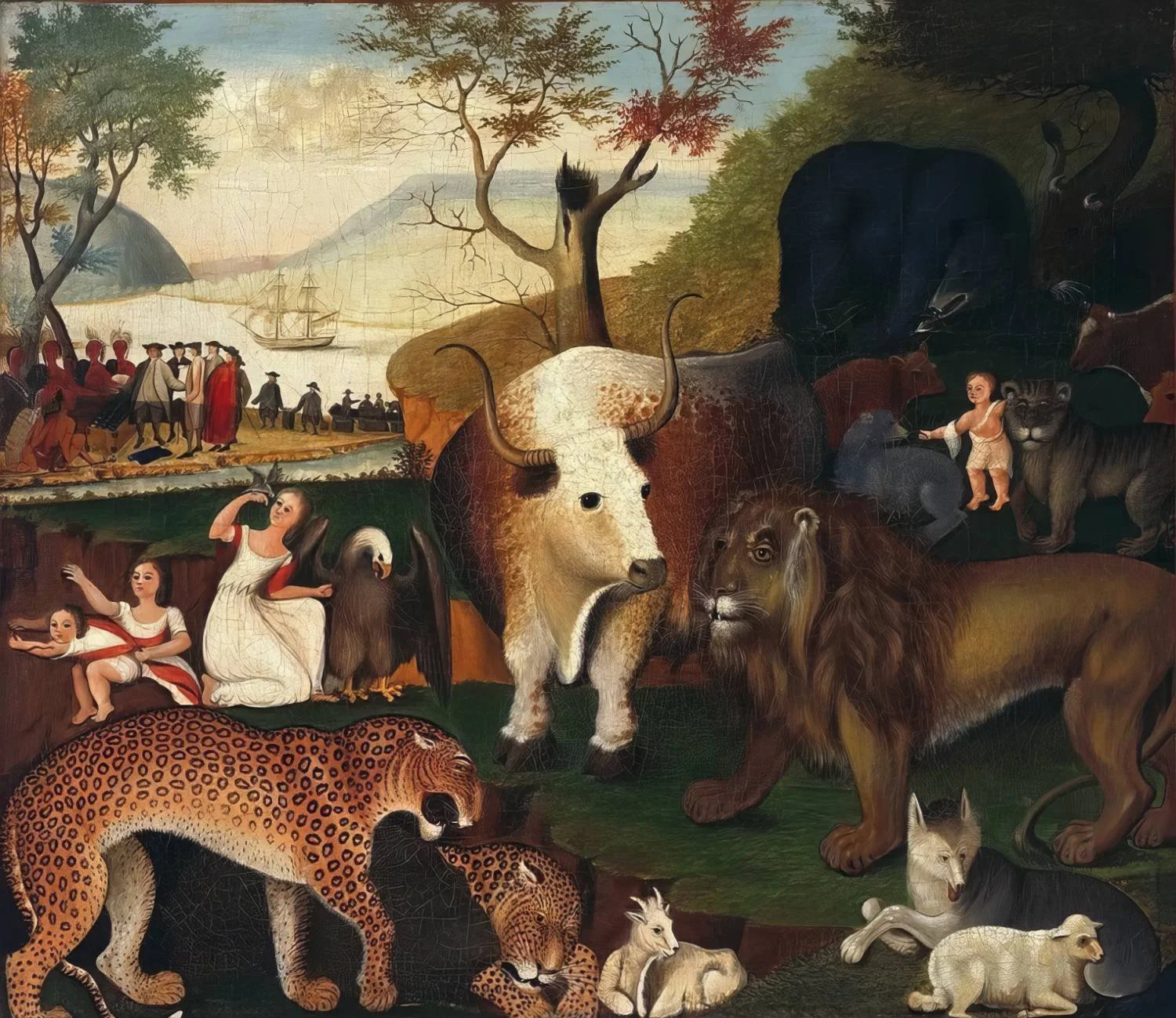
The creation narrative teaches that God created a world of peace, where all creatures lived in community, without exploitation, and that we are headed back to this great peace. (“The Peaceable Kingdom,” Edward Hicks, United States, 1820s, Wikimedia Commons)
Love, faithful discipleship, and what Christians choose to eat
1 John 4:8 and 1 John 4:16
God is love.
By providing an example of how Christians are to live, Jesus modeled a life of expansive, ever-expanding, generous love, a life filled with acts of compassion and kindness, and a life of self-sacrificing service toward those deemed so lowly as to be unworthy of his tender care. Christians are not called to decide which creatures of God are worthy of our time and energy, or which creatures of God we will show compassion for and take time to help.
Christians are called to love expansively, to serve God by tending all this groaning creation. Some Christians argue that because animals eat one another, we also may eat animals, but Christians are not called to model their lives on cats and alligators, but on the life of Jesus. (For more on the life of Jesus and Christian ethics, see Teachings.)
1 Corinthians 13:13
…faith, hope, and love abide, these three; and the greatest of these is love.
When we buy dairy products, we pay to have newborn calves taken from their mothers. When we buy eggs, we pay to have hens crowded into tiny cages throughout the entirety of their precious lives. When we buy flesh of any kind, we pay for slaughter, for the blood of those not yet full grown, blood of a life that is God’s, blood that runs onto the floor and down sludge drains. When we learn of sufferings caused God’s animals by our choices, Christian love pleads for change.
“It is contrary to human dignity to cause animals to suffer or die needlessly.”
— Catechism of the Catholic Church 2418
Each of us must discern, in our own time and way, how to faithfully and obediently serve God by loving all that God has made. The beauty and power of Scripture, combined with reflection and prayer, can help us to see that love and responsibility require us to recognize the many ways that we harm animals in our daily lives, and change how we live. (For more on what Scriptures indicate is expected of us, see Sacred Texts.)
1 John 4:19
We love because he first loved us.
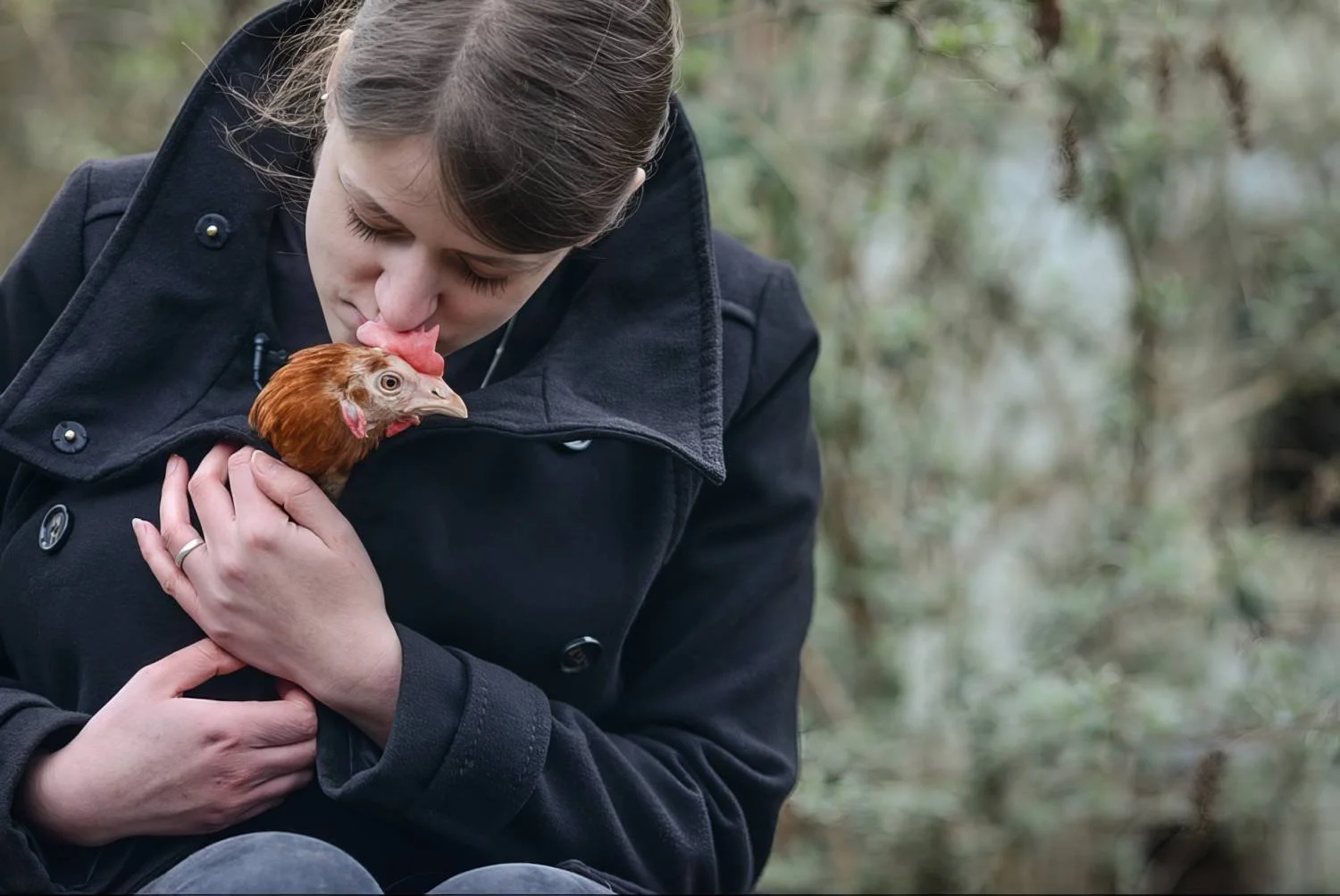
At a vegan anymal sanctuary in Denmark, a hen rescued from the egg industry is provided with loving care while waiting to be rehomed. (We Animals Media)