
Jesus, Fish, and Christian Food Ethics
Jesus, Fish, and Fishing — Should We Eat Fish?
The plural for “fish” reminds Christians that fishes are many living beings, each one a creature of God, each one endowed with life, able to suffer, and seeking to avoid pain and death.
Jesus ate, served, and helped people to catch fishes—are Christians to eat meat?
Matthew 14:19-20 (also Matthew 15:36-37 and Mark 6:36-44 and 8:1-9)
Taking the five loaves and the two fish, he looked up to heaven and blessed and broke the loaves and gave them to the disciples, and the disciples gave them to the crowds. And all ate and were filled….
John 21:5-6 (also Luke 5:4-6 and John 21:13)
Jesus said to them, “Children, you have no fish, have you?” They answered him, “No.” He said to them, “Cast the net to the right side of the boat, and you will find some.” So they cast it, and now they were not able to haul it in because there were so many fish.
Luke 24:42-43
They gave him a piece of broiled fish, and he took it and ate in their presence.

Jesus showed his wounds and ate fish from a nearby pan in order to demonstrate that he had defeated death. (“The Resurrected Christ,” Sandro Botticelli, Italy, 1480, Wikimedia Commons)
The Creator, creation, Christianity, and contemporary fishing
Eating fishes from the Sea of Galilee 2000 years ago is not the same as choosing to eat fishes in the 21st century. When Jesus lived, there were comparatively fewer people, far fewer food options, fishing methods were simpler and less destructive, and fishing was important for subsistence.
Romans 10:2
…they have a zeal for God, but it is not based on knowledge.
Contemporary, industrialized fishing raises many serious concerns for Christians, concerns that did not exist in biblical times. Every day, fishers (including smaller family fishing boats), set hundreds of miles of nets and hundreds of miles of lines that are riddled with hooks into the home that God created for water-creatures.
Today, fish nets entangle endangered species—turtles, whales, seals, dolphins, and innumerable other unintended creatures of God. These animals drown and are counted only by the pound. Hundreds of thousands of hooks are dropped in God's oceans and lakes, hooks that catch whatever species grabs hold, including endangered fishes and endangered birds—tens of thousands of kilos/pounds of unintended catch.
Industrialized fishing endangers fish populations and water ecosystems—God’s creation.
For more information and sources on fishing, ecosystems, and species depletion, see Eating Earth.
Genesis 2:15
The LORD God took the man and put him in the garden of Eden to till it and keep it. (The original Hebrew translates as “to serve and protect it.”)
What is important in the Bible is not the cultural patterns from time and place that are inevitably woven into the narrative, but the Word of God and the example that Jesus provided. Rather than ask, “What did Jesus eat?” Christians are invited to ask, “What do the Word of God and the life of Jesus show me about food choices today?”
For more on Christian ethics and animals, see Teachings.

A loon, responsible for feeding and tending a small chick, has become tangled in someone’s barbs, hooks, and lost fishing line, almost surely causing the death of both mother and young. (We Animals Media)
The New Testament: cultural norms, food metaphors, and the risen Jesus
Matthew 5:6
Blessed are those who hunger and thirst for righteousness, for they will be filled.
Food metaphors, common in the New Testament and particularly in the teachings of Jesus (also see John 4:31-38, John 6:27, 2 Corinthians 9:10, 1 Peter 2:2-3), are not about food or eating, and are not meant to be taken literally. These metaphors convey extremely important spiritual messages about faith and obedience, salvation and eternal life, trust in God, the comparative emptiness of worldly pursuits, and the vital importance of spreading the Good News. Food metaphors also record mundane aspects of culture from the place and time of Jesus, cultural details that are irrelevant to critical spiritual messages of the New Testament. Rather than worldly details of daily life, it is best to focus on the primary, core, deep, and important message of salvation and how to live, delivered by Christ.
John 6:35
I am the bread of life. Whoever comes to me will never be hungry, and whoever believes in me will never be thirsty.
Scriptures that mention fishing or eating fishes do not necessarily encourage or justify fishing or eating fishes, whether now or 2000 years ago, let alone encouraging or justifying the eating of meat, dairy, or eggs.
The plight of oceans and fishes is different now from what it was when there were only a couple hundred million people on a very large planet. Now there are more than eight billion human beings on the planet and uncounted and growing numbers of boats, nets, and hooks riddling the Earth’s fresh and salty waters.
Making matters worse, many fishers use illegal methods, methods that are against the law because they damage ecosystems and endangered sea life, but it is impossible for authorities to patrol the Earth’s vast waters. Today’s fishing mega-fleets destroy not only God’s creatures, but God’s waterways, even causing extinctions—the permanent disappearance of God’s creatures.
Christians are called to explore what it means to eat fish in the Twenty-first Century, what eating fishes means for God’s creatures, for humankind, and for God’s holy and good creation.
In a bucket on a family fishing boat in Italy, a small fish struggles to live while dying from asphyxiation. (We Animals Media)
Proverbs 1:7
The fear of the LORD is the beginning of knowledge.
Both obedience and service to God require Christians to learn and understand what is happening in contemporary food industries. If we learn that our food choices harm God’s creatures and God’s good Earth, it is our responsibility to take the necessary time and reflection to realign our faith with our actions.
When faith calls us to adjust our daily habits, we are invited to choose something else to put on our plates. God has provided many wonderful foods for our table.
For more on Christian ethics, see Teachings.
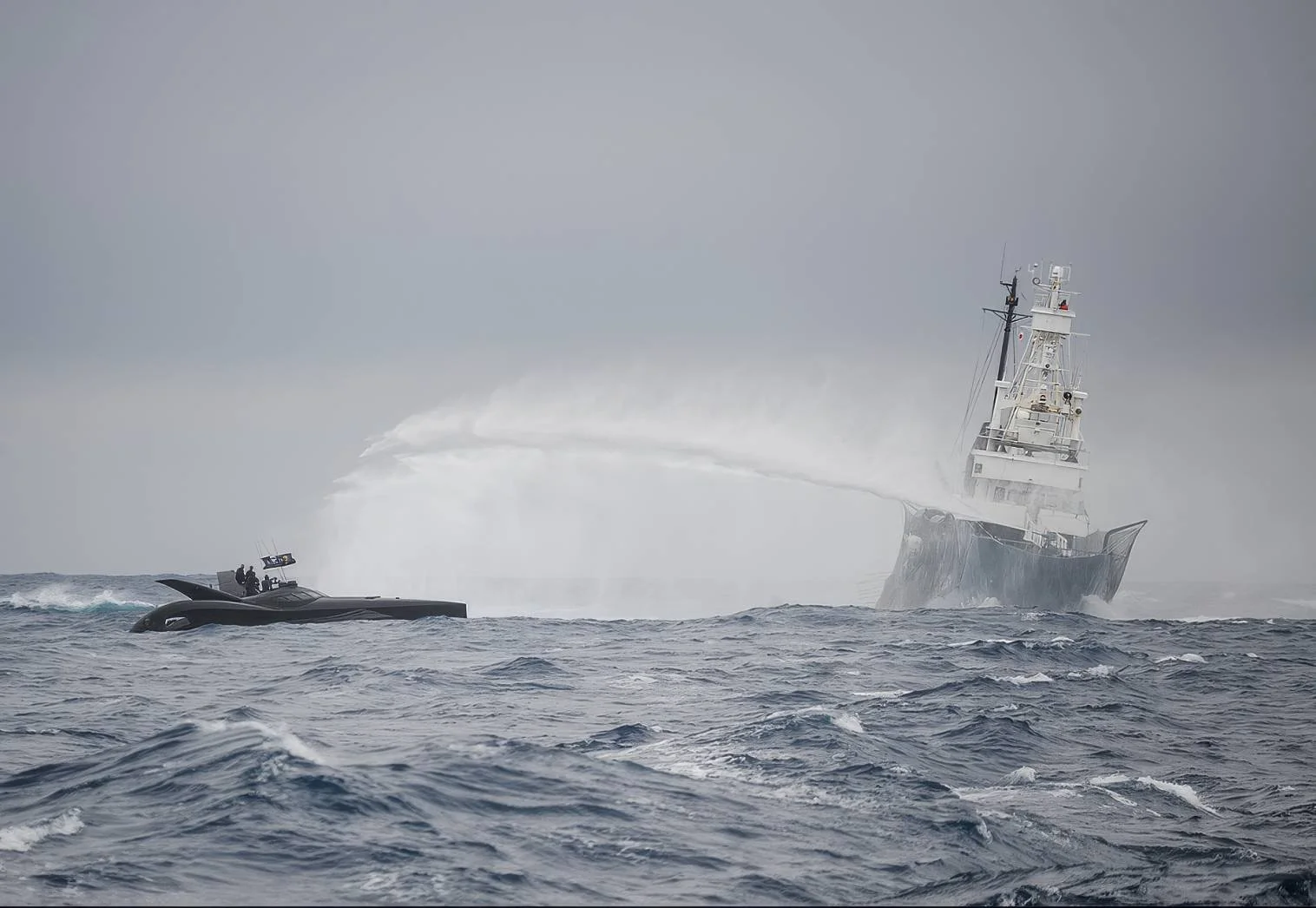
Activists help to fill in for a dearth of officers patrolling the world’s seas. In this photo an illegal Japanese whaling vessel blasts activists, ultimately sinking their small boat. (Photo We Animals Media)
How does Jesus prove to a doubting humanity that he has defeated death?
Luke 24:36-42
While they were talking about this, Jesus himself stood among them and said to them, “Peace be with you.” They were startled and terrified, and thought that they were seeing a ghost. He said to them, “Why are you frightened, and why do doubts arise in your hearts? Look at my hands and my feet; see that it is I myself. Touch me and see; for a ghost does not have flesh and bones as you see that I have.” And when he had said this, he showed them his hands and his feet. While in their joy they were disbelieving and still wondering, he said to them, “Have you anything here to eat?” They gave him a piece of broiled fish, and he took it and ate in their presence.
The Gospel of Luke recalls Jesus eating a piece of broiled fish as a means of demonstrating to a doubting humanity that he has risen from the dead, that he is again embodied—“flesh and bones.” So Jesus asks for food, not fishes specifically, just whatever someone might provide so that he can prove that he is risen.
In Jesus’s time and place, fishes were a common food, and so we find fishes in the New Testament. Luke 24:42 is not a lesson about what we may or may not eat, and Luke 24:36-42 does not justify eating fishes, let alone eating cows, pigs, turkeys, sheep, chickens, dairy products, or eggs.
Jesus drank wine, yet many Christians today choose to abstain. Jesus wore sandals and spoke Aramaic, yet we do not imitate these behaviors; Jesus did not eat fast food or drive a car, yet many of us do. Christians generally recognize that these ways of living in Biblical times are not important to faithful, righteous Christianity.
Jesus ate a morsel of fish after resurrection because fish happened to be in a pan nearby, and he did so only to prove that he had risen from the dead—not to demonstrate that we ought to eat fishes, let alone to show us that it is good to eat meat in daily life.
These passages are not about food ethics or food laws. The cultural particulars of the day that are incidentally recorded in sacred texts are not moral injunctions. To interpret these passages as indicating best food practices is to miss the point, a very important point: Jesus defeated death so that all of us might gain eternal life.

Jesus showed his wounds and ate whatever happened to be in nearby pan in order to demonstrate that he had defeated death. The specifics of what he ate are irrelevant to what Scriptures tell us about Jesus—he has risen. (“Christ's Appearance to Mary Magdalene After the Resurrection,” Alexander Ivanof, Russia, 1834, Wikimedia Commons)
Jesus wore sandals and spoke Aramaic; Jesus did not eat fast food or drive a car. Jesus drank wine, and yet many of today’s Christians choose to abstain. To argue that Christians ought to do as Jesus did only when he ate a morsel of fish, particularly given that Scriptures indicate that he did so only because such food was what happened to be nearby, and only to prove that he had risen from the dead (not a likely scenario for any of us), makes no sense. The cultural particulars of the day that are incidentally recorded in sacred texts are not moral injunctions; they do not tell Christians what they should or should not do.
Exodus 23:2
You shall not follow a multitude in wrongdoing.
Also worth noting, Jesus did not kill even one fish by eating a bite of cooked fishes from a nearby pan. If we go fishing or purchase fishes in the market, we either kill fishes or cause fishes to be killed.
Christians are called to devote time to prayer and reflection, to use faithful discernment to ponder food ethics in light of sacred texts and the life of Jesus. With time and grace, Christians are asked to decide how best to align faith with practice. Including our daily eating habits.
For books on animal agriculture and the environment, see Eating Earth: Environmental Ethics and Dietary Choice and Vegan Ethics: AMORE.
James 2:17
So faith by itself, if it has no works, is dead.
Fish living and dying in the murky waters of aquaculture. (We Animals Media)
What does the miracle of loaves and fishes tell Christians about food?
Matthew 15:34-37 (similarly Mark 8:1-9, also Matthew 14:15-21 and Mark 6:36-44)
Jesus asked them, “How many loaves have you?” They said, “Seven, and a few small fish.” Then … he took the seven loaves and the fish; and after giving thanks he broke them and gave them to the disciples, and the disciples gave them to the crowds. And all of them ate and were filled.
Fish was a common source of sustenance during Jesus’ time. Fishes were caught with nets small enough to be pulled by hand into wooden boats powered with oars and poles, sometimes with the help of sails.
The Gospels remind us that, when it was time to eat, and the masses around Jesus were hungry, all that they could produce for food were a couple of dead fishes and five loaves of bread (Matthew 14:17). Jesus used these to create enough food for all who were present. In the process, Jesus did not kill even one fish.
In contrast, when we buy or catch fishes, we take on the responsibility of causing suffering and bloodshed. We contribute to the destruction of imperiled sea ecosystems. Christians who look to Jesus multiplying fishes and loaves to justify eating fishes, will need to serve up fishes without causing any loss of life.
To learn more about fishing, the planet, and humankind, see Eating Earth: Environmental Ethics and Dietary Choice and Vegan Ethics: AMORE.
1 Corinthians 13:13
Faith, hope, and love remain, these three, and the greatest of these is love.

Jesus multiplied fishes who were already dead and fed the masses, not killing so much as one fish.
(“Miracle of the Loaves and Fishes,” Jan Rombouts, Belgium, c. 1525–30)
Meanings in the New Testament: what does it mean to be a fisher of men?
Luke 5:4-11 (also John 21:5-6, 19)
…he said to Simon, “Put out into the deep water and let down your nets for a catch.” Simon answered, “Master, we have worked all night long but have caught nothing. Yet if you say so, I will let down the nets.” When they had done this, they caught so many fish that their nets were beginning to burst….
Then Jesus said to Simon, “Do not be afraid; from now on you will be catching people.” When they had brought their boats to shore, they left everything and followed him.
When people depended on fish for survival, and fishing was hard and sometimes dangerous work, the miracle of full nets would have made a strong impression on those watching Jesus, and those who told others about the unusual powers of this very special person. And it was through this miracle that Jesus was able to redirect fishermen to help spread the teachings of Jesus.
The Gospels that report the miracle of the full fishing nets (Luke 5:4-7 and John 21:5-6) are not intended to sanction fishing or eating fishes, especially in contemporary times. Nor are the passages intended as a defense for eating flesh, dairy, and eggs.
These passages tell of Jesus performing a miracle to stop fishers from fishing with the end goal of spreading the teachings of Jesus, the Good News of eternal salvation. The other two Gospels cut directly to this point, leaving out the miracle of full nets, exposing the fish as superfluous to the point of these passages:
Matthew 4:18-22 (also in Mark, 1:16-18)
…they were fishers. And he said to them, “Follow me, and I will make you fishers of people.” Immediately they left their nets and followed him. As he went from there, he saw two other brothers... mending their nets, and he called them. Immediately they left the boat and their father and followed him.
Filling fishing nets was a miracle. For those who care deeply about God’s creatures, this miracle raises some relevant questions: Were these fishes materialized (and not pre-existent) solely for the purpose of filling nets? If so, what are these “fishes”?
We cannot know if Jesus materialized miracle-fishes to fill the nets. If Jesus created fishes out of thin air, for this purpose, then this is nothing like pulling fishes from the ocean or lakes around our homes. Especially today, in a world where we worry that there are not enough fish to sustain God’s creatures who depend utterly on fishes for survival.
It is possible that Jesus created fishes just for this purpose, who were incapable of suffering, for example. These fishes were embodied only for this purpose. Given that this is the story of a miracle, it is certainly possible that Jesus did not cause the deaths of any fishes, and it would seem in keeping that he did not cause any suffering.
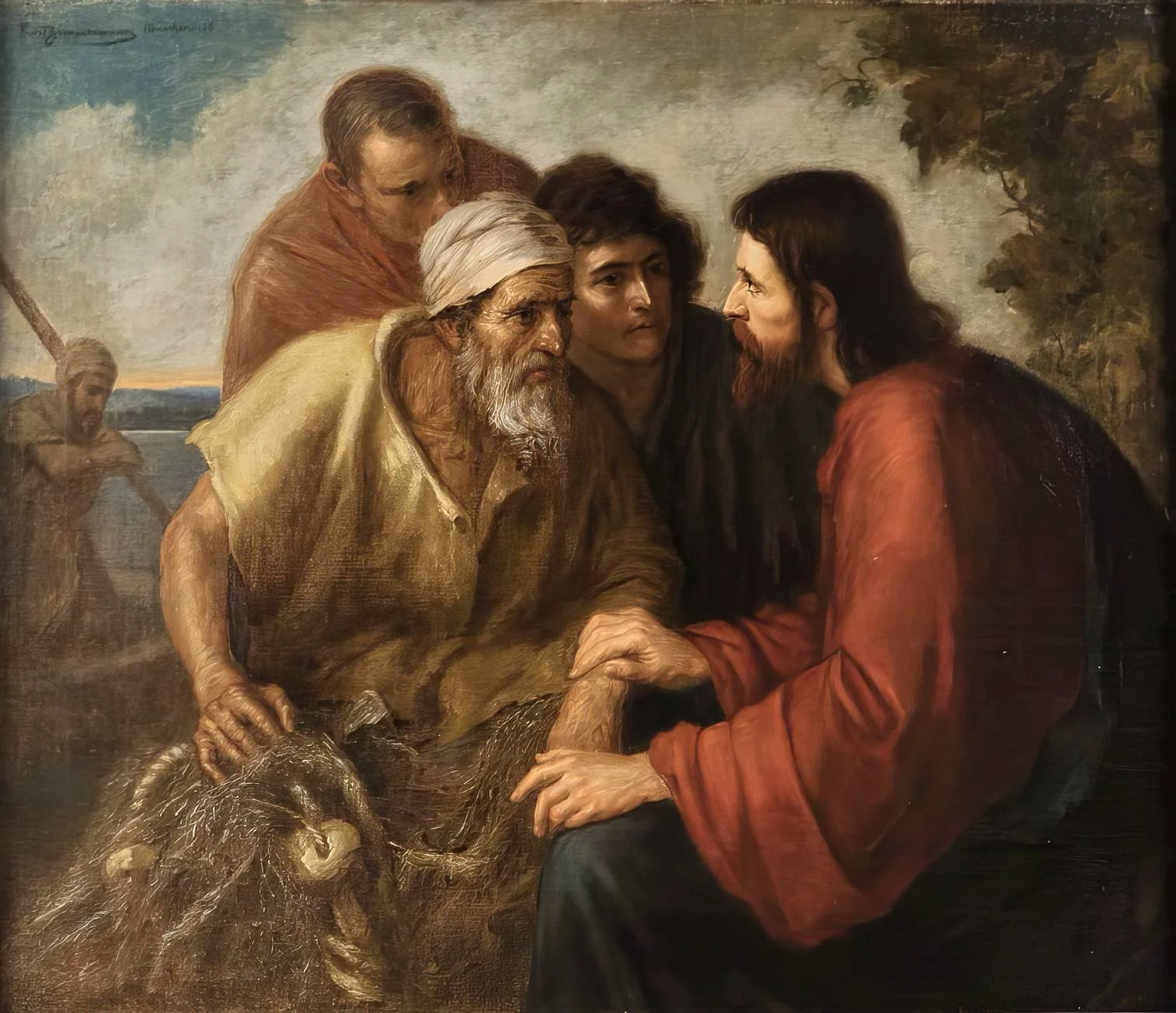
Jesus draws fishermen from fishing to spreading the Good News of salvation. (Argoikos Archival Library of History and Culture)