
The Swine of Gerasene
God's Power, Simple Faith, and Symbolism
Jesus, evil spirits, and pigs: layers of meaning in the Swine of Gerasene
Luke 8:26-39
Then they arrived at the region of the Gerasenes, which is opposite Galilee. As he stepped out on shore, a man from the city who had demons met him. For a long time he had not worn any clothes, and he did not live in a house but in the tombs. When he saw Jesus, he cried out and fell down before him, shouting, “What have you to do with me, Jesus, Son of the Most High God? I beg you, do not torment me,” for Jesus had commanded the unclean spirit to come out of the man. (For many times it had seized him; he was kept under guard and bound with chains and shackles, but he would break the bonds and be driven by the demon into the wilds.) Jesus then asked him, “What is your name?” He said, “Legion,” for many demons had entered him. They begged him not to order them to go back into the abyss.
Now there on the hillside a large herd of swine was feeding, and the demons begged Jesus to let them enter these. So he gave them permission. Then the demons came out of the man and entered the swine, and the herd stampeded down the steep bank into the lake and was drowned.
When the swineherds saw what had happened, they ran off and told it in the city and in the country. Then people came out to see what had happened, and when they came to Jesus, they found the man from whom the demons had gone sitting at the feet of Jesus, clothed and in his right mind. And they became frightened. Those who had seen it told them how the one who had been possessed by demons had been healed. Then the whole throng of people of the surrounding region of the Gerasenes asked Jesus to leave them, for they were seized with great fear. So he got into the boat and returned. The man from whom the demons had gone out begged that he might be with him, but Jesus sent him away, saying, “Return to your home, and declare how much God has done for you.” So he went away, proclaiming throughout the city how much Jesus had done for him.

“The Demons and the Swine,” Visoki Dečani, Kosovo, 14th century, Pravoslavie)
Exploring biblical meanings: simple faith And the power of God, the Swine of Gerasene and Job
The account of the Swine of Gerasene (Matthew 8:28-34, Mark 5:1-20, and Luke 8:26-39) recalls a man who is possessed by demons and, consequently, has become dangerous to the community. He became “so fierce that no one could pass that way” (Matthew 8:28). When Jesus is about to expel the evil spirits, they request to be sent into a nearby herd of pigs. Jesus gives them permission, and they move to the pigs, who dash into the water and drown.
This account records the miraculous powers of Jesus and affirms that he is the Son of God, the Christ, that we are right to put our faith in him, to spread the Good News of His Word.
New Testament narratives convey this important message in a variety of ways. For example, in Matthew 21:18-22 (as in Mark 11:12-14 and 20-25, and in Luke 13:6-9), Jesus withers a fig tree and speaks of throwing mountains into the sea:
Matthew 21:18-22
In the morning, when he returned to the city, he was hungry. And seeing a fig tree by the side of the road, he went to it and found nothing at all on it but leaves. Then he said to it, “May no fruit ever come from you again!” And the fig tree withered at once. When the disciples saw it, they were amazed, saying, “How did the fig tree wither at once?” Jesus answered them, “Truly I tell you, if you have faith and do not doubt, not only will you do what has been done to the fig tree, but even if you say to this mountain, ‘Be lifted up and thrown into the sea,’ it will be done. Whatever you ask for in prayer with faith, you will receive.”
It would seem extraordinary for Christians to argue that these narratives disvalue fig trees, mountains, or creation more generally. Of course the life of Jesus was interwoven with his surroundings, whether seeds or fig trees or pigs, but the important messages in these passages are not about comparative value of the various aspects of creation.
Miracles are much more important than that: Miracles reveal the power of God, and in so doing, convey the critical importance of placing our faith in Jesus.
Hebrews 11:6
For without faith it is impossible to please him, for whoever would approach God must believe that he exists and that he rewards those who seek him.

Jesus withers a fig tree, showing onlookers his miraculous powers. (“Christus en het teken van de vijgenboom,” “Christ and the Withered Fig Tree,” Jan Luyken, Holland, 1703, Wikimedia Commons)
The parable of the Swine of Gerasene does not convey that pigs (or animals or creation more generally) are of lesser, little, or no value compared with any other part of God’s creation. We can see this by exploring the Book of Job. If the story of the Swine of Gerasene is to be understood as disvaluing the lives of pigs, then the story of Job disvalues the lives of living beings in general, including humankind. In the account of Job, many lives are destroyed but the lesson is about the humble place of humankind and the importance of unwavering faith in God.
At the outset, Satan and God talk, and Job is noted as a loyal servant of God, “blameless and upright” (1:8). Satan speaks first:
Job 1:9-12
“Does Job fear God for nothing? Have you not put a fence around him and his house and all that he has, on every side? You have blessed the work of his hands, and his possessions have increased in the land. But stretch out your hand now, and touch all that he has, and he will curse you to your face.” The Lord said to Satan, “Very well, all that he has is in your power; only do not stretch out your hand against him!”
The next passages parallel the story of the Swine of Gerasene and Jesusin that lives are lost because of a decision made by God, who permits Satan to test Job:
Job 1: 13-22
One day when his sons and daughters were eating and drinking wine in the eldest brother's house, a messenger came to Job and said, “The oxen were plowing and the donkeys were feeding beside them, and the Sabeans fell on them and carried them off, and killed the servants with the edge of the sword; I alone have escaped to tell you.” While he was still speaking, another came and said, “The fire of God fell from heaven and burned up the sheep and the servants, and consumed them; I alone have escaped to tell you.” While he was still speaking, another came and said, “The Chaldeans formed three columns, made a raid on the camels and carried them off, and killed the servants with the edge of the sword; I alone have escaped to tell you.” While he was still speaking, another came and said, “Your sons and daughters were eating and drinking wine in their eldest brother's house, and suddenly a great wind came across the desert, struck the four corners of the house, and it fell on the young people, and they are dead; I alone have escaped to tell you.”
Then Job arose, tore his robe, shaved his head, and fell on the ground and worshiped. He said, “Naked I came from my mother's womb, and naked shall I return there; the Lord gave, and the Lord has taken away; blessed be the name of the Lord.” In all this Job did not sin or charge God with wrongdoing.
Because God allows Satan to test Job, Job loses not only camels and donkeys, but also his servants and his children. While Job is ultimately blessed with another set of offspring (and even more wealth), those who have perished do not again walk the Earth.
It would seem extremely unlikely for Christians to argue that these passages offer a lesson about the diminished value of some lives in comparison with others, or about the unimportance of humankind more generally. As with the account of the Swine of Gerasene, this narrative from the Book of Job is not about the value of life. It is about God’s divine wisdom and power in comparison with our humble creaturely ignorance and vulnerability.
This story teaches humility and to maintain unwavering faith: It is not ours to question (let alone challenge) God, but to obey and worship, no matter what befalls us. Similarly, the story of the Gerasenedemoniac speaks to the miraculous powers of God and the importance of complete and unwavering faith in Jesus Christ.

In the story of Job, human lives are lost because God accepts Satan’s challenge, but the story is not about the value of human life, but about faith in the one, true God. (“Job’s Sons and Daughters Overwhelmed by Satan,” William Blake, England, 1805, Wikimedia Commons)
Hebrews 11:1
Now faith is the assurance of things hoped for, the conviction of things not seen.
It is difficult for mere mortals to understand why God allowed Satan to kill Job’s family, or why Jesus allowed the demons to enter and destroy the pigs, but it is easy to understand the core message of each of these accounts. These narratives are not about the value of life, whether that of pigs or that of humankind. These Scriptures are about the importance of sincere and unwavering faith in the One True God.
Romans 1:17
The one who is righteous will live by faith.
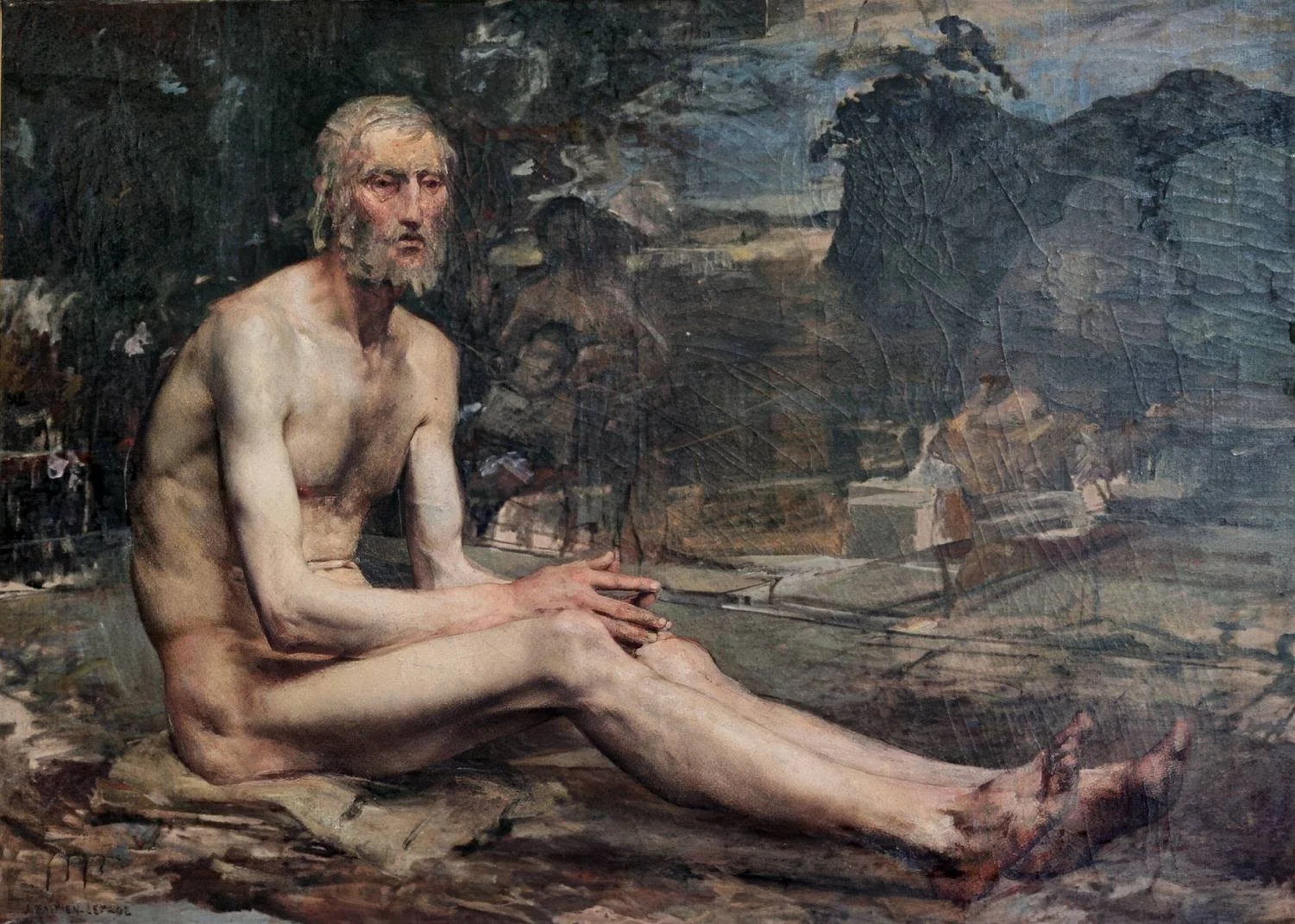
The story of Job, like the story of the Gerasene demoniac, does not speak to the value of life, but to the importance of Christian faith. (“Job,” Jules Bastien Lepage, France, 1886, Wikimedia Commons)
Symbolism and meaning in narratives about Jesus and the Swine of Gerasene
Many theologians have explained that accounts of the Swine of Gerasene are more about politics than pigs. Taking account of history, the swine represent the occupying Roman army. Seen in this light, these narratives are about resistance and political satire: Possessed pigs running into the sea is a metaphor for driving out the unwelcome Roman military.
Pigs were considered unclean in Jewish communities, and Gerasene was dominated by gentile Romans. This account recalls Roman occupation: The demoniac gives, as his name, the term for Roman forces, “legion” and includes a description of “chains and shackles.” At the end, the pigs rush into the sea, drowning, just as Pharaoh’s army drowned in the Red Sea in Exodus.
These passages are an additional account of Scriptures revealing the legitimacy and importance of taking a stand against oppressions: In the Hebrew Bible, the oppression of the Pharaoh, and in the Gospels, the oppression of the occupying Roman army.
In the narrative of the Swine of Gerasene, Jesus again exposes the evil of oppressive domination, rejects imperial models of absolute power, and teaches of an alternative reign grounded in justice and mercy. Jesus always stands on the side of liberation for the oppressed.
This divine message against oppression cannot reasonably be taken as encouragement to exploit pigs—on the contrary.
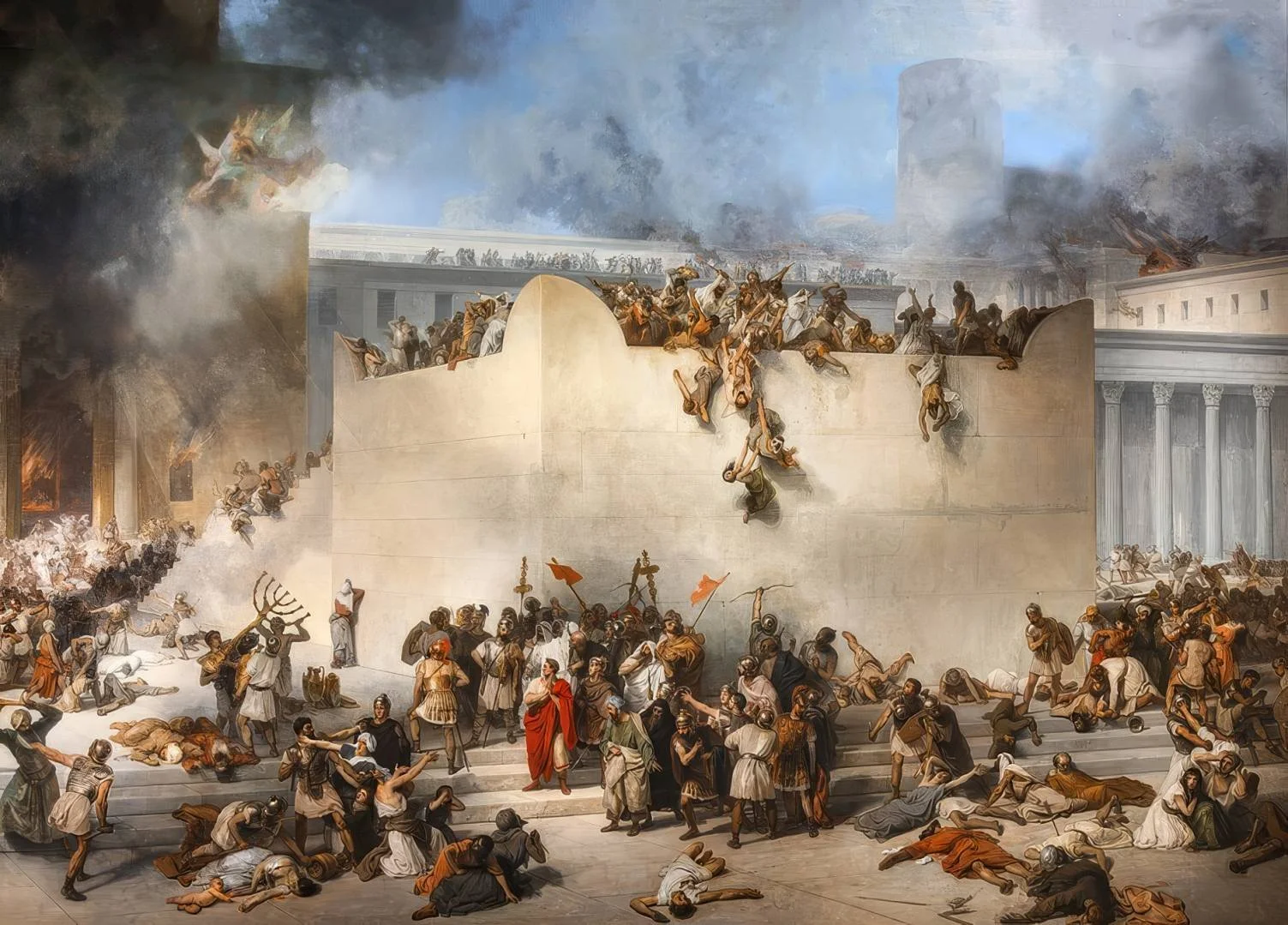
Occupying Romans destroy the temple of Jerusalem in 70 AD. (“The Destruction of The Temple of Jerusalem,” Francesco Hayez, Italy, 1867, Wikimedia Commons)
These passages reveal God taking a stand against oppression: In the latter story, the oppression of the Pharaoh, and in the Gospels, the oppression of the occupying Roman army. Jesus exposes the evil of oppressive domination, rejects imperial models of absolute power, teaches of an alternative reign grounded in justice and mercy, and proclaims liberation for the oppressed. A divine message against oppression does not encourage the slaughter of pigs—on the contrary.
Luke 4:18
The Spirit of the Lord is upon me,
because he has anointed me
to bring good news to the poor.
He has sent me to proclaim release to the captives
and recovery of sight to the blind,
to set free those who are oppressed.
There is yet another symbolic meaning in the story of the Swine of Gerasene, one that seems particularly important for Christians today.
Pigs are considered unclean and forbidden as food in the Hebrew Bible: “And the pig, because it divides the hoof but does not chew the cud, is unclean for you. You shall not eat their meat, and you shall not touch their carcasses” (Deuteronomy 14:8, also Leviticus 11:7).
Pigs were not kept by observant Jews and are therefore important to the intended message of the Swine of Gerasene: Jesus was working either in a gentile community (perhaps Roman) or in a non-observant Jewish community. The presence of pigs reminds readers that the ministry of Jesus must not be restricted, that the reach of the Gospels is not to be limited; followers of Jesus are to carry the Good News to all nations, all communities, all people.
Accounts of the Swine of Gerasene in the New Testament have nothing to do with the value of the lives of pigs. However, this narrative speaks to churches today: A vegan church welcomes those who eat meat, dairy, and eggs, while also welcoming those who are vegan.
Matthew 28:19
Go therefore and make disciples of all nations….

Whether viewed as a political satire or as a message about the importance of faith in the one true God, the story of the Swine of Gerasene has nothing to do with the value of life. Pigs are God’s creatures and they make excellent companions—they are inquisitive, playful, intelligent, and friendly. (We Animals Media)