Sparrows & the Scope of Christian Love
"You Are Worth More Than Many Sparrows" —Hierarchy or Love?
Jesus compares humankind with sparrows: is it right for Christians to accept conventional hierarchies?
Matthew 6:25-26 (also Luke 12:22–24)
Therefore I tell you, do not worry about your life…. Look at the birds of the air: they neither sow nor reap nor gather into barns, and yet your heavenly Father feeds them. Are you not of more value than they?
Luke 12:6-7 (also Matthew 10:29-31)
Are not five sparrows sold for two pennies? Yet not one of them is forgotten in God’s sight…. Do not be afraid; you are of more value than many sparrows.
What do Scriptures say about hierarchies of value in God's creation?
Four New Testament passages elevate humankind above sparrows, ravens, or birds more generally, depending on the account (Matthew 6:26 and 10:29-31, Luke 12:6-7 and 12:22-4). Some Christians, on reading these passages, come to believe that we are more important to God than birds, and can therefore use birds for our purposes, even choosing to harm and kill them as food, even if other options are available.
Deuteronomy 7:6
You are a people holy to the LORD your God; the LORD your God has chosen you out of all the peoples on earth to be his people, his treasured possession.
Scriptures elevate some human beings over other human beings: The people of Israel are exalted above others—“For you are a people holy to the LORD your God; it is you the LORD has chosen out of all the peoples on earth to be his people, his treasured possession” (Deuteronomy 14:2). Other passages set priests apart and above the larger community (Numbers 16), while other writings grant kings a privileged status (1 Samuel 24) or firstborn sons (Deuteronomy 21:17).
The New Testament gives men authority over women (1 Corinthians 11:3 and 1 Timothy 2:12) and owners authority over people they have enslaved (Ephesians 6:5, also Exodus 21).
If we accept the supremacy of humans over birds, consistency would invite Christians to also accept other hierarchies noted in Scripture. Alternatively, Christians can recognize these passages as nothing more than a record of the hierarchy and values of the day, where one’s own tribe was most important, where religious elites and kings were elevated above commoners, and where the wealthy lorded over the poor, men over women, and humans over animals.
Scriptures that recall the social hierarchy of the day are not moral dictates. These writings merely record the facts of the time. Jesus rejected social hierarchies, serving those considered most lowly. And historically, it has not been the habit of Christians to maintain long-established social hierarchies—except where animals are concerned.
Choosing to reject social hierarchies from biblical times honors core Biblical ethics that affirm the value of all of creation as singular and as good and holy. Choosing to reject social hierarchies recorded in Scriptures is consistent with the life and teachings of Jesus.
Jesus refused to accept the social hierarchy of his day. He treated all of humankind as morally important, as worthy of care and attention—much to the amazement of others, who were locked into conventions. Whether viewed as impure outcastes or lowly due to poverty, whether overlooked as women or outsiders, Jesus firmly rejected social hierarchies. Paul carried this message forward: “we, who are many, are one body in Christ” (Romans 12:5).
For more on Christian ethics, see Teachings.
Galatians 3:28
There is no longer Jew or Greek; there is no longer slave or free; there is no longer male and female, for all of you are one in Christ Jesus.
The social hierarchy of the day is described and in some places in the Hebrew Bible, affirmed, but these passages stand in opposition to the work of Jesus and core biblical ethics. The bible records the customs of the day, but Christians need not sell five sparrows for two pennies, enslave other human beings, favor their eldest male child, or view songbirds as lower and lesser than human beings.
Christians are invited to follow the example provided in the life of Jesus. Christians are called to humbly serve God by guarding and protecting creation, by helping those who are marginalized and downtrodden, including animals.
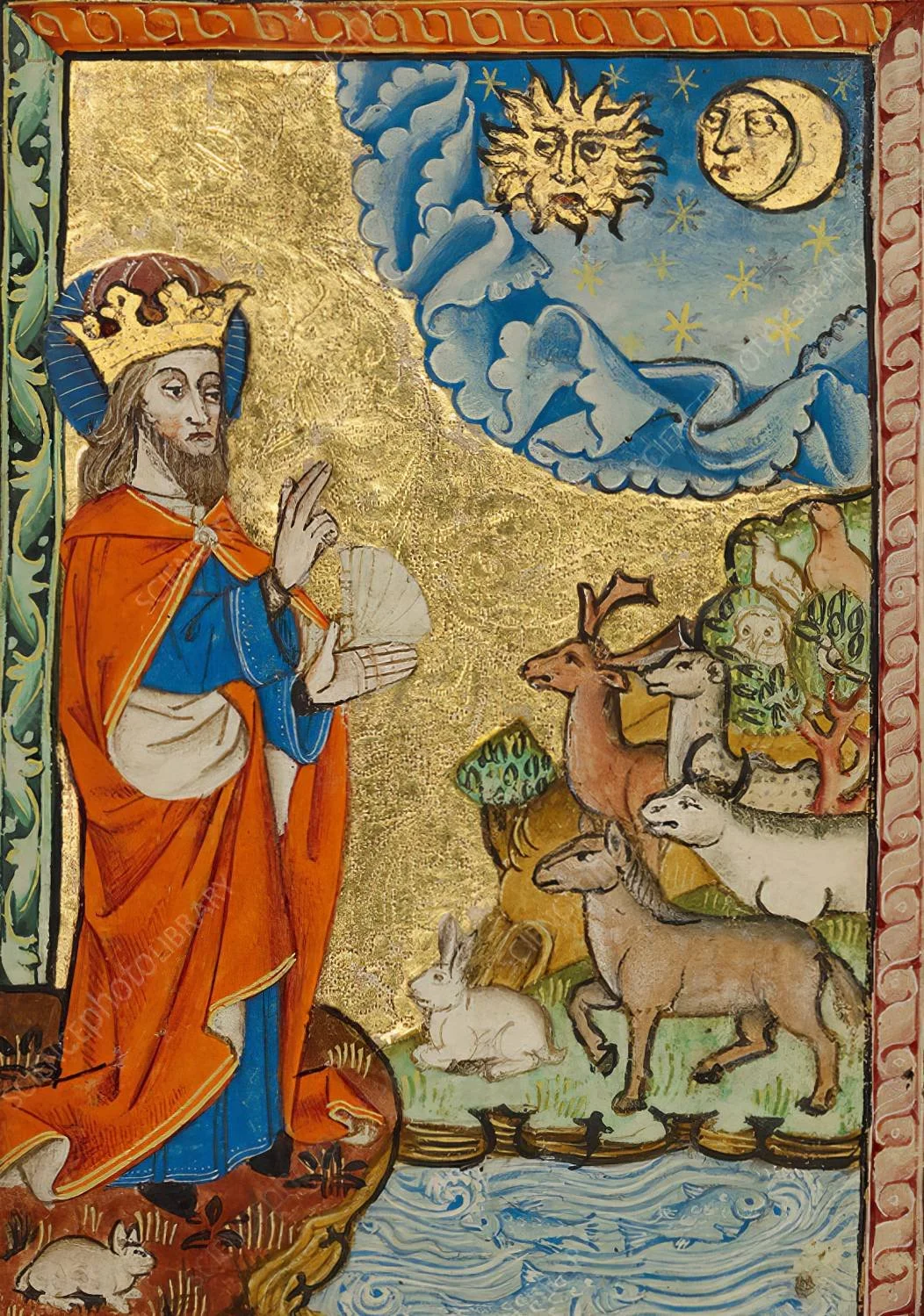
Everything that exists is God’s and we respect God by respecting all that God has created, and like Jesus, by showing special attention to those who are marginalized, downtrodden, and exploited by the powerful.
(“The Creation,” artist unknown, United Kingdom, c. 1190, The Getty/Science Photo Library)
Exploring core meanings in the Bible: Christian social justice rather than hierarchies of power
Scripture is fundamentally liberatory. In the Hebrew Bible, the Israelites are liberated from bondage and slavery in Egypt (Exodus). The prophet Isaiah states that God has sent him to aid the oppressed and free captives (61:1).
Biblical law protects the vulnerable:
Exodus 22:21
You shall not wrong or oppress a resident alien….Exodus 22:22
You shall not abuse any widow or orphan.Leviticus 19:34
The alien who resides with you shall be to you as the native-born among you; you shall love the alien as yourself….Deuteronomy 27:19
Cursed be anyone who deprives an alien, an orphan, or a widow of justice….Isaiah 61:1
The spirit of the Lord GOD is upon me
because the LORD has anointed me;
he has sent me to bring good news to the oppressed,
to bind up the brokenhearted,
to proclaim liberty to the captives
and release to the prisoners.

God liberated the Israelites from the oppression of the Egyptians. (“The Exodus from Egypt,” Jan Sadeler I, Flemish, 1585, Wikimedia Commons)
Jesus modeled inclusive love. The New Testament calls Christians to follow Jesus, who carried the arc of liberation and justice forward, inverting hierarchies and centering those who were marginalized. His arc of compassion and service included all of the downtrodden. He refused to marginalize or exclude anyone.
Jesus walked right through cultural barriers that would have expected him to stay clear of lepers, slaves, the poor (especially poor women) and those hailing from culturally distinct communities. Jesus healed whoever came to him, disregarding cultural norms. He even broke the barriers that forbid healing on the Sabbath.
Luke 14:13 (also see Luke 14:7–11)
When you give a banquet, invite the poor, the crippled, the lame, and the blind.
Mark 9:35 (also Mark 10:44 and Matthew 19:30)
Whoever wants to be first must be last of all and servant of all.
Matthew 20:25–26
You know that the rulers of the Gentiles lord it over them… It will not be so among you, but whoever wishes to be great among you must be your servant.
Luke 6:20 (also James 2:5)
Blessed are you who are poor, for yours is the kingdom of God.
Matthew 20:16
So the last will be first, and the first will be last.
The Bible reflects social realities of the time, but again and again the arc of liberation, justice, love, and compassion pushes through domination, hierarchy, and oppression, to side with the enslaved, the poor, the displaced, and the vulnerable.

Jesus healed those others would not touch because they were considered impure and treated as outcasts. (“Christ Healing the Paralytic at Bethesda,” Palma il Giovane, Italy, 1592, Wikipedia)
What are Christians called to do for those labeled as lesser and lowly?
Mark 10:45
The Son of Man came not to be served but to serve.
Social hierarchies seem to be a human tendency worldwide and across time. Scripture teaches Christians that this tendency is not a license for exploitation or further marginalization, but a call to justice, an invitation to work for change.
Luke 4:18
The Spirit of the Lord is upon me,
because he has anointed me
to bring good news to the poor.
He has sent me to proclaim release to the captives
and recovery of sight to the blind,
to set free those who are oppressed.
Following in the footsteps of our Savior, Christians are called to serve the downtrodden. Where the Bible describes the hierarchies of the day, Christians are invited to stand apart, to reject cultural norms that diminish God’s creatures, that show disrespect for God’s creatures, not one of which any human being can create or even restore to life.
Animal exploitation calls for a righteous response. The Bible, especially the life of Jesus, teaches Christians to free the captives, defend the oppressed, protect the vulnerable, heal the injured—respect and protect all of God’s good and holy creation.
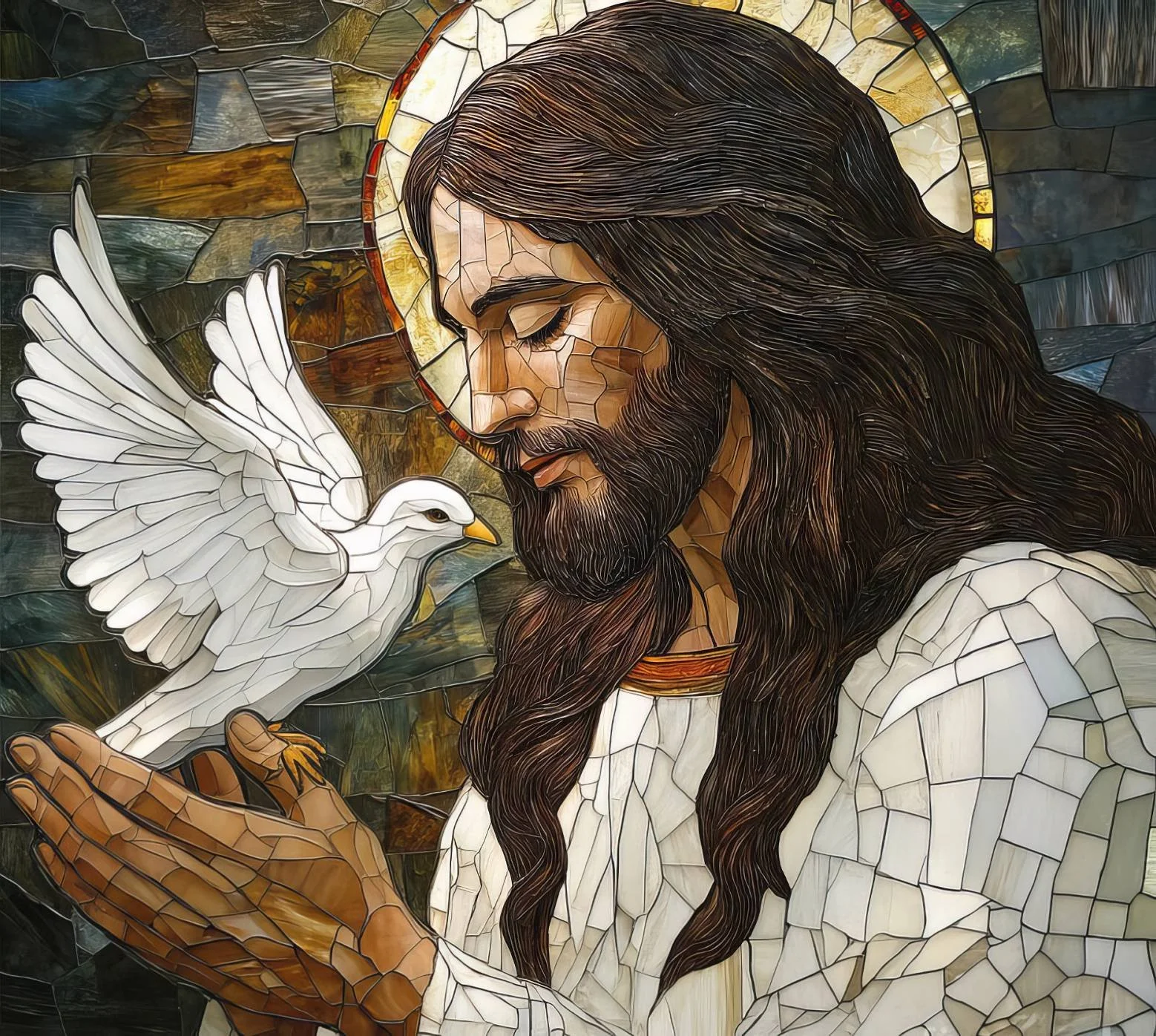
Jesus with a dove. (Tina LeCour, Fine Art America)
How does the life of Jesus invite Christians to empathize with animals?
Matthew 25:40
Truly I tell you, just as you did it to one of the least of these… you did it to me.
Jesus identified with those who were made to feel lowly and lesser, with outcastes and the impure, with those who were suffering and downtrodden. To harm animals is to work against God. To walk with Jesus is to protect and defend the vulnerable, and at the hands of humankind, animals are extremely vulnerable.
To help the downtrodden is to work with and for God: “just as you did not do it to one of the least of these, you did not do it to me” (Matthew 25:45). When we help the oppressed, we walk alongside Jesus, and when we open our hearts to the oppressed, we open our hearts to God: “Whoever welcomes one such child in my name welcomes me” (Matthew 18:5).

A hen rescued from the egg industry is well cared for and handled respectfully at a vegan anymal sanctuary in Australia. (We Animals Media)
Matthew 25:35–40
“…I was hungry and you gave me food, I was thirsty and you gave me something to drink, I was a stranger and you welcomed me, I was naked and you gave me clothing, I was sick and you took care of me, I was in prison and you visited me.” Then the righteous will answer him, “Lord, when was it…?” And the king will answer them, “Truly I tell you, just as you did it to one of the least of these brothers and sisters of mine, you did it to me.”
Whatever we do for those in need, whomever “those” might be, we do for and with God. When we serve the needs of animals, we are guided by the love of Christ and we serve God.
What is the relationship between what Jesus says about birds and what Christians choose to eat?
Scriptures record treatment of songbirds in biblical times that surely was painful for birds—to be caged instead of flying free. Nothing in Scriptures tells Christians that we ought to maintain this practice. Instead, core Biblical teachings carry a liberatory message, a message of broad and inclusive compassion.
Scripture overwhelmingly teaches liberation, compassion, and thoughtfulness for those conventionally considered unworthy of moral concern and this is nowhere more evident than in the life of Jesus. Nonetheless, some find license in these New Testament passages to use birds as we wish, perhaps eating chickens and turkeys, or eating hen’s eggs, but nothing about these passages speaks to food choice, whether birds, fishes, or mammals. But Scripture does teach humility amid creation and we do well to remember that “God opposes the proud, but gives grace to the humble” (James 4:6). (For more on humility, see Sacred Texts and Discord.)
In mentioning birds, the message of Jesus is one of the assurance of hope, reminding humankind of God’s attentive, loving care: If God feeds every songbird, then we need not fret and worry about how we are to live because we, too, fall under the protective care of a loving God. Rather than attempt to defend behaviors that harm God’s creatures, Christians are to be comforted that we cannot be forgotten, that Jesus walks with each of us.
In these passages, which record conventional disregard for the lives and happiness of birds then, as now, there is no entitlement to harm or exploit God’s creatures. This is especially true when viewed against the backdrop of the larger body of Christian ethics. Jesus has shown Christians the importance of expansive love. Jesus reminded us that God cares for all living beings, including those whom we might tend to view as unworthy.
Psalm 84:3
Even the sparrow finds a home
and the swallow a nest for herself,
where she may lay her young,
at your altars, O LORD of hosts,
my King and my God.

In Malta, an animal activist holds a small bird rescued from an illegal trap that was set to capture songbirds, who are eaten and enslaved as pets in many places around the world. (We Animals Media)
Scripture records the hierarchy of the day. Such passages do not justify or encourage maintaining these forms of marginalization and oppression: The Bible is strongly liberatory. Jesus worked against power structures and privilege, supported the downtrodden, and spoke up on behalf of the oppressed. Inasmuch as Jesus was committed to defending the downtrodden, excluding no one, Christians are called to do the same.
To conclude that oppression is only a moral concern, or a breach of justice, when human beings are harmed, overlooks core teachings of The Bible. Scriptures teach Christians to assist and uplift the downtrodden, to walk amid God’s creation with love, mercy, and compassion.