
Peter's Vision
& New Testament Ethics
Christian Hospitality and the Universal Call to Salvation
Acts 10:9–16
About noon the next day, as they were on their journey and approaching the city, Peter went up on the roof to pray. He became hungry and wanted something to eat, and while it was being prepared he fell into a trance. He saw the heaven opened and something like a large sheet coming down, being lowered to the ground by its four corners. In it were all kinds of four-footed creatures and reptiles and birds of the air. Then he heard a voice saying, “Get up, Peter; kill and eat.” But Peter said, “By no means, Lord, for I have never eaten anything that is profane or unclean.” The voice said to him again, a second time, “What God has made clean, you must not call profane.” This happened three times, and the thing was suddenly taken up to heaven.
1 Corinthians 6:12
“All things are permitted for me,” but not all things are beneficial. “All things are permitted for me,” but I will not be dominated by anything.
Peter’s vision does not require Christians to kill and eat living creatures, but it does call us to remove barriers that block the spread of the Good News of salvation.
In Peter’s time, Jews were forbidden to eat pagan food and dine in pagan homes, yet the apostles were tasked with making “disciples of all nations” (Matthew 28:18-20). Peter’s vision reveals necessary change for the spread of the Good News. This is clear by the end of the narrative: Peter breaks from the norm, receiving gentiles as guests, who thereby received the Holy Spirit (Acts 10:44).
Acts 10:44-48
While Peter was still speaking, the Holy Spirit fell upon all who heard the word. The circumcised believers who had come with Peter were astounded that the gift of the Holy Spirit had been poured out even on the gentiles, for they heard them speaking in tongues and extolling God. Then Peter said, “Can anyone withhold the water for baptizing these people who have received the Holy Spirit just as we have?” So he ordered them to be baptized in the name of Jesus Christ.
Broader and Deeper meanings of Peter’s Vision
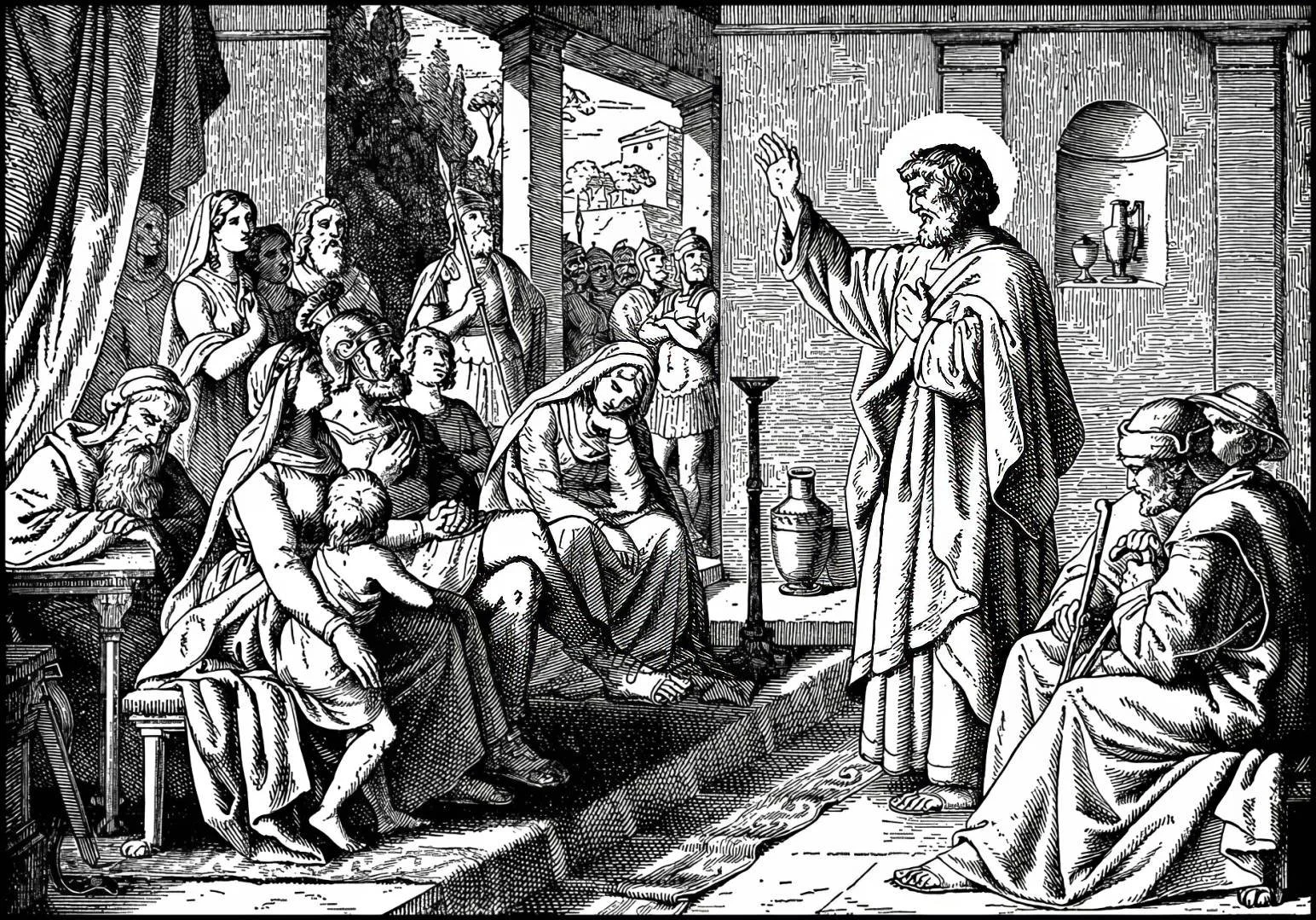
Peter broke with convention so that he would be able to spread the Gospels to as many people as possible. (“Peter Preaches to Jews and Gentiles,” ClipArt Etc.)
This narrative indicates that it is permissible to eat flesh, but we already know this from Genesis 9—permitted is not the same as preferred. At its core, the account of Peter’s vision addresses the problem of barriers that block the spread of God’s word, warning against actions that exclude people, create separation, or cause division.
Christians are called to spread the Good News. This invites the faithful to ponder any changes that might be necessary toward this important end. Because Peter broke with tradition, people were welcomed at the table and they received the Holy Spirit.
Peter’s vision has an important application in today’s world, where some Christians are spiritually adrift specifically because churches have failed to provide a Gospel welcome. Some of the faithful have left their church because they feel alienated when they are overtly and repeatedly overlooked and excluded at after-service tea, at Sunday afternoon barbeques, and at ice-cream socials. Though it would be remarkably easy to accommodate these brothers and sisters of Christ, they are ignored and excluded.
Who are these people of faith? These alienated people of God are those who feel overlooked and excluded because they choose a Genesis 1 diet.
1 Peter 4:9
Be hospitable to one another without complaining.
Many of these faithful would be fully satisfied if the church would always provide Genesis 1 options: tea that includes plant-milk options, treats made without cow’s milk or eggs, and cold treats like dairy-free fudgsicles and fruit pops.
Still others among the faithful cannot stand the smell or sight of flesh, dairy, or eggs—especially at the table, when they are eating. They perhaps recognize flesh for what it is, and understand the process by which we collect the nursing milk of cows and the reproductive eggs of chickens. In any case, they will not (perhaps cannot) eat around the sight and smell of at least some animal products.
To understand these brothers and sisters in Christ, it may be helpful to close our eyes and imagine eating next to someone who is dining on a food that you find deeply repugnant—inedible and firmly against your faith. How would you feel? What would you do?
Perhaps by using our imaginations in this way we can gain some clarity as to what people might feel if they are committed to a Genesis 1 diet—especially those who chose this diet decades ago—when faced with a table laden with meat, dairy, and eggs. Our ability to feel with other congregants draws us closer.
Romans 12:13
… pursue hospitality to strangers.

Yummy food picture (We Animals Media)
The problem of exclusion is larger than food. It is important to remember that some may feel alone in their congregation simply because church leaders never mention or address our responsibilities toward God’s creatures, never even speak about animals, and if they do, certainly not in away that draws them into our moral circle. Some vegans may lose a measure of respect for church leaders who shy away from mentioning the serious health and environmental problems associated with eating eggs, dairy, and meat—these are important moral concerns of our day.
Today, given that some among us choose to adhere strictly to Gensis 1 foods, churches are called to accommodate those with a Genesis 1 diet. While we rarely think about this fact, and so we are likely to find it a bit surprising, pretty much everyone eats Genesis 1 foods. In contrast, only some people eat meat, dairy, and eggs.
Given that eating plant foods is the norm, it makes sense to serve only plant foods at church. In this way churches serve all of the faithful and avoid alienating or excluding members of the flock who don’t want to be around meat, dairy, or eggs.
A Genesis 1 diet welcomes those who eat meat, dairy, and eggs, and vegans, with a cornucopia of nuts, grains, fruits, berries, seeds, legumes, and greens—a universal welcome at every service and every church function.
Congregations need to embrace all of God’s creatures to embrace those who care deeply about all of God’s creatures. Peter’s vision encourages congregations to make sure that everyone is welcome at the table—a Genesis 1 church is the best way to be sure that we can serve everyone who walks in the door.
Romans 15:7
Welcome one another, therefore, just as Christ has welcomed you, for the glory of God.

Peter’s vision can serve as a reminder for contemporary Christians that some Christians do not eat animal products, and we are called to be inclusive, indicating Genesis 1 foods. (“Saint Peter,” Pompeo Batoni, Italy, 18th Century. Wikimedia.)
1 Corinthians 8:7-13
It is not everyone, however, who has this knowledge. Since some have become so accustomed to idols until now, they still think of the food they eat as food offered to an idol, and their conscience, being weak, is defiled. “Food will not bring us close to God.” We are no worse off if we do not eat and no better off if we do. But take care that this liberty of yours does not somehow become a stumbling block to the weak. For if others see you, who possess knowledge, eating in the temple of an idol, might they not, since their conscience is weak, be encouraged to the point of eating food sacrificed to idols? So by your knowledge the weak brother or sister for whom Christ died is destroyed. But when you thus sin against brothers and sisters and wound their conscience when it is weak, you sin against Christ. Therefore, if food is a cause of their falling, I will never again eat meat, so that I may not cause one of them to fall.
1 Corinthians, Romans, and Acts 10 support these broader and deeper meanings conveyed by Peter’s vision, strengthening the New Testament message of radical inclusion at the table of faith.
In 1 Corinthians 8, Paul warns the faithful not to eat foods that might cause others to stray from the path of salvation. In his day, the primary culprit seems to have been serving foods that had been “offered to idols” (1 Corinthians 8:4).
Paul is clear: for those strong in faith, it does not matter whether the foods we eat have been offered to idols. And again, such foods are not forbidden, but permitted is not the same as preferred. Paul invites people to avoid such foods—any foods that might cause someone to stray from the church or that might prevent someone from receiving the Good News or the Holy Spirit.
In 1 Corinthians 8, Paul teaches Christians that it is best not to eat or serve anything that might drive people from the fold. Romans 14 provides the same caution.
Romans 14:15–21
If your brother or sister is distressed by what you eat, you are no longer walking in love. Do not let what you eat cause the ruin of one for whom Christ died…. For the kingdom of God is not food and drink but righteousness and peace and joy in the Holy Spirit…. Let us then pursue what makes for peace and for mutual upbuilding. Do not, for the sake of food, destroy the work of God. Everything is indeed clean, but it is wrong to make someone stumble by what you eat; it is good not to eat meat or drink wine or do anything that makes your brother or sister stumble.
The cleanest and surest way to open the doors for everyone is to offer only plant foods (while also avoiding major allergens, like peanuts). Worshipers may or may not choose to keep a Genesis 1 diet at home, but if all food offered in the church can be enjoyed by all who are present—those who also eat eggs, dairy, and meat, and those who only eat plant foods—then the church has included everyone at the table.
1 Corinthians 8:8-13 and Romans 14:15-21 support the broader and deeper meanings conveyed by Peter’s vision, reminding Christians of the importance of spreading the Gospel to all nations. 1 Corinthians states that to fail to welcome God’s children is to “sin against” children of God—and thereby “sin against Christ” (8:12).
A Gospel welcome calls Christians to establish churches that serve only plant foods: A Genesis 1 church welcomes all, those who eat meat, dairy, and eggs, and those who do not.
While the process of institutional change is complex, avoiding meat, dairy, and eggs at church is a simple way forward, a simple way of honoring the biblical expectation that we create churches that are open to all for whom Christ died.
Matthew 28:19
Go therefore and make disciples of all nations….
Hebrews 13:2
Do not neglect to show hospitality to strangers, for by doing that some have entertained angels without knowing it.
1 Corinthians 8, Romans 14, & Peter’s Vision
Mark 7: 18-21
He said to them, “So, are you also without understanding? Do you not see that whatever goes into a person from outside cannot defile, since it enters not the heart but the stomach and goes out into the sewer?” (Thus he declared all foods clean.) And he said, “It is what comes out of a person that defiles. For it is from within, from the human heart, that evil intentions come.
Walking the true path begins in our relationship with Jesus. Faithfulness takes root in the heart and is expressed in good works. Jesus reminded people that mundane bodily functions are not a reasonable focus for righteousness, including the food that we eat.
Following the example set by Jesus, Christians are to serve God by tending to the needs of those whom others may find too insignificant to be worthy of attentive care, including both animals and humankind.
It is here that our food choices matter morally—every time we sit down to eat, we choose if the foods we eat cause pain and suffering for animals, and whether or not we are willing to offer a radical welcome. What we eat, in and of itself, does not matter, but whether we cause harm and bloodshed, or exclude others, does matter.
Mark 7:8
You abandon the commandment of God and hold to human tradition.
Mark 7 & Peter’s Vision
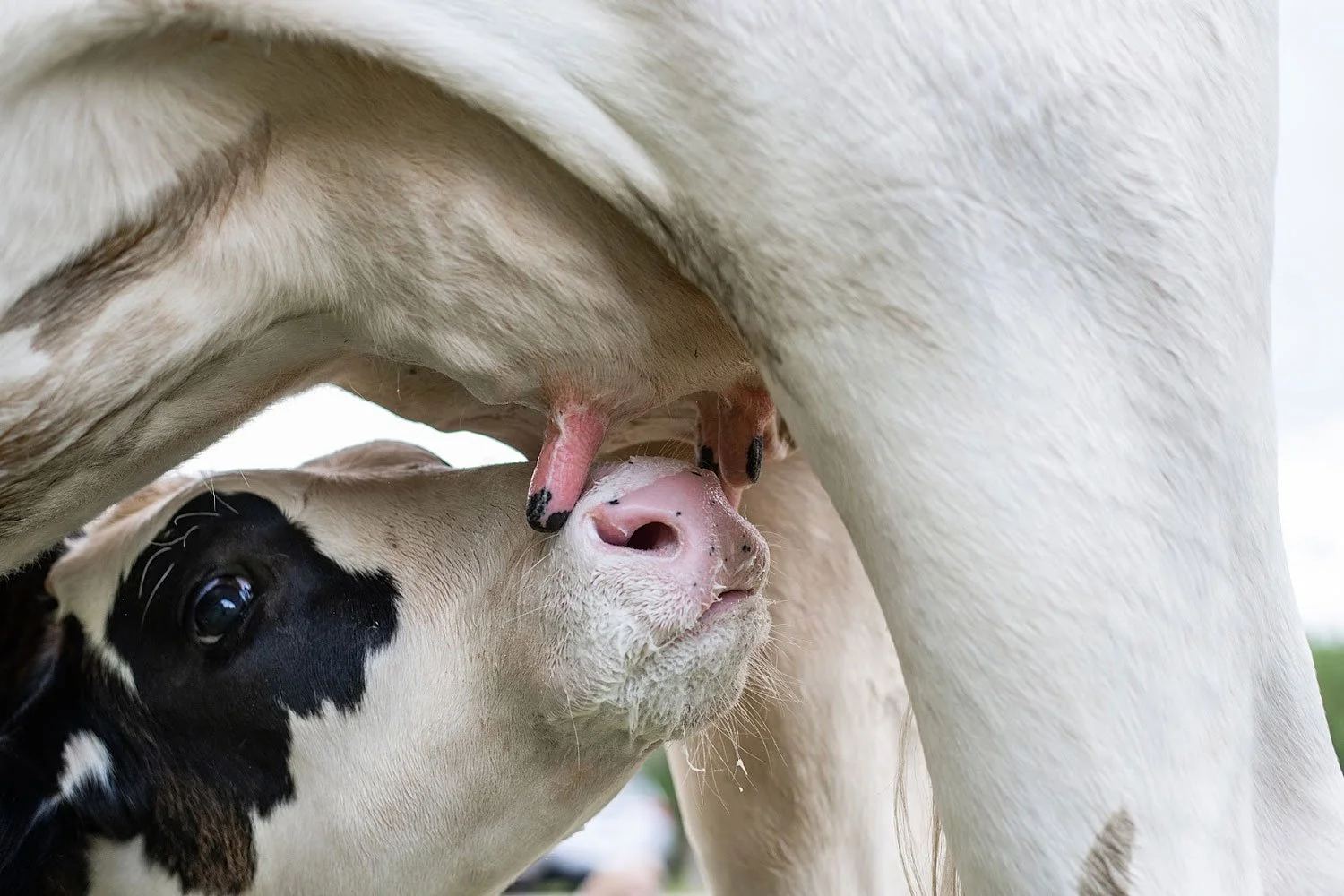
A calf at a sanctuary comes to mama for milk, reminding us who cow's milk is for. (We Animals Media)
Many Christians assume that dairy products, because they do not technically require killing, are not cruel or harmful to cows. Nothing could be farther from the truth.
Those who buy dairy products pay to continue an industry where cows are repeatedly, forcibly impregnated by a cattle breeder. They carry their offspring for nine months, suffer the pains of a natural birth, but are not allowed to nurse or tend their babies. Calves are taken from their mothers almost immediately and their mothers are perpetually milked to supply milk and milk products. After four or five cycles of birth, calf-removal, reimpregnation, and perpetual milking, cows in the dairy industry are sent to slaughter. Then, when her youth fades, so does her value, and she becomes hamburger.
Mother cows in the dairy industry never nurse a single calf because we want their milk. Male calves, and 30-40% of female calves, are sold directly into the veal industry. These young orphans are slaughtered within the first six months of life.
In buying yogurt and ice cream, we pay to perpetuate this process of suffering and slaughter.
When we understand a little bit about the industry, we understand why some of our brothers and sisters in Christ choose a Genesis 1 diet. Every time we go shopping, we vote with our money. We vote whether or not we will pay for this kind of misery and bloodshed, whether or not we will respect the beauty and grace of motherhood, and the lives of God’s creatures.
Matthew 25:40
Truly I tell you, just as you did it to one of the least of these brothers and sisters of mine, you did it to me.
James 4:17
Anyone, then, who knows the right thing to do and fails to do it commits sin.
picture picture picture picture
It is important for congregations to remember that many who choose a Genesis 1 diet avoid meat, dairy, and eggs because of their respect for life, because they have a deep sensitivity to suffering, and due to their great depth of compassion. Christians who choose a Genesis 1 diet often do so due to strong faith, obedience, and as part of remembering God whenever they shop, eat, and share foods.
Vegans whose choices reflect concern for animals, people, and the planet act from a place of caring that is quintessentially Christian. When we see the hearts of Christian vegans, it is easier to accommodate these sensitive, compassionate Children of God. It is also easier to understand why so many who choose a Genesis 1 diet.
Isaiah 49:15
Can a woman forget her nursing child?
When we recognize that providing Genesis 1 foods is an expression of Christian fidelity, congregations are more likely to understand the importance of adjusting food offerings to serve all of God’s children, to facilitate the spread of the Good News of Jesus Christ.
Matthew 18:5
Whoever welcomes one such child in my name welcomes me.
Leviticus 19:34
The alien who resides with you shall be to you as the native-born among you; you shall love the alien as yourself….

Sensitive to the sufferings and death of newborn calves, and the pains of mother cows when their young are taken, an Australian activist stands up against dairy. (Kai Weinbeck, PETA)
Testimonials from Christian Vegans
“It can be really difficult being a Christian animal rights activist in a non-vegan world. When you hear fellow Christians using the Bible to justify the torture and harm that animals needlessly experience every day, it can leave your faith shaken.” (Pride Goes Before Destruction)
“Every time I attended my small group, the issue of veganism was raised and I was teased. I never once raised the issue, it was always the meat eaters who wanted to provoke and make jokes. It was like being back on a school playground.” (Sarx: For All God’s Creatures)
“As a vegan Christian, I spent ten or so years feeling like I was a pretty big freak. At church, I was the only vegan. In the animal protection world, I was one of only a tiny handful of Christians…. It’s so tempting to leave, to disengage from this tradition and these communities who have failed again and again to see us and love us well.” (CreatureKind)
“A hog roast was planned for a church social event. I was a regular server… but I explained to the pastor that I didn’t feel comfortable serving at a hog roast. I did, however, say I would help serve a vegan option if it was made available. The pastor was furious and told me ‘Jesus has made everything clean. If you want to forbid yourself from eating pork, become a Muslim.’” (Sarx: For All God’s Creatures)
“Today’s followers of Jesus have a duty to engage seriously with animal concerns, and after much prayer and contemplation, my conclusion was to become vegan.” (Evangelical Alliance)
“I was horrified when the woman working there tore the hook from the fish’s mouth and blood shot out. I never realized that fish had blood, red like ours. The violent removal of the hook didn’t kill the fish, however, so the woman held him (her?) by the tail and smashed the body hard on the stainless-steel table. There was more blood, and then, stillness. She handed me my “prize” in a baggy. I was horrified. I knew that a life had left this earth because of me, but I also knew that if I told the priest in confession that I’d committed murder, he’d tell me that I hadn’t. There was nowhere to go for absolution.” (Fish Feel)
“Caring and advocating for animals, and endeavouring to live compassionately, can be a lonely and disheartening experience in a world in which the plight of so many suffering sentient beings seems to be lowest on any political and religious agenda, and does not seem to matter in the lifestyle choices of most people around us.” (Catholic Concern for Animals)
“Change is vital to ensuring the ongoing relevance of the Christian voice within a wider society which is becoming ever more concerned about the way we treat animals. So what practical steps can clergy and members of Christian communities take in making churches a welcoming place for vegans? Our vegan vicars came up with a long list of action points including ensuring there is always provision for vegans at church functions, avoiding attractions such as hog roasts during summer fairs, providing vegan wine for communion services, holding an annual St Francis Day/Animal Blessing service, welcoming local vegan groups to use their spaces for potluck suppers, running a vegan stall at a church festival and including animals within prayers and preaching.” (Sarx: For All God’s Creatures)
“My pastor never expounded on the message of true compassion. I veered from my roots through the years, and coming home to my love for Christ is elevated by my study of vegan messages in the Bible - the truth.” (Creation Care Church)"
Ephesians 4:21-24For surely you have heard about him and were taught in him, as truth is in Jesus, to put away your former way of life, your old self, corrupt and deluded by its lusts, and to be renewed in the spirit of your minds, and to clothe yourselves with the new self, created according to the likeness of God in true righteousness and holiness.