
A Snake in the Garden
Reading Familiar Passages with Fresh Eyes
Genesis 3:1
Now the serpent was more crafty than any other wild animal that the LORD God had made. He said to the woman, “Did God say, ‘You shall not eat from any tree in the garden’?”

Unfortunately, many human beings feel a visceral dislike for snakes. Some people kill snakes on sight, even harmless little grass snakes like this one. (Wikimedia Commons)
The snake account in Genesis 3 has traditionally been interpreted from a point of view that is unfriendly toward snakes, a perspective perhaps shaped by fear of snakes. The snake is accused of deliberately and deceitfully convincing the first human beings to disobey God, thereby bringing about the Fall, causing humankind to be cast from the Garden of Eden. This is a heavy burden with which to saddle any creature of God.
In this section we take a very close look at the narrative in Genesis 3, where a snake is part of the account. What insights emerge when we examine what is written in Genesis 3 alongside familiar interpretations? What do the actual words of Genesis 3 say about this snake in the Garden of Eden?
Psalm 50:11
I know all the birds of the air, and all that moves in the field is mine.
The snake in Genesis 3 is traditionally associated with evil, with manipulating humankind into disobedience, leading to the Fall. Consistent with tradition, this Rembrandt image depicts the snake as a powerful dragon, hovering over the first human beings, who look disoriented and confused. (“The Fall of Man,” Rembrandt Van Rijn, Holland, c. 1638, 1st Art Gallery)
Genesis 3 reveals a snake and the first human beings as neighbors who pause for conversation in the Garden of Eden. When we read with fresh eyes, we find something positive in what this narrative teaches us about humankind and snakes.
The snake is described as “crafty,” a translation of the Hebrew word, ’arum. This term is neutral and depends on context to see if the attribute is negative or positive.
Forms of ’arum appear elsewhere in the Hebrew Bible. For example, ’arum describes the intelligence of David (1 Samuel 23:22), where it is translated with positive connotations as “cunning,” indicating prudent, resourceful, and effective. ’Arum also appears in the Book of Job, where the context has negative connotation. In this narrative, humankind is reminded to be humble before God, no matter how intelligent we might think ourselves to be—an important lesson.
’Arum shows up eight times in Proverbs (12:16, 12:23, 13:16, 14:8, 14:15, 14:18, 22:3, 27:12), in each instance with strongly positive connotations, generally translated as “prudent” or “clever.”
Proverbs 12:16
Fools show their anger at once, but the prudent ignore an insult.
Proverbs 13:16
The clever do all things intelligently, but the fool displays folly.
Proverbs 22:3 and 27:12
The clever see danger and hide, but the simple go on and suffer for it.
Overall, the Bible presents ’arum as a positive attribute.
In Genesis 3, the term ’arum tells readers that the snake is exceptionally intelligent. There is no reason to assume this to be a negative attribute, especially given that there are many more positive than negative instances of ’arum in the Bible.
The snake asks the first woman if God has told the first humans that they may not eat from a particular tree. The first woman replies that God has prohibited eating of the fruit from a specific tree, lest they die (Genesis 3:3). The snake corrects her: “You will not die; for God knows that when you eat of it your eyes will be opened, and you will be like God, knowing good and evil” (Genesis 3:4–5).
It is worth stating plainly that the first human beings trust the snake’s information enough to act on what they have heard. Apparently desiring to know good and evil and to be more Godlike, the human beings eat from the forbidden tree.
The outcome indicates that, regarding the forbidden fruit, the snake understood and spoke the truth: After eating the fruit, the “eyes of both were opened, and they knew that they were naked” (Genesis 3:7).
Genesis 3:6-7
So when the woman saw that the tree was good for food and that it was a delight to the eyes and that the tree was to be desired to make one wise, she took of its fruit and ate, and she also gave some to her husband, who was with her, and he ate. Then the eyes of both were opened, and they knew that they were naked, and they sewed fig leaves together and made loincloths for themselves.

The snake in this image is portrayed in a conventional fashion, as aggressive and sly, slithering across a woman who is presented as vulnerable, presumably to whisper evil in her ear—information that will cause the Fall. While a common take on Genesis 3, a fresh read uncovers something quite different. (“Eve Taking the Forbidden Fruit,” unknown artist, Paris Iconographic Collections, no date, Wikimedia Commons.)
The Creator, of course, is displeased that the humans have eaten from the forbidden tree. When questioned, the man blames both the woman for sharing the fruit and God for pairing him with the woman: “The woman whom you gave to be with me, she gave me fruit from the tree, and I ate” (Genesis 3:12). In turn, the woman blames the snake: “The serpent tricked me, and I ate” (Genesis 3:13). In contrast, the narrative records no reply from the snake, who holds silence before God—perhaps another indication of wisdom.
1 John 1:8-10
If we say that we have no sin, we deceive ourselves, and the truth is not in us. If we confess our sins, he who is faithful and just will forgive us our sins and cleanse us from all unrighteousness.
Matthew 7:3
Why do you see the speck in your neighbor’s eye but do not notice the log in your own eye?
If we look at this narrative with fresh eyes, we see that the snake knew and spoke the truth about eating the forbidden fruit: humankind did not perish but instead gained knowledge, becoming a little more like God (Genesis 3:5). Despite the blaming of humankind, the snake did not instruct humankind to eat the forbidden fruit.
Rather than place responsibility on the shoulders of both of the first human beings, each of whom chose to taste the forbidden fruit, there has been a tendency to rest blame primarily on the snake, and secondarily on the woman, as if the man were not an equal moral agent.
James 1:14
…one is tempted by one’s own desire, being lured and enticed by it….
Proverbs 28:13
No one who conceals transgressions will prosper, but one who confesses and forsakes them will obtain mercy.

Bush vipers are shy and reclusive, hiding in the tropical rainforests of Africa. (Save the Snakes)
Reading on, the Bible tells us that God punished both human beings and the snake:
Genesis 3:14-19
The LORD God said to the serpent,
“Because you have done this,
cursed are you among all animals
and among all wild creatures;upon your belly you shall go,
and dust you shall eat
all the days of your life.I will put enmity between you and the woman
and between your offspring and hers;
he will strike your head,
and you will strike his heel.”To the woman he said,
“I will make your pangs in childbirth exceedingly great;
in pain you shall bring forth children,
yet your desire shall be for your husband,
and he shall rule over you.”And to the man he said,
“Because you have listened to the voice of your wife
and have eaten of the tree
about which I commanded you,
‘You shall not eat of it,’
cursed is the ground because of you;
in toil you shall eat of it all the days of your life;
thorns and thistles it shall bring forth for you;
and you shall eat the plants of the field.
The harshest punishment would seem to be death, which falls on all living creatures: “you are dust, and to dust you shall return” (Genesis 3:19). For this painful outcome, Christians have traditionally blamed the snake.
It seems reasonable for readers to wonder why the reptile is punished: The snake spoke the truth since humankind did not die from eating the fruit, but their eyes were “opened” (Genesis 3:5). The first humans were disobedient. The Genesis 3 narrative does not tell us that the snake has disobeyed God.
Does Genesis 3 present humankind as ignorant and gullible in comparison with the snake, who appears to be informed and knowledgeable? Would it have been best if humankind retained the Garden-of-Eden innocence and ignorance presented at the outset? Overall, has humankind used brainpower and knowledge to serve God and to do good works? The Bible’s snake narrative raises some very complex and engaging questions about humankind, knowledge, and obedience to God.
Indeed, while there are many noteworthy gains that have come from our knowledge, it is easy also to see serious negative outcomes, such as pollution from the industrial revolution, the destructive nature of modern warfare, and the unconscionable sufferings of animals in contemporary industries. With a fresh read, Genesis 3 is yet another reminder of the infinite wisdom of our Creator.
Importantly, God’s punishment does not require enmity between snakes and humankind any more than men are required to toil amid thorns. In fact, the biblical call to seek peace invites Christians to anticipate and participate in the return of the Peaceable Kingdom.
Romans 12:18
…live peaceably with all.
Psalm 34:14
…seek peace, and pursue it.
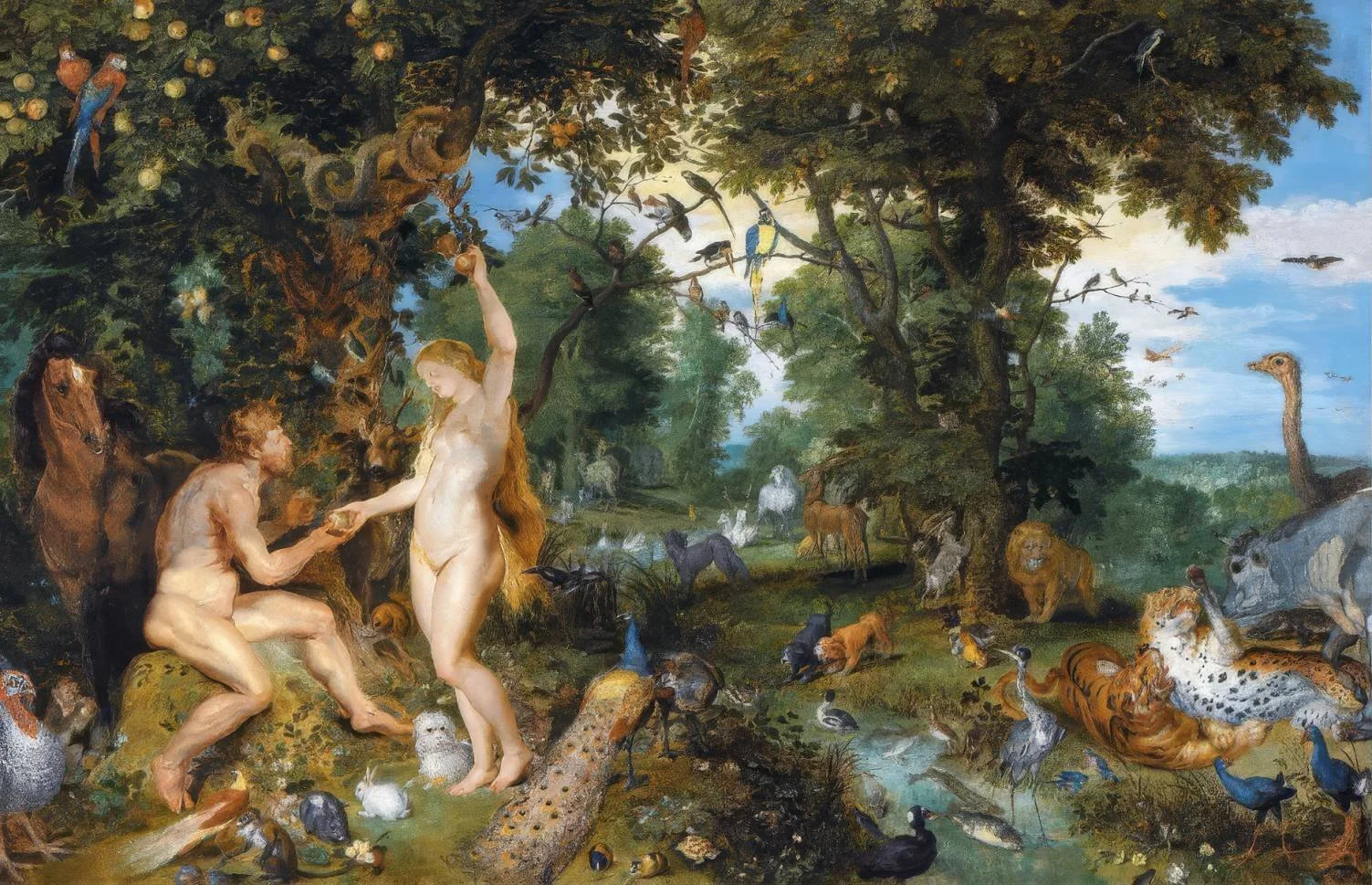
Earthly creatures all together in the Garden of Eden, including a snake overhead, and the first humans—choosing to disobey God by eating the forbidden fruit. (“The Fall of Man,” Peter Paul Rubens and Jan Brueghel the Elder, Belgium, c. 1615, Wikimedia Commons)
Genesis 3 teaches the importance of obedience, of bending to the will of God. In the process, this famous narrative notes that snakes are intelligent, thinking individuals. Genesis 3 shows that God created humankind and the animals, including snakes, not just as neighbors, but to be neighborly.
We are all created on the 6th day as land animals, we all share nephesh chayyah, and both animals and woman are created to address the aloneness of the first man—it is intended that animals and humankind share company. In this larger biblical context, Genesis 3 also invites Christians to live as neighbors, kin, and companions with God’s creatures.
Mark 12:31 (also James 2:8, Galatians 5:14)
…love your neighbor as yourself.
Luke 6:31 (also Matthew 7:12)
Do to others as you would have them do to you.
Genesis 3 shows Christians that enmity between human beings and snakes is contrary to God’s original plan. Humankind and snakes were not created to fear or hate one another. Genesis tells us that God established a world of perfect peace and interspecies kinship, where snakes and human beings could share company.
God is sole proprietor of all that exists, including snakes. Humankind is not entitled to harm or destroy what God has made, only to serve God by guarding and protecting what God has made. Perhaps, when we read Genesis 3 without the weight of tradition, we can begin to heal our relationship with these slender citizens that God has placed with us amid creation.
Genesis 1:31
God saw everything that he had made, and indeed, it was very good.
Romans 11:36
For from him and through him and to him are all things.

Christians are called to guard and protect what God has created (Genesis 2:15) and to anticipate and participate in the return of the Peaceable Kingdom, “on earth as it is in heaven” (Matthew 6:10). The bible tell us that the lives and wellbeing of snakes matter, even if humankind has a tendency to be frightened of snakes, even if humankind does not prefer that snakes remain in certain places.
When we see snakes, we are invited to admire them from a distance—we were created by the same God, and they also have a life to live, a life gifted by the grace of God. Let them—or help them—to go their way.
A fresh, close read of Genesis 3, a narrative about two humans and a snake in the Garden of Eden, shows a knowledgeable snake sharing company with humankind in the Garden of Eden, chatting as if pausing at a garden gate to speak with a neighbor. A fresh, close read of Genesis 3 supports what Christians have long recognized as the key message of Genesis 3: Humankind chose to disobey, and we are called to bend to the will of God.
As Christians, obedience calls us to model our lives on the life of Jesus, who served God by tending to the needs of those most downtrodden. Today, we are invited to extend loving care to animals, whose sufferings and needs are often overlooked. Animals are certainly among those most in need of our attentive care, including God’s remarkable snakes.
Psalm 24:1
The earth is the LORD ’s and all that is in it, the world, and those who live in it….
Psalm 104:24
O LORD, how manifold are your works! In wisdom you have made them all; the earth is full of your creatures.
Our first chapter, Teachings, examines the Bible to discover rightful Christian responsibilities for animals. The next chapter, Tension, exposes the gap between core Christian teachings that would otherwise protect animals, such as humility and the expectation that we serve God in this world, and our collective, common understandings and practices, which ultimately harm animals.

A snake expert pauses to enjoy the majesty of a wolf snake. (Save the Snakes)