Saints & Animals
Holy People—Close to God & Close to Animals
Psalm 31:23
Love the LORD, all you his saints.
1 John 2:6
…whoever says, “I abide in him,” ought to walk in the same way as he walked.
Hagiographies record the lives of saints, who are well-defined as exemplary Christians, as holy people. Hagiographies tell us that some saints lived with animals, sharing their hermitages with foxes, lions, otters, badgers, hares, deer, donkeys, and innumerable other living creatures.
These writings recall how those whom many people view as exemplary Christians honored God’s creatures, embracing God’s creatures as worthy of time and attention—as one community, as neighbors, our rightful relationship with animals according to the Bible: We are all created on the 6th day as land animals, we all share nephesh chayyah, and woman and animals are all created to keep the first man company, so that he will not be alone.
Hagiographies portray saints welcoming animals into their spiritual communities and extending kindness, protection, and care across species.
Genesis 1:30
And to every beast of the earth and to every bird of the air and to everything that creeps on the earth, everything that has the breath of life….
Mark 12:31 (also James 2:8, Galatians 5:14)
…love your neighbor as yourself.
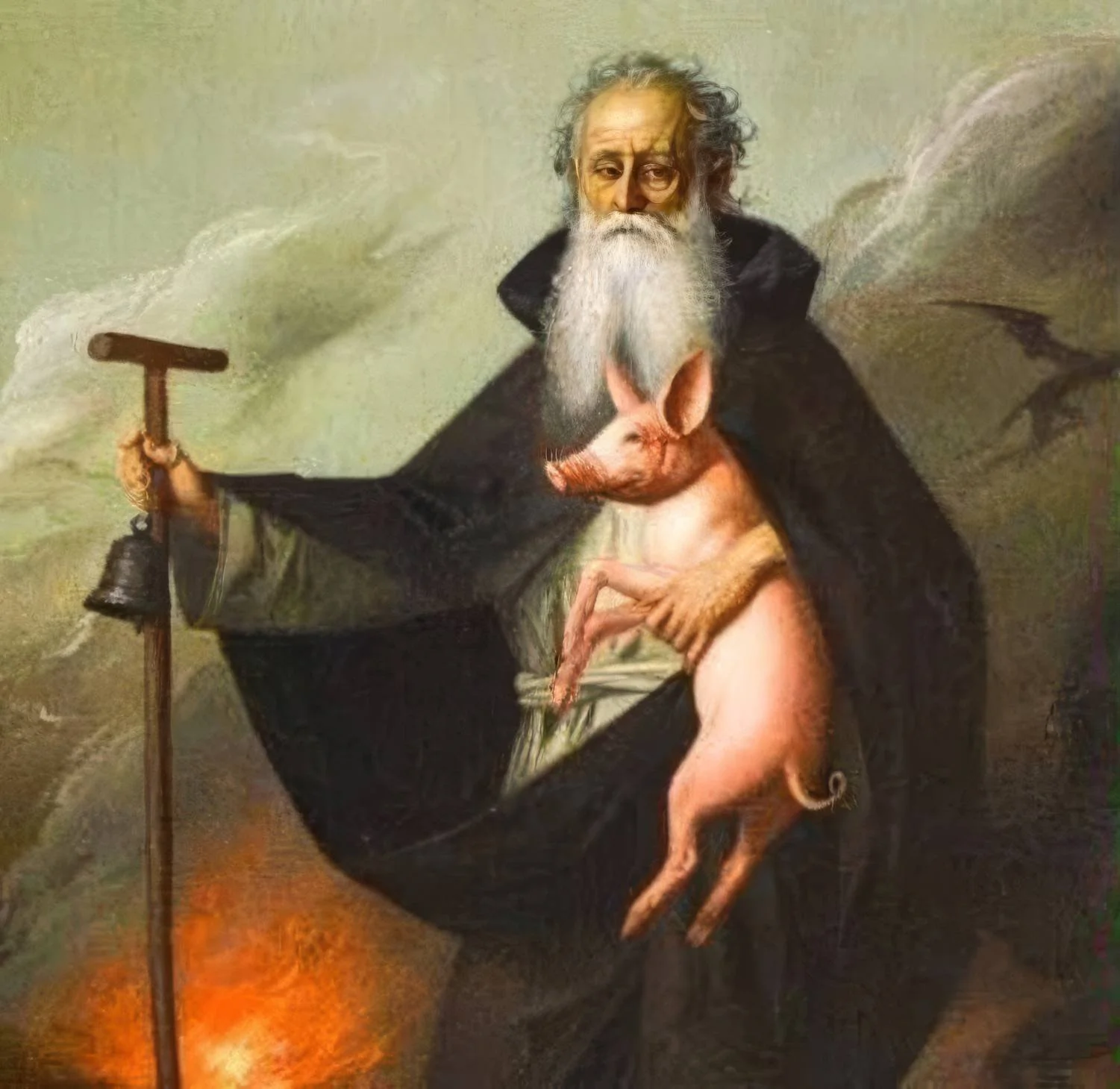
Saint Anthony the Great of Egypt, the Father of Monks, holding a pig that he healed, who became his constant companion. (Random Times)
Christian saints follow in the footsteps of Jesus, doing good deeds of love and mercy, tending to the needs of those whom others believe to be outside of the Christian moral circle, those more generally viewed as unworthy of tender and attentive care. Hagiographies tell that Bartholomew rescued a chick who was lodged in a rock crevice. Hagiographies tell that Saint Columba took responsibility for a wind-driven crane. Hagiographies tell that Saint Martin de Porres fed rats and mice at the edge of his garden and created a hospital for lost dogs and cats. Similarly, hagiographies tell that Saint Bernard of Corleone healed sick and injured animals.
Hagiographies, which preserve traditional accounts and faith-based memories, indicate that many who were honored for living close to God also lived close to animals. More importantly, hagiographies portray saints as honoring the individuality and moral importance of animals with whom they lived. In these hagiographies, Christian saints serve God amid creation, as the Creator would do or have them do, guarding and protecting God’s creatures, living among and serving the needs of animals.
Matthew 25:40
Truly I tell you, just as you did it to one of the least of these brothers and sisters of mine, you did it to me.
Luke 6:31 (also Matthew 7:12)
Do to others as you would have them do to you.
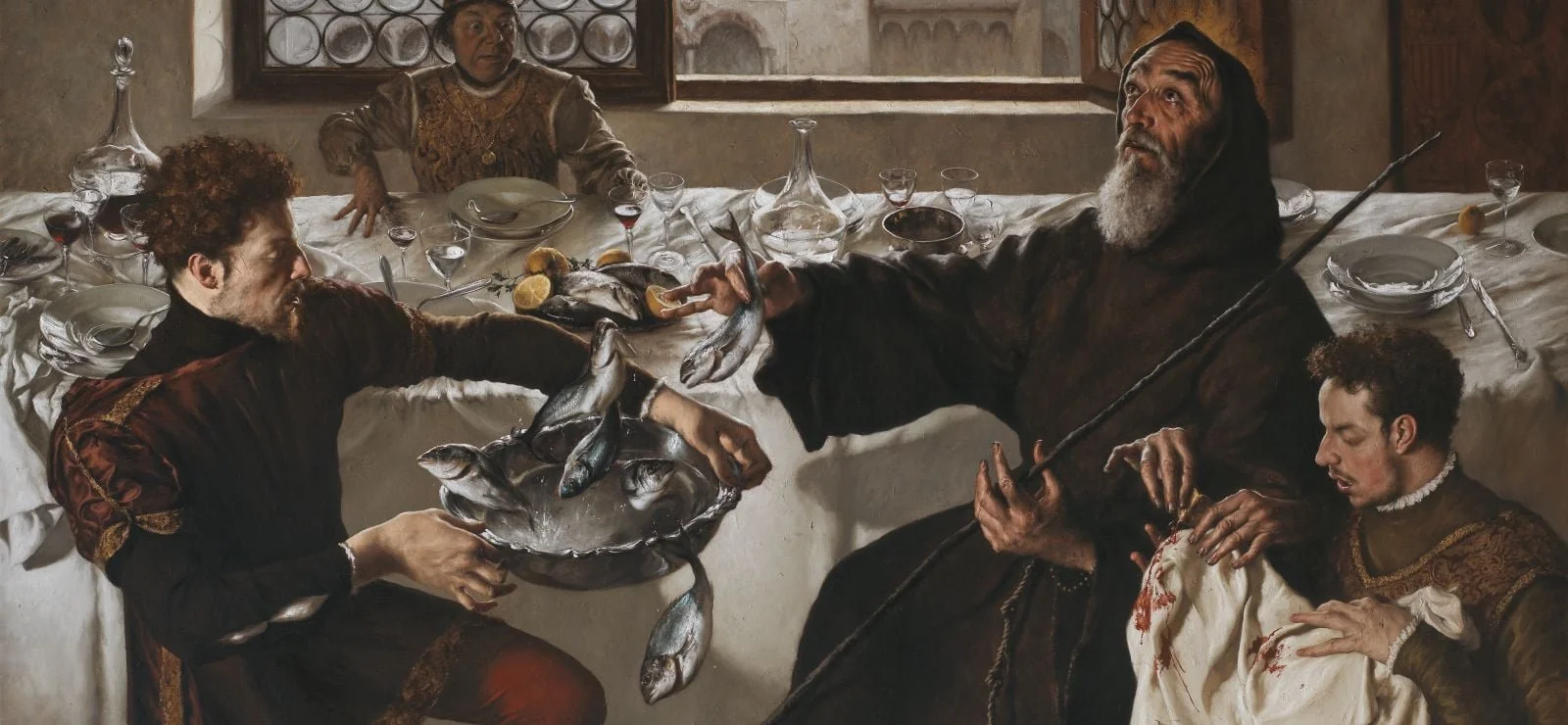
Saint Francis is the most renowned among saints for tending to the needs of animals. Hagiographies tell that Saint Francis tended, healed, and released wounded animals; he extricated a rabbit from a trap, confiscated turtle doves who were being taken to the market to be sold, and when his fish-friend was caught and fried, he restored to life the whole pan of fishes.
Saint Francis revived his friend, who happens to be a fish. (ListVerse)
Perhaps the best-known hagiographic example of the relationship between Saint Francis and animals is the taming of the wolf of Gubbio—a wolf who was eating human beings. Hagiographies tell that Saint Francis traveled to the village to solve the problem, and on seeing the saint, the wolf lay down at the feet of Saint Francis. In the hagiography, the wolf clearly recognized the saint as exceptional, perhaps the wolf knows that he is holy.
God told us what we are to eat in Genesis 1—plants, and hagiographies recall Saint Francis admonishing the wolf for frightening and eating God’s creatures, in this case, humankind.
The wolf agreed not to harm any of God’s creatures, the hagiography notes, and the villagers promised to feed the wolf. The narrative continues, and two years later, when the village wolf passed, the community of Gubbio sincerely mourned the loss of their noble friend.
Genesis 1:29
God said, “See, I have given you every plant yielding seed that is upon the face of all the earth and every tree with seed in its fruit; you shall have them for food.”
Galatians 5:22–23
… the fruit of the Spirit is love, joy, peace, patience, kindness, generosity, faithfulness, gentleness, and self-control.
Our section on Living looks closely at the Bible and what we are to eat.

Saint Francis admonished the wolf of Gubbio for frightening and eating God’s creatures (humans), working with God to help restore peace on Earth. (From The Franciscans in America, Francis Dent, United States, 1903, Wikimedia Commons)
Narratives of saints tell us that both Saint Moling and Saint Ciaran lived with and ministered to animals, tending to the needs of all who came, no matter what their species. Foxes, though decidedly a challenge for the saints, are shown to be no less important: Hagiographies teach that these saints accepted foxes into their spiritual community, modeling the expansive moral circle that is foundational to Christian ethics.
The Bible tells us that Jesus was born to save not only humankind, but “to reconcile all things, whether on earth or in heaven” (Colossians 1:19–20). The Bible tells us that, through Jesus, “the creation itself will be set free from its enslavement to decay and will obtain the freedom of the glory of the children of God” (Romans 8:20-21). Our Savior died and rose not only for humankind, but to take in all things (Ephesians 1:8-10), to release all of creation from the enslavement of decay (Romans 8:20-21).
Hagiographies tell us that at least some saints shared company with animals, as the Bible tells us God intended (Genesis 2:18). Saints, we are told, welcomed a wide variety of creatures into their spiritual communities.
Romans 8:20-21
For the creation was subjected to futility, not of its own will, but by the will of the one who subjected it, in hope that the creation itself will be set free from its enslavement to decay and will obtain the freedom of the glory of the children of God.
Psalm 36:6
Your righteousness is like the mighty mountains; your judgments are like the great deep; you save humans and animals alike, O LORD.

Saint Moling with one of his disciples, a fox. (Catholic Ireland)
A later hagiographic legend about Saint Jerome tells us that he pulled a thorn from a lion’s paw, and the lion chose to stay with him, serving as protector for a donkey who was already living with the saint. The donkey and the lion, we are told, became Saint Jerome’s constant companions.
One day, the narrative recounts, the donkey went missing, and Saint Jerome concluded that the lion had at last eaten the donkey. He did not accuse the lion directly, instead instructing the lion to do the donkey’s work.
When not in harness and doing the donkey’s work, the innocent lion searched tirelessly for the donkey; the two had become close friends. The donkey had been stolen by thieves.
One day, when searching for the donkey, the lion stumbled onto a robber’s camp. As the lion approached, the thieves fled, abandoning both the donkey and a string of camels.
The hagiography recalls that the lion led the donkey and the camels safely back to the monastery and Saint Jerome added a string of camels to his small but important Peaceable Kingdom.
James 3:18
And the fruit of righteousness is sown in peace by those who make peace.
Isaiah 11:6
The wolf shall live with the lamb;
the leopard shall lie down with the kid….

Saint Jerome and his companions, a donkey and a lion (seen here asking the saint for help with a thorn in his paw). (“Jerome in the Wilderness,” Giovanni Bellini, Italy, 15th Century, Wikimedia Commons)
Hagiographies repeatedly tell readers that, in dread of hunters, animals sought refuge with those close to God, especially deer and hares (rabbits), though a hunted boar found refuge with Saint Kevin of Glendalough.
In various hagiographies, deer escaped the hunting pleasures of humankind by sheltering with saints Giles, Godric, and Maedoc. Running from hunters and their hounds, a doe (female deer) found refuge with Saint Giles. An over-eager hunter mistakenly hit the saint with his arrow.
When a tired and terrified stag dashed into Saint Maedoc’s hermitage for protection, hagiographical writings tell us that, though the saint was in prayer, he nonetheless threw the corner of his cloak over the stag’s antlers, protecting him so that the hunters and dogs ran past the hermitage without even seeing the exhausted, frightened deer.
Colossians 3:12-15
…clothe yourselves with compassion, kindness, humility, meekness, and patience…. Above all, clothe yourselves with love, which binds everything together in perfect harmony. And let the peace of Christ rule in your hearts….

Saint Giles was hit by a hunter’s arrow while protecting a deer.
(“Saint Giles and the Hind,” artist unknown, c. 1500, Wikimedia Commons)
Hagiographies record hunted hares sheltering with Saints Cuthbert, Anselm, Francis, and Philip. In one narrative, a little hunted hare dashed into a thicket of brambles, desperately seeking to escape and to survive. Saint Melangell crawled into the brambles to protect the hunter’s innocent and harmless target.
When the hunter, Prince of Powys, found Saint Melangell praying and protecting the small, frightened hare, he was impressed by her piety and courage. In this hagiography, she stepped in to protect a small hare against whomever would show up—almost surely an armed man who might eagerly strike without clearly seeing that a human being was there—deep in the brambles.
The prince did not shoot the hare, or Saint Melangell, and and the hagiography tells that he rewarded her for her Christian courage and compassion, gifting her his lands as an animal sanctuary. And the prince also gave up hunting.
Christians are to model their lives on the life of Jesus. The Gospels portray Jesus tending and protecting life, especially those to whom others give little value, little consideration—especially those commonly viewed as beneath moral concern. Our Savior served God by tending and protecting what God created, by tending and protecting the downtrodden.
Hagiographies show saints applying this pattern of care by standing between hunted animals and hunters. Narratives about Catholic saints show readers that devout Christians have a long history of standing between hunters and God’s vulnerable creatures.
Psalm 145:9
The LORD is good to all, and his compassion is over all that he has made.
Genesis 49:6
May I never come into their council; may I not be joined to their company, for in their anger they killed men, and at their whim they hamstrung oxen.
Many Christian saints stood between hunters and the innocent creatures they pursued. Our section on bloodsports in Tension explores how some churches, in some ways, sanction bloodsports such as bullfighting, and how some Christians choose to participate in bloodsports, despite core teachings in the Bible conveying our responsibility for animals and the importance of compassion. Our chapter titled Advocacy offers a deeper look at Christian activists working to restore peace, kinship, and compassion with animals—one community. For a deeper look at the effects of hunting on God’s creatures and on God’s good and holy Earth, see the chapter on hunting in Eating Earth and the chapter on environment in Vegan Ethics: AMORE.

Saint Kevin with a blackbird and a deer. (Glendalough Hermitage Centre)

Saint Melangell, Welsh patron saint of animals, protecting a hunted hare. (Green Canticle)
The Gospels tell us that Jesus pulled fishers from the sea to become his disciples, and hagiographies tell us that Jesus drew hunters from the field to become not only disciples, but saints. In these hagiographies, Jesus invited those previously fishing and hunting for animals to become fishers and hunters of humankind.
Devotional accounts about Saint Hubert and Saint Eustace record the men giving up hunting to serve God. In an odd twist of fate, they are the patron saints of hunters—both would be more appropriately viewed as patron saints of the Peaceable Kingdom.
According to these traditional accounts, Saint Hubert and Saint Eustace shifted from hunting to spreading the Good News of Jesus. In each case, hagiographies recall a vision of Jesus appearing in the horns of a stag to turn these men from hunting with intent to kill to a different type of hunting—hunting with intent to serve God. Saint Hubert and Saint Eustace gave up hunting to become disciples of Jesus, to help spread the Gospels.
Hosea 2:18
I will make for you a covenant on that day with the wild animals, the birds of the air, and the creeping things of the ground, and I will abolish the bow, the sword, and war from the land, and I will make you lie down in safety.
Psalm 34:14
…seek peace, and pursue it.

According to the hagiography, Saint Eustace sees a vision of Christ between a stag’s antlers and gives up hunting. (University of California, Irvine)
Hagiographies report that Saint Julian the Hospitaller was a nobleman and hunter who killed his parents by mistake. According to these sacred accounts, Julian was pursuing a stag with intent to kill when a deer confronts him and foretells his future—that he would kill his own parents. Thoroughly shaken, Julian leaves home to avoid fulfilling the stag’s vision.
The narrative continues, and years later, searching for their son, Julian’s parents arrive at his door. Their son is out hunting, and on returning, he finds two people in the bed that he normally shares with his wife. With his deadly hunting weapons in hand, believing his wife is sleeping with another man, in a moment of passion, Julian kills both of his parents.
Julian is filled with grief and repentance in the traditional narrative of Saint Julian the Hospitaller, which reminds us that deadly weapons and a readiness to kill sometimes damage or destroy those we never intended to harm. Readers learn that he is forever finished with hunting.
As the hagiography continues, he and his wife build a hospice near a dangerous river crossing where Julian and his wife offer shelter and ferry people across the river. Instead of slaying innocents, Julian serves those in need and at risk, taking in the poor and the sick, as well as travelers. Saint Julian the Hospitaller is now patron saint of travelers, innkeepers, boatmen, and of hospitality.
Unlike Saint Hubert or Saint Eustace, whom hagiographies indicate immediately shifted from bloodsports to hunting souls due to the intervention of our Savior, Saint Julian took longer to give up hunting, which led to a great tragedy. In repentance, the narrative recalls, Saint Julian the Hospitaller turned to serving God through kindness and generosity.
1 John 4:7–8
Beloved, let us love one another, because love is from God; everyone who loves is born of God and knows God. Whoever does not love does not know God, for God is love.
John 13:15
For I have set you an example, that you also should do as I have done to you.
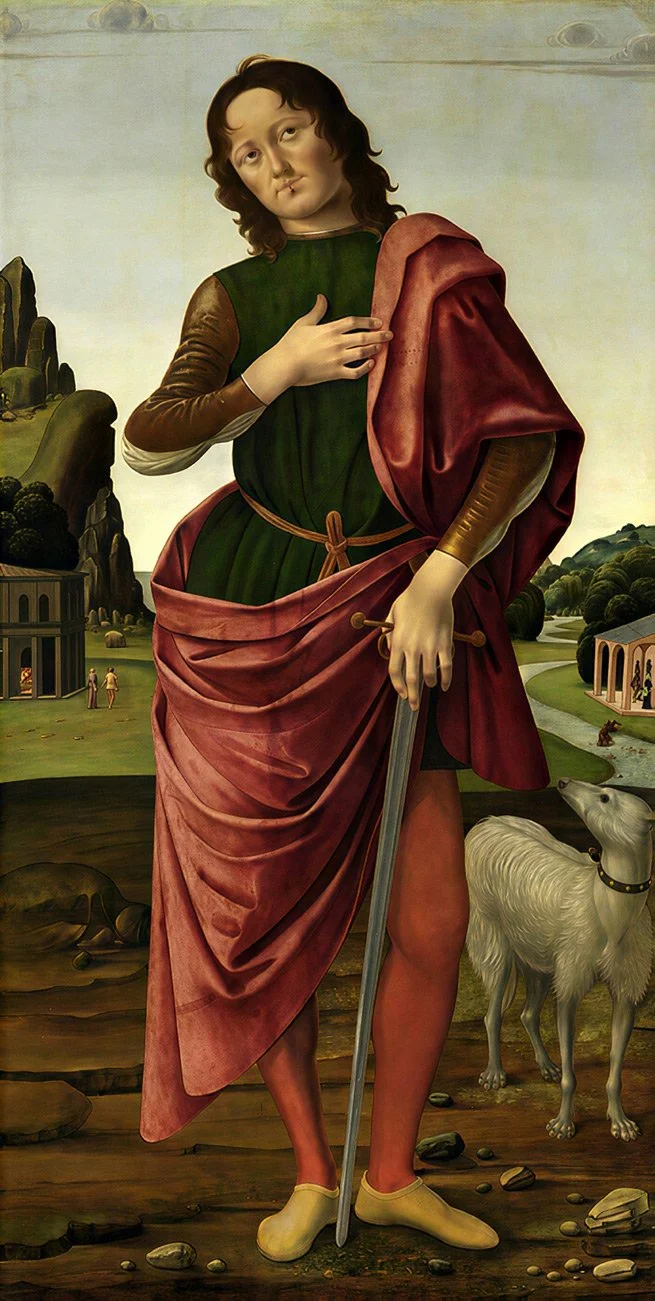
Hunters seek to kill God’s creatures; hunting is an act of violence against God’s creatures. “Saint Julian the Hospitaller,” Pietro del Donzello, Italy, 1452-1509 (Wikimedia Commons)
Both Scripture and hagiographies reveal animals working with and for God. In the Bible, Jonah 1:17 tells us that “the LORD provided a large fish to swallow up Jonah, and Jonah was in the belly of the fish three days and three nights.”
Hagiographies record animals assisting saints, sometimes stepping in where humankind has failed: We can read how animals raised and harbored Saint Keneth Cenydd of Wales after his human community rejected and abandoned him due to his physical deformities.
As a baby, hagiographies indicate that Saint Keneth lived high in the trees in a bird’s nest nurtured by the milk of a hind (doe). As an adult, he chose to remain with the animals, building a hut by the sea.
As the narrative unfolds, on hearing of a deformed youth living among the animals, a healer visits and restores Keneth’s body. Keneth tells the healer that his “infirmity” is a blessing: Because he was deformed, he had the privilege of living among the animals.
Hearing this, the healer restores Saint Keneth’s previous form, and he lives happily with the animals for the rest of his days.
Psalm 24:1
The earth is the LORD ’s and all that is in it, the world, and those who live in it….

Saint Kevin’s church in Glendalough. (Wikimedia Commons)
Saints are exemplary Christians by definition. Hagiographies tell readers that many saints, who lived particularly close to God also shared respectful, close, and caring company with animals. Sacred narrative recall many saints, noted for living close to God, also living close to animals—as if the Peaceable Kingdom were already at hand (Isaiah 11:8–9 and Matthew 6:10).
Hagiographies affirm that, following in our Savior’s footsteps, many saints tended to the needs of those considered beneath consideration, those pushed outside the moral community—outcastes, those with chronic or infectious illnesses, the poor, and animals.
Hagiographies remind Christians that all life is God’s, that God is sole proprietor of all that exists, and we are here on Earth to serve God. The kind and gentle nature of Christian saints in these narratives recall Genesis—that God did not create animals to be harmed or destroyed for our purposes, whether for experiments, entertainment, food, or to be used as materials for clothing or decoration.
The Bible tells us that all of creation is God’s, that all living creatures were made as one community, that creation is good. We are created on the 6th day, the same day that all land animals were created; we all share nephesh chayyah, and both animals and woman are created to address the aloneness of man, revealing the divine intention that animals and humankind share company.
Hagiographies recall that Christian saints, who walk closely with Jesus, honor and serve God by living peacefully with animals, in kinship—and we are all called to be saints (1 Corinthians 1:2).
1 Corinthians 1:2
To the church of God that is in Corinth, to those who are sanctified in Christ Jesus, called to be saints, together with all those who in every place call on the name of our Lord Jesus Christ, both their Lord and ours….
Our first chapter, Teachings, focuses on Christian ethics and animals, exploring the Bible to discover our rightful duty regarding animals. Our final chapter, Advocacy, introduces both historical and contemporary Christian voices that bear witness on behalf of animals.