
Creation & Animals
Genesis 1 & 2—Kinship & Responsibility
Genesis 1:3
Then God said, “Let there be light,” and there was light.
Genesis 1 and 2 record the world as it was when freshly created—the most perfect world—before the sin of disobedience (Genesis 3). This perfect world at the start of Genesis is a world of kinship and community across species, a world of perfect and total peace.
Kinship: Sixth Day
Genesis 1:23-26
And there was evening and there was morning, the fifth day.
And God said, “Let the earth bring forth living creatures of every kind: cattle and creeping things and wild animals of the earth of every kind.” And it was so. God made the wild animals of the earth of every kind and the cattle of every kind and everything that creeps upon the ground of every kind. And God saw that it was good.
Then God said, “Let us make humans….
The Genesis creation narrative shows the place of humankind among living creatures.
Land animals were created on the 6th day (including humans). Being human, sometimes suffering from the sin of hubris, people may not notice that humankind is created with other land animals.
There is something of a cultural tendency to look down on God’s many other miraculous creatures. Our tendency toward exceptionalism—the idea that humankind is the most special of God’s creatures—is likely part of why many readers may not see Genesis 1 clearly and sometimes come away believing that only humankind was created on the 6th day.
Genesis is clear: All land animals were created on the sixth day, and as land-dwelling creatures of God, humankind was created on that same day. To be created as land animals is a gift from God, and it is also a gift from God to have so many other amazing animals sharing this planet.
Job 12:7
But ask the animals, and they will teach you…
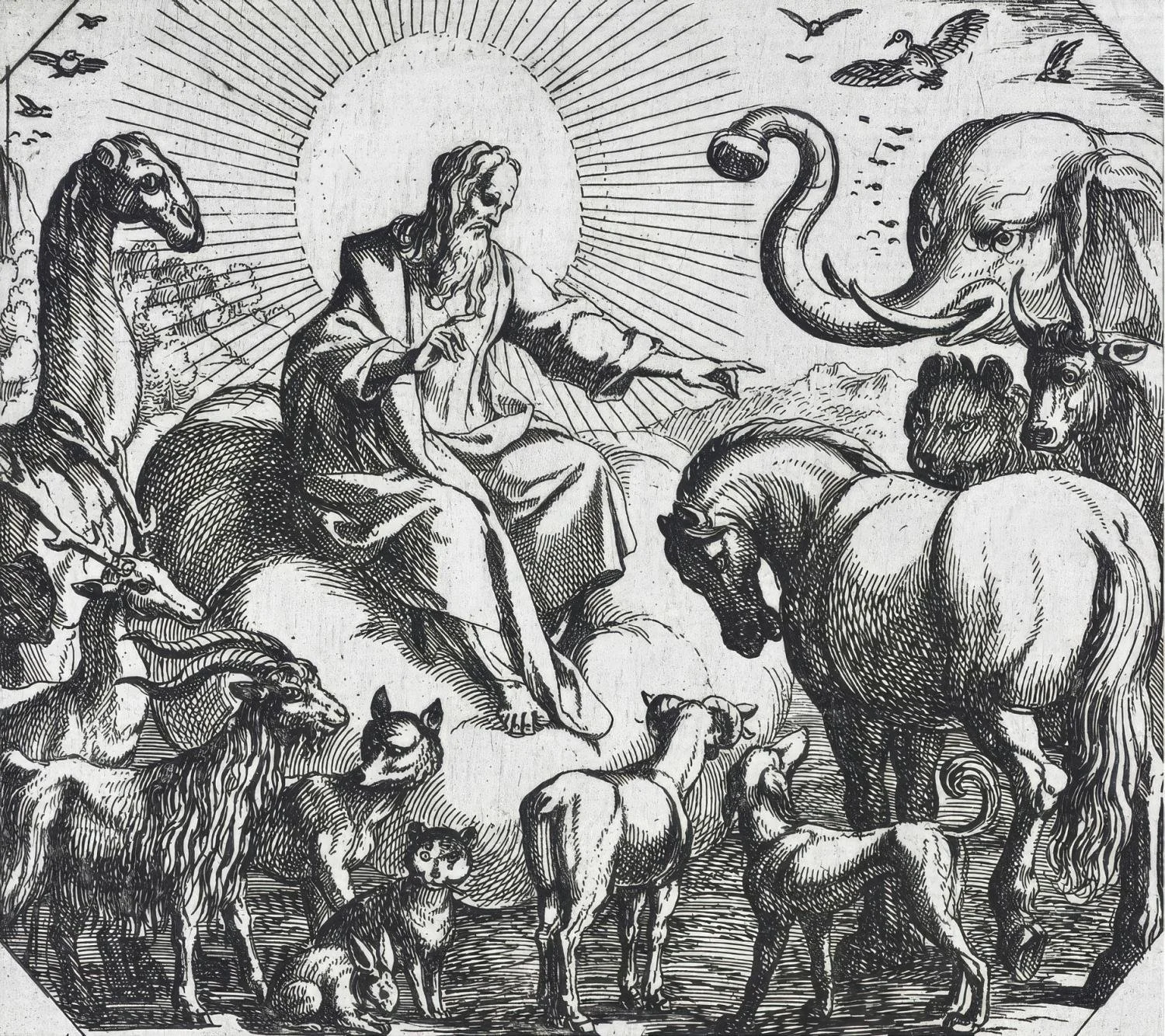
In Genesis 1, humankind is created on the sixth day along with all the other land animals. As is often the case, this etching shows God creating land animals without humankind, visually separating what Genesis places together on the sixth day. (“God Creating the Animals,” Antonio Tempesta, Italy, c. 1600, Wikimedia Commons)
Genesis 1:30
And to every beast of the earth and to every bird of the air and to everything that creeps on the earth, everything that has the breath of life….
In Genesis 1, every living creature is referred to as “nephesh chayyah” (above translated as “breath of life”).
In the Hebrew Bible, Nephesh chayyah distinguishes animals from plants, animate and conscious beings from plants. Sea creatures and birds are gifted this special quality in Genesis 1:20–21; land animals are granted this special quality in Genesis 1:24–25. Human beings are created in Genesis 1:27, and later, in Genesis 1:30, the term nephesh chayyah is used to refer to all living creatures, including human beings.
Unfortunately, many Bibles incorrectly and inconsistently translate nephesh chayyah into English, using words that privilege humankind and creating a separation between human beings and God’s many other creatures that is not present in the original Hebrew. In Genesis 1 God gifts nephesh chayyah to all animate life, including creatures of the water, of the air, and of the land (which includes humankind).
In Genesis 1:20, 21, 24, and 2:19 nephesh chayyah describes the conscious life of animals of the sea, air, and land, but in Genesis 2:7, the same words are used to describe the first man. In the former instances, the words are translated into English as “living creature” or “living creatures,” but these same words, when used to describe the first man, are translated into English as “living being” (NRSVUE, RSV, AMP, EHV, MEV, NABRE), “living soul” (ASV, KJV, WEBBE), “man began to live” (GNT), “living person” (NLT, PEV). The Orthodox Jewish Bible does not translate the words, and instead, simply writes an English version of the Hebrew words: “nefesh chayyah.”
Translations aside, the original Hebrew in Genesis 1 and 2 is plain and straightforward: Animals are distinct from plants, and all alike one another, in having been given nephesh chayyah.
This is not to say that the Bible does not include differences between humankind and animals. Every species is distinct and every creature is unique. But where nephesh chayyah is concerned, all living creatures (including humankind) are alike.
Psalm 104:24
O LORD, how manifold are your works! In wisdom you have made them all; the earth is full of your creatures.
God does not give humankind any special position or power that invites human beings to harm or destroy animals for preference, profits, or simply out of habit. However, humankind has been given the Hebrew Bible and the New Testament—and the choice to be obedient or disobedient, loving or cruel, generous or selfish.
Fidelity to the Creator leads Christians to a deep compassion and respect for creation, including all of God’s creatures. There is no reason to assume that our loving care and attention to need belongs only to our own needs, our family, our community, our nation, or our species. Jesus has shown us that the Christian heart is drawn wherever there is need.
Through no fault of their own, despite Scripture, animals have often been excluded from the Christian moral circle. When the Bible speaks of “neighbors” and “others”—this
rightly includes our kin, the animals. Christians today are invited to do as Jesus has shown us, to expand our moral circle and help “the least of these” (Matthew 25:40), regardless of what species an animal might be.
John 8:12
I am the light of the world. Whoever follows me will never walk in darkness but will have the light of life.
Psalm 145:9
The LORD is good to all, and his compassion is over all that he has made.
Our chapter on Narratives also presents kinship in sacred writings, perhaps most memorably in the lives of the Saints.
Kinship: Nephesh Chayyah
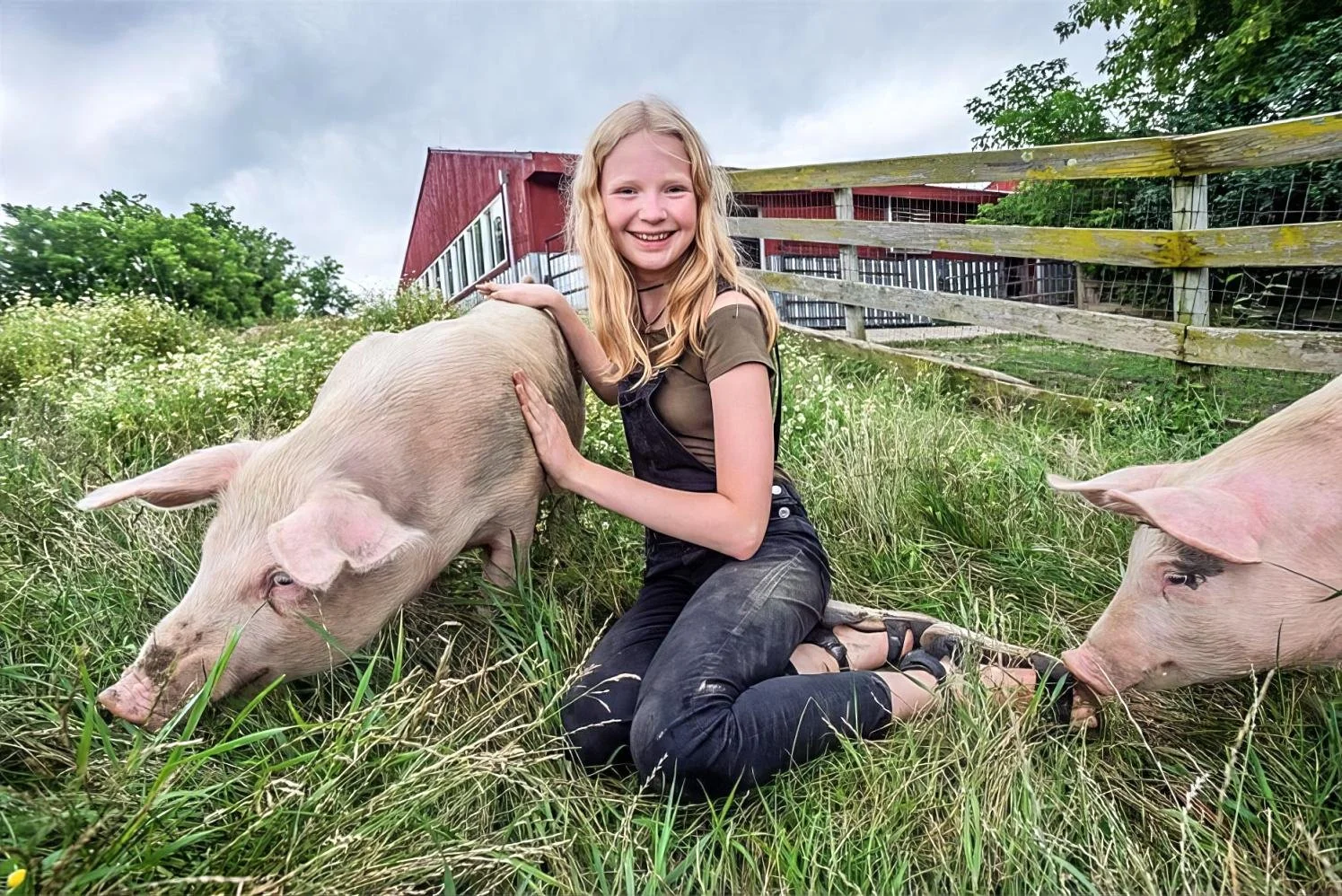
A young person, perhaps for the first time, meets a couple of God’s many other large land animals at a sanctuary, and visibly delights in her new-found feeling of kinship across species. (We Animals Media)
Genesis 1:26
Then God said, “Let us make humankind in our image…”
Genesis 1 teaches that God has created humankind with some very special traits. Perhaps most importantly, humankind was made in the “image” or “shadow” (slm/tzelem) of God.
Exploring ancient texts from the wider region sheds light on the meaning of this phrase. In neighboring Egypt, a manuscript called Teaching for King Merikare, in which a king instructs his son in responsible leadership (dated from 2025–1700 BCE), describes human beings as the creator’s “images,” brought forth from the creator’s body. The phrase indicates that human beings carry something of the divine, but what is most clear are the moral implications: As the creator’s image, the king was to shepherd the people justly and to tend to the needs of the weak. In Egypt, being made in the image of god carried clear moral responsibilities, the responsibility of social justice.
In the Hebrew Bible, to be made in the image or shadow of God is similarly understood to carry moral expectations. This imaging or shadowing of God reaffirms clear and direct moral expectations throughout Scripture: Humankind is to serve God on Earth through the godly work of justice, mercy, and caretaking.
Malachi 3:18
Then once more you shall see the difference between the righteous and the wicked, between one who serves God and one who does not serve him.
The life and teachings of Jesus are consistent with this understanding: Christians are called to serve God through justice, mercy, and caretaking here on earth. Humankind is called to good works, to faithfully reflect, shadow, or image our Savior throughout the course of lives here on Earth.
Humility is core to Christianity: Pride brings destruction (Proverbs 16:18). Human beings are not divine. Each one of us is a creature of God, like the first man, made on the 6th day with other land animals.
The life of Jesus helps us to see that being made in the image of the Creator is not a license of privilege, but a duty of servitude to God amid creation, a duty of healing and caretaking what God has made, including God’s creatures.
Proverbs 11:2
When pride comes, then comes disgrace, but wisdom is with the humble.
In the Image of God
Dominion
Genesis 1:26-31
Then God said, “Let us make humans in our image, according to our likeness, and let them have dominion over the fish of the sea and over the birds of the air and over the cattle and over all the wild animals of the earth and over every creeping thing that creeps upon the earth.”
So God created humans in his image,
in the image of God he created them;
male and female he created them.God blessed them, and God said to them, “Be fruitful and multiply and fill the earth and subdue it and have dominion over the fish of the sea and over the birds of the air and over every living thing that moves upon the earth.” God said, “See, I have given you every plant yielding seed that is upon the face of all the earth and every tree with seed in its fruit; you shall have them for food. And to every beast of the earth and to every bird of the air and to everything that creeps on the earth, everything that has the breath of life, I have given every green plant for food.” And it was so. God saw everything that he had made, and indeed, it was very good. And there was evening and there was morning, the sixth day.
Immediately after being made “in the image of God,” humankind is given dominion, and instructed to fill and subdue the Earth (Genesis 1:26 and 28). In the next passage humankind is told what to eat: “every plant yielding seed,” “every tree with seed in its fruit,” and “every green plant.” And when the man is placed in the garden in Genesis 2, he is told that he may eat the fruit of “every tree” except one (2:16-17).
Genesis 1 and 2 are in agreement: God commanded humankind (and every other creature) to eat only plant foods.
Genesis 2:15-16
The LORD God took the man and put him in the garden of Eden…. And the LORD God commanded the man, “You may freely eat of every tree of the garden….”
Only in this context can humankind understand human dominion and God’s command to subdue the Earth. God created a world of peace and harmony, a place of kinship and community, a world in which humankind was not permitted to harm or exploit other creatures for food. It is in this context that people are given dominion and told to subdue the earth. And it is also in the context of serving God amid creation “in the image of God.”
Humankind is given a very special status: We were created to serve God amid creation on behalf of the Creator (Genesis 1:26). And this was to be done as described in Genesis 1—eating only foods that come from plants.
Genesis 1:29-30
God said, “See, I have given you every plant yielding seed that is upon the face of all the earth and every tree with seed in its fruit; you shall have them for food. And to every beast of the earth and to every bird of the air and to everything that creeps on the earth, everything that has the breath of life, I have given every green plant for food.”
John 14:15
If you love me, you will keep my commandments.
Genesis 1 and 2 describe a diet given to humankind by God in a peaceful creation rooted in kinship—we are to eat foods that come from plants. Our fourth chapter, Living, explores core Christian teachings and contemporary food choices. Our chapter titled Tension also explores Christian feasts.
Genesis 2:4-8 and 15
In the day that the LORD God made the earth and the heavens, when no plant of the field was yet in the earth and no vegetation of the field had yet sprung up—for the LORD God had not caused it to rain upon the earth, and there was no one to till the ground, but a stream would rise from the earth and water the whole face of the ground—then the LORD God formed man from the dust of the ground and breathed into his nostrils the breath of life, and the man became a living being. And the LORD God planted a garden in Eden, in the east, and there he put the man whom he had formed….
The LORD God took the man and put him in the garden of Eden to till it and keep it.
Luke 4:8
Worship the Lord your God, and serve only him.
The Genesis 2 creation narrative clarifies what Christians are to do as servants of God, in the image of God, here on Earth. In these passages, God creates the land. Next, man is created specifically to serve the land by guarding and protecting what God has made.
Genesis 2 tells readers that no vegetation had yet sprung up because God had not caused it to rain and there was no one “to till the ground” (Genesis 2:5). God continues the work of creation: After a stream waters the ground, the first man is formed, and then the garden is planted. God places the first man in the garden to “till it and keep it” (2:15).
English translations usually say that the first man is placed in the garden to “till” (’abad) and “keep” (shamar) the land, but these translations fall short of the Hebrew meaning. ’Abad is better translated as “to serve” or “to work,” with the work indicated being that of a servant. This is yet clearer when ’abad is used in Joshua 24:15: “choose this day whom you will serve.”
Genesis 2 presents the man as formed to work in the garden, to tend and keep God’s garden. Genesis 2 specifically indicates that the first man is created to care for what God has made.
A more direct translation of Genesis 2:15 affirms what Jesus has shown us: Humankind is to serve God by caretaking creation.
Galatians 6:9-10
So let us not grow weary in doing what is right….
The Hebrew word shamar translates as “protect” or “guard.” In Numbers 6:24, translated as “keep,” this word conveys a proactive, emotionally invested action: “The Lord bless you and keep you.”
Numbers 6:24 conveys the full meaning of shamar—a loving, tender, protective guardianship.
Genesis 2:15 tells Christians that humankind was created to serve/work the land by guarding and protecting (with tender care) the ground/soil/land, and plants that grow therein—on behalf of God.
The Bible tells us that God has instructed the faithful to humbly serve our Creator by guarding and protecting what God has made, as God would do—with loving care (Genesis 2:15). The life of Jesus fulfills this teaching. Following in his footsteps, Christians are called to live as God’s gentle servants, tending to the needs of creation (Genesis 1:26).
Genesis 2 clarifies our Christian duty here on Earth: Humankind is to be God’s caretakers amid creation.
Ephesians 2:10
For we are what he has made us, created in Christ Jesus for good works, which God prepared beforehand so that we may walk in them.
Psalm 24:1
The earth is the LORD ’s and all that is in it, the world, and those who live in it….
Duties Assigned by God
Genesis 2:18-22
Then the LORD God said, “It is not good that the man should be alone; I will make him a helper as his partner.” So out of the ground the LORD God formed every animal of the field and every bird of the air and brought them to the man… but for the man there was not found a helper as his partner. So the LORD God caused a deep sleep to fall upon the man, and he slept; then he took one of his ribs and closed up its place with flesh. And the rib that the LORD God had taken from the man he made into a woman and brought her to the man.”
Genesis 2 tells us that animals and the first woman are God’s solution to the solitary life of the first man in the Garden of Eden.
In teaching that animals and the first woman were created so that the first man would not be alone, Genesis 2 teaches that humankind and animals were created to share company. Genesis 2 exposes a God-given, deep kinship across species—closeness between animals and humankind is built into creation.
Genesis 1 and 2 teach that the first man was created in the image of God and placed in the Garden of Eden to serve God by guarding and protecting the land with loving, sustaining care on behalf of the Creator, as the Creator would do. Genesis 2, in teaching that animals and the first woman were created to address the first man’s aloneness, shows readers that companionship stretched across species.
Genesis 2 invites readers to recognize animals and humankind as members of one community—animals were created in the hope of filling the first man’s need to have a “helper as his partner,” placing companionship and shared life across species firmly in the design of creation.
Genesis 1 and 2 do not establish an earthly hierarchy where humans are above and apart from animals, who were created to serve the needs of humankind, or that permits humankind to harm or disregard animals. On the contrary. We are one shared community—companions—and only God stands apart.
Genesis 2 shows animals and humankind as one community, made to share company, kindred, neighbors, and companions amid creation.
Psalm 36:6
…you save humans and animals alike, O LORD.
Ecclesiastes 3:19
For the fate of humans and the fate of animals is the same; as one dies, so dies the other. They all have the same breath, and humans have no advantage over the animals….
Shared Company

Animals and the first woman were created so that Adam would not be alone. The narrative places companionship and shared life within the design of creation. (“God Creating Adam and Eve,” unknown artist, Italy, c. 1600, Wikimedia Commons)
Genesis 1:31
God saw everything that he had made, and indeed, it was very good.
Before creating humankind, God announces that light, vegetation, and all living creatures of the sea, sky, and land are “good” (Genesis 1:4, 10, 12, 18, 21, 25). Throughout the creation narrative, God notes that what is made is good; the Bible tells us that creation is good.
Everything exists by and through the Creator and Scripture reminds that humankind is not independent from the rest of creation. Nor are human beings the source or measure of creation’s goodness. Animals of the sea and land are “good” in their own right, all are collectively pronounced “good” before humankind is made.
We are creatures of the Earth, made from the Earth, matter amid matter, creatures among creatures, life amid life. Christian humility asks us to live in the knowledge that all of creation—every living being—comes from God and that each is thereby good and worthy of respect. Only God stands apart.
The Bible tells us that human beings are not necessary to the goodness of what God has made. All that is necessary for the goodness of creation, including the animals, is God.
Hebrews 11:3
By faith we understand that the worlds were prepared by the word of God, so that what is seen was made from things that are not visible.
Creation as Good

The Bible tells us that human beings are not necessary to the goodness of creation. (“A Storm in the Rocky Mountains, Mt. Rosalie,” Albert Bierstadt, United States, 19th century, Wikimedia Commons)
Isaiah 11:6-9
The wolf shall live with the lamb;
the leopard shall lie down with the kid;
the calf and the lion will feed together,
and a little child shall lead them.
The cow and the bear shall graze;
their young shall lie down together;
and the lion shall eat straw like the ox.
The nursing child shall play over the hole of the asp,
and the weaned child shall put its hand on the adder’s den.
They will not hurt or destroy
on all my holy mountain,
for the earth will be full of the knowledge of the LORD
as the waters cover the sea.
God created humankind and animals to live in community with one another, without predation, in perfect peace and harmony. This is what God intended. The latter prophets remind humankind of the expected trajectory: Time will turn us back to the perfect peace of Genesis 1, the Peaceable Kingdom.
Isaiah eloquently speaks to the work necessary to restore the knowledge of God that is reflected in a world of peace, a world where humankind “will not hurt or destroy on all my holy mountain; for the Earth will be full of the knowledge of the Lord” (Isaiah 11:9).
While Christians are right to look with great hope to salvation, Genesis tells us that people are to serve God during our time here on Earth by guarding and tending creation, that Christians are to restore God’s kingdom of peace on Earth (Matthew 6:10).
The Bible tells us that human beings are to do the will of God amid creation. Christians are called to work to restore justice and peace in our communities, in the here and now, as Jesus did. Our earthly service to God encompasses all of creation, including animals.
James 3:18
And the fruit of righteousness is sown in peace by those who make peace.
Psalm 34:14
…seek peace, and pursue it.
The Bible teaches Christians to serve God in creation in the here and now, but Christians may sometimes look to the world to come, neglecting to care for what God has made. This gap between teaching and practice, and how it affects animals today, is covered under Christian Care for Creation, in our chapter titled Tension. Many of the teachings of Genesis 1 and 2 are overlooked in what human beings choose to eat, a topic that is covered in our fourth chapter, Living. Chapter two (Narratives) explores the lives of saints, who exemplify living as if the Peaceable Kingdom had already been restored—in kinship with animals on Earth.
A Peaceful Planet
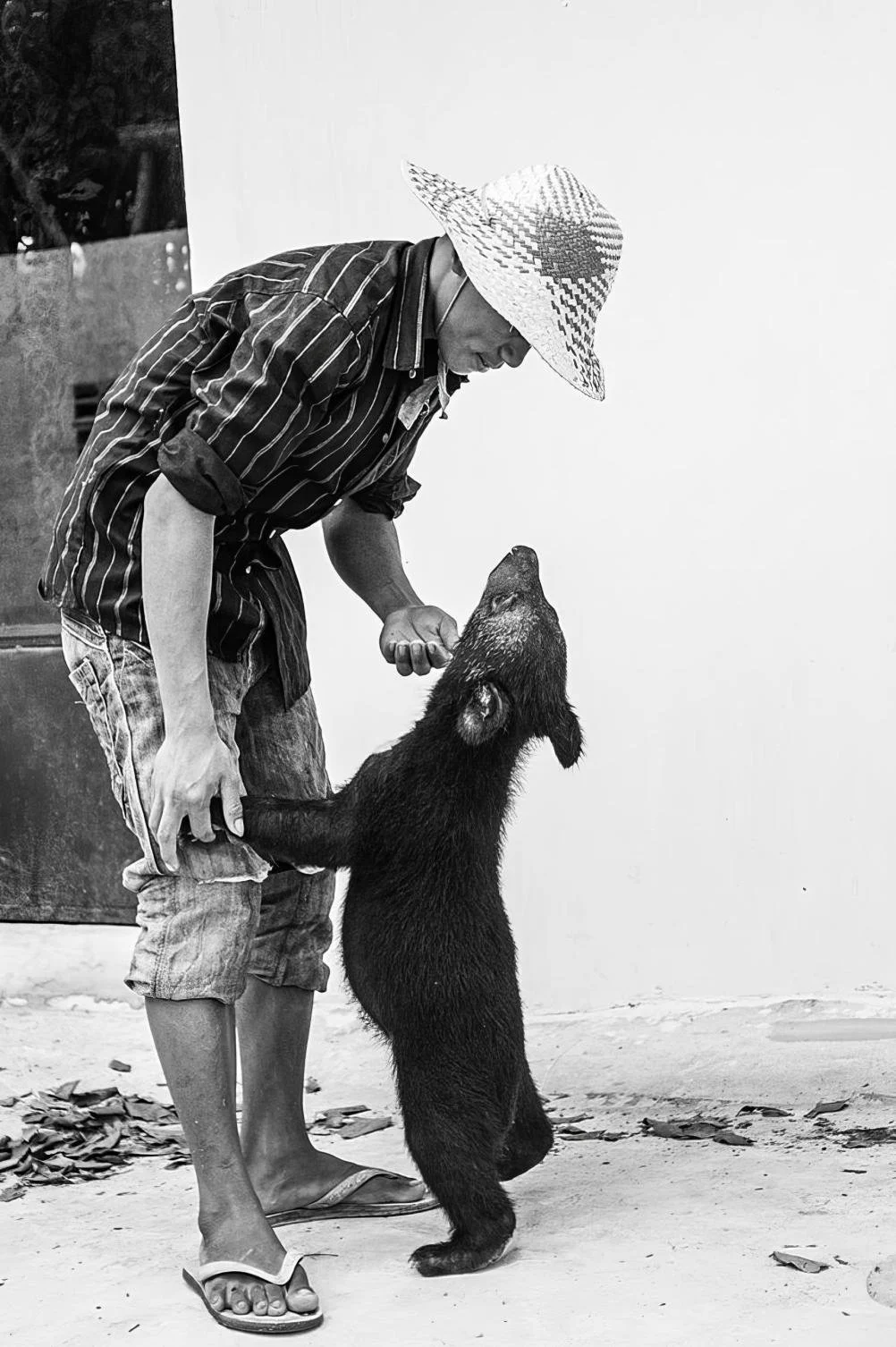
A moon bear cub, whose mother was killed or captured (for profit), looks to her caretaker in the hope of satisfying the simple but essential needs that her mother would have fulfilled. Christians are called to help heal the harm that humankind causes, to help reestablish peace on Earth. (We Animals Media)